How often can you safely get a glutathione IV drip?
How often can you get a glutathione IV drip? No universal safe interval exists. Learn what needs clinical review before you book another infusion.

There is no universally established safe frequency for glutathione IV drips used for skin lightening or general wellness; a weekly or monthly booking schedule is not proof of safety. Before you repeat a treatment, a clinician should review its purpose, the exact formulation, your health history and any reaction to the previous infusion. Do not book a repeat drip simply because you tolerated the last one.
TL;DR- How often can you get a glutathione IV drip? No universal safe interval exists for cosmetic or wellness use.
- A glutathione infusion needs a clinical reason, product checks and a review before repeat treatment.
- DarDoc provides at-home IV drip services in the UAE; home delivery does not establish a safe treatment frequency.
- Breathing difficulty, throat swelling or collapse after an infusion requires emergency help, not another appointment.
Why this matters
A calendar answers when an appointment happens. It does not answer whether another infusion is appropriate. In 2026, your decision should start with a clinical assessment, not a prepaid course or a promise of brighter skin.
If you are comparing glutathione IV drip clinics in Dubai, ask how each provider decides whether to treat, postpone or decline. A provider should be able to explain those decisions without promising a result or presenting a standard package as medical evidence.
This distinction matters even when a treatment feels routine. An intravenous treatment bypasses the usual barriers involved in taking something by mouth, and the procedure introduces risks associated with the product, its preparation and the cannula.
How often can you safely get a glutathione IV drip?
No single interval makes glutathione IV treatment safe for everyone. For cosmetic or general wellness use, do not interpret a suggested weekly, fortnightly or monthly appointment as a validated safety limit. The interval must follow a defensible treatment decision, not substitute for one.
The following comparison explains common scheduling language. These are descriptions of proposed schedules, not recommendations to follow them.
| Proposed schedule | What it tells you | What it does not establish | Best next step |
|---|---|---|---|
| Every 7 days | The provider proposes weekly appointments | That weekly exposure is necessary, effective or safe for you | Ask for the clinical rationale before agreeing |
| Every 14 days | The provider proposes fortnightly appointments | That a longer gap removes product or infusion risks | Review the formulation and your health history |
| Every 30 days | The provider proposes recurring monthly appointments | That ongoing maintenance has a proven benefit | Ask what outcome justifies continuing |
| No repeat appointment yet | Treatment is paused pending a decision | Whether treatment will eventually be appropriate | Resolve symptoms, uncertainties or assessment needs first |
A schedule of every 7 days is more frequent than every 30 days, but neither interval supplies the missing evidence about benefit or individual risk. Spacing out an unnecessary treatment does not make it necessary.
Is a weekly glutathione drip safe?
A weekly glutathione drip is not automatically safe because a clinic offers it. Ask why repeated exposure is justified for your particular goal and what would make the prescriber stop.
A previous uneventful infusion is useful history, but it does not guarantee the next infusion will be uneventful. The formulation, preparation, accompanying ingredients and your health can differ between appointments.
Is a monthly glutathione drip safer?
A monthly glutathione drip is not a universally validated safer alternative. Fewer appointments mean fewer infusion procedures, but that alone does not establish a favourable balance of benefit and risk.
Do not accept “maintenance” as a complete explanation. Ask what is being maintained, how that outcome is assessed and why an intravenous treatment is needed to maintain it.
Why the decision to repeat treatment varies
A repeat-treatment decision depends on more than elapsed time. Your clinician should consider these factors before discussing another appointment:
- Treatment purpose: Skin lightening, unexplained tiredness and a diagnosed medical condition are different clinical questions. A broad wellness label does not establish an indication.
- Exact formulation: The glutathione dose, diluent and any added ingredients matter. An infusion described as a blend needs its own assessment.
- Previous reactions: Rash, breathing symptoms, fever, fainting or problems around the cannula require review before another treatment.
- Current health: New illness, pregnancy, breastfeeding, kidney disease or heart disease can change the assessment of an elective infusion.
- Medicines and supplements: Give the clinician a complete list, including treatments received elsewhere. Assessing glutathione alone misses the rest of the exposure.
- Product and procedure controls: Product identity, preparation, traceability, infection prevention and an emergency response plan remain relevant at every visit.
A responsible 2026 treatment plan should explain these considerations in language you understand. A list of ingredients without a reason for treatment is not a personalised plan.
What should happen before another infusion?
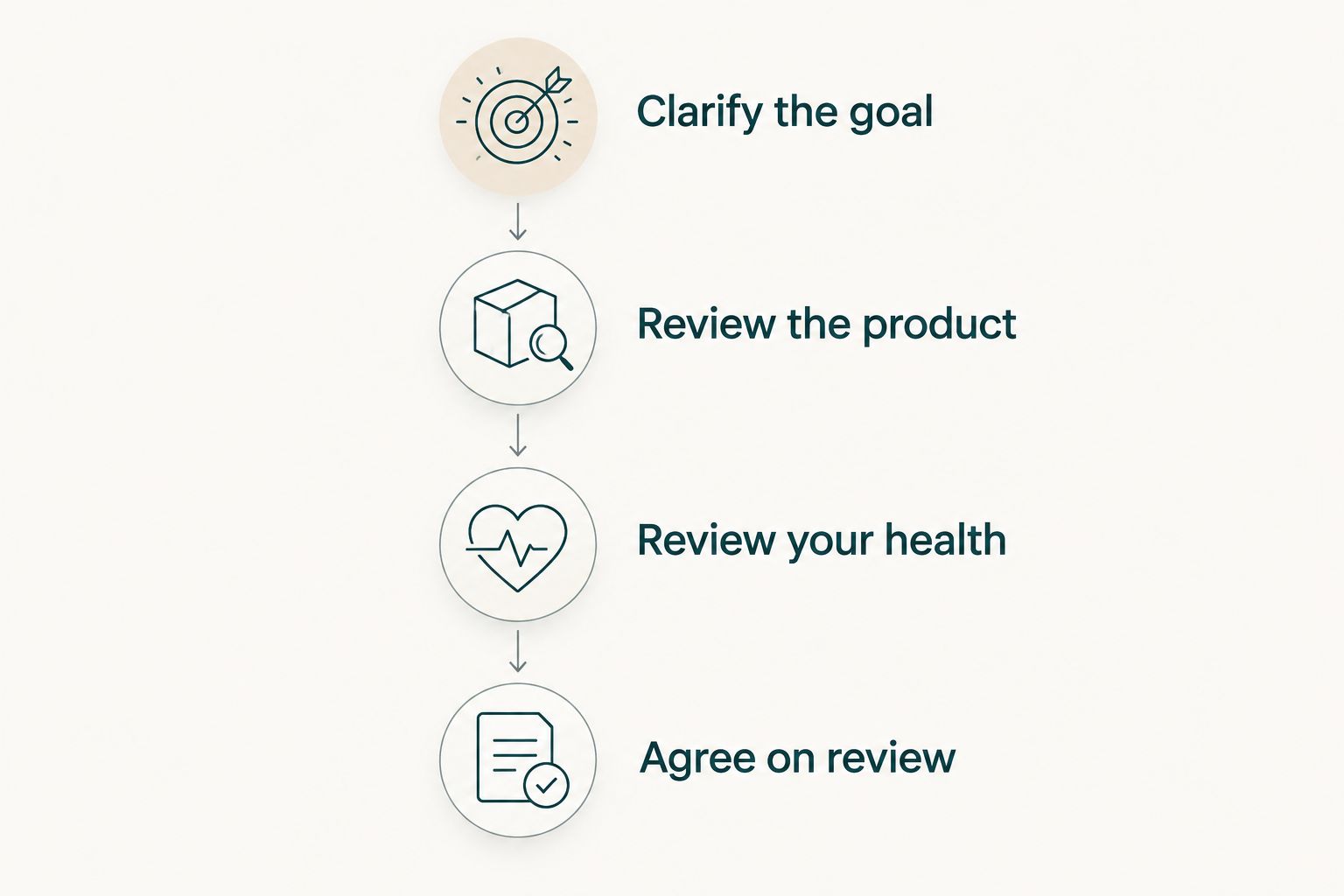
Use this sequence before agreeing to repeat treatment. The assessment comes before the appointment schedule.
- Clarify the goal. Explain what you want to change and whether a clinician has assessed the underlying concern. Persistent tiredness, for example, deserves assessment rather than an automatic infusion booking.
- Review the product. Ask for the exact ingredients, prescribed dose and product identification. Do not assume every treatment sold as a glutathione drip contains the same preparation.
- Review your health. Report medical conditions, allergies, medicines, supplements and pregnancy or breastfeeding. Include symptoms that began after the last infusion, even if they have resolved.
- Agree on review. Ask what benefit is realistically expected, what uncertainty remains and what symptoms mean treatment must stop. Agree on how the clinician will decide whether another infusion is justified.
Ask who is prescribing the treatment and who will administer it. In Dubai, check the relevant DHA licensing; in Abu Dhabi, check the relevant DoH licensing. A professional licence is an essential check, but it is not evidence that every proposed cosmetic use has proven benefit.
For your 2026 appointment, request a written record of what was administered. That record is more useful for a future assessment than a marketing name such as a glow or detox package.
What evidence should support a repeat-treatment plan?
Evidence that glutathione has a role in human biology is not the same as evidence that repeated IV glutathione improves a cosmetic or wellness outcome. Nor does a study of an oral preparation automatically justify an intravenous schedule.
Ask the prescriber to distinguish the proposed route, treatment goal and patient group. A claim about an antioxidant mechanism does not answer whether you should receive another infusion next week.
The US Food and Drug Administration has published safety concerns about injectable skin-lightening products and reports involving compounded injectable glutathione. These concerns are a reason to scrutinise the preparation and indication, not a basis for inventing a different “safe” interval.
For a treatment decision in 2026, ask to see the evidence behind the exact recommendation. If the explanation rests entirely on testimonials, before-and-after photographs or a package description, it does not establish a safe repeat schedule.
What are the benefits and limitations of treatment at home?
At-home treatment removes the journey to a clinic. It does not remove the need for prescribing, appropriate product handling, observation or an emergency plan. Convenience changes the location, not the clinical standard.
DarDoc provides at-home IV drip services as part of its UAE home healthcare offering. DarDoc is best suited to UAE families seeking healthcare at home, not to choosing an infusion frequency without assessment. That is a service fit, not a recommendation that you need glutathione.
The practical benefit is receiving care without travelling. The limitation is that a home visit is not a hospital emergency setting, so you should understand what happens if a reaction occurs and how urgent escalation works.
Before proceeding with DarDoc or another provider, ask who assesses suitability, what will be infused and what follow-up is included. Do not infer a glutathione-specific protocol or clinical outcome from the fact that a provider offers IV drips.
When should you postpone another glutathione drip?
Postpone an elective repeat infusion if you have unresolved symptoms after the previous treatment. Tell the clinician what happened, when it started and whether you needed treatment. Do not attend another appointment simply to see whether the reaction happens again.
Seek medical assessment for increasing redness, warmth, swelling, pain or discharge around a previous cannula site, particularly if you also feel unwell. A provider should assess the problem rather than dismiss it as a routine detox response.
Sudden breathing difficulty, swelling of the lips or throat, collapse or severe chest pain needs emergency help. In the UAE, call 998 for an ambulance. Do not wait for the infusion provider to reply to a message.
Also pause when you cannot identify the preparation or obtain a clear explanation of why another infusion is being proposed. Uncertainty about a product is a reason to resolve the uncertainty, not to select a longer interval.
Do blood tests tell you when another drip is safe?
Blood tests alone do not establish a safe glutathione infusion interval. A clinician can request tests to investigate symptoms or assess a relevant medical condition, but the results need interpretation alongside your history and the proposed treatment.
There is no basis for treating a routine wellness blood panel as clearance for unlimited repeat infusions. A result within a laboratory reference range does not certify the sterility of a preparation or rule out an infusion reaction.
Avoid ordering a broad panel solely to justify a booking. Ask which clinical question each test will answer and how the result would change the decision to treat, postpone or stop.
What should a clear treatment plan include?
A useful plan explains why the treatment is proposed, not just when it happens. Before paying for a course in 2026, check that you understand the following:
- Purpose: The specific concern being addressed and whether it needs further assessment.
- Preparation: The exact ingredients and the prescribed amount to be administered.
- Expected benefit: What the evidence supports and what remains uncertain.
- Monitoring: Who observes you during treatment and how you report symptoms afterwards.
- Stopping criteria: Which reactions, lack of benefit or changes in health end the plan.
- Reassessment: Who decides whether another infusion is justified.
A clear plan also allows the answer to be no. If a provider cannot explain when treatment should stop, the proposed course is incomplete.
FAQ
How often can you get a glutathione IV drip safely?
There is no universally established safe interval for cosmetic or general wellness glutathione IV use. A clinician should assess the indication, preparation, health history and previous reactions before considering repeat treatment.
Can I have a glutathione drip every 7 days?
An interval of every 7 days does not establish that a glutathione drip is safe or necessary. Ask the prescriber to explain the evidence for that schedule and the criteria for stopping.
Is a glutathione drip every 30 days a safe maintenance plan?
An interval of every 30 days is not a universally validated maintenance plan. A longer gap does not resolve uncertainty about benefit, product quality or your individual risk.
Does feeling fine after my first drip mean I can repeat it?
Feeling fine after a first infusion does not guarantee that a repeat infusion will be safe. Report any delayed symptoms and have the next treatment decision reviewed rather than automatically repeating it.
Do I need blood tests before every glutathione infusion?
Blood tests before every glutathione infusion are not a universal safety rule. A clinician should select tests for a specific clinical question rather than use a routine panel as blanket clearance.
Can I get a glutathione drip while pregnant or breastfeeding?
Do not arrange an elective cosmetic glutathione infusion during pregnancy or breastfeeding without assessment by your treating clinician. A wellness label does not establish safety for you or your baby.
Does DarDoc offer IV drips at home?
DarDoc offers at-home IV drip services in the UAE. Ask about the specific preparation and clinical assessment rather than assuming that an at-home service establishes suitability for glutathione treatment.
What should I do if I cannot breathe after an IV drip?
Call 998 for an ambulance in the UAE if you develop breathing difficulty, throat swelling or collapse after an IV drip. Do not wait for a routine follow-up or another appointment.
One last thing
Ask “What would make you advise against another infusion?” before asking for the next available date. The answer reveals whether the plan includes a genuine decision about your health or simply repeats a booking.
Keep the treatment record, including the ingredients administered and any symptoms afterwards. If you change providers, bring that record; the phrase “I had a glutathione drip” does not identify everything you received.
Related guides
Join our newsletter for 20% off all DarDoc services.*
*20% off all DarDoc services, except newborn care services.


