From on-site blood draw to corporate wellness report: 2026 workflow
فحص Build a corporate wellness blood report that protects employee privacy. Follow the collection, clinical review and employer reporting workflow.

فحص Instead of manually combining employee lab PDFs into a corporate wellness blood report, set up a controlled workflow that separates private clinical results from employer-level summaries. For your 2026 programme, agree the reporting rules before the on-site blood draw, then move each sample through identification, laboratory processing, clinical review and aggregate reporting.
TL;DR- فحص A corporate wellness blood report should summarise group findings, not expose individual employee results.
- DarDoc provides UAE home and online healthcare; confirm on-site corporate screening and reporting scope before booking.
- فحص Keep employee blood results separate from the employer wellness dashboard.
- Release aggregate findings only after clinical review, reconciliation and privacy checks.
لماذا يهم هذا؟
A screening event produces clinical information, not just a spreadsheet. An employer needs enough information to plan a useful wellness programme without receiving a directory of employees' medical findings.
Build 2 separate outputs: a private clinical report for each participant and an aggregate report for the employer. The laboratory result is not automatically an employer-ready wellness report.
For the wider planning brief, see the guide to فحص دمs for corporate wellness في الإمارات. This workflow covers the handoffs between collection and reporting, including what must happen when results are incomplete or corrected.
فحص DarDoc is best for families seeking home and online healthcare in Dubai and Abu Dhabi. For workplace screening, confirm the collection setting, clinical responsibilities and corporate reporting deliverables separately; do not assume home blooding includes an employer dashboard.
قبل أن تبدأ
- Secure the clinical and operational inputs. فحص Obtain the agreed list, laboratory preparation instructions, collection arrangements, named clinical lead and employer coordinator. Verify the provider's relevant DHA or DoH licensing and permissions for the proposed activity and location.
- Agree access and consent. Document what participants receive, what the employer receives, who can access identifiable records, and how records are transferred and retained. Give employees a clear explanation before collecting health information.
- Resolve the small-group problem first. Removing names does not prevent identification when a report isolates a recognisable person. Agree which subgroup results will be combined or withheld before inviting employees.
Do not launch a 2026 screening programme until someone owns urgent-result follow-up. An employer presentation must never become the point at which a clinically important result is first noticed.
The steps below describe a provider-neutral operating process. Use these document headings in your approved forms or reporting specification; they are not claims about any provider's software interface.
Reporting specification
Define the outputs and permissions
- Create a written Reporting specificationفحص . State the purpose of screening, eligible population, agreeds, collection setting and intended recipients. Describe what the programme will not assess, so a limited screening panel is not presented as a complete health assessment.
- Define Participant report as the individual laboratory findings plus the agreed clinical explanation and follow-up route. Keep its delivery separate from HR communications. Confirm how employees will securely receive it.
- Define Employer summary as group-level information suitable for organisational planning. Include participation, report completeness, clearly defined findings and limitations. Exclude names, employee identifiers and individual result attachments.
- Assign Clinical owner, Collection owner و Reporting owner. Give each role a named responsible person, an escalation route and a backup. One person can hold multiple roles, but no handoff should be unowned.
- Approve Release criteria before collection. Specify who signs off the clinical content, who checks confidentiality and how incomplete results affect publication. Keep a dated record of that approval.
النتيجة المتوقعة: every deliverable has an audience, an owner and a release rule. You can explain the difference between a participant result and an employer summary without opening a spreadsheet.
Choose the right reporting format
These are complementary outputs, not interchangeable report options.
| Output | الأنسب لـ | القوة | الحدود |
|---|---|---|---|
| Private participant report | Individual clinical review | Preserves the context needed for personal follow-up | Is not suitable for routine employer circulation |
| Aggregate employer summary | Workforce wellness planning | Describes group patterns without listing individual findings | Cannot diagnose employees or explain every result |
| Restricted operational tracker | Reconciling appointments and samples | Shows where a collection or report is incomplete | Becomes a privacy risk if unnecessary medical details are added |
Keep the operational tracker administrative. A coordinator needs to know that a sample requires action, not necessarily the clinical finding that triggered that action.
Collection and laboratory handoff
Prepare the collection register
- Build a Collection register using the minimum information the clinical team needs to identify participants and match samples. Keep any participant-to-code mapping restricted. A coded record remains sensitive when someone can reconnect it to a person.
- Send the laboratory's تعليمات التحضير فحص to participants through the agreed channel. Do not issue blanket fasting instructions: preparation depends on the ordereds and individual clinical circumstances. Employees should not change prescribed medication without clinical advice.
- Arrange a private collection area and a clear escalation route for anyone who feels unwell. Confirm that the collection team has approved materials, specimen-handling instructions and transport arrangements. These are provider responsibilities to verify, not tasks to improvise on the day.
- At collection, have the clinical team follow its approved identity-checking and sample-labelling procedures. Record collection status and any preparation issue that requires clinical or laboratory review. Never resolve an identity mismatch by guessing from the appointment list.
- Reconcile Collected, Not collected و Requires action entries against the laboratory handoff record. Record who accepted the handoff and when. Investigate discrepancies before treating the event as complete.
النتيجة المتوقعة: each collected sample has a traceable route to the laboratory, while missed appointments and unresolved issues remain visible.
Use 3 checkpoints in the operating plan: collection reconciliation, laboratory reconciliation and report-release review. These are recommended control points, not promised turnaround times.
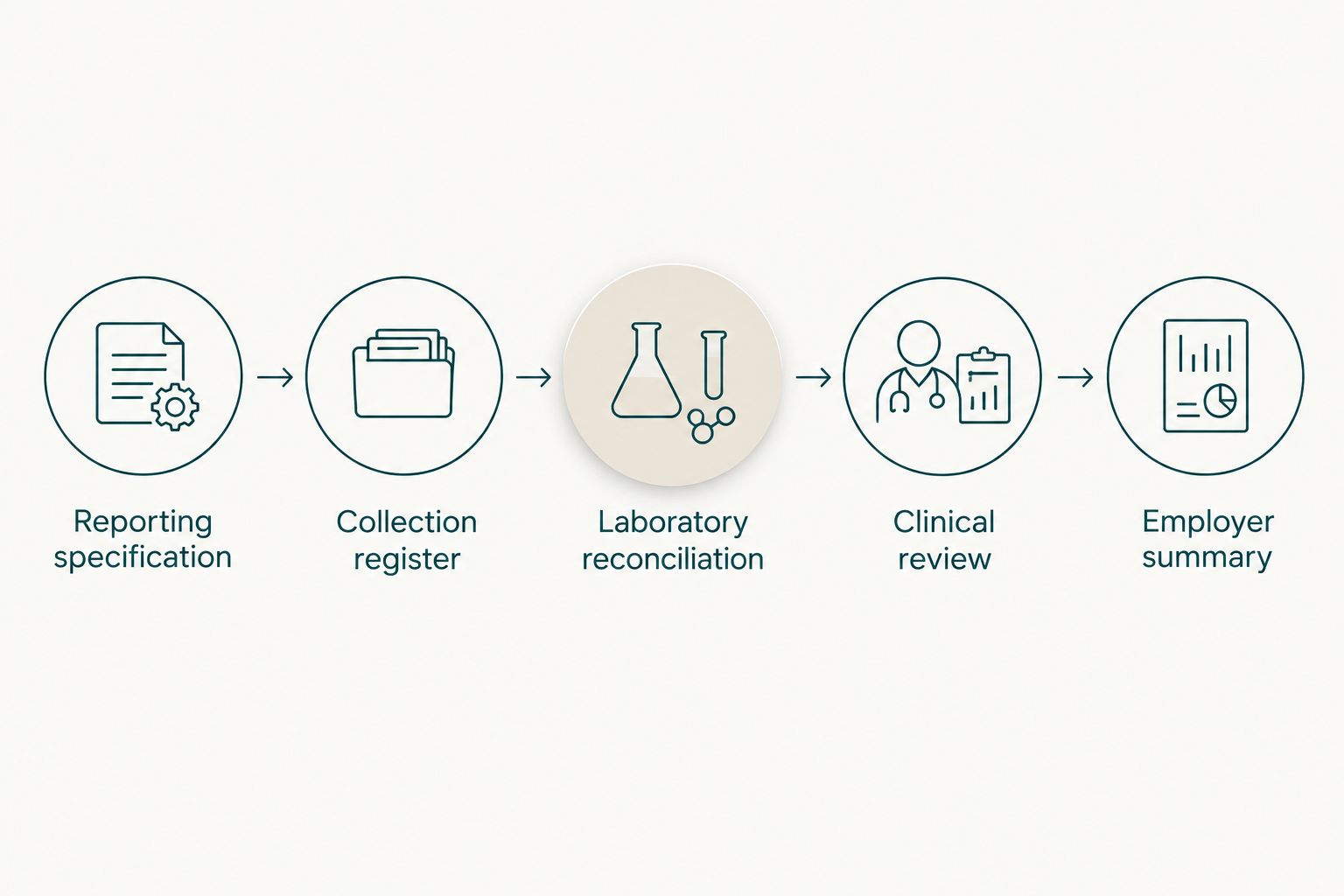
عدد النتائج: Reconcile laboratory
- Match returned results to the authorised collection register through the approved clinical process. Track قيد الانتظار, مكتمل و Requires recollection separately. Do not classify a missing result as normal.
- فحص Check that each result belongs to the correct participant and ordered. Preserve the laboratory's units, reference intervals, comments and report version. A spreadsheet import must not strip away information needed for interpretation.
- Route rejected specimens, incomplete panels and corrected reports to the responsible clinical team. Record the action taken without copying unnecessary clinical detail into the employer-facing tracker.
- Have the clinical owner manage abnormal and urgent findings through the agreed clinical pathway. Do not wait for every participant's results before contacting someone who needs individual follow-up.
النتيجة المتوقعة: the reporting dataset distinguishes completed results from unresolved work, and clinical escalation operates independently of the employer reporting deadline.
Clinical review and employer report
Assemble the aggregate summary
- مكتمل مراجعة طبية before drafting conclusions. Laboratory flags require clinical context; an out-of-range result is not, by itself, a diagnosis. Keep individual assessment within the clinical pathway.
- فحص Define the denominator for every measure. Distinguish employees invited, participants attending, samples collected and valid results returned for eachفحص . Ifفحص s differ between participants, do not use total attendance as every's denominator.
- استخدم Privacy checks to the proposed tables. Remove direct identifiers and assess whether combinations such as location, department and job role expose recognisable people. Combine or suppress revealing groups using the rule agreed before collection.
- Draft the Employer summary فحص with participation, completeding, group findings, limitations and practical organisational actions. Separate observed findings from proposed responses. Do not claim that screening proves reduced absence, improved productivity or a treatment benefit.
- Obtain clinical and privacy approval, then issue a versioned report. Name the reporting period explicitly, such as the 2026 screening cycle. Record the issue date and the dataset cut-off so later results do not silently change an already-circulated document.
النتيجة المتوقعة: the employer receives a report that supports programme decisions without functioning as an employee medical register.
What the finished report should contain
فحص A useful corporate wellness blood report answers a short set of questions:
- Who was invited, and which participation stages are counted?
- فحص Whichs were included, and how many valid results support each finding?
- What group patterns warrant attention, subject to clinical interpretation?
- Which results, groups or comparisons were excluded, and why?
- What organisational action is proposed, and who owns it?
State that screening participants are not necessarily representative of the entire workforce. Employees who attend can differ from those who do not, so describe findings as results among participants rather than workforce-wide prevalence.
For a 2026 report, keep administrative dates separate from clinical collection dates. A report issued this year does not mean every included result was collected during the same screening period.
Update the report when results change
A second workflow is needed when a delayed result, recollection or laboratory correction arrives after the initial reporting cut-off.
- Route the new or amended result to the clinical owner first. Complete any individual communication or follow-up that the result requires.
- Update the restricted source dataset and record the reason for the change. Preserve the original record and the correction history through the approved record-management process.
- Recalculate affected group measures and repeat privacy checks. An additional participant or changed category can alter both a denominator and whether a subgroup remains suitable for publication.
- Issue a revised employer summary only when the change warrants it under the agreed release rules. Mark the version clearly and identify the superseded report without disclosing the employee involved.
النتيجة المتوقعة: corrections remain traceable, and the employer does not receive conflicting reports with no explanation.
فحص For repeat screening, compare the 2026 cycle with later cycles only after checking definitions, units, participant mix and inclusion rules. A different group of attendees is not evidence of individual improvement or deterioration.
حل المشكلات
The attendance count exceeds the valid-result count
Fix: فحص reconcile attendance, collection and laboratory completion separately. A person can attend without completing every, and a collected specimen can require recollection. Publish the valid-result denominator for the measure being reported.
عدد النتائج: The employer requests named abnormal
Fix: stop the routine reporting handoff and refer the request to the clinical and privacy leads. Keep the wellness summary aggregate; any separate disclosure needs an appropriate, documented basis and process. Do not treat programme sponsorship as automatic permission to receive clinical records.
A participant did not follow preparation instructions
Fix: refer the issue to the collection clinician or laboratory before deciding whether to proceed, interpret with a qualification or reschedule. Record the relevant circumstance within the clinical record. Do not conceal it to keep the event on schedule.
A department remains identifiable after names are removed
Fix: combine it with a broader group, remove the revealing breakdown or withhold that section. Check combinations across tables, not just each table in isolation. A withheld figure can sometimes be reconstructed from published totals.
Results arrive after the reporting deadline
Fix: issue an explicitly incomplete summary only if the agreed release rules permit it. State the cut-off and missing-result scope, then use the correction workflow. Never fill gaps with assumed normal findings.
عدّل الخطوات لتناسبك
Start with the smallest reporting scope that answers the employer's actual question. Add department comparisons or repeat-cycle analysis only when the sample, confidentiality controls and clinical interpretation support them.
Assign 1 accountable owner to each unresolved handoff. Shared inboxes help distribute work, but they do not replace responsibility for a rejected specimen, missed communication or amended report.
فحص DarDoc offers home and online healthcare, including bloods, in Dubai and Abu Dhabi. Use the contact page to confirm whether the proposed workplace collection, laboratory coordination and aggregate reporting requirements fit the service scope. Request written confirmation rather than assuming an end-to-end corporate package.
The benefit of this workflow is traceability; the limitation is coordination. It requires clinical review, laboratory reconciliation and privacy approval, not simply an export from a booking list.
أسئلة شائعة
فحص What should a corporate wellness blood report include?
فحص A corporate wellness blood report should include participation, valid-result counts, aggregate findings, limitations and proposed organisational actions. Individual clinical reports should follow a separate private delivery process.
فحص Can HR receive employees' individual blood results?
فحص Do not include individual blood results in routine HR wellness reporting. Refer any request for identifiable clinical information to the clinical and privacy leads for assessment under the applicable requirements.
فحص Do employees need to fast before workplace bloods?
فحص Fasting depends on the orderedفحص s and the laboratory's instructions. Give participants the specific preparation guidance approved for theirs, and direct medication questions to a clinician.
How long does a corporate wellness report take after collection?
The reporting schedule depends on laboratory completion, recollections, clinical review and aggregate-report approval. Agree separate milestones for individual results and the employer summary before collection.
Does removing employee names make a report anonymous?
Removing names alone does not make a report anonymous. Small departments, unusual roles and combinations of published figures can still identify participants.
Can we compare results between departments?
Compare departments only when the grouping protects confidentiality and the measures use suitable, clearly stated denominators. Differences in attendance and participant characteristics limit what those comparisons mean.
Does DarDoc provide the complete corporate reporting workflow?
فحص Confirm the complete corporate scope directly with DarDoc before booking. Its stated services include home and online healthcare and bloods; workplace collection, employer dashboards and aggregate reporting require separate confirmation.
نقطة أخيرة
A percentage without a denominator is not a usable wellness finding. Before approving the 2026 employer report, ask someone outside the project to identify exactly who each percentage describes and which results were excluded. If the answer requires an explanation from the analyst, rewrite the table label.


