How long does an IV drip session take at home in Dubai?
How long does an IV drip session take at home? Timing depends on your prescription. Learn what a Dubai visit includes and what to confirm before booking.

An at-home IV drip session in Dubai has no single standard duration: the prescribed fluid volume, infusion rate and your clinical assessment determine how long it takes. The infusion itself is only part of the appointment; allow for assessment, cannula placement, monitoring and removal before you return to your plans.
TL;DR- How long does an IV drip session take at home? Confirm both infusion time and total appointment time.
- DarDoc provides at-home IV drips in Dubai; ask for a treatment-specific duration before arranging your day.
- The prescribed fluid volume and infusion rate determine delivery time; clinical checks add to the visit.
- Never ask for a faster infusion just to meet a work, travel or social deadline.
How long does an IV drip session take at home in Dubai?
Ask for the expected arrival-to-departure time, not just the time the fluid runs. An appointment estimate is useful only when you know what it includes and which treatment it describes.
For a 2026 booking, separate these parts of the visit before blocking your calendar:
| Part of the visit | What it includes | What to confirm |
|---|---|---|
| Assessment | Reviewing symptoms, relevant history and suitability | Whether assessment happens before arrival, at home or both |
| Preparation | Explaining treatment, preparing equipment and placing the cannula | Whether this is included in the appointment estimate |
| Infusion | Delivering the prescribed fluid at the prescribed rate | The expected running time for your treatment |
| Completion | Removing the cannula, checking the site and giving instructions | Whether further observation is required |
You can explore DarDoc when arranging home healthcare, but obtain an individual timing estimate before committing to another appointment afterwards. A general service description is not a personalised treatment schedule.
A useful booking question is: How long should I keep free from the clinician’s arrival until the visit is complete, including any observation? That wording prevents a short infusion estimate from being mistaken for the whole appointment.
Why this matters
Home treatment removes the journey to a clinic. It does not remove the need for assessment, safe administration or monitoring, and it does not make an IV appropriate for every symptom.
For your 2026 calendar, protect the full appointment rather than fitting the drip between tightly scheduled commitments. If you cannot allow flexibility, discuss another appointment time instead of asking the clinician to speed up treatment.
There is also a clinical question before the scheduling question: do you need intravenous treatment at all? NICE’s Intravenous fluid therapy in adults in hospital guideline, published in 2013, recommends IV fluids only when fluid needs cannot be met by oral or enteral routes. Its scope is hospital care, not Dubai home-service timings, but the distinction matters: convenience is not an indication for an infusion.
What happens during the home visit?
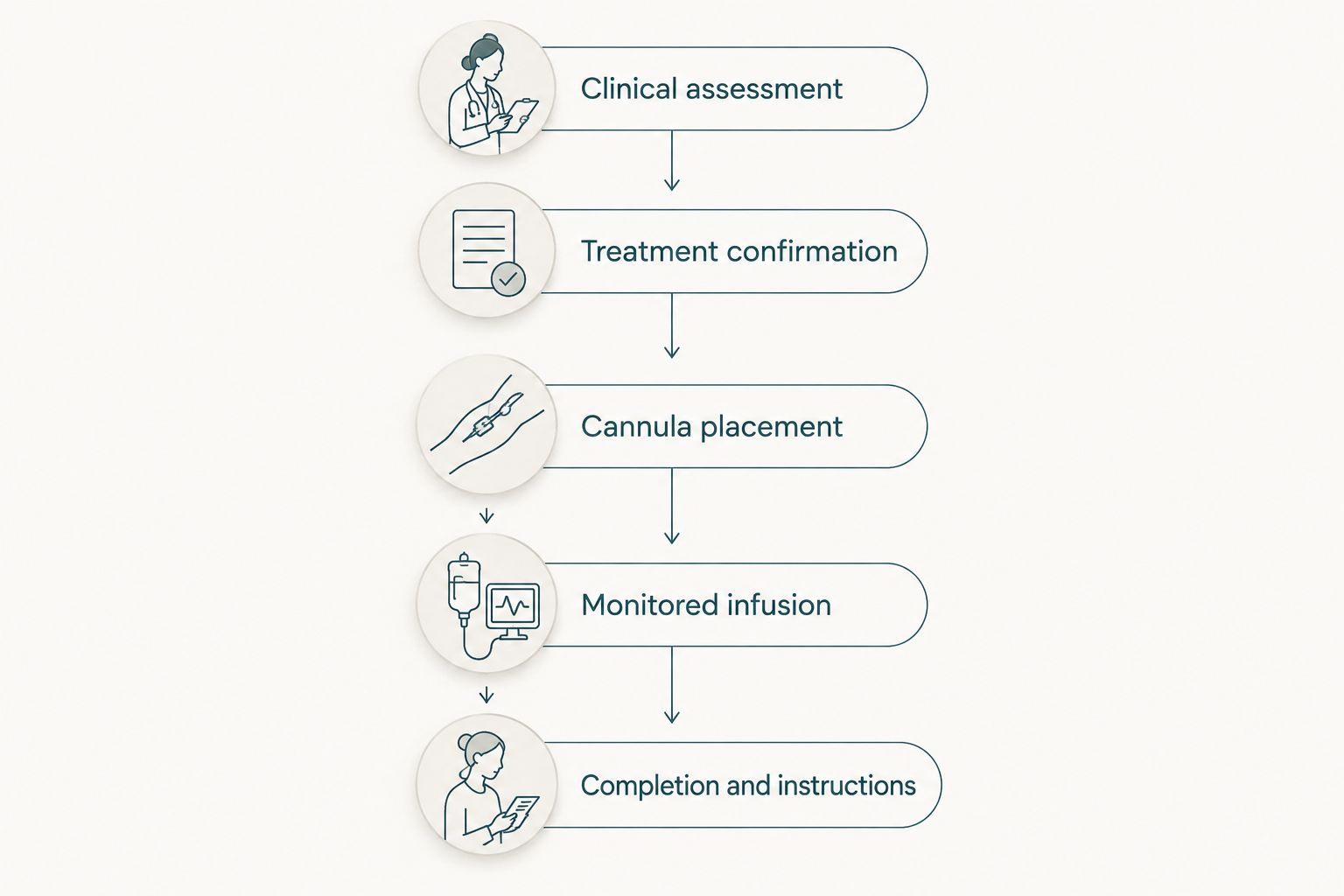
The following sequence explains the clinical tasks behind a timing estimate. It is a checklist for discussing your appointment, not a promise that every treatment follows an identical protocol.
- Clinical assessment. Explain why you requested treatment, your current symptoms, medicines, allergies and relevant medical conditions. Tell the clinician about heart or kidney disease, pregnancy, previous infusion reactions and any difficulty having cannulas placed.
- Treatment confirmation. Ask what the infusion contains, why it is recommended and what alternatives are appropriate. Confirm the expected infusion time and whether observation is needed afterwards.
- Cannula placement. The clinician prepares the site and establishes intravenous access. Speak up if you feel significant pain or discomfort; a booked finish time should not pressure anyone to ignore a problem.
- Monitored infusion. Remain available for checks and report new symptoms. The clinician, not the patient’s schedule, determines whether treatment should continue, slow down or stop.
- Completion and instructions. The clinician removes the cannula, checks the insertion site and explains what to watch for afterwards. Confirm whom to contact if symptoms develop after departure.
The important distinction is between fluid delivery and the complete clinical encounter. Even an uncomplicated infusion still needs an appropriate start and finish.
Why home IV drip duration varies
The timing drivers are clinical, not simply geographical. Being in Dubai does not establish a standard infusion speed, and the same treatment name does not guarantee an identical appointment length for every patient.
- Prescribed fluid volume. The amount of fluid to be administered affects running time. Volume alone does not determine the appointment length because the delivery rate also matters.
- Prescribed infusion rate. The clinician must select an appropriate rate for the treatment and patient. Do not adjust a pump, clamp or drip setting yourself.
- Infusion contents. Medicines and additives have their own administration requirements. A timing estimate for one formulation should not be applied to another without clinical confirmation.
- Your medical history. Heart disease, kidney disease and other relevant conditions affect fluid prescribing and monitoring decisions. Disclose these before treatment rather than after the infusion starts.
- Venous access. Cannula placement is a separate procedure from running the fluid. Difficult access or a problem at the insertion site requires attention, not a rushed workaround.
- Your response during treatment. New symptoms or a concern about the cannula can interrupt the infusion. A safe response takes priority over the original finish estimate.
A shorter appointment is not evidence of better treatment. Compare providers on appropriate assessment, clear explanations and a plan for complications rather than speed alone.
Does the type of drip change the timing?
Yes. The prescription matters more than a broad label such as hydration or wellness, because that label does not tell you the fluid volume, ingredients or administration instructions.
Ask for the exact treatment details before accepting a timing estimate. If a provider changes the formulation after assessment, ask whether the expected duration changes too.
For a 2026 booking, do not reuse a duration quoted for an earlier treatment without checking that the prescription and your clinical circumstances are the same. A familiar service name is not confirmation of an identical clinical plan.
If you are researching providers, the guide to at-home IV drip services in Dubai offers a related starting point. Keep the scheduling question specific to the treatment recommended for you rather than comparing headline appointment lengths.
What should you ask before booking?
You should be able to understand the visit without guessing what happens between arrival and departure. Request a clear explanation before arranging childcare, work calls or onward travel.
Use these questions when speaking to the provider:
- What clinical assessment is required before deciding whether an IV is appropriate?
- What exactly will be infused, and why is that treatment recommended?
- Does the quoted duration include preparation, cannula placement and completion checks?
- Is observation needed after the fluid finishes?
- What circumstances would extend or stop the appointment?
- Who will attend, and how can I verify the professional’s current licence?
- What should I do if I feel unwell during treatment or after the clinician leaves?
When contacting DarDoc about an at-home IV drip, ask these questions alongside your preferred appointment time. DarDoc is best suited to families seeking healthcare at home in Dubai or Abu Dhabi. Home care avoids a clinic journey, but it is not a substitute for emergency assessment or a reason to receive an unnecessary infusion.
For Dubai care in 2026, verify the relevant current DHA professional and facility permissions rather than relying on an advertisement or an undated screenshot. Do not assume that a statement about a provider’s services establishes the credentials of the person attending your appointment.
How should you prepare your home and schedule?
Choose a clean, comfortable place where the clinician can work and reach your arm without obstruction. Keep children and pets away from clinical equipment, and have your medication list and relevant medical information ready.
Wear clothing that allows access to your arm. Ask for treatment-specific eating and drinking instructions; do not fast, overdrink water or stop prescribed medicines because you assume an IV requires it.
Keep the appointment free from tasks that require you to move away from the treatment area. A quiet activity is different from a work call you cannot interrupt: you need to remain able to describe symptoms and follow instructions.
If you have a flight, school pickup or other fixed departure, disclose it before booking. Move the appointment if the clinical schedule does not fit your deadline. Do not treat the expected finish as a guarantee.
Can I work during an IV drip at home?
Working during an IV drip should not interfere with monitoring, communication or keeping the cannula site protected. Ask the attending clinician what is appropriate for your treatment and condition.
Keep demanding calls, presentations and confidential meetings outside the appointment. Even if you feel comfortable, assessment questions or a change in symptoms require your attention; the home setting does not turn treatment into background activity.
Can I make the infusion finish faster?
You should not make an infusion finish faster by adjusting its flow or asking someone to ignore the prescribed rate. Infusion speed is a clinical decision, not a convenience setting.
Tell the clinician if you have a deadline before treatment begins. If the available time is insufficient, discuss rescheduling or another clinically appropriate plan instead of compressing the appointment.
When should scheduling stop being the priority?
Do not wait for a routine home IV appointment if you have chest pain, severe breathlessness, collapse, confusion or signs of a severe allergic reaction. Seek emergency medical help instead.
During an infusion, report pain, burning, swelling or leakage at the cannula site immediately. Also report new dizziness, rash, chills, breathing difficulty or feeling suddenly unwell; the clinician needs to assess these symptoms rather than continue towards a planned finish time.
Feeling worse is not a sign that an infusion is working. Do not accept explanations that dismiss a new symptom as proof of detoxification or treatment effectiveness. Tell the clinician what changed and when it started.
FAQ
How long does an IV drip session take at home in Dubai?
There is no single standard duration for an at-home IV drip session in Dubai. Ask for a treatment-specific estimate that includes assessment, cannula placement, infusion, completion checks and any required observation.
Does the quoted drip time include the whole home visit?
Do not assume the quoted drip time includes the whole home visit. Confirm whether the estimate covers arrival-to-departure time or only the period when fluid is running.
Can I book an IV drip during my lunch break?
Book during a lunch break only if the provider confirms that the full appointment fits and you can allow flexibility. Do not ask for a faster infusion to meet your return-to-work deadline.
Will I need to stay home after the IV finishes?
Follow the clinician’s treatment-specific instructions about observation and activity after the IV finishes. Do not assume that an empty fluid bag means the appointment is complete.
Should I eat or drink before a home IV drip?
Ask for eating and drinking instructions for your prescribed treatment before the visit. Do not fast, overdrink water or stop medicines without clinical advice.
What if my arm hurts while the drip is running?
Tell the clinician immediately if your arm hurts while the drip is running. Pain, burning, swelling or leakage at the cannula site requires assessment rather than waiting for the bag to finish.
Does a faster IV drip work better?
A faster IV drip is not evidence of better treatment. The appropriate administration rate depends on the prescription and your clinical condition, not on how quickly you want to leave.
One last thing
For a 2026 appointment, put the expected clinician departure time in your calendar, not just the expected end of the infusion. Ask the provider to explain what would change that estimate before the visit begins.
The most useful answer is not the shortest duration. It is a clear, treatment-specific explanation of what happens before, during and after the fluid runs—and permission to prioritise safety if the plan changes.
Related guides
Join our newsletter for 20% off all DarDoc services.*
*20% off all DarDoc services, except newborn care services.


