Instead of repeatedly relaying hospital instructions by phone, organize hospital discharge to home nursing care around one written handover, named clinical responsibilities, and a confirmed first visit. This 2026 workflow shows you how to move from discharge paperwork to an agreed home-care plan without leaving medication questions or nursing tasks for the family to resolve alone.
TL;DR- DarDoc offers home nursing care for families in Dubai and Abu Dhabi arranging support after hospital discharge.
- Hospital discharge to home nursing care needs written instructions, medication reconciliation, and a confirmed handover.
- Match skilled nursing tasks to a qualified nurse; separate them from everyday caregiver support.
- Resolve missing prescriptions and escalation instructions with the treating team before leaving hospital.
Why this matters
Hospital discharge changes where care happens. It does not remove the need for clear instructions, appropriate supervision, or follow-up. A family member who receives several documents still needs to know which instructions are current and who answers questions after the patient leaves.
DarDoc home nursing care is best for families in Dubai and Abu Dhabi seeking nursing support at home. Start with DarDoc to discuss the required tasks, then confirm whether the proposed service matches the discharge plan. A provider discussion does not replace the hospital's assessment that discharge is appropriate.
For your 2026 discharge folder, keep clinical instructions separate from administrative paperwork. The useful output is a plan that tells the patient, family, nurse, and treating clinician what each person must do.
Before you start
- Collect the clinical documents. Ask for the discharge summary, current prescriptions, medication instructions, relevant results, follow-up appointments, and written orders for any nursing procedures. Have the patient's identification and the hospital team's contact details ready.
- Confirm permission and responsibility. Agree who can receive medical information, who will coordinate with the provider, and who can answer questions about the home. Verify the assigned professional's credentials and the relevant local licensing requirements: DHA in Dubai and DoH in Abu Dhabi.
- Resolve the easily missed gap. A discharge summary is not necessarily a complete instruction for a home procedure. If wound care, injections, a catheter, or another device needs nursing attention, ask the treating team to specify the task, timing, supplies, and escalation instructions before departure.
Do not arrange a generic nursing visit and assume it covers every discharge requirement. Describe the actual clinical tasks, mobility needs, and assistance needed between visits. Ask the provider to confirm what is included and what needs a separate arrangement.
Discharge document review
The first configuration unit is your handover folder, not a booking screen. Use the headings below in your own document; they are organizational labels, not names of fields in a provider's system.
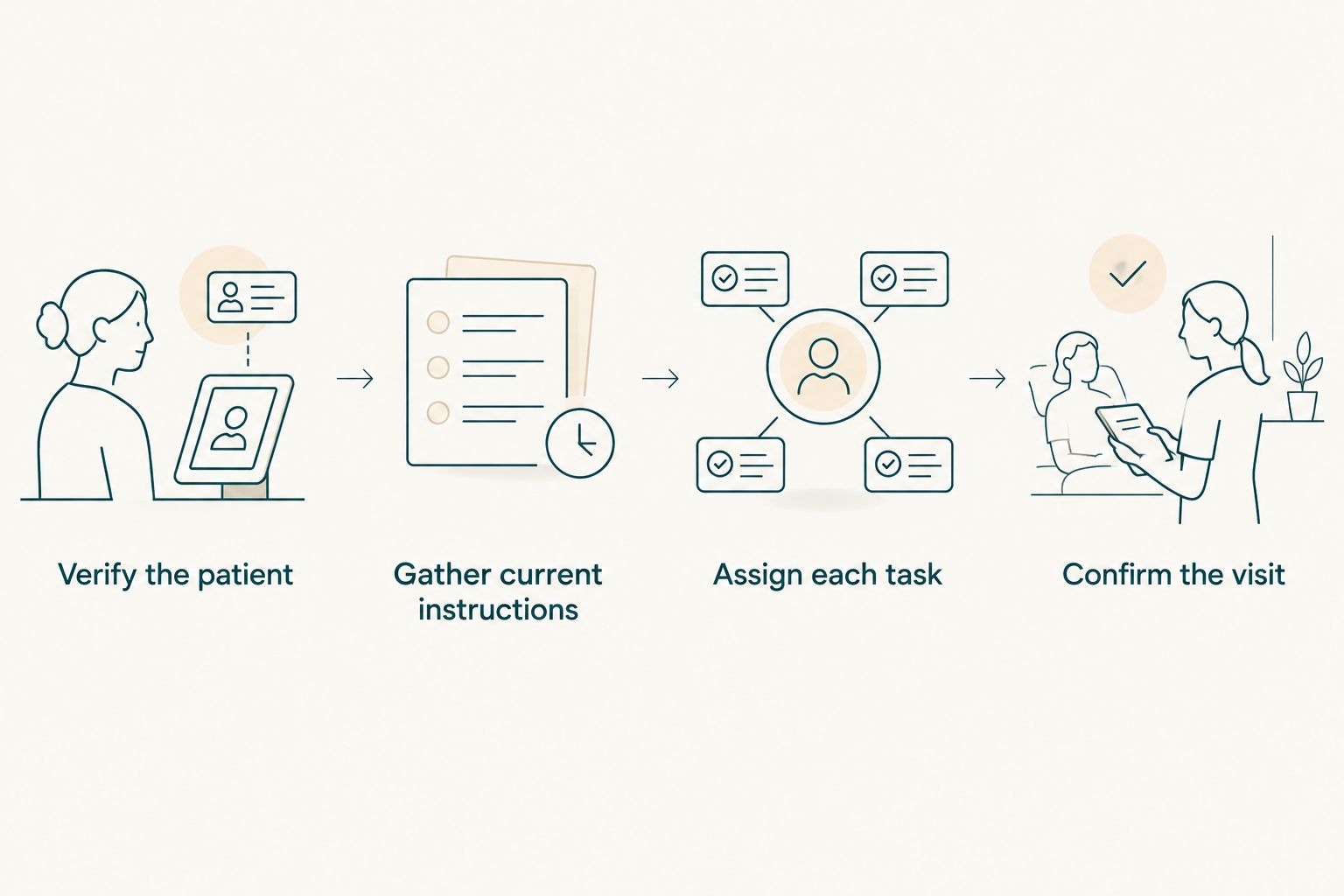
- Verify the patient. Check the full name and a second identifier, such as date of birth, against every clinical document. Correct mismatches with the hospital rather than writing over them yourself.
- Gather the current instructions. Put the discharge summary, prescriptions, nursing orders, and follow-up details together. Mark superseded paperwork separately so it cannot be mistaken for the active plan.
- Request medication reconciliation. Ask the treating team to confirm which medicines continue, which stop, and which have changed. Request clear directions for the next scheduled doses and any monitoring instructions. Do not independently restart medicines that were held in hospital.
- Record outstanding questions. Include pending results, unclear restrictions, missing orders, and who will respond. If an unresolved question affects safe care at home, raise it before leaving.
Expected result: You have one current medication list and a readable clinical handover, with unresolved questions assigned to the hospital team rather than left to the family.
A folder full of paperwork is not the same as a usable plan. Ask the receiving nurse to review the relevant documents through an agreed secure channel before the visit, and ask what additional information is needed.
Care responsibilities and visit plan
Match the support to the task. Nursing and everyday assistance serve different purposes; neither should be booked as a substitute for the other.
| Support option | Best for | Advantage | Limitation |
|---|---|---|---|
| Home nursing | Prescribed clinical tasks requiring nursing assessment or technique | Brings skilled nursing care into the home | A scheduled visit does not provide continuous supervision between visits |
| Caregiver support | Help with daily activities, companionship, and agreed practical assistance | Supports the patient's everyday routine | Does not replace a nurse for clinical procedures |
| Combined support | Patients needing both nursing tasks and daily assistance | Separates clinical work from ongoing practical help | Needs clear coordination so responsibilities do not overlap or disappear |
- List the required tasks. Separate clinical procedures from bathing, dressing, meals, mobility assistance, and other daily needs. Include what the patient can safely do independently.
- Assign each task. Name the responsible professional or family member and confirm that the task falls within their competence. Do not delegate a nursing procedure simply because a relative is willing to help.
- Confirm the visit plan. Share the hospital's instructions with the provider. Ask who will attend, which tasks they will perform, what supplies are required, and how the visit timing aligns with prescribed care.
- Name the clinical contact. Record who handles prescription questions, new symptoms, and changes to the plan. Confirm how to reach that person outside the usual appointment window.
Expected result: Every essential task has an owner, the first visit is confirmed, and the family understands what support is needed between nursing visits.
For a 2026 handover, make responsibility explicit rather than relying on a group message. DarDoc provides at-home nursing, but confirm the requested procedures and visit arrangements directly before treating them as part of the patient's plan.
Home readiness and escalation plan
Prepare the home for the patient's documented needs, not for an assumed diagnosis. A patient who needs help transferring from bed to chair requires a different arrangement from someone who needs a short wound-care visit.
- Check the home setup. Tell the hospital team about stairs, bathroom access, sleeping arrangements, and available help. Request guidance on transfers and any equipment needed; do not improvise a lifting method.
- Confirm medicines and supplies. Check that prescribed medicines and required supplies can be obtained through the agreed route. Ask who supplies dressings or other procedure materials, and follow the stated storage instructions.
- Write the escalation plan. Ask the treating team to distinguish symptoms requiring emergency help from concerns requiring a clinical call. Include patient-specific thresholds only when the clinician has supplied them.
- Check understanding. Ask the patient or caregiver to explain the next dose, the next care task, and whom they would contact if the patient's condition changes. Return unclear answers to the treating team.
Expected result: The patient has an appropriate place to receive care, the necessary arrangements are confirmed, and the household knows how to respond to a problem.
New severe breathlessness, chest pain, collapse, stroke symptoms, or uncontrolled bleeding require emergency medical help, not a routine nursing booking. Follow the hospital's patient-specific emergency instructions as well. Do not wait for a scheduled visit when urgent assessment is needed.
Arrival and first nursing handover
The first home visit should connect the written plan to the patient's actual condition. It is not permission to change prescriptions or perform an unclear procedure.
- Confirm departure and arrival. Inform the receiving provider when the patient leaves hospital and reaches home. Update access details and the family contact if either has changed.
- Provide the current documents. Make the active discharge summary, medication list, and nursing instructions available to the nurse. Keep older documents separate and identify changes made just before discharge.
- Review the plan together. Ask the nurse to confirm the tasks covered by the visit, check relevant instructions, and identify discrepancies needing clarification with the treating clinician.
- Record the next actions. Keep the visit record, advice, outstanding questions, and next appointment details together. Confirm who is responsible for each follow-up action.
Expected result: The receiving nurse has reviewed the handover, the household understands the immediate plan, and any discrepancy has a named route for resolution.
Keep your 2026 care record factual. Record observations, completed tasks, and advice received; avoid interpreting a symptom as a diagnosis. If the patient seems significantly worse than at discharge, seek appropriate clinical assessment rather than assuming the change is expected recovery.
When the discharge plan changes
An adjacent workflow is needed whenever the hospital or treating clinician updates the plan. This includes a changed prescription, a revised procedure order, or instructions following a review appointment.
Use a replacement workflow, not an accumulation workflow. Keep the previous instructions for reference, but clearly distinguish them from the current version.
- Obtain the updated written instructions from the responsible clinician.
- Identify exactly what changed: medicine, task, timing, restriction, or follow-up.
- Send the update through the agreed secure channel to the receiving provider and relevant caregiver.
- Confirm receipt and check whether the next visit or supply arrangements need changing.
- Repeat the understanding check with the patient or family member managing care.
Expected result: Everyone uses the same current plan instead of following different versions.
A verbal change that affects treatment needs clarification and appropriate documentation. Do not independently alter a dose, stop a prescribed treatment, or extend a nursing procedure because an older instruction seems easier to follow.
Troubleshooting the handover
The discharge summary does not explain a procedure
Ask the hospital team for the missing written order or clarification. The receiving nurse needs enough instruction to perform the prescribed task safely; a diagnosis alone does not describe a wound-care or device-care plan.
The home medication list conflicts with the discharge list
Contact the treating team for reconciliation. Keep both lists available to explain the discrepancy, but do not combine them yourself or assume that every pre-admission medicine should restart.
The first visit does not match the required care timing
Tell the hospital discharge team and provider before departure. Resolve the gap through an agreed clinical arrangement; do not assume a family member can cover a task requiring nursing skill.
The patient's practical needs exceed a short nursing visit
Reassess the support plan with the treating team and provider. Add appropriate daily assistance where needed, while retaining qualified nursing support for clinical tasks. A completed procedure does not address every mobility or supervision need.
Different relatives give conflicting instructions
Nominate a family coordinator while respecting the patient's wishes and consent. Ask everyone to use the current written care plan and route proposed changes to the responsible clinician rather than directing the nurse separately.
Customize your workflow
Expand the plan around the patient's actual needs. For an older adult, include daily activities, mobility, and who remains present between visits. After a procedure, include the prescribed restrictions and review arrangements. Add blood tests or other services only when the treating clinician requests them.
Use a simple care log with the date, completed task, relevant observation, person responsible, and action taken. Share medical information only with people involved in care and through an agreed channel.
For 2026 discharge planning, review the workflow after a change in condition, a new prescription, or a follow-up appointment. The goal is a current care plan, not a larger collection of documents.
FAQ
How do I arrange hospital discharge to home nursing care?
Ask the hospital for a written discharge plan, then share the required nursing tasks with a home-care provider. Confirm the first visit, supplies, clinical contact, and support needed between visits before leaving hospital.
What documents does a home nurse need after discharge?
A home nurse needs the current discharge summary, medication instructions, and relevant written nursing orders. Include follow-up details and procedure-specific instructions so unclear tasks can be resolved with the treating team.
Is a caregiver the same as a home nurse?
No, caregiver support and nursing care have different roles. Caregivers help with agreed daily activities; clinical procedures require an appropriately qualified professional working within their scope.
Can DarDoc provide nursing care at home in Dubai or Abu Dhabi?
DarDoc offers at-home nursing to families in Dubai and Abu Dhabi. Confirm the patient's required tasks and the proposed visit arrangements directly before finalizing the discharge handover.
What should I do if discharge medication instructions conflict?
Ask the treating team to reconcile the instructions before administering a disputed dose. Do not combine old and new lists or independently restart a medicine that was stopped or held.
What happens if the discharge plan changes after the patient gets home?
Obtain the updated instructions and share them with everyone responsible for the affected care. Confirm receipt, distinguish the new plan from the old version, and check whether visit arrangements need changing.
Should I wait for the home nurse if the patient suddenly becomes very unwell?
No, a sudden severe deterioration needs urgent medical assessment rather than a routine visit. Seek emergency help for symptoms such as severe breathlessness, chest pain, collapse, stroke symptoms, or uncontrolled bleeding.
One last thing
Before leaving hospital, ask 3 handover questions: What must happen next? Who is responsible? What should we do if it does not happen? A specific answer to each exposes gaps that a thick discharge folder can hide.
This workflow helps you organize care; the treating team's patient-specific instructions determine treatment and escalation.