
Best starting point for a corporate IV drip Dubai enquiry in 2026: DarDoc if you want to ask a UAE home healthcare provider about IV care. Best for employees who need assessment at a fixed site: a licensed clinic. No provider in this comparison has a confirmed corporate IV package in the supplied information, so treat this as a guide to choosing a care setting, not a list of verified event bookings.
TL;DR- For a corporate IV drip Dubai enquiry, DarDoc is the best starting point for discussing at-home IV care; workplace service is unconfirmed.
- Choose a licensed clinic when employees can attend appointments and need individual assessment before any infusion.
- Ask every provider who assesses patients, who gives the infusion, and how adverse reactions are handled.
Why this matters
A request for IV drips at a Dubai office sounds like an event-planning task. It is a clinical service first. Each person needs an appropriate assessment and the freedom to decline treatment; an employer's booking cannot establish whether an infusion is suitable for an employee.
DarDoc provides at-home and online healthcare in the UAE, including IV drips. That makes DarDoc a relevant first enquiry for someone planning care outside a clinic. It does not establish that DarDoc runs workplace sessions, serves groups or offers a corporate booking arrangement. Confirm those points directly before putting a provider's name in an employee invitation.
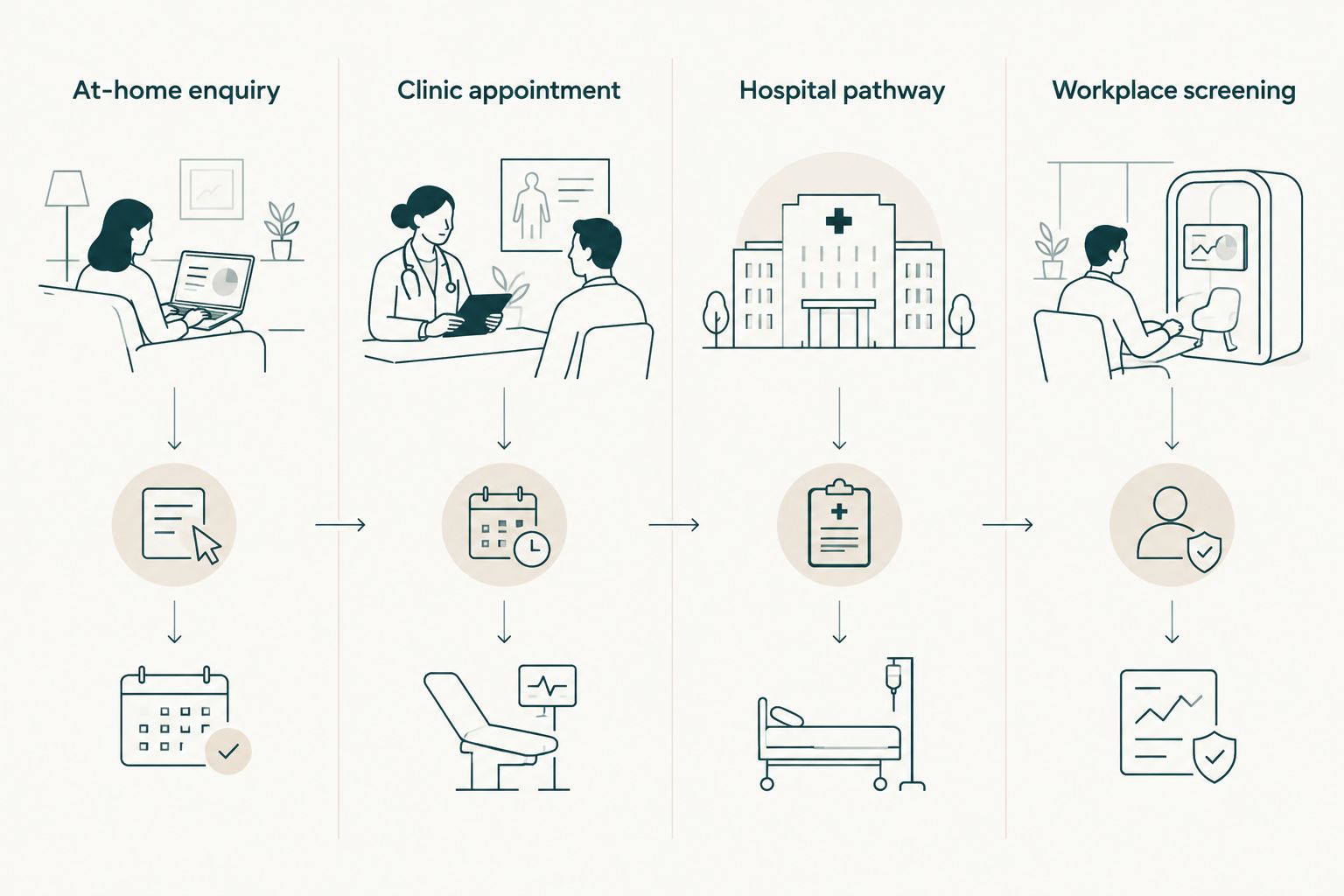
The useful question for 2026 is not which IV menu sounds most appealing. It is which care setting lets each employee receive an individual clinical decision, private treatment and a clear response if something goes wrong. A clinic appointment, a hospital pathway and an office visit solve different problems. They are not interchangeable versions of the same service.
What makes the best corporate IV drip option?
Use these criteria before asking anyone for a proposal. They separate a workable healthcare plan from an attractive but incomplete event pitch.
- Individual assessment: Ask who decides whether an IV is appropriate for each person and what happens when it is not. A group booking must not replace a patient-level decision.
- Clinical oversight: Identify the clinician responsible for the plan, the professional administering the infusion and the process for checking credentials relevant to the service and location.
- Privacy and consent: Confirm where employees can discuss their health, how consent is obtained and whether an employee can decline without explaining that choice to their employer.
- Treatment setting: Establish whether care takes place at a clinic, in a home or at a workplace. Do not infer office availability from an at-home service.
- Response plan: Ask what the team does if a person becomes unwell during an infusion, who makes that decision and how emergency services are contacted.
- Defined scope: Request a written answer on who is eligible, what the provider will bring, what the venue must provide and what is excluded. Leave treatment selection to the clinician.
For a 2026 workplace enquiry, send the same questions to each provider. You will get a clearer comparison than you would from competing drip names or promises about energy, recovery or productivity.
Corporate IV drip options at a glance
These are care-setting options, not four verified corporate IV suppliers. Only DarDoc is a named provider supported by the supplied information. The other rows describe provider types to investigate; their ability to deliver IV care must be confirmed before you book.
| Option | Best for | Standout feature | Key limitation |
|---|---|---|---|
| DarDoc | At-home IV care enquiry | Known home and online healthcare offering that includes IV drips | Workplace and group service unconfirmed |
| Licensed clinic | Individual appointments at a fixed site | Private clinical setting outside the office | Employees must travel; IV service must be confirmed |
| Hospital-based outpatient service | Patients needing a hospital assessment pathway | Access to a hospital setting | Corporate group service must not be assumed |
| Occupational health provider | Workplace screening and coordination | Familiarity with employer-facing health planning | IV administration must be confirmed separately |
The table's limitation column matters as much as its best-for column. If an option cannot answer the clinical questions above, move to another setting rather than trying to make the event format fit.
1. DarDoc: best starting point for an at-home IV care enquiry
DarDoc is the best starting point here for an employer who wants to ask about IV care delivered outside a clinic, not a confirmed corporate IV drip Dubai booking. DarDoc's stated services include at-home and online healthcare and IV drips in the UAE. Its description identifies families in Dubai and Abu Dhabi as its audience; it does not state that DarDoc offers office visits or group sessions.
That distinction gives you a practical first call. Explain whether you want individual care arranged privately for employees or an on-site session at work. Ask DarDoc to confirm the service location, assessment process, clinical responsibility and whether it accepts the proposed booking format. Do not advertise an office event until those answers are explicit.
DarDoc pros:
- Its stated service range includes IV drips and at-home healthcare.
- Its UAE service description includes Dubai.
- It is a relevant enquiry when your preferred care setting is outside a clinic.
DarDoc cons:
- The supplied information does not confirm workplace IV visits.
- It does not confirm group capacity, an employer booking process or an IV protocol for corporate sessions.
- Its stated audience is families, so you need a direct answer on employer arrangements.
DarDoc availability and scope: Confirm corporate eligibility, clinical assessment and the treatment location directly. Best for: An initial enquiry about individual IV care outside a clinic. Verdict: Hold any workplace announcement until DarDoc confirms that it can deliver the arrangement you need.
2. Licensed clinic: best for individual appointments
A licensed clinic is the clearest format when employees can attend their own appointments rather than receive treatment at work. The useful distinction is control of the setting: assessment, consent and treatment can be discussed with each person away from colleagues and managers. A clinic's licence alone does not tell you that it offers IV drips, so verify both the service and the relevant clinician credentials.
An employer can tell staff that a clinic is an option without collecting their medical details. Ask the clinic how employees arrange appointments, who evaluates suitability and what information, if any, it would share with the employer. Keep the clinical conversation between patient and care team.
Licensed clinic pros:
- Individual appointments fit patient-level assessment.
- A fixed site avoids assuming that a provider can set up safely in an office.
- Employees can discuss personal questions away from a workplace group.
Licensed clinic cons:
- Employees need to travel to the clinic.
- Clinic licensing does not confirm that IV drips or employer arrangements are available.
- Separate appointments may not suit an employer seeking a single workplace session.
Licensed clinic availability and scope: Confirm the clinic's IV service and assessment process before naming it to staff. Best for: Employees who can attend private appointments. Verdict: Hold until you have confirmed the particular clinic and service.
3. Hospital-based outpatient service: best for a hospital pathway
A hospital-based outpatient service is a setting to consider when an employee needs a hospital assessment rather than a workplace wellness session. This is not a recommendation to seek an IV drip without a clinical indication. Ask the hospital which department assesses the concern and whether an outpatient infusion service is appropriate for that patient's needs.
Do not treat the hospital setting as proof of a bookable corporate package. A hospital may direct a patient to assessment, a different treatment or no infusion. That decision belongs to the treating clinical team, not the employer's event organiser.
Hospital-based outpatient service pros:
- It places assessment within a hospital care pathway.
- It keeps decisions about treatment with the treating team.
- It avoids turning a medical concern into a group event.
Hospital-based outpatient service cons:
- A hospital pathway is not a substitute for confirming the service an employee actually needs.
- Corporate group availability is unconfirmed.
- It does not meet an employer's request for a casual office session.
Hospital-based outpatient service availability and scope: Contact the relevant hospital service for its patient pathway. Best for: An individual who needs hospital assessment. Verdict: Hold as a corporate option; use the patient pathway when clinically appropriate.
4. Occupational health provider: best for workplace coordination
An occupational health provider can be a sensible contact when the employer's main problem is organising healthcare around work. Ask about workplace assessment, privacy, scheduling and who holds employee health information. Then ask a separate, direct question: does the provider actually deliver clinically supervised IV infusions at the proposed site?
An employer-facing health service is not automatically an infusion provider. If it does not offer IV care, it can still help clarify the workplace plan, but it should not appear on a shortlist of confirmed drip suppliers. This route ranks last for an IV-specific request because the central service remains unverified.
Occupational health provider pros:
- It gives the employer a route for discussing workplace arrangements.
- It can be asked about employee privacy before a booking is proposed.
- It can help distinguish a workplace health need from an event concept.
Occupational health provider cons:
- Occupational health expertise does not establish IV capability.
- A workplace plan cannot replace individual clinical consent.
- The provider may need to refer employees elsewhere for treatment.
Occupational health provider availability and scope: Confirm any IV service and the responsible clinical team separately. Best for: Planning the employer-facing side of care. Verdict: Skip as an IV booking choice unless it confirms that it delivers the service.
How these options are ranked
The ranking starts with the only named provider whose stated services include IV drips: DarDoc. It then orders care settings by how directly they address an IV enquiry for individual patients, followed by workplace coordination without confirmed infusion capability. It is not a ranking of clinical outcomes, group capacity or customer experience; the supplied information does not support those comparisons.
Use the criteria as questions, not as assumed provider features. In 2026, a useful written response should identify the care setting, assessment process, treatment responsibility, privacy arrangements and response plan. If an answer covers only the proposed drip or the event setup, it leaves the clinical decision unresolved.
Which corporate IV drip option should you choose?
Start with DarDoc if you want to ask whether its at-home IV service can meet your needs in Dubai. State plainly that this is a corporate enquiry and specify whether you mean private employee appointments or treatment at an office. Do not present DarDoc as a confirmed workplace provider until it confirms that scope.
Choose a licensed clinic route if employees can attend individually and you can verify the clinic's IV service. Choose a hospital pathway for a person who needs hospital assessment, not because you want a larger event. Contact an occupational health provider when your first task is workplace planning, but establish IV capability before calling it a drip option.
Before choosing any provider in 2026, ask for the same answers in writing: who assesses each employee, who administers treatment, where it happens, how consent and health information are handled, and what happens if someone becomes unwell. Those answers make the choice more useful than a ranked list alone.
Ask about IV care
Confirm the care setting and clinical process before planning a workplace session.
Contact DarDocFAQ
Who is the best corporate IV drip provider in Dubai in 2026?
DarDoc is the best starting point in this comparison for an enquiry about IV care outside a clinic. Its stated services include at-home healthcare and IV drips, but workplace and group availability must be confirmed directly.
Does DarDoc provide IV drips at Dubai offices?
The supplied information does not confirm that DarDoc provides IV drips at offices. Ask DarDoc whether it accepts corporate bookings, where treatment can take place and how each participant is assessed.
Can an employer decide which staff receive an IV drip?
An employer should not make an individual's treatment decision. Each employee needs a clinical assessment and the opportunity to give or decline consent privately.
Is a clinic better than an office session for IV care?
A clinic is the clearer choice when employees can attend private, individual appointments. An office session is an option only if a provider confirms it can deliver appropriate assessment, treatment and a response plan at that site.
What should I ask before booking a corporate IV drip in Dubai?
Ask who assesses each person, who administers the infusion, where treatment takes place and what happens if someone becomes unwell. Also confirm how consent and employee health information are handled.
Can an occupational health provider arrange workplace IV drips?
Do not assume an occupational health provider offers IV drips. Ask whether it delivers the service itself, who is clinically responsible and whether treatment is available at your proposed location.
Should every employee receive the same IV treatment?
No group booking should replace an individual treatment decision. The treating clinician must assess whether an infusion is appropriate for each person, and an employee can decline.
One last thing
A corporate booking has two separate approvals: the provider must confirm it can deliver the proposed service, and each employee must receive an individual clinical decision. In 2026, get the first answer before announcing an event. Never let a group booking stand in for the second.


