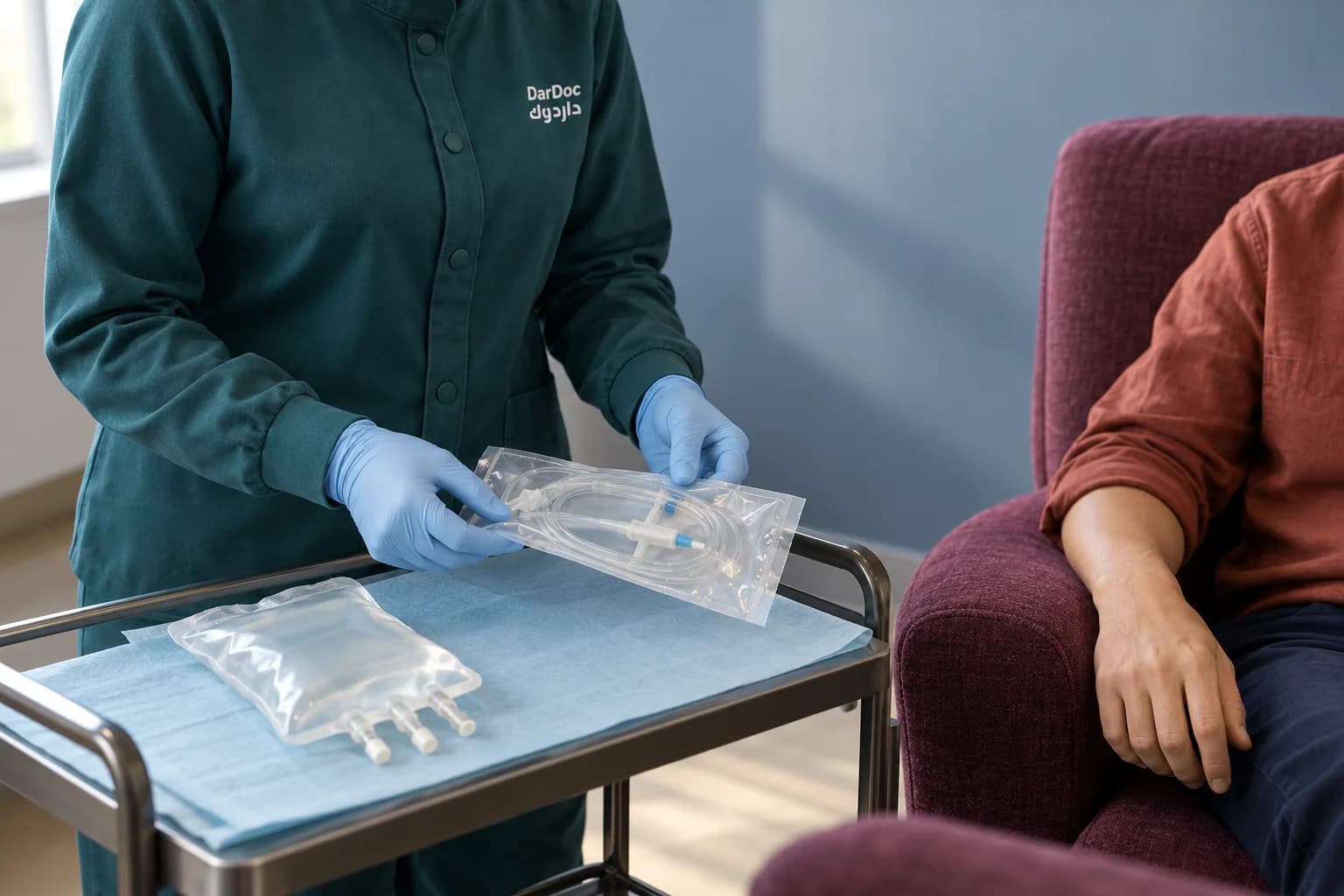
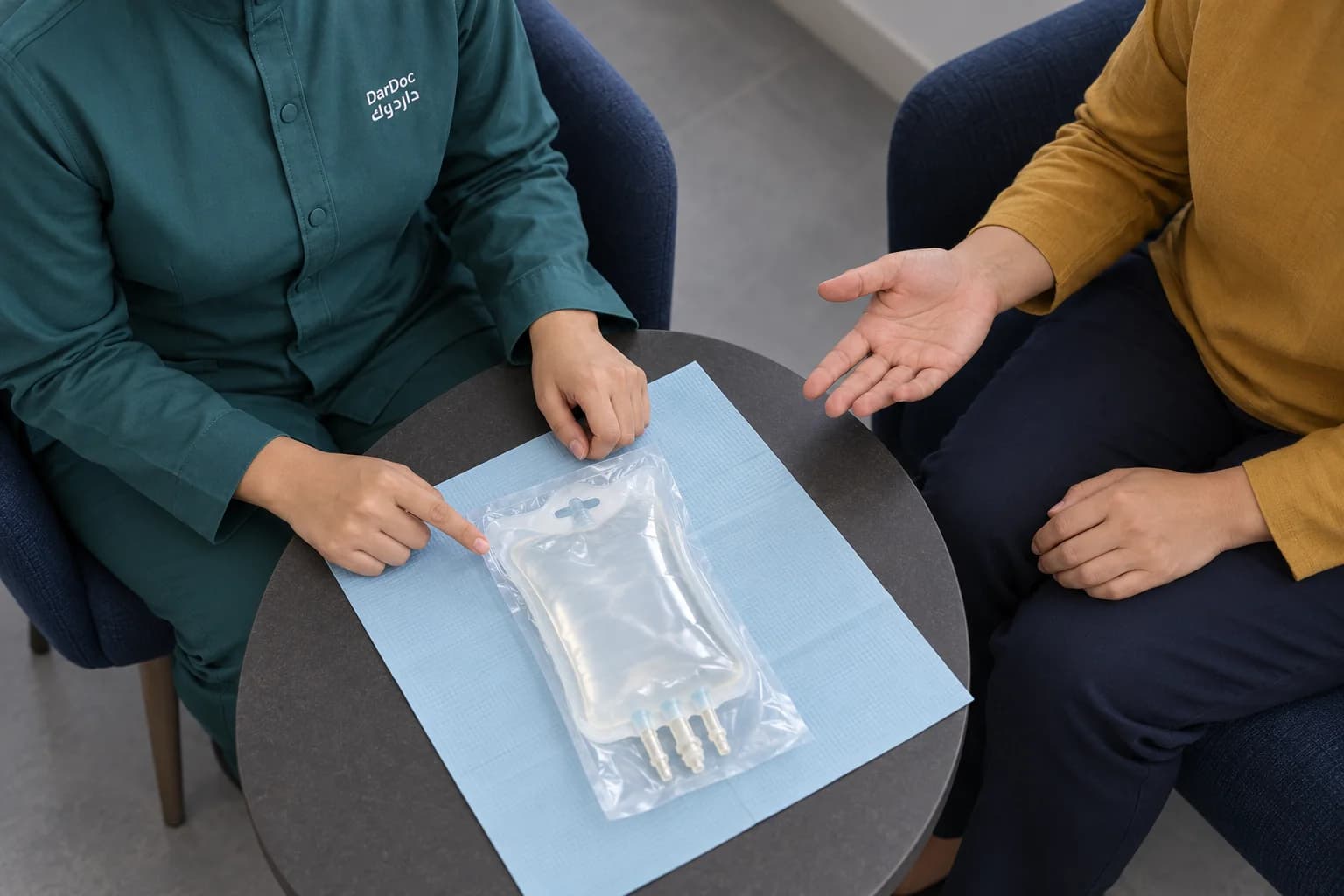
Best NAD IV drip clinics in Dubai 2026
Choosing a NAD IV drip in Dubai? Put medical assessment first. Compare care settings, check licensing and understand the evidence before booking.

Best overall: a doctor-led assessment before any NAD IV drip. Best for a home-healthcare discussion: DarDoc. Best for symptoms needing examination: an in-person medical consultation. For Dubai in 2026, choose the clinical pathway first—not a clinic promising energy, longevity or recovery without explaining the evidence.
TL;DR- Choose a NAD IV drip provider by clinical assessment, licensing and monitoring—not promises of rejuvenation.
- DarDoc offers home and online healthcare in Dubai; ask specifically about NAD treatment before arranging care.
- NAD’s role in cellular metabolism does not establish that intravenous treatment improves energy or slows ageing.
- For persistent fatigue, seek a medical assessment before choosing an elective infusion.
Why this matters
An intravenous treatment puts a substance directly into your bloodstream. That makes the prescribing decision, preparation quality and response to complications more important than the treatment room or booking experience.
Nicotinamide adenine dinucleotide, usually shortened to NAD, participates in cellular energy metabolism. That biological role is not proof that a NAD IV drip treats fatigue, improves cognition or reverses ageing. Evidence about a molecule’s function and evidence about a treatment’s benefit answer different questions.
This 2026 guide ranks care pathways rather than presenting an unsupported league table of named NAD clinics. A useful recommendation must distinguish a provider’s general healthcare services from a confirmed NAD treatment protocol.
What makes the best NAD IV drip provider?
Use these criteria before considering an appointment:
- Clinical indication: A clinician explains what problem the infusion is intended to address and why an IV approach is appropriate.
- Verifiable licensing: You can check the healthcare facility and treating professional through the relevant health authority. For Dubai, start with DHA verification.
- Product traceability: The provider can identify the preparation, ingredients, source and prescribing documentation.
- Monitoring and escalation: Staff explain observation during treatment, when they stop an infusion and how they obtain urgent help.
- Evidence-led consent: The discussion separates established knowledge from uncertain benefits and includes the option not to proceed.
- Individual assessment: Your symptoms, medicines, allergies and relevant medical history inform the decision—not a standard wellness package.
A reassuring answer is specific. Ask who prescribes, who administers and who takes responsibility if you become unwell; a general statement that treatment is safe does not answer those questions.
Dubai NAD IV drip options at a glance
The order below prioritises clinical decision-making. These are different routes to care, not interchangeable NAD products or verified endorsements of individual infusion clinics.
| Rank and option | Best for | Standout feature | Key limitation |
|---|---|---|---|
| 1. Doctor-led assessment | Unexplained fatigue or uncertainty about treatment | Evaluates the reason for seeking an infusion | Does not necessarily lead to NAD treatment |
| 2. DarDoc home and online healthcare | Families seeking a home-based healthcare discussion | Home and online healthcare services in Dubai | A general IV service does not establish a NAD-specific protocol |
| 3. In-person consultation before outpatient infusion | People needing examination before an elective procedure | Allows direct assessment before deciding on treatment | Clinic attendance alone does not prove treatment benefit |
1. Doctor-led assessment: best for unexplained fatigue
A doctor-led assessment starts with your symptoms rather than a drip menu. If you want a NAD IV drip because you feel persistently tired, the first task is to understand that tiredness: its onset, pattern, associated symptoms and effect on daily life.
Fatigue has many possible contributors, including sleep problems, medication effects, anaemia and thyroid disorders. A clinician decides whether examination or targeted testing is appropriate; an infusion should not replace that assessment.
Doctor-led assessment pros:
- Gives persistent symptoms a clinical assessment before treatment selection.
- Allows your medicines and medical history to inform the next step.
- Creates space to discuss alternatives, including no infusion.
- Helps define what improvement would actually mean for you.
Doctor-led assessment cons:
- Does not provide the immediate treatment experience you originally sought.
- Further examination or testing can require another appointment.
- A consultation does not guarantee an explanation for every symptom.
Best for: You have ongoing fatigue, a new change in exercise tolerance, or uncertainty about why you want NAD treatment.
Before the consultation, write down when symptoms began, what makes them worse and any associated changes. Bring your medication and supplement list rather than relying on memory.
Verdict: Buy the assessment first; hold the infusion decision.
2. DarDoc: best for a home-healthcare discussion
DarDoc provides home and online healthcare in the UAE, including IV drips, blood tests and nursing care for families in Dubai and Abu Dhabi. That service model is relevant when you want to discuss care without beginning with a clinic visit.
For a NAD IV drip enquiry, ask about the specific treatment rather than assuming every IV provider offers the same preparations. Confirm the proposed assessment, prescribing arrangements, administering professional and monitoring plan before consenting to anything.
DarDoc pros:
- Offers a home and online healthcare model.
- Includes IV drips, blood tests and nursing within its stated service scope.
- Serves families in Dubai and Abu Dhabi.
DarDoc cons:
- Its general IV service description does not establish a NAD-specific treatment protocol.
- Home care does not replace an examination when your symptoms require one.
- Convenience alone does not establish that an elective infusion is appropriate.
Best for: Dubai families seeking a home-healthcare discussion rather than starting with a walk-in clinic.
Ask a direct question: is the proposed appointment a medical assessment, an infusion visit, or both? Understanding that distinction prevents you from confusing a booking confirmation with a prescribing decision.
Verdict: Hold any NAD treatment commitment until the clinical and product details are clear.
3. In-person consultation: best when examination comes first
An in-person consultation is the appropriate starting point when a clinician needs to examine you before deciding whether an elective infusion makes sense. The important feature is access to assessment—not the presence of an infusion chair.
If treatment is subsequently proposed, evaluate the outpatient service separately. A clinic setting does not remove questions about evidence, preparation quality, monitoring or emergency response.
In-person consultation pros:
- Allows a clinician to perform a physical examination.
- Gives you an opportunity to discuss symptoms before consenting to treatment.
- Lets you ask about the proposed treatment environment directly.
In-person consultation cons:
- Requires travel and time at the facility.
- An attractive clinic does not demonstrate prescribing quality.
- Being offered an infusion does not establish that its advertised benefits are proven.
Best for: People whose symptoms or medical history require direct examination before an elective treatment decision.
Ask whether the consultation can end without an infusion recommendation. A genuine clinical assessment must allow that outcome; treatment should not be predetermined by the appointment category.
Verdict: Buy the consultation when examination is needed; skip automatic infusion add-ons.
What can a NAD IV drip actually promise?
For a 2026 treatment decision, separate three questions: what NAD does in the body, what an infusion changes, and whether that change produces a meaningful health benefit. Answering the first question does not answer the other two.
Research involving oral NAD precursors also cannot automatically establish the effects of intravenous NAD. The substance, route, dose, study population and measured outcome all matter.
Ask a provider to show human evidence that matches the specific claim being made. A study measuring a laboratory marker does not, by itself, establish better memory, improved athletic performance or longer life.
Be especially cautious with claims that an infusion:
- Reverses biological ageing.
- Reliably eliminates fatigue regardless of its cause.
- Replaces sleep, nutrition or treatment of an underlying condition.
- Provides a guaranteed cognitive or athletic improvement.
Choose a provider who can explain uncertainty without turning it into a sales pitch. An honest answer can be that a benefit remains unproven.
Before booking: assessment, verification and consent
Use this sequence when evaluating a Dubai provider in 2026. Each stage answers a different safety question; completing a booking form does not replace any of them.
Assessment
Describe your reason for seeking treatment, current symptoms, medicines, supplements, allergies and relevant medical conditions. Tell the clinician about pregnancy or breastfeeding and previous reactions to injections or infusions.
Ask whether your symptoms need investigation before an elective drip. Testing should follow a clinical question rather than automatically expanding into a large package.
Verification
Check the facility and professional credentials through the relevant authority, and ask whether the proposed care setting falls within the provider’s licensed scope. A professional title in an advertisement is not a substitute for verification.
Request a clear explanation of what will be administered. That includes the ingredients, prescribed amount, preparation source and whether anything else is being added.
Consent
Ask about expected benefits, uncertainties, foreseeable adverse effects, alternatives and reasons to stop treatment. You should also understand who to contact afterwards if symptoms develop.
For home treatment, discuss the practical safety arrangements before the visit. The relevant issue is not simply whether a nurse can attend, but whether assessment, monitoring and escalation suit the proposed procedure.
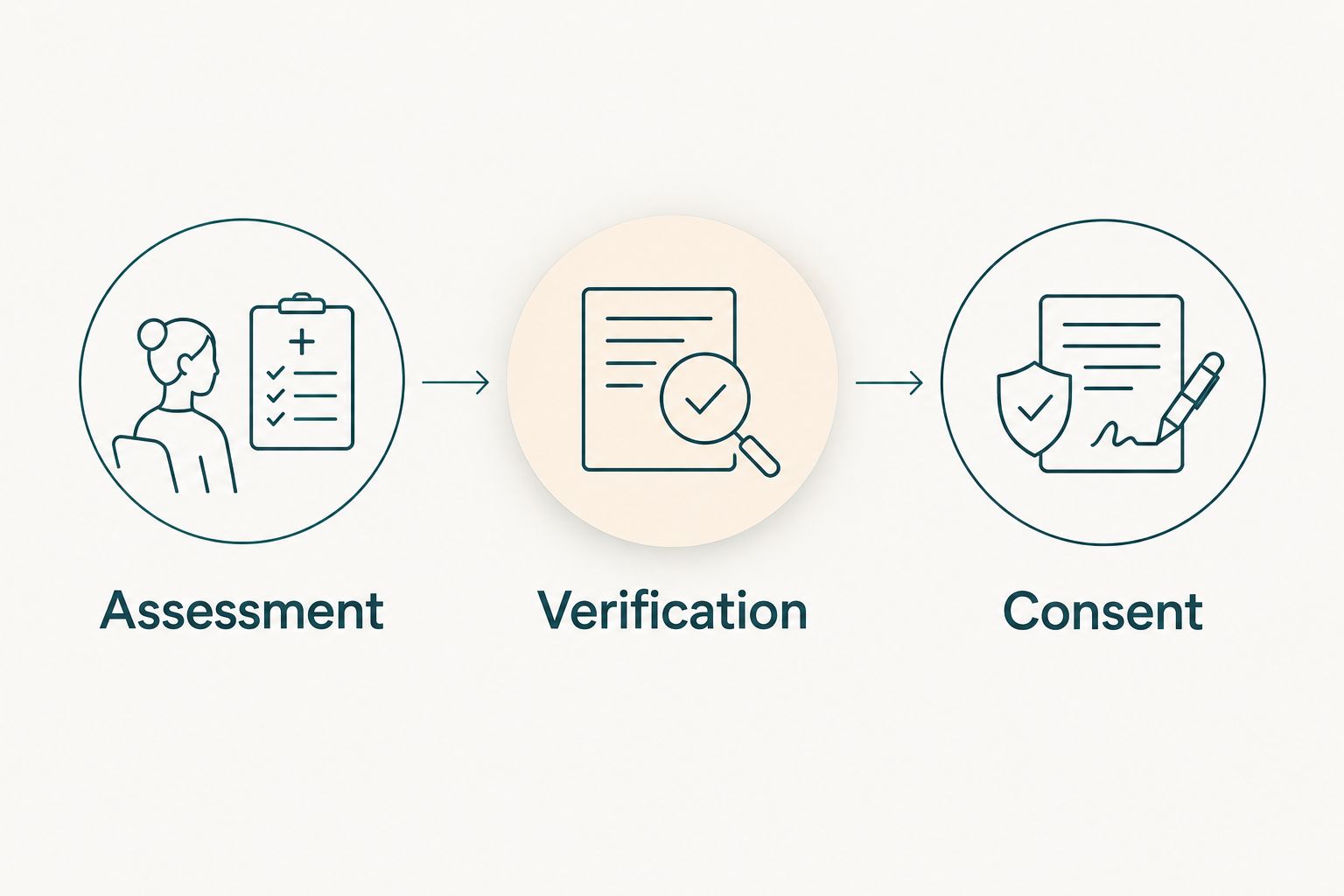
Keep these three stages distinct when comparing providers. Clear paperwork supports a clinical process; it cannot replace one.
What should happen during and after treatment?
Before any infusion starts, the administering professional should confirm your identity, prescription, allergies and the planned preparation. Ask how you will be monitored and what symptoms you should report immediately.
Pain, burning or swelling around the cannula needs prompt attention. New chest pain, breathing difficulty, fainting or marked illness requires urgent assessment—not reassurance that discomfort proves the treatment is working.
Do not accept pressure to tolerate symptoms in order to finish a session. The clinical response depends on what is happening, and the treating professional must assess it.
Afterwards, keep the treatment record and follow the instructions you receive. If you feel different, record what changed and for how long; a subjective change after treatment does not establish its cause.
How these options were ranked
This 2026 ranking puts assessment ahead of convenience and convenience ahead of an unsupported treatment promise. The criteria are clinical indication, licensing, product traceability, monitoring, consent and individual review.
The order reflects what you need to decide first. It is not a claim that named providers have been tested against one another, nor that any listed pathway guarantees a benefit from NAD treatment.
Which option should you choose?
Choose a doctor-led assessment if you are undecided. It addresses the reason you are considering a NAD IV drip and leaves room for a recommendation against treatment.
Choose a home-healthcare discussion when that setting suits your needs, while keeping the treatment decision separate. Choose an in-person consultation when examination is required; do not treat a clinic visit as an automatic commitment to an infusion.
For Dubai in 2026, the best provider is the one that explains both when to proceed and when not to.
FAQ
What's the best NAD IV drip clinic in Dubai?
Choose a provider that verifies licensing, assesses you before prescribing and explains the limits of NAD evidence. A named clinic cannot be recommended solely because it advertises NAD infusions or has an appealing treatment room.
Does DarDoc provide NAD IV drips?
DarDoc’s stated services include IV drips, but that does not confirm a specific NAD treatment. Ask directly about the preparation, prescribing process and monitoring arrangements before arranging care.
Is a NAD IV drip proven to reverse ageing?
A NAD IV drip is not an established treatment for reversing ageing. NAD’s role in cellular metabolism does not demonstrate that intravenous administration extends life or reverses age-related changes.
Should I get a NAD drip if I feel tired all the time?
Persistent tiredness needs a medical assessment before an elective infusion decision. A clinician can review symptoms, sleep, medicines and relevant medical history, then decide whether examination or testing is needed.
Is a NAD IV drip at home safer than treatment in a clinic?
Neither setting is automatically safer. Safety depends on appropriate patient selection, the preparation, qualified staff, monitoring and a suitable response to complications.
How long should a NAD IV drip take?
Ask the prescribing clinician for the duration of the specific prescribed infusion. Do not choose a provider because it promises the fastest session; administration must follow the clinical plan and your response.
What should I ask before consenting to a NAD infusion?
Ask why it is being recommended, what evidence supports the intended benefit and what will be administered. Also confirm the treating professionals, monitoring, alternatives and instructions if you become unwell.
One last thing
Ask what finding would make the clinician advise against the infusion. That question reveals more about the assessment than a list of promised benefits: an individual treatment decision must include reasons not to proceed.