In the last five years, the vocabulary of cognitive enhancement has migrated from the corners of the internet that originally produced it into mainstream UAE professional culture. "Nootropic" was once a fringe word used by Silicon Valley biohackers and a small number of academic neurologists. It is now a category that appears in DIFC dinner conversations, on the Instagram pages of clinics in Saadiyat, and in the procurement decisions of the high-functioning professional cohort that drives a meaningful slice of the UAE wellness market. Within that broader nootropic conversation, peptides have become the most-asked-about subset, partly because they have a research pedigree that pure supplement nootropics often lack, and partly because the UAE regulatory framework allows them to be prescribed where the consumer cognitive-enhancement market in many other jurisdictions is more constrained.
This article is about three peptides, Semax, Selank, and Dihexa, that come up most often in cognitive-enhancement conversations in UAE clinical practice. All three are experimental. All three have meaningful gaps in their clinical evidence bases. All three have legitimate mechanistic stories that explain why they ended up in the cognitive-enhancement vocabulary in the first place. The clinically honest version of this conversation is more nuanced than the marketing version, and that is the conversation worth having with patients who walk in asking about them by name.
What "cognitive enhancement" actually means
"Cognitive enhancement" is a vague term that obscures more than it clarifies. The brain does many cognitive things, and an intervention that supports one of them does not necessarily support the others. A useful starting point in any cognitive-peptide conversation is to be specific about what is actually being targeted.
- Attention and focus. The capacity to direct cognitive resources toward a specific task and sustain that focus over time. Different from short-term memory, different from learning, and the cognitive function most disrupted by stress, sleep deprivation and emotional dysregulation.
- Working memory. The capacity to hold and manipulate information in mind over short timescales (seconds to minutes). Working memory capacity is relatively stable across adulthood until the sixth decade, after which it declines gradually.
- Long-term memory consolidation. The biological process by which information moves from short-term to long-term storage, predominantly during sleep. Distinct from the retrieval of already-consolidated memories.
- Mental energy and stamina. The subjective sense of having cognitive resources available for work. Closely linked to sleep quality, metabolic state, mood and stress, and not reducible to any single neurochemical pathway.
- Stress resilience and emotional regulation. The capacity to maintain cognitive function under emotional or environmental pressure. Often the limiting factor in real-world cognitive performance.
- Neuroprotection and longevity. The maintenance of cognitive function across decades, against the background of age-related neurobiological decline. A different timescale and a different mechanism set than acute cognitive performance.
Different cognitive peptides target different items on this list. The clinical conversation should start by clarifying what the patient is actually trying to support, because the peptide that fits one goal may not fit another.
Semax: a Russian peptide with a specific neurological pedigree
Semax is a heptapeptide developed in the 1980s at the Institute of Molecular Genetics of the Russian Academy of Sciences. Its sequence is a fragment of adrenocorticotropic hormone (ACTH 4-7) modified with the addition of a tripeptide tail. It was initially developed as part of a broader research programme on neurotropic peptide fragments, and was approved for clinical use in Russia for indications including stroke recovery, transient ischaemic attack and certain neurological rehabilitation contexts [Asmarin et al., Russian Journal of Physiology, 1997]. Its approval status outside of the former Soviet Union is more limited, and in Western jurisdictions it remains a research compound rather than an approved drug.
The mechanistic story for Semax has several components. The peptide has been shown to influence the expression and signaling of brain-derived neurotrophic factor (BDNF), a neurotrophin involved in synaptic plasticity, learning and neuroprotection. It also has effects on dopaminergic and serotonergic neurotransmission, and a documented neuroprotective effect in animal models of cerebral ischaemia. The breadth of the mechanism is part of what has made the peptide interesting in cognitive-enhancement contexts beyond its original neurological indications.
The clinical evidence base outside of the Russian regulatory context is genuinely thin. There have been small studies in cognitive performance, attention and stress resilience, with mixed but generally favourable results [Kaplan et al., Neurochemistry International, 1996]. The Russian-language literature is more substantial than the English-language literature, but that produces a familiar problem: not all of the Russian studies have been independently replicated in Western research settings, and the regulatory standards for approval differ across jurisdictions in ways that affect how the evidence translates.
Semax is most commonly used clinically in two contexts. The first is post-stroke or post-injury cognitive rehabilitation, where its original Russian indication maps onto a clinical case that exists in any country. The second is acute cognitive performance support (periods of intense work, exam preparation, high-demand cognitive tasks), where the peptide is used in short cycles for its effects on focus and mental stamina. The two use cases have different clinical justifications and different cycling patterns. Both are off-label outside Russia.
Selank: a peptide with anti-anxiety pedigree
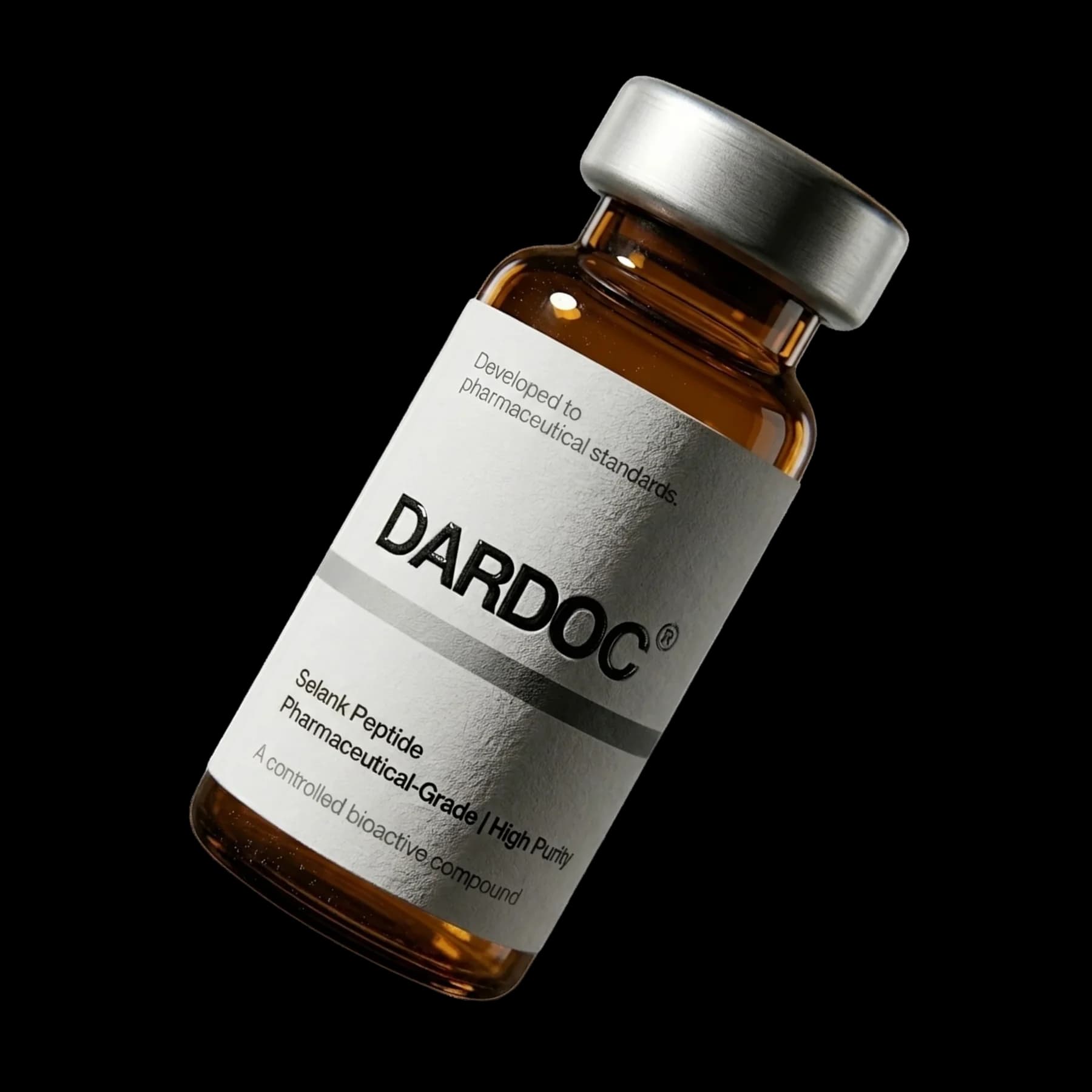
Selank is also a Russian-developed peptide, a synthetic analogue of a naturally occurring tetrapeptide called tuftsin. It was developed at the same Russian institute that produced Semax, and was approved in Russia in 2009 for the treatment of generalised anxiety disorder [Kozlovskaya and Kozlovskii, Eksperimental'naia i Klinicheskaia Farmakologiia, 2008]. Like Semax, it is not approved in Western jurisdictions and remains a compounded research peptide outside Russia.
The mechanistic story differs from Semax in important ways. Selank's primary documented action is on the GABAergic system, the brain's principal inhibitory neurotransmitter system, with effects that resemble those of benzodiazepines but without the sedation, dependence or tolerance associated with benzodiazepine use. It also has effects on serotonergic and noradrenergic neurotransmission, and there is evidence of immunomodulatory activity that is unusual for a centrally acting peptide.
In clinical use, Selank is most commonly considered for situations where mild anxiety or stress is interfering with cognitive performance. The patient archetype is typically a high-functioning professional whose work demands sustained focus under pressure, and whose primary cognitive limitation is not pure attention or memory but the capacity to maintain composure and perform under stress. Selank is not a substitute for the proper treatment of clinical anxiety disorders, and patients with significant anxiety pathology need a different conversation that includes appropriate psychiatric and psychological care.
The evidence base outside Russia is similar in shape to that for Semax: small studies, mostly Russian-language, with mixed but generally favourable results, and no Phase III trials in Western regulatory frameworks. Both Semax and Selank are sometimes prescribed together on the basis of their complementary mechanisms: Semax for the cognitive-enhancement and BDNF-related effects, Selank for the calm-focus and stress-resilience effects.
Dihexa: the most experimental of the three
Dihexa is the most recently developed and most genuinely experimental of the three peptides discussed in this article. It is a synthetic small molecule developed at Washington State University in the laboratory of Joseph Harding, derived from research on the brain's renin-angiotensin system. The compound is not strictly a peptide in the traditional sense (it is a small synthetic molecule with peptide-like properties) but it is conventionally grouped with peptides in the cognitive-enhancement market because of its mechanism and its administration profile.
The mechanistic story is interesting and explains why Dihexa has accumulated the attention it has. The compound has been shown in preclinical work to potentiate hepatocyte growth factor (HGF) signaling in the brain, which in turn drives synaptogenesis, the formation of new synaptic connections between neurons. The reported effect on synaptogenesis is, in animal models, substantial: orders of magnitude greater than the effect of BDNF on the same parameter, on the basis of the published preclinical work. This is the basis of the dramatic claims that have been made for Dihexa in cognitive-enhancement marketing.
The honest qualifier is that the human evidence is essentially absent. There has been no significant human clinical trial of Dihexa for any cognitive indication. The animal model data is interesting and the mechanism is real, but the translation from rodent synaptogenesis to human cognitive performance is exactly the gap where many promising preclinical findings have failed to deliver in the past. The compound is also relatively new, with limited safety data, and its long-term effects in humans are unknown. Of the three peptides discussed in this article, Dihexa has the most exciting mechanism, the most aggressive marketing, and the thinnest clinical evidence base. Both of the first two facts should be moderated by the third.
In clinical practice in the UAE, Dihexa comes up most often in conversations with patients who have read about it in cognitive-enhancement contexts and want to try it. The clinically honest version of that conversation acknowledges the interesting mechanism, acknowledges the substantial preclinical signal, and is explicit that the human evidence is genuinely absent. It also typically includes a discussion of whether other interventions (including the better-evidenced cognitive peptides, sleep optimisation, exercise, and nutrition) have been adequately addressed before considering an experimental compound.
Speak to a DarDoc physician
How the three peptides are used clinically
All three peptides are typically administered in short cycles rather than continuously. The cycling patterns differ by peptide and by indication.
- Routes of administration. Semax and Selank are most commonly administered as intranasal sprays, with subcutaneous injection being a less common alternative. The intranasal route has practical advantages for patients (no needles, easy self-administration, faster onset of effect) and is the route used in most of the underlying research. Dihexa is most commonly administered orally as a capsule, although it is also available in some other formats.
- Cycle length. Semax cycles are typically two to four weeks for acute cognitive-performance indications, sometimes extended in post-stroke or rehabilitation contexts under specialist supervision. Selank cycles are similar in length. Dihexa, due to its experimental status, is typically prescribed in shorter trial cycles to assess tolerance and response before any extension.
- Combination protocols. Semax and Selank are sometimes combined on the basis of their complementary mechanisms: Semax for cognitive enhancement, Selank for stress resilience. The combination is mechanistically reasonable but has not been formally studied in trials, and the evidence is empirical.
- Monitoring. None of these peptides typically requires laboratory monitoring during use, but all three benefit from clinical follow-up to assess subjective response, tolerance and any unexpected effects. A patient on a cognitive peptide protocol should expect a mid-cycle and end-cycle review with the prescribing clinician.
Side effects and safety
All three peptides have relatively modest side-effect profiles in the available literature, though the literature itself is thinner than for many better-studied peptides.
- Semax. Most commonly reported issues are mild local irritation with intranasal use and occasional headaches. Serious adverse events have not been documented at typical clinical doses in the available studies.
- Selank. Similar profile to Semax, with the addition of occasional reports of fatigue or sedation in some patients, particularly at higher doses. The sedation tends to be mild and dose-related.
- Dihexa. Limited safety data, which is the most important caveat for this compound. The available animal and limited human data suggest a generally tolerable profile in short-term use, but long-term safety is genuinely unknown. The angiogenic and growth-factor-related mechanisms raise theoretical concerns in patients with malignancy history that warrant explicit discussion before any prescription.
The honest caveats apply to all three peptides. None has long-term human safety data at five or ten years of cumulative use. None has been studied in pregnancy or breastfeeding, and all are contraindicated in those contexts. Patients with significant psychiatric pathology (major depression, anxiety disorders, psychotic disorders) should not be using cognitive peptides as a substitute for proper psychiatric care. Patients with active or recent malignancy warrant particularly careful evaluation, particularly for Dihexa given its growth-factor-related mechanism.
The MOHAP, DHA and DoH regulatory reality
None of the three peptides discussed here is FDA-approved. The FDA's compounding guidance covers Semax and Selank in the broader category of compounded peptides outside the bulk substances list [FDA Guidance on Compounded Peptides, 2023]. Dihexa sits in a slightly different regulatory space due to its small-molecule rather than peptide structure, but the practical regulatory situation is similar.
In the UAE, all three peptides sit in the compounded category. A licensed clinic working with a licensed UAE compounding pharmacy can, in principle, prescribe and dispense them for off-label use after a documented physician consultation. The same regulatory framework applies as for every other compounded peptide protocol in this country: licensed clinic, licensed compounding pharmacy, documented physician prescription, cold-chain delivery.
What cognitive peptides do not fix
The most important section of any cognitive-peptide article is the one that names what these peptides do not address. The cognitive-enhancement conversation is particularly susceptible to peptide-as-shortcut thinking, and the consequences of skipping the foundation are usually that the peptide does not work and the patient blames the wrong factor.
- Sleep deprivation. The single largest determinant of cognitive performance in healthy adults is sleep, and no peptide will substitute for adequate sleep duration and quality. A patient sleeping six hours a night has a cognitive deficit that no Semax cycle will compensate for. The first cognitive intervention is always sleep, and if sleep is the problem, the relevant peptide conversation is about sleep peptides, not cognitive peptides.
- Untreated mood disorder. Depression and anxiety produce significant cognitive deficits, and the cognitive symptoms typically improve when the mood disorder is treated. A patient whose primary cognitive complaint sits inside a broader picture of depression or anxiety needs the broader picture addressed before, or alongside, any cognitive peptide protocol.
- Chronic stress and burnout. High-functioning professionals who have been working unsustainably for months or years often present looking for cognitive enhancement when the actual problem is sustained stress that has overwhelmed their cognitive reserves. No peptide is a substitute for actually rebalancing workload, recovery and life structure. Selank may help at the margins. It does not solve the underlying problem.
- Substance use. Alcohol, particularly the volume of alcohol that the UAE professional culture sometimes normalises, has substantial effects on cognitive function that no peptide will compensate for. Caffeine, in patterns of severe overconsumption, has its own effects. Honest conversations about substance use are an essential part of the cognitive performance conversation.
- Untreated medical conditions. Hypothyroidism, vitamin B12 deficiency, sleep apnoea, anaemia and several other medical conditions cause cognitive symptoms that are reversible with appropriate treatment. A baseline medical evaluation is the first step before any cognitive peptide conversation, and a patient whose cognitive issues turn out to have an underlying medical cause needs that cause treated, not a peptide protocol.
The clinically honest version of the cognitive peptide conversation is that these compounds are a small layer on top of a much bigger picture of sleep, mood, stress, substance use and underlying medical health. A patient who has the foundation in place may benefit from a peptide protocol at the margins. A patient who has not done the foundation work first will not get the most out of one, regardless of which peptide is chosen.
Who cognitive peptides are, and aren't, for
A reasonable case for considering cognitive peptide therapy looks like this. An adult patient with a specific cognitive-performance goal (sustained-focus work over a defined high-demand period, support during a cognitive rehabilitation context under specialist supervision, or a specific stress-resilience indication) who has the foundational layer in place: adequate sleep, no untreated mood disorder, reasonable stress management, no relevant substance use issues, no untreated medical condition that explains the cognitive symptoms. The patient has realistic expectations about what a cognitive peptide can deliver, has informed consent that the evidence base is small-trial-based and the protocol is off-label, and is using the peptide as a layer on top of the foundation rather than as a substitute for it.
An unreasonable case looks like this. A patient with significant untreated mood or anxiety disorder who needs proper psychiatric care first. A patient with chronic sleep deprivation who needs to fix their sleep first. A patient looking for a peptide as a substitute for rebalancing life structure or addressing burnout. A patient with active or recent malignancy. A patient who is pregnant, breastfeeding, or under eighteen. A patient who wants Dihexa specifically without a clear understanding of how thin the human evidence base actually is.
The bottom line
Semax, Selank and Dihexa are three compounded peptides that come up most often in cognitive-enhancement conversations in UAE clinical practice. All three have legitimate mechanistic stories. All three have clinical evidence bases that are best characterised as small, mixed and mostly outside the Western regulatory frame. Semax has the broadest neurological pedigree and the most use in cognitive rehabilitation contexts. Selank has the most specific stress-resilience and anxiolytic profile. Dihexa has the most exciting preclinical mechanism and the thinnest human evidence base of the three.
All three are reasonable to consider for the right patient, with the right specific cognitive goal, with the foundational layer of sleep, mood, stress and medical health in place, with a licensed physician, a licensed compounding pharmacy, cold-chain integrity, a defined cycle and review point, and explicit informed consent that the evidence base is small-trial-based and the protocol is off-label. None is reasonable as a substitute for sleep, for proper psychiatric care, for life restructuring, or for the appropriate medical workup of cognitive symptoms.
If you are thinking about cognitive peptides for a specific goal, the first conversation is not about the peptides. It is about what is actually limiting your cognitive performance, what alternatives have been considered, and whether the foundation is in place that any peptide protocol can build on. Those conversations belong with a DHA-, DoH-, or MOHAP-licensed clinician who knows the literature, the regulatory frame and your medical history. This article is educational. It is not medical advice for your specific situation.