Does insurance cover at-home IV drip therapy in Dubai?
Does insurance cover at-home IV drip therapy? Not automatically. Check medical necessity, home-care benefits and written approval before booking in Dubai.

Insurance does not automatically cover at-home IV drip therapy in Dubai: payment depends on your policy, the medical reason for treatment, the provider and whether home administration is included. A prescription alone does not establish coverage, and approval for the infusion does not necessarily include the consultation, nursing visit or other charges.
TL;DR- Does insurance cover at-home IV drip therapy? Only when your policy covers the treatment and its home administration.
- DarDoc offers at-home IV care in the UAE; confirm insurance eligibility separately before booking.
- Check medical necessity, provider eligibility and prior approval rather than relying on a prescription alone.
- Direct billing and reimbursement are different payment routes; neither establishes that a treatment is covered.
Why this matters
An IV booking involves two separate decisions: whether the treatment is clinically appropriate and whether your insurer will pay. Keep those decisions separate. Insurance approval is not a clinical recommendation, and a clinician's recommendation is not an insurer's payment commitment.
For a Dubai appointment in 2026, check the policy documents that apply on your treatment date, not an old benefits summary. Before arranging treatment, read the at-home IV drip therapy safety guide alongside your coverage checks.
Does insurance cover at-home IV drip therapy in Dubai?
Coverage is policy-specific, not a standard feature of every at-home IV booking. Your insurer needs to assess the actual treatment, its indication and the proposed care setting against your benefits and exclusions.
Describe the service precisely. An infusion prescribed for a documented condition and a drip requested for general wellness are different requests; do not assume an answer about one applies to the other.
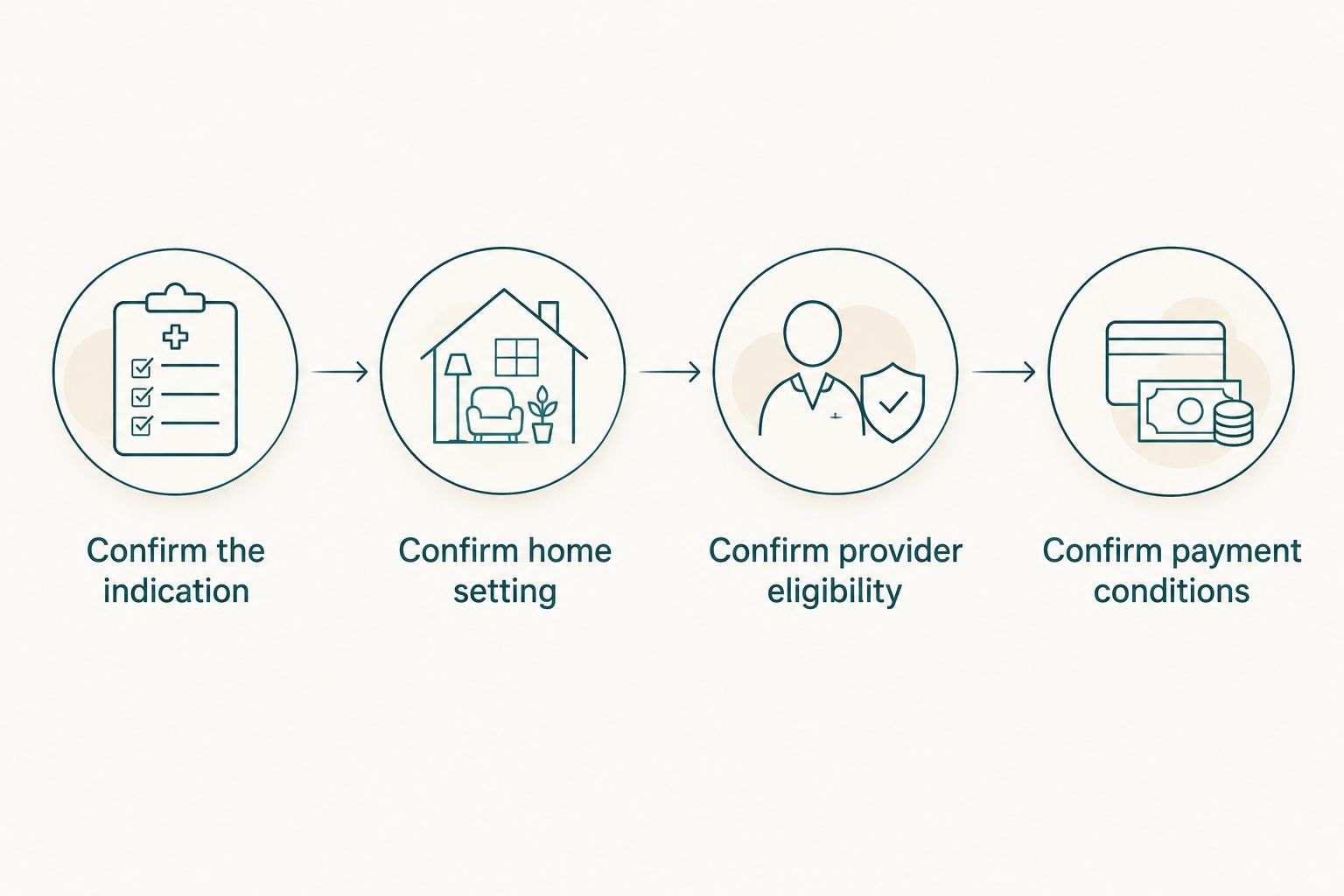
Use these 4 checks before you commit to an appointment:
- Confirm the indication. Ask the prescribing clinician to explain the diagnosis, the proposed infusion and why IV administration is appropriate.
- Confirm the home setting. Ask the insurer whether your benefit includes administering that treatment at your Dubai address.
- Confirm provider eligibility. Give the insurer the provider's legal billing name, not just its trading name or booking platform.
- Confirm payment conditions. Establish whether prior approval is required, which charges are included and how any patient contribution is calculated.
Ask for a written response tied to your policy and proposed treatment. A general telephone answer about IV therapy leaves too much unresolved: it does not identify the infusion, provider, location or billing items being assessed.
Medical treatment versus an elective wellness drip
The reason for treatment belongs at the start of the insurance discussion. Give the insurer the clinician's assessment rather than relying on a package name such as hydration, recovery or wellness.
A documented medical indication supports an assessment of medical necessity; it does not override exclusions or benefit limits. Equally, feeling tired or wanting hydration does not by itself establish that an infusion is medically necessary.
Ask your clinician whether oral treatment, observation or assessment in a healthcare facility is more appropriate. Do not choose an IV simply because you believe insurance will pay for it. The route of administration needs a clinical reason, independent of the billing route.
For a wellness-focused booking in 2026, ask explicitly whether the policy excludes the proposed purpose or ingredients. Do not interpret a general outpatient benefit as confirmation that every elective infusion is included.
Direct billing versus reimbursement
Direct billing describes who submits the bill; reimbursement describes a claim you submit after paying. Neither term tells you whether your specific treatment is an eligible benefit.
| Payment route | Best for | Practical advantage | Limitation to check |
|---|---|---|---|
| Direct billing | Patients whose insurer confirms an eligible provider and service | The provider submits eligible charges to the insurer | Patient contributions, exclusions and approval conditions still apply |
| Reimbursement | Patients whose policy permits claims after payment | You submit the required records after the appointment | Paying first does not guarantee the claim will be accepted |
| Self-payment | Patients proceeding without insurance payment | The appointment does not depend on an insurer paying the bill | You remain responsible for the agreed charges |
Ask the provider whether direct billing applies to this infusion under your plan, not whether it accepts insurance generally. A provider's participation in one network does not establish eligibility under every policy issued by the same insurer.
If reimbursement is the proposed route, obtain the insurer's document checklist before treatment. Keep the original records in the format requested and check the submission deadline in your current policy.
What does prior approval actually confirm?
Read an approval as a specific authorisation, not an open-ended promise. Check the patient name, provider, authorised treatment, care setting and applicable conditions against the appointment you intend to book.
Ask whether the authorisation includes all planned visits or only the initial treatment. If the prescription, ingredients, provider or location changes, ask whether the existing approval still applies before proceeding.
For a 2026 claim, retain the approval reference and the written terms issued with it. A reference number helps identify the decision, but the wording explains what was assessed and what remains your responsibility.
Do not treat a provider's statement that a request has been submitted as confirmation that the insurer has approved it. Submission, approval and final claim payment are separate stages. Ask which stage your booking has reached.
Why insurance coverage varies
These 5 factors explain what you need to verify. They are questions for your own policy, not promises about a particular Dubai insurer.
- Treatment purpose: Ask whether the documented indication falls within covered treatment or an exclusion.
- Care setting: Confirm that home administration is included; an answer about clinic treatment does not settle home-care eligibility.
- Provider eligibility: Check the legal billing entity and applicable network against your plan.
- Authorisation requirements: Establish whether approval is required before the appointment and which documents support the request.
- Benefit conditions: Check patient contributions, remaining benefits, exclusions and any limits relevant to the proposed service.
Employer-provided cover also needs an individual check. Use your own membership details and current benefits schedule rather than a colleague's experience, even when you share an employer or insurer.
If an answer is unclear, ask the insurer to identify the relevant policy clause. That gives you something specific to discuss with the provider instead of passing conflicting verbal messages between booking and claims teams.
Which charges should you ask the insurer to assess?
Ask for an itemised treatment proposal before seeking confirmation. An advertised appointment description does not tell you how each component will be billed or assessed.
Request clarification on the consultation, prescribed infusion, administration, home nursing attendance, consumables and any proposed tests. These are items to ask about, not a statement that every booking includes every item.
Then ask the insurer which proposed components are eligible and which remain payable by you. If the answer refers only to the medication, follow up about administration and home attendance rather than assuming they are included.
For repeat treatment, clarify whether the approval applies to the whole prescribed course or requires further assessment. Do not purchase a course on the assumption that an initial approval automatically covers later appointments.
What should you send before booking?
Prepare 3 record groups: your policy details, the clinical request and the provider's billing information. These help the insurer identify what you are asking it to assess; use its own checklist for the final submission requirements.
- Policy details: Your membership information, current benefits schedule and relevant exclusions.
- Clinical request: The clinician's assessment, prescription and supporting records requested by the insurer.
- Billing information: The provider's legal name, itemised proposal and proposed treatment location.
For a planned appointment in 2026, use a message such as:
Please confirm whether my policy covers the prescribed infusion administered at home in Dubai by the named provider. Please specify prior-approval requirements, eligible billing items, patient contributions and whether direct billing or reimbursement applies.
Keep the response with your appointment records. If the insurer needs more information, ask the provider for the specific document requested rather than resending the same incomplete submission.
Where DarDoc fits
DarDoc's at-home healthcare is best for UAE families seeking care delivered at home. Its services include IV drips, nursing and online healthcare; insurance eligibility still needs a separate check for the proposed treatment.
When discussing care with DarDoc, ask for the clinical assessment and billing information needed for your insurer's review. Do not interpret an available home service as confirmation of network participation, direct billing or reimbursement.
Home care offers the practical benefit of receiving an appropriate service without attending a clinic. Its limitation is that the home setting must suit both the clinical situation and any applicable insurance conditions; convenience cannot settle either question.
What if the insurer declines the request?
Start with the written reason. A missing document calls for a different response from an excluded benefit, an ineligible provider or a decision that the proposed treatment is not medically necessary.
Ask the insurer which review or complaint process applies and what supporting information it requires. If the issue concerns clinical justification, ask the treating clinician to address the specific reason given; do not change the description to disguise an elective treatment as something else.
If the treatment is clinically necessary, discuss suitable alternatives with your clinician while the payment issue is resolved. Do not delay urgent assessment while waiting for routine insurance clarification.
Can I use clinic approval for a home infusion?
Clinic approval does not establish home-infusion coverage. Ask the insurer to confirm the home setting and named provider before changing where the treatment will take place.
If you already have written approval, send the proposed change for review. Do not rely on the fact that the prescribed medication remains the same.
Is a doctor's prescription enough for insurance approval?
A doctor's prescription is not an insurance approval. It records the treatment prescribed, while the insurer assesses payment against policy terms and any required clinical documentation.
Ask the clinician for the information the insurer specifically requests. A longer medical report is not automatically more useful than a clear answer to the insurer's stated question.
FAQ
Does insurance cover at-home IV drip therapy in Dubai in 2026?
Coverage depends on your current policy, the medical indication, the provider and whether home administration is included. Obtain written confirmation for the proposed treatment rather than assuming all IV therapy is covered.
Will insurance pay for a wellness or hydration drip?
Do not assume a wellness or hydration drip is covered. Ask the insurer to assess its purpose, ingredients and clinical documentation against your benefits and exclusions.
Can I claim back an IV drip after paying for it?
You can seek reimbursement only under the claim provisions of your policy; payment upfront does not establish eligibility. Check the required documents, submission deadline and any prior-approval conditions before booking.
Does direct billing mean I will pay nothing?
Direct billing does not mean you have no patient contribution. Ask which charges are eligible and whether deductibles, co-payments or excluded items remain payable by you.
Does a prescription guarantee that my infusion will be covered?
A prescription does not guarantee insurance coverage. The insurer still assesses the treatment against your policy and any authorisation requirements.
Does DarDoc providing home IV therapy mean my insurer covers it?
DarDoc providing at-home IV care does not establish coverage under your policy. Confirm provider eligibility, the proposed treatment and the home setting with your insurer before booking.
What should I do if my at-home IV claim is rejected?
Request the written rejection reason and the insurer's review procedure. Address the specific issue with the provider or prescribing clinician, and retain the relevant approval and treatment records.
One last thing
Ask whether the home setting is covered even after the infusion itself is approved. That single follow-up separates a treatment decision from a location decision and helps expose gaps in a general answer.
For your 2026 booking, keep the clinical plan, written insurance response and itemised proposal together. The strongest confirmation describes the same treatment, provider and setting you actually intend to use.