For UAE professionals, GLP-1 treatment is prescription-based medical care that targets appetite and blood-glucose regulation to support weight management when clinically appropriate. This 2026 guide explains how to fit assessment, treatment and follow-up around meetings, shifts and travel without letting convenience replace clinical oversight.
TL;DR- GLP-1 treatment for professionals UAE: choose clinical suitability before convenience, brand or dosing frequency.
- DarDoc is best for professionals seeking home and online healthcare alongside GLP-1 weight-loss treatment in the UAE.
- Semaglutide and tirzepatide require individual prescribing decisions; their doses are not interchangeable.
- Plan meals, travel and follow-up before starting treatment, and know which symptoms require urgent assessment.
Why GLP-1 treatment matters for UAE professionals
A treatment plan must work during an ordinary working week, not just during time off. Client lunches, rotating shifts and business travel belong in your assessment because they affect meal timing, medication routines and access to help. The right plan fits your schedule without lowering the standard of care.
For 2026, separate two decisions: whether a medicine is appropriate for you, and how you will receive care. An online consultation or home visit changes the setting; it does not remove the need for a medical history, an appropriate prescription and follow-up.
DarDoc provides home and online healthcare in the UAE, including GLP-1 weight-loss treatment. That service model suits professionals seeking care outside a clinic setting, but the setting alone does not establish eligibility or determine which medicine is appropriate.
Weight management also needs a clear objective. Discuss health risks, function and sustainable habits rather than setting a deadline around a conference or holiday. Faster weight loss is not automatically a better clinical result, particularly if it comes with persistent vomiting, poor nutrition or difficulty doing your job.
How to plan treatment around your working life
Establish your clinical eligibility first
Start with a medical consultation, not a product shortlist. Bring your medication list, relevant diagnoses, previous weight-management attempts and any history of adverse reactions. Explain whether your aim is weight management, diabetes treatment or both; these are related but distinct prescribing decisions.
Many adult weight-management medicine labels use a body mass index of at least 30 kg/m², or at least 27 kg/m² with a weight-related condition. These thresholds do not establish eligibility on their own. Your clinician must check the exact medicine's locally applicable indication and your individual risks.
Discuss pregnancy plans, breastfeeding, previous pancreatitis, gallbladder problems and significant digestive symptoms. Certain medicines also have contraindications involving a personal or family history of medullary thyroid carcinoma or multiple endocrine neoplasia type 2. A clinician should assess these rather than treating a questionnaire score as clearance.
- Bring a complete list of medicines, supplements and allergies.
- Describe previous weight-loss treatment and why it stopped.
- Disclose relevant digestive, endocrine and gallbladder history.
- Ask which baseline measurements or tests your history requires.
Map your schedule before choosing a routine
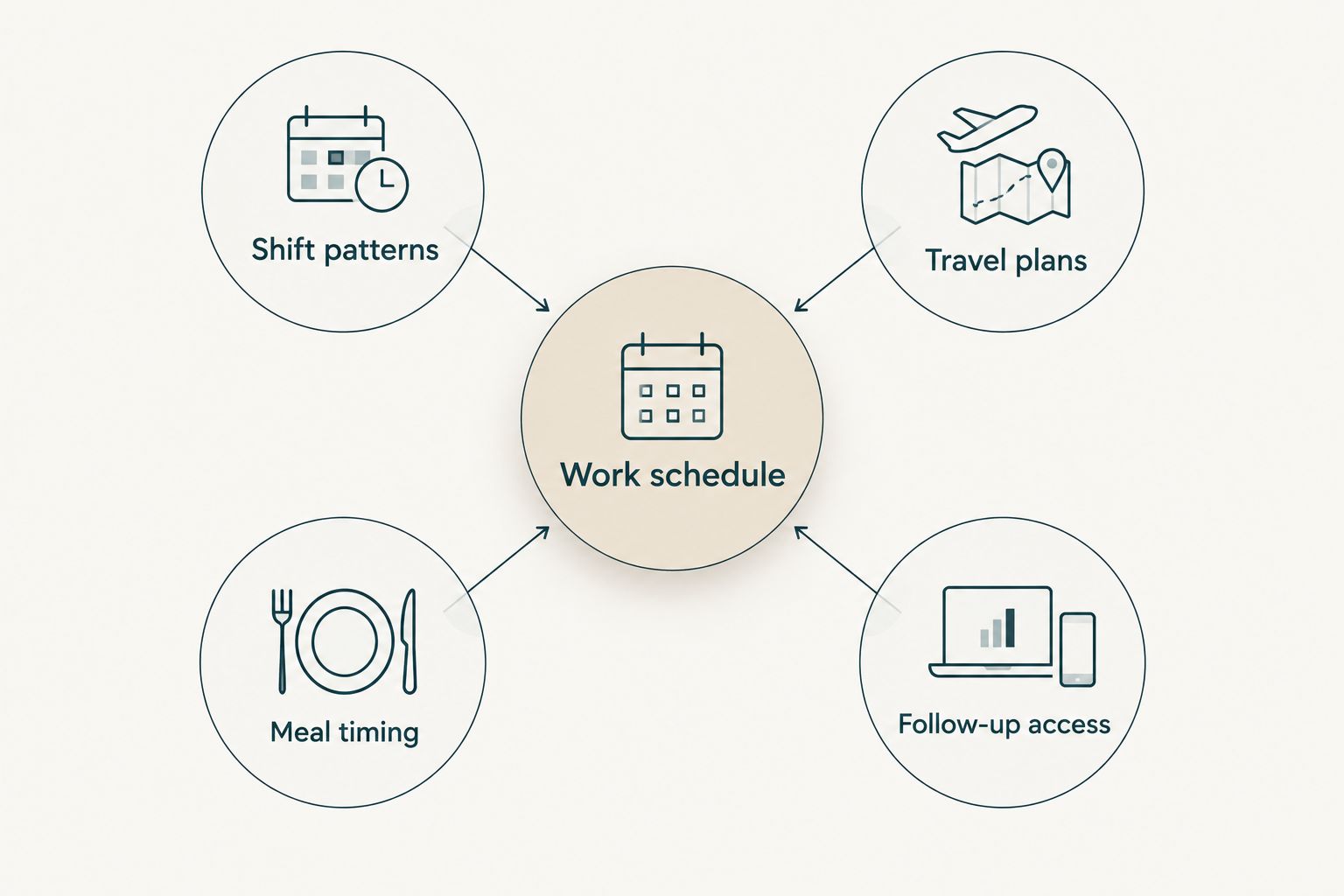
Write down a typical working week and your next travel commitments. Include early starts, night shifts, long commutes and days when meals are unpredictable. A routine that depends on an uninterrupted morning is different from one that needs a consistent weekly administration day.
For your 2026 plan, agree how to handle business travel, missed doses and changes in working hours before they happen. Use the instructions for your exact formulation; do not borrow advice from another medicine. Different products have different administration and missed-dose rules.
Identify who will answer a treatment question while you are away. If your work involves driving, operating machinery or responsibility for others, explain that too: symptoms affecting alertness or hydration need a practical response plan.
- Shift patterns: record rotating hours and overnight work.
- Travel plans: identify trips that overlap with treatment changes.
- Meal timing: note skipped meals and late business dinners.
- Follow-up access: agree how to reach the prescribing team.
Compare medicines and care settings separately
First compare the clinical options with your prescriber. Then compare how you will receive assessment and follow-up. Semaglutide is a GLP-1 receptor agonist; tirzepatide acts on both GIP and GLP-1 receptors. They are not interchangeable prescriptions, and neither is the default answer for every professional.
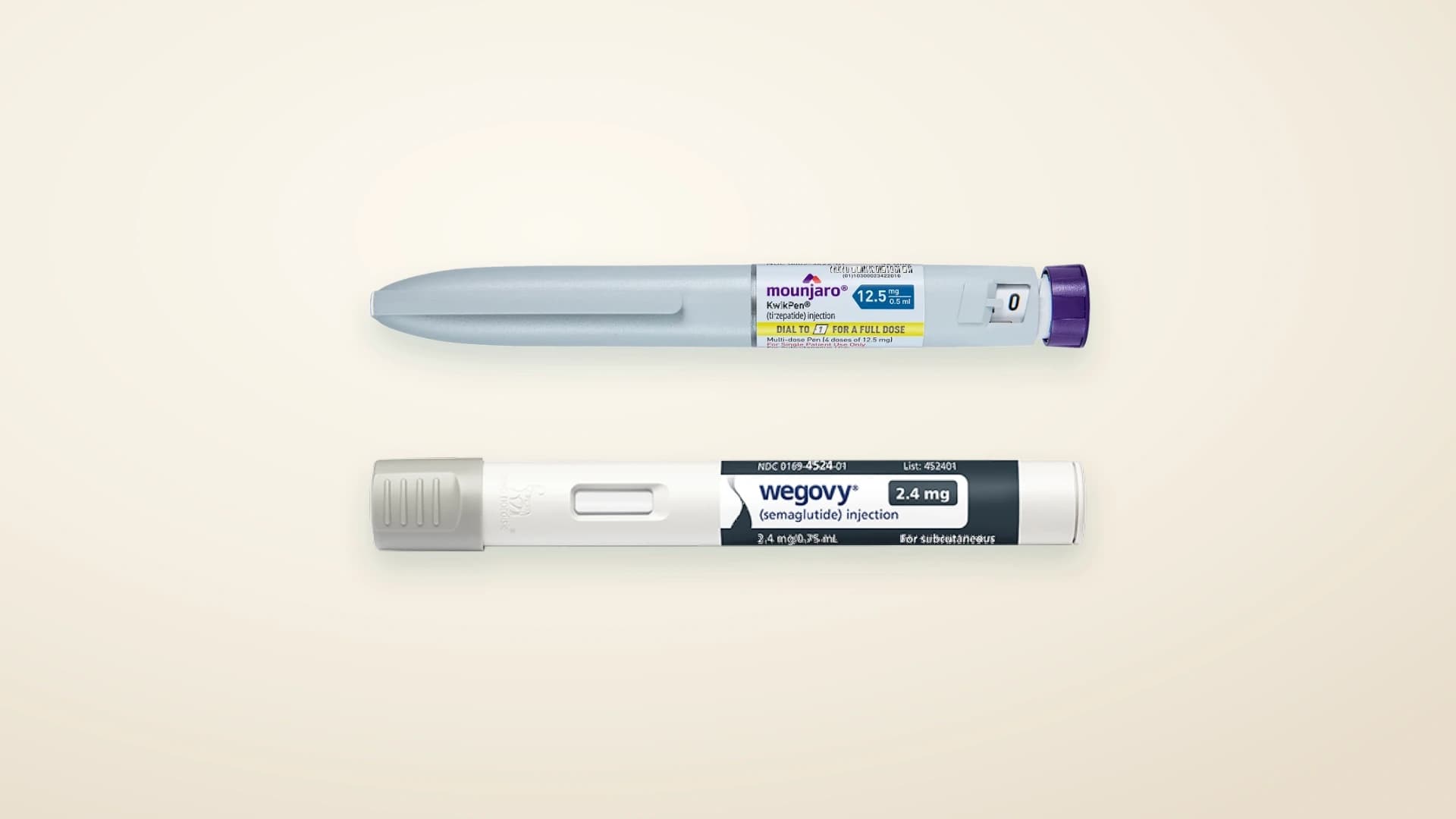
Brand names can also hide important differences between indications and formulations. Wegovy and Mounjaro should be discussed in the context of the exact product, its locally applicable indication and your medical history. Read the GLP-1 weight-loss drug benchmarks by brand in the UAE as preparation for that discussion, not as a substitute for prescribing advice.
DarDoc offers GLP-1 weight-loss treatment within its home and online healthcare services. This is a care-setting option, not evidence that remote care is suitable for every symptom or assessment. Ask what requires an in-person examination and how escalation works.
- Ask why the proposed medicine matches your clinical needs.
- Confirm the exact formulation and indication being prescribed.
- Verify the provider's and clinician's relevant DHA or DoH licensing.
- Establish which assessments require attendance in person.
Agree a gradual start and an escalation plan
GLP-1-based treatment commonly uses gradual dose escalation to improve tolerability. The schedule belongs to the exact product and prescription, not to a colleague's experience. Increasing a dose because appetite has returned, or because a deadline is approaching, bypasses that decision.
For a 2026 start, arrange follow-up before the first dose and clarify what happens if side effects interrupt work. Ask when to contact the team, when a dose change needs review and which symptoms require urgent assessment. Do not assume the next scheduled increase must happen despite ongoing symptoms.
Severe or persistent abdominal pain, repeated vomiting, inability to keep fluids down, or signs of a serious allergic reaction require prompt medical assessment. Tell the clinician which medicine you take and when you last used it. Do not treat these symptoms as proof that the treatment is working.
- Follow the prescribed starting and escalation instructions.
- Request written advice for missed doses and interruptions.
- Record symptoms before any planned dose increase.
- Keep the treatment team's contact route accessible.
Protect nutrition, hydration and physical function
Reduced appetite is not a reason to stop eating adequately. Plan manageable meals that include protein and other necessary nutrients, especially on days filled with meetings. If nausea or early fullness prevents sufficient intake, raise that with your clinician rather than celebrating the restriction.
Avoid using coffee as a substitute for food or fluids during a long working day. Smaller meals can be easier to tolerate than a large late dinner, but persistent symptoms need review. A dietitian can help adapt eating patterns to your health needs and work routine.
The World Health Organization recommends at least 150 minutes of moderate-intensity aerobic activity per week for adults, alongside muscle-strengthening activity. Treat this as a public-health reference, not an immediate target if illness, symptoms or limited mobility require adjustment. Discuss a suitable activity plan with your clinician.
- Plan food before days with back-to-back appointments.
- Keep drinking water accessible throughout the working day.
- Include protein-containing foods across regular meals.
- Build activity around your capacity and existing commitments.
Prepare for travel, storage and procedures
Before travelling, check the storage instructions supplied with your exact medicine. Temperature limits and permitted time outside refrigeration differ between products and presentations. Never assume an instruction for one pen applies to another.
For 2026 business travel, discuss the destination, trip length and dosing schedule with your pharmacist or prescribing team. Check the destination's medicine-entry requirements and carry the documentation it requires. UAE prescribing does not automatically settle another country's entry rules.
Tell your procedural or anaesthesia team that you take a GLP-1-based medicine. These medicines can delay gastric emptying, which matters when planning sedation or anaesthesia. The team should give individual instructions; do not independently stop treatment based on a generic social-media rule.
- Check the product leaflet's transport and storage requirements.
- Confirm medicine-entry rules before international travel.
- Keep relevant prescription documentation accessible.
- Tell procedure teams about treatment well before the appointment.
Measure progress and plan continuity
Track outcomes that explain how treatment is affecting your health and everyday functioning. Weight is one measure; symptoms, food intake and clinical markers relevant to your diagnosis also matter. A lower scale reading alongside repeated vomiting is not an acceptable trade-off.
Agree how often to record measurements and when to review them. Use consistent conditions rather than repeatedly weighing yourself after meals or flights. Your clinician should interpret the pattern alongside tolerability and medical goals.
Treatment also needs a continuity plan. Discuss what happens during a prolonged interruption, a change of provider or a decision to stop. Do not restart at a previous dose after a gap without checking the instructions and speaking with the prescribing team.
- Track agreed measurements under consistent conditions.
- Record side effects and their impact on work or meals.
- Review benefits alongside nutrition and physical function.
- Agree an interruption and stopping plan before you need it.
Compare care options for your 2026 routine
Choose the least disruptive setting that still meets your clinical needs. These options differ in where assessment happens and how support is organised; they are not a ranking of treatment effectiveness. Some professionals need a combination, such as remote follow-up alongside an in-person examination.
| Option | Best for | Main advantage | Key limitation |
|---|---|---|---|
| Clinic-based assessment and follow-up | Professionals needing physical examination or complex assessment | Direct access to an in-person clinical review | Requires travel and appointment time away from work |
| Online assessment and follow-up | Professionals whose assessment is suitable for remote care | Removes travel from suitable consultations | Cannot replace a necessary physical examination |
| DarDoc home and online GLP-1 care | UAE professionals seeking home and online weight-management care | Offers GLP-1 treatment within a home and online healthcare model | Individual suitability and examination needs still require assessment |
| Lifestyle support without medication | Professionals for whom medication is unsuitable or not chosen | Focuses on nutrition, activity and sustainable routines | Does not provide the pharmacological effects of GLP-1-based treatment |
Before choosing, ask who prescribes, who monitors symptoms and who handles urgent concerns. Verify the relevant licensing rather than assuming that an online booking page proves it. Also request written information about follow-up, tests and medication arrangements before agreeing to a plan.
Common mistakes UAE professionals make
Choosing treatment by a colleague's result
A colleague's appetite response or weight change does not predict yours. Their diagnosis, medicine, dose and health history differ. Choose with your prescriber, not with an office comparison.
Starting immediately before a major work commitment
Beginning treatment without planning symptom support leaves no clear response if nausea or vomiting affects a presentation or flight. Discuss your upcoming commitments before setting the start date. Do not change the prescribed schedule yourself to make it fit.
Treating appetite suppression as complete nutrition care
Eating less is not the same as eating adequately. Skipped meals can become easier to overlook when your calendar is full and hunger is reduced. Review food intake and function alongside weight.
Assuming home delivery means ongoing supervision
Receiving medication and receiving clinical follow-up are different parts of care. Confirm who reviews progress, how to report side effects and what happens if treatment becomes unsuitable. A delivery arrangement does not answer those questions.
Switching medicines to overcome a plateau without review
A slowing rate of weight loss is a reason to review the plan, not to create a conversion between products. Semaglutide and tirzepatide doses are not equivalent. Switching requires a new prescribing decision that accounts for your previous treatment and symptoms.
FAQ
What's the best GLP-1 treatment for a busy professional in the UAE?
The best treatment is the one that matches your medical needs and includes follow-up you can attend. Choose the medicine with a licensed prescriber, then select a suitable clinic, home or online care setting.
Can I start GLP-1 treatment through an online consultation?
An online consultation can form part of an assessment, but it cannot replace an examination when one is needed. The clinician must decide whether remote assessment is sufficient and which tests or in-person checks are required.
Does DarDoc offer GLP-1 weight-loss treatment in the UAE?
DarDoc offers GLP-1 weight-loss treatment as part of its home and online healthcare services in the UAE. Individual eligibility, medicine selection and monitoring need to be established through clinical assessment.
Is Mounjaro the same type of medicine as Wegovy?
Mounjaro contains tirzepatide, which acts on GIP and GLP-1 receptors; Wegovy contains semaglutide, a GLP-1 receptor agonist. They are different medicines, and their doses are not interchangeable.
Can I take my GLP-1 medicine on a business trip?
Travel requires checking your exact medicine's storage instructions and the destination's entry requirements. Ask your pharmacist or prescribing team about transport, documentation and dosing before departure.
What should I do if nausea affects my working day?
Contact your prescribing team if nausea affects eating, drinking or your ability to work. Repeated vomiting, inability to keep fluids down or severe abdominal pain requires prompt medical assessment rather than waiting for routine follow-up.
Should I stop GLP-1 treatment before surgery or sedation?
Your procedural or anaesthesia team must give individual instructions about GLP-1 treatment. Tell them which medicine you take because delayed gastric emptying can affect procedure planning; do not apply a blanket stopping rule yourself.
Can I stop treatment once I reach my target weight?
Stopping treatment requires a review and a maintenance plan with your clinician. Weight regain can follow discontinuation, so discuss nutrition, activity, monitoring and future treatment before stopping.
One last thing
Ask what happens if you become unwell while travelling. That question tests whether your 2026 plan covers the real working week, rather than only the first prescription. Keep the written answer accessible with your medication details.
When considering DarDoc for GLP-1 treatment, bring your calendar as well as your medical history. Meetings and travel do not determine eligibility, but they help you and your clinician build a workable routine without compromising assessment or follow-up.