Stroke patients’ home nursing is clinician-directed care at home aimed at safe recovery after hospital discharge and fewer preventable complications. For families researching home nursing for stroke patients Dubai in 2026, the priority is matching nursing support to swallowing safety, mobility, medicines and communication needs—not simply arranging someone to stay with the patient.
TL;DR- Home nursing for stroke patients Dubai should follow a written discharge plan, with clear escalation instructions.
- DarDoc offers at-home nursing in Dubai; confirm that the proposed care covers the patient’s specific stroke needs.
- Nursing supports clinical care; physiotherapy, occupational therapy and speech therapy address different rehabilitation needs.
- New stroke symptoms are an emergency: call the UAE ambulance service on 998, rather than waiting for a nurse.
Why home nursing matters for stroke patients
A stroke can affect movement, swallowing, speech, memory and awareness. Two people discharged with the same diagnosis can therefore need very different support at home. Your care plan should describe what the patient can do safely, what requires assistance and what needs a trained clinician.
Family members often become the link between hospital instructions and daily care. They need a workable routine, not a collection of discharge documents. A nurse can support prescribed treatment and clinical observation, but nursing alone does not replace a rehabilitation team or the treating doctor.
DarDoc is an option for Dubai families seeking at-home nursing, not a substitute for specialist stroke rehabilitation. You can explore DarDoc while checking whether the proposed nursing arrangement matches the discharge team's instructions. Ask about stroke-specific competencies rather than assuming that every home nursing service covers every procedure.
For your 2026 care arrangements, separate convenience from clinical suitability. A home visit is appropriate only when the patient's condition, equipment, caregiver support and escalation arrangements make care at home safe. The treating team should decide readiness for discharge.
How to arrange stroke nursing at home
Collect the discharge instructions before booking care
Start with the hospital's written discharge summary. Ask the ward team to explain unfamiliar terms and show your family the tasks you will perform. Keep a single, accessible care folder so the nurse, therapists and family work from the same instructions.
The summary should distinguish the patient's usual post-stroke difficulties from changes that need urgent attention. If speech is already impaired, for example, carers need to know what the baseline looks like. That makes a new deterioration easier to recognise and describe.
Use one current care plan, not competing instructions from different conversations. When a recommendation is unclear, ask the prescribing or discharging team to clarify it before changing treatment. Do not fill gaps with advice from another patient's recovery story.
Before the first visit, collect:
- The discharge summary and current medicine list.
- The swallowing assessment and prescribed food or fluid instructions.
- Mobility, transfer and equipment recommendations.
- Instructions for wounds, catheters or feeding tubes, if present.
- Follow-up appointments and named clinical contacts.
Define the nursing tasks and verify competence
Write down the actual tasks needed during an ordinary day and night. Separate skilled nursing tasks from help with washing, dressing, meals and companionship. A family member can document the routine without buying anything; the discharge team can identify which activities require professional assessment or supervision.
Then ask the proposed provider to explain who will perform each task. Check the professional's current licence through the relevant regulator, including DHA for Dubai practice, and confirm the service's authorised scope. A licence does not, by itself, establish competence in every stroke-related procedure.
When discussing home nursing with DarDoc, describe the patient's limitations and prescribed care rather than requesting a generic package. Ask for an assessment of fit before making arrangements. The benefit is care delivered at home; the limitation is that you still need to verify the individual clinical scope.
Ask specifically about:
- Experience supporting patients after stroke.
- Competence in any prescribed tube, catheter or wound care.
- Safe handling and transfer training.
- Documentation and communication with the treating team.
- Cover arrangements when the assigned nurse is absent.
Build a written daily plan and handover
A simple paper checklist is a useful starting point. Divide the day into prescribed medicines, meals, personal care, movement and rest. Record what needs assistance and who is responsible. Do not create new monitoring targets or treatment schedules yourself.
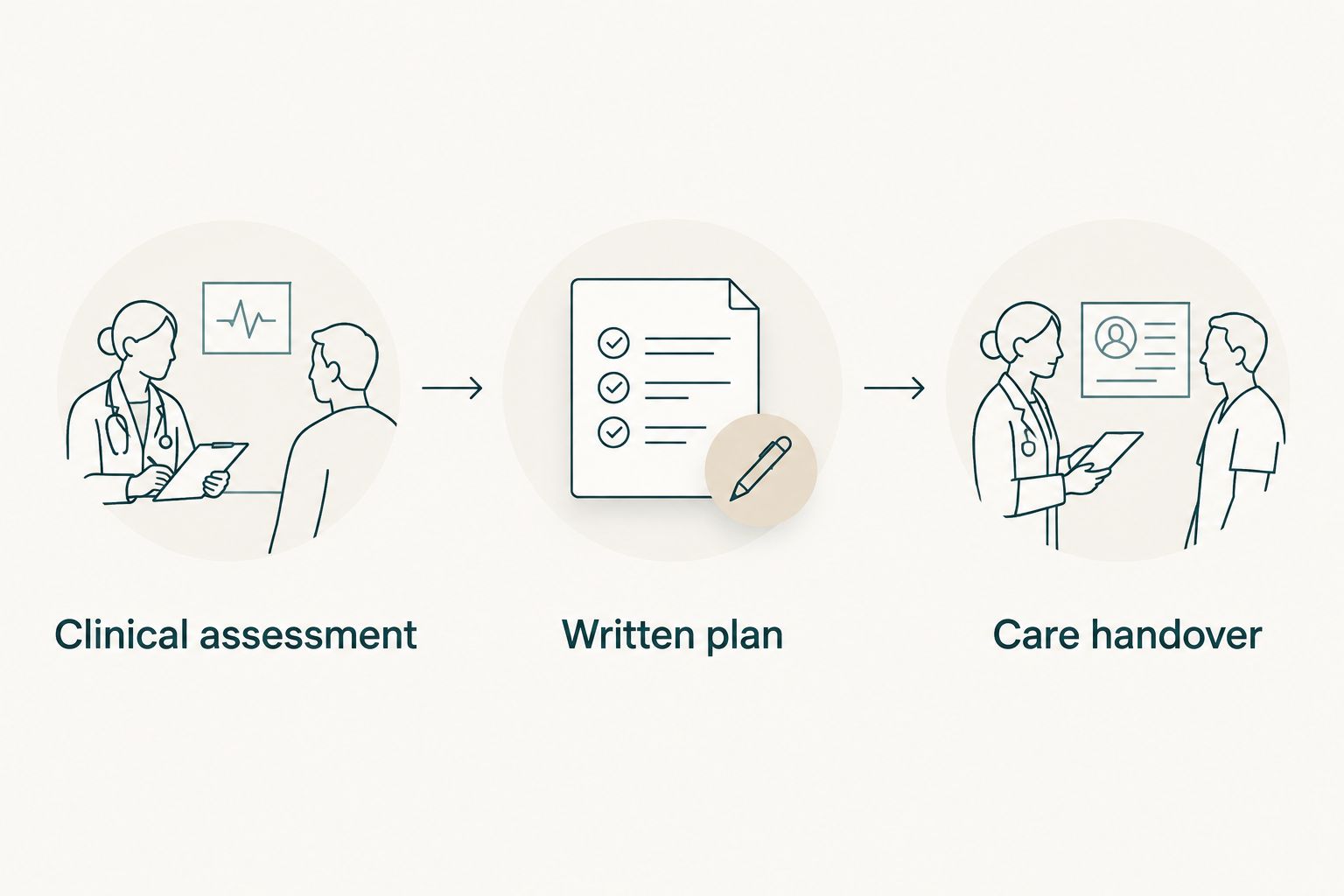
For a 2026 home-care plan, use this sequence: Clinical assessment, Written plan, Care handover. Assessment establishes the patient's needs; the written plan assigns actions; handover keeps the next caregiver informed. Ask the nurse to help turn the doctor's instructions into practical tasks without changing the prescription.
Keep a 1-page handover sheet for essential information, with detailed records available separately. Record observations factually: what happened, when it happened and what action followed. Avoid vague entries such as better today when a specific description is possible.
Include these items in the daily plan:
- Prescribed tasks and the person responsible.
- The patient's usual communication and mobility abilities.
- Clinician-set monitoring instructions and escalation thresholds.
- Changes in symptoms, intake or function.
- Updates passed to the next caregiver.
Protect swallowing safety and medicine accuracy
Follow the swallowing plan issued by the clinical team. Stroke-related swallowing difficulty can make ordinary food, drinks or tablets unsafe. Do not test swallowing with water at home or change food texture because a patient seems more alert.
Ask the speech and language therapist or treating clinician to explain eating position, required supervision and the prescribed consistency of food and fluids. A nurse can help carry out the plan, but a family observation is not a replacement for a swallowing assessment.
Use the discharge medicine list to organise administration and record each prescribed dose. Ask a pharmacist or prescriber before crushing tablets, opening capsules or giving medicines through a feeding tube. These changes can affect how a medicine works.
Do not independently stop blood-thinning treatment, alter blood-pressure medicine or add supplements. Questions about missed doses and side effects belong with the treating clinician or pharmacist.
Make the routine explicit:
- Follow the prescribed food and fluid instructions.
- Provide the specified supervision during meals.
- Record medicine administration clearly.
- Check administration questions with a pharmacist.
- Report new swallowing difficulty or concerning symptoms promptly.
Make movement and skin care safer
Walk through the home with the patient’s mobility recommendations in hand. Remove loose obstacles, improve lighting and keep essential items within reach. These practical changes are a starting point; they do not replace an assessment when transfers or walking are difficult.
Ask the physiotherapist or occupational therapist to demonstrate safe transfers and specify the equipment required. Do not pull on an affected arm to move the patient. If a transfer requires equipment or trained assistance, do not improvise because the patient wants to get up quickly.
Patients who cannot change position independently need an individual skin-care and repositioning plan. The nurse should assess risk and follow clinical instructions rather than applying an arbitrary schedule to everyone. Report persistent skin redness, broken skin or new pain.
Your movement and skin-care checklist should cover:
- The agreed transfer method and required assistance.
- Safe access to the bed, bathroom and seating.
- Clinician-recommended positioning and support.
- Skin observation and prescribed pressure-relieving equipment.
- Therapist-approved activity, with rest as directed.
Coordinate rehabilitation and communication
Nursing and rehabilitation have different jobs. Nursing supports clinical care and prescribed treatment; physiotherapy addresses movement, occupational therapy supports daily activities, and speech and language therapy addresses communication and swallowing. Some patients need several disciplines working together.
Start with the exercises and activities already prescribed. Keep them accessible to everyone supporting the patient, and ask therapists to demonstrate what correct assistance looks like. Do not increase intensity or introduce exercises from online videos without checking suitability.
For communication difficulties, use the strategy recommended by the treating team. Give the patient time to respond, reduce background noise and check understanding without speaking over them. Difficulty speaking does not establish that someone cannot understand or participate in decisions.
Review the rehabilitation plan in 2026 whenever function or care needs change, rather than treating discharge instructions as permanent.
Coordinate these practical details:
- Each therapist's goals and prescribed activities.
- The assistance needed to perform activities safely.
- Communication methods that work for the patient.
- Appointment information and transport needs.
- Changes to share with the treating team.
Prepare an emergency plan and review care needs
Write down the emergency response before you need it. Sudden facial drooping, arm weakness or speech difficulty can signal another stroke. New symptoms require emergency assessment even if the patient has had a previous stroke or the symptoms improve.
Call 998 for an ambulance in the UAE when stroke symptoms appear. Do not wait for the next nursing visit. Note when symptoms started, or when the patient was last known to be at their usual baseline, and tell emergency responders. Do not give food or drink while awaiting assessment.
Also ask the treating team which other changes require urgent review, including breathing difficulty, reduced alertness or complications related to prescribed devices. The nurse's contact details are useful, but they are not an emergency-service replacement.
Set a review point with the care team. Increase, reduce or change support according to assessed needs—not simply because a booking period has ended.
Prepare these essentials:
- The emergency number and full home address.
- The patient's medicine list and discharge summary.
- Clear instructions for recognising new symptoms.
- A backup caregiver and handover arrangement.
- A clinician-agreed review of ongoing care needs.
Compare the care options before choosing
For stroke care in Dubai in 2026, choose by task rather than by service label. Family support, skilled nursing and rehabilitation often complement one another. The best arrangement is the one that covers the assessed needs without assigning clinical responsibilities to someone unqualified.
| Option | Best for | Main benefit | Key limitation |
|---|---|---|---|
| Family-led support | A medically stable patient whose agreed routine is within the family's abilities | Familiar support and continuity between professional visits | Family members do not replace skilled nursing or specialist assessment |
| At-home nursing | A patient with prescribed clinical tasks or nursing assessment needs | Professional support in the home environment | Nursing does not replace emergency care or the full rehabilitation team |
| Home rehabilitation visits | A patient needing targeted movement, daily-living, communication or swallowing support | Discipline-specific assessment and rehabilitation | Therapy visits do not provide continuous supervision or general nursing cover |
| Facility-based rehabilitation | A patient whose treating team recommends coordinated care in a rehabilitation setting | Access to an organised rehabilitation environment | Requires clinical suitability and a move away from the home setting |
DarDoc offers at-home nursing, but confirm stroke-specific suitability, staffing and responsibilities directly. Do not assume that offering nursing also means providing every rehabilitation discipline or continuous cover. Ask for a written explanation of what the proposed arrangement includes and excludes.
Common mistakes families make after a stroke
Booking hours before defining tasks
A long visit does not guarantee appropriate care. List the patient's needs first, then identify the professional skills and supervision required. A task-based plan makes gaps visible before the first shift.
Treating a caregiver and a nurse as interchangeable
Help with personal care is different from clinical assessment or prescribed procedures. Ask who is qualified and authorised to perform each activity. Keep family responsibilities within the training and instructions provided by the treating team.
Changing food or medicines without review
A patient asking for ordinary water does not prove swallowing is safe. Likewise, a difficult-to-swallow tablet is not automatically suitable for crushing. Check changes with the relevant clinician or pharmacist before acting.
Measuring recovery only by walking
Stroke recovery also involves communication, swallowing, cognition and everyday independence. Use the goals set by the rehabilitation team. A patient can improve in one area while still needing substantial support in another.
Waiting for the nurse when symptoms change suddenly
A scheduled home visit is not the response to a suspected new stroke. Keep 998 visible and explain the emergency plan to every caregiver. Familiarity with existing symptoms must not lead to dismissing a sudden change.
FAQ
What does home nursing for stroke patients in Dubai include?
Home nursing supports the clinical tasks identified in a stroke patient's assessed care plan. Depending on the prescription and the nurse's competence, this can include medicine support, clinical observation, skin care or care of prescribed devices; confirm the exact scope before booking.
Is a home nurse enough for stroke rehabilitation?
A home nurse does not replace a stroke rehabilitation team. Physiotherapy, occupational therapy and speech and language therapy address different recovery needs, and the treating team should decide which services are required.
How do I check a stroke patient's home nurse in Dubai?
Check the nurse's current professional licence and confirm competence in the patient's specific care tasks. Ask the provider to explain its authorised service scope, documentation process and arrangements for communicating with the treating doctor.
Can a stroke patient eat and drink normally at home?
A stroke patient should follow the swallowing instructions issued by the clinical team. Do not change food texture or fluid consistency, or test swallowing with water, without appropriate clinical guidance.
Does a stroke patient need someone present overnight?
Overnight support depends on the patient's assessed supervision and care needs. Ask the discharge team about help with transfers, toileting, prescribed treatments and the patient's ability to summon assistance.
What should I do if stroke symptoms return at home?
Call the UAE ambulance service on 998 immediately for new stroke symptoms. Note when symptoms started or when the patient was last at their usual baseline, and do not wait for a home nursing appointment.
Can DarDoc provide home nursing for a stroke patient?
DarDoc offers at-home nursing in Dubai, but the patient's stroke-specific requirements need confirmation before arranging care. Share the discharge plan and ask which tasks, competencies and staffing arrangements the proposed service covers.
One last thing
Before the first night at home, ask each caregiver to explain the plan back in their own words: how the patient moves, what they can swallow, which tasks they handle and when they call for help. A signed document does not establish that everyone understands it.
For your 2026 discharge checklist, make that conversation a specific task. Any disagreement is a reason to clarify instructions with the care team before an unfamiliar caregiver takes over. A clear handover is part of safe care, not administrative housekeeping.