Instead of sending the same paperwork repeatedly, connect your ADNIC insurance home nursing care claims through a documented workflow: confirm the benefit, obtain any required authorisation, match nursing records to the approved care, and submit through the route ADNIC confirms for your policy. DarDoc provides home healthcare in Dubai and Abu Dhabi; confirm insurance eligibility separately before arranging care on the assumption that it will be covered.
TL;DR- ADNIC insurance home nursing care claims start with policy confirmation, not a nursing booking.
- DarDoc provides home nursing care; confirm ADNIC eligibility and billing arrangements separately.
- Keep the doctor's order, authorisation, nursing records and invoices together for claims submission.
- Direct billing and reimbursement are different workflows; ask which applies to your policy.
Why this matters
A home nursing appointment and an insurance claim are separate arrangements. Booking care does not establish that your policy covers the service, that the provider qualifies, or that any required approval has been issued.
DarDoc home nursing care is best suited to families seeking care at home in Dubai and Abu Dhabi, with insurance eligibility checked separately. The advantage is care in the home setting; the limitation is that the service description alone does not establish ADNIC coverage or direct billing.
For care arranged in 2026, use the policy documents covering the actual treatment date. A previous claim or an earlier approval does not establish entitlement for a new episode.
Before you start
- Policy access: Have your insurance membership details, current benefits schedule, policy wording and access to the official contact channel shown on your insurance documents.
- Clinical paperwork: Gather the treating clinician's referral or order, relevant medical report and proposed nursing care plan. Ask what documentation ADNIC requires for the specific service before requesting additional records.
- The easily missed distinction: Ask whether your plan distinguishes medically necessary skilled nursing from personal assistance, companionship or long-term support. Do not submit these categories as though they are interchangeable.
Keep 1 claim file per care episode, with separate sections for clinical records, insurer correspondence and financial documents. This is an organisation method, not an insurer filing requirement.
Policy and billing confirmation
Establish the benefit before booking
- Contact ADNIC through the official channel identified in your policy documents. Explain the nursing task, clinical reason, proposed location and expected schedule.
- Ask whether the proposed service falls within your current benefits. Request the relevant benefit wording, including exclusions and any conditions attached to home treatment.
- Ask whether a referral, prior authorisation or further clinical assessment is required before the first visit.
- Confirm whether provider eligibility depends on a network, an approved facility or another policy condition. Give the provider's exact details rather than asking about home nursing generally.
- Ask which submission route applies and what deadlines govern notification, treatment and claim filing. Record the response and its reference number.
Expected result: You have a policy-specific answer about the proposed service, the provider requirements and the next administrative step. A general statement that your policy includes healthcare is not enough.
For your 2026 claim file, save the applicable benefits schedule alongside the insurer's response. Record who supplied the answer, when they supplied it and what service you described.
Separate direct billing from reimbursement
Ask which arrangement applies before agreeing to the administrative process. Neither route should be assumed from a provider's general service offering.
| Billing route | Best for | Practical advantage | Limitation to resolve |
|---|---|---|---|
| Direct billing, if confirmed | A care episode for which the insurer and provider confirm direct submission | The provider handles the agreed insurer-facing billing process | Confirm provider eligibility, authorisation and your responsibilities separately |
| Reimbursement, if confirmed | An eligible care episode submitted by the insured member | You retain the submission record and correspondence | You must follow the member claim process and supply the required evidence |
Choose the route ADNIC confirms for your policy and provider, not the route that sounds simpler. Ask who submits the claim, who responds to document requests and how you receive the decision. Keep these responsibilities in writing.
Clinical plan and authorisation
Align the referral with the nursing tasks
- Ask the treating clinician to describe the clinical need and the nursing tasks being requested. The order should support the actual care rather than use a broad description that leaves the service unclear.
- Give the proposed provider the referral and ask for a care plan that matches it. Check the patient details, requested tasks, visit schedule and intended review point.
- Ask ADNIC which supporting records are needed for assessment. Submit relevant documents through the authorised channel rather than sending a complete medical history without checking necessity.
- If prior authorisation is required, obtain the written decision before treating the requested care as approved.
- Read the decision against the proposed care plan. Check the service, provider, permitted period, visit allowance and any stated conditions wherever those details appear.
Expected result: The clinician's request, provider's plan and insurer's decision describe the same care episode. Any unresolved difference is identified before it becomes a billing dispute.
An authorisation request is not an authorisation decision. Likewise, a reference number acknowledges a record or interaction; it does not by itself establish approval.
Record the handoffs
Use 3 checkpoints: Benefit confirmation, Authorisation, and Claim submission. At each checkpoint, record the responsible person, the document received and the next action.
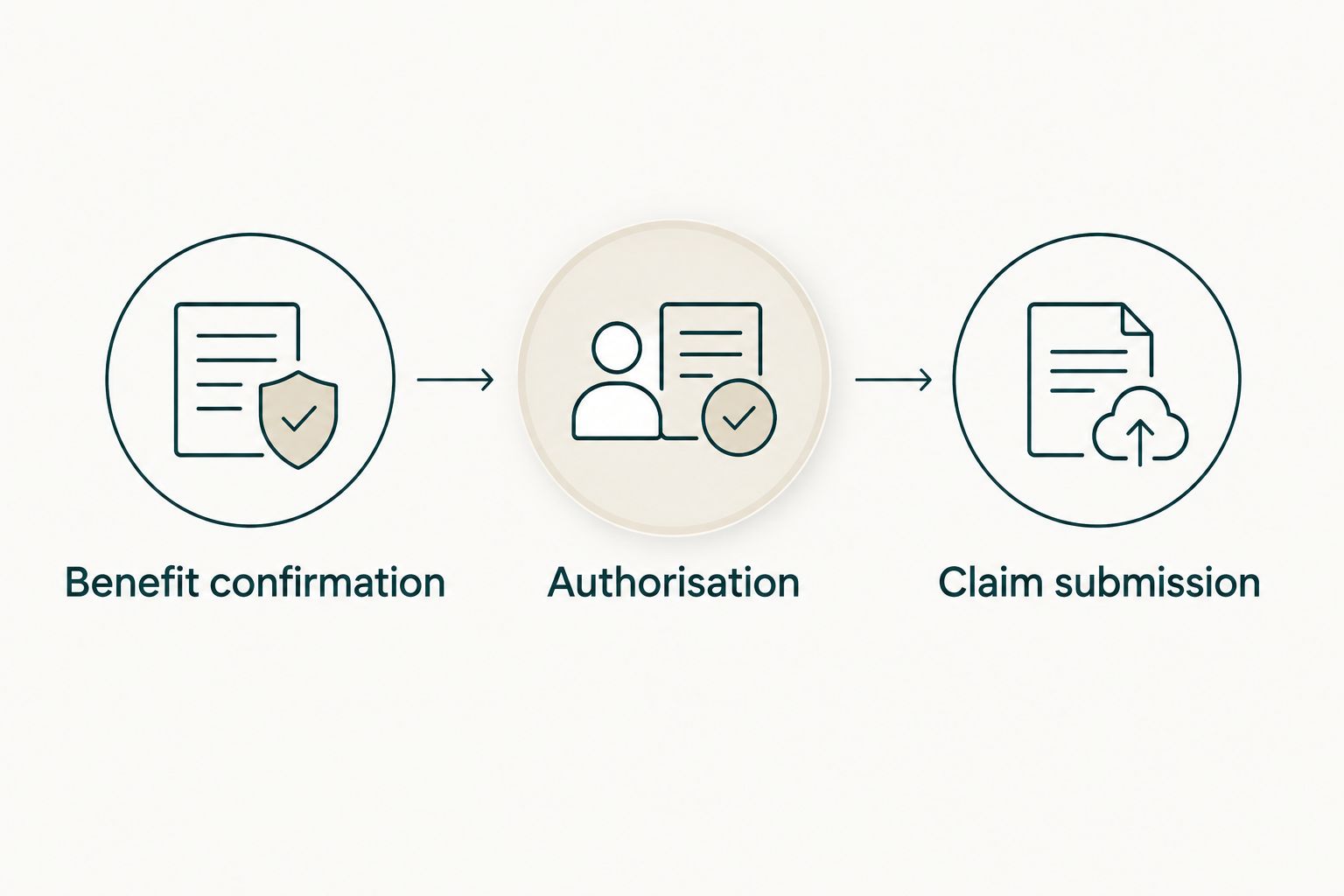
Give the provider only the information needed for the relevant handoff, using the agreed secure channel. Keep the insurer's correspondence accessible to the person coordinating care so a change in family caregiver does not interrupt the administrative record.
If an authorisation issued in 2026 contains an end date, put that date in your own reminder system. Use the actual decision letter; do not substitute a general renewal interval.
Visit records and claim submission
Match delivered care to the documentation
- Check that each visit record identifies the patient, treatment date and nursing care delivered. Ask the provider to correct factual omissions through its normal records process.
- Compare the records with the clinical order and any authorisation. Flag changes in tasks or schedule rather than assuming the original approval covers them.
- Obtain the itemised invoice and any payment evidence required for your confirmed submission route. Check that the patient and service details agree across documents.
- Complete the current claim form or submission process identified by ADNIC. Follow its actual field names and attachment instructions; a general online guide is not a substitute for the current form.
- Save the submitted documents, submission acknowledgement and claim reference together. Keep originals where the insurer's instructions require them.
Expected result: The submission shows a consistent chain from clinical need to care delivered and the amount being claimed, without conflicting patient details or dates.
Maintain 2 separate records: the provider's appointment record and the insurer's claim-status record. A completed visit does not mean a submitted claim, and a submitted claim does not mean an accepted claim.
Track the decision without duplicating the claim
When following up, use the existing claim reference and ask what action is outstanding. Distinguish between a request for more information, a pending assessment and a final decision.
If ADNIC requests another document, attach it through the instructed route and retain the acknowledgement. Do not open another claim for the same care merely because the first submission has not been resolved.
For claims submitted in 2026, record deadlines exactly as stated in your policy or correspondence. Do not rely on a generic claim window from another insurer or another member's experience.
When an existing nursing plan changes
An extension or change in care needs its own administrative check. The original authorisation does not establish that additional visits or different nursing tasks are covered.
- Ask the treating clinician to document the reason for the proposed change and update the care plan where clinically appropriate.
- Compare the new request with the existing authorisation. Identify the changed service, schedule or treatment period.
- Ask ADNIC whether the change requires an amendment, extension or new request. Use the existing episode reference when instructed.
- Give the provider the written response and confirm which care it applies to.
- Keep the earlier and revised decisions clearly separated so invoices can be matched to the correct period.
Expected result: The amended plan has a traceable decision rather than an assumption that earlier approval continues unchanged.
Do not postpone urgent medical assessment while resolving paperwork. If the patient's condition deteriorates, seek appropriate clinical help; insurance administration is not a substitute for medical triage.
Troubleshooting
The claim is returned for missing information
Read the document request and identify the exact omission. Obtain the required record from the clinician or provider, then submit it against the existing reference through the instructed channel.
Keep a copy of the request and your response. Do not alter a clinical record yourself to make it fit a claim.
The service does not match the authorisation
Compare the decision, care plan, visit notes and invoice line by line. If the provider made an administrative error, request a corrected document; if care genuinely changed, ask ADNIC how that change must be assessed.
Do not relabel personal care as skilled nursing to obtain coverage. Accurate descriptions protect both the clinical record and the claim.
The provider cannot confirm direct billing
Ask ADNIC whether the named provider qualifies for your plan and whether another submission route applies. Ask DarDoc to confirm its role in the proposed home nursing care arrangement without treating that confirmation as an insurer coverage decision.
Keep the provider's billing answer and the insurer's benefit answer separate. They resolve different questions.
The decision does not explain the refusal
Request the written reason and the policy provision used in the assessment. Compare that explanation with the submitted records before supplying more paperwork.
If you disagree, ask for the applicable review or complaint process and its deadline. A review request should address the stated reason, not simply repeat the original submission.
Customize your workflow
For ongoing care, assign a family coordinator to maintain the claim file and a backup who knows where it is stored. Add reminders based on actual authorisation dates, clinical reviews and submission deadlines rather than an assumed monthly cycle.
When discussing home nursing care with DarDoc, bring the clinician's order and your insurer's written requirements. Ask which records the provider supplies and which actions remain with you.
Review your 2026 checklist whenever the policy, provider or care plan changes. Keep administrative decisions separate from clinical decisions: the insurer determines benefits under the policy, while the treating clinician determines the patient's medical needs.
FAQ
Does ADNIC insurance cover home nursing care?
Coverage depends on your ADNIC policy and the proposed care. Ask for confirmation of the benefit, exclusions, provider requirements and any authorisation needed before relying on insurance payment.
How do I connect ADNIC insurance to a home nursing booking?
Connect the booking through a documented claims process, not an assumed automatic integration. Confirm eligibility, establish the billing route, obtain any required approval and match the visit records to the claim.
Can DarDoc bill ADNIC directly for home nursing?
Confirm direct billing with both DarDoc and ADNIC for your specific policy and care episode. A home nursing booking alone does not establish a direct-billing arrangement.
Do I need approval before home nursing starts?
Ask ADNIC whether prior authorisation is required for your proposed service. If it is required, obtain the written decision and check its scope before treating the care as approved.
What documents should I prepare for a home nursing claim?
Prepare your membership details, clinician's order, relevant medical report, care plan, any authorisation, visit records and itemised invoice. ADNIC's instructions determine the exact documents and payment evidence required for your submission route.
What happens if I need more nursing visits?
Ask whether the additional visits require an extension, amendment or new authorisation request. Keep the updated clinical plan and written decision linked to the existing episode.
What should I do if my home nursing claim is rejected?
Obtain the written reason and the policy provision used in the decision. Correct factual errors or supply missing evidence, then follow the stated review process if you dispute the outcome.
One last thing
The most useful claims check is consistency, not document volume. Before submission, compare the patient details, care description and treatment dates across the order, authorisation, nursing record and invoice. More attachments do not resolve a contradiction between those records.