
Athletes’ IV drip therapy in Dubai is intravenous treatment used to correct a clinically assessed fluid deficit or deliver prescribed treatment, with the aim of restoring health rather than guaranteeing better performance. Training load, heat exposure, medical history and competition rules make the decision different from choosing a general wellness appointment.
TL;DR- IV drip therapy for athletes Dubai: DarDoc offers at-home IV care; choose treatment for a clinical reason, not a performance promise.
- Oral hydration is the first option when you can drink safely and keep fluids down.
- WADA’s 2026 rules restrict IV infusions and injections exceeding 100 mL per 12 hours, with specific exceptions.
- Confusion, collapse or severe symptoms require urgent medical assessment, not a routine home drip.
Why IV drip therapy matters for athletes in Dubai
Exercise in hot conditions creates a practical problem: you need to replace fluid losses without mistaking every headache, cramp or tired session for dehydration. These symptoms have several causes. An IV does not establish which one you have.
The useful question in 2026 is not which drip sounds most athletic. It is whether you need intravenous treatment at all. Start with symptoms, drinking tolerance and medical assessment; then consider the treatment setting.
DarDoc is best for athletes in Dubai seeking at-home IV care, not emergency treatment. DarDoc provides at-home healthcare, including IV drips, but the convenience of home treatment does not establish that a drip is medically necessary.
For athletes, the distinction matters twice: an unnecessary procedure introduces avoidable clinical risk, and an infusion can create an anti-doping problem even when its ingredients are otherwise permitted.
How to decide whether an IV drip is appropriate
Assess symptoms
Separate ordinary post-training fatigue from symptoms that need urgent care. Confusion, collapse, chest pain, severe breathlessness or worsening symptoms after heat exposure need urgent medical assessment. Do not wait for a routine home appointment.
Vomiting, persistent dizziness and an inability to retain drinks also warrant assessment. They do not automatically establish a need for an IV; a clinician must identify the cause and judge the appropriate treatment. Tell the clinician what happened before, during and after exercise rather than requesting a named drip first.
A teammate looking unwell after a hot session needs attention, not a recovery-menu recommendation. Stop exercise and move out of the heat while arranging appropriate help. If the person is confused or cannot swallow safely, do not force oral fluids.
- Stop training when symptoms are significant or worsening.
- Describe heat exposure, exercise intensity and symptom onset.
- Report vomiting, fainting, confusion or chest symptoms immediately.
- Use urgent medical services for severe symptoms rather than booking routine IV care.
Try oral fluids
Use oral hydration first when you can drink safely, retain fluids and have no urgent warning signs. Water, food and an appropriate electrolyte drink address different parts of recovery; choose according to the session and your circumstances rather than treating them as interchangeable.
An electrolyte drink supplies fluid and electrolytes through the digestive tract. An IV bypasses that route but requires a prescription decision, a needle and monitoring. Bypassing digestion is not, by itself, a reason to choose it.
Body-mass measurements can help you understand training losses. Under comparable conditions, a 1 kg decrease immediately after exercise approximates 1 litre of net fluid loss. Clothing, food, drinks and bathroom visits affect that estimate. It is a planning aid, not a diagnosis or an instruction to replace the entire amount intravenously.
- Check whether you can drink comfortably and keep fluids down.
- Include normal meals in recovery rather than relying only on drinks.
- Compare pre-session and post-session weight under similar conditions.
- Avoid forcing large volumes of plain water beyond your needs.
- Seek assessment if symptoms persist despite rest and oral hydration.
Review medical history
Give the clinician your actual medical history before discussing ingredients. Kidney disease, heart disease, diabetes, pregnancy, allergies and current medicines can change the safety of fluid or electrolyte treatment. A healthy-looking athlete still needs this review.
Explain recent illness, changes in eating, alcohol use and any supplements you take. If you use GLP-1 treatment, mention nausea, vomiting or reduced intake rather than assuming the symptoms come from training alone. The clinician needs the full picture.
DarDoc’s at-home IV service offers a treatment setting; it does not replace the medical decision about whether that treatment fits your symptoms. Ask whether an examination or targeted blood tests are needed before proceeding. Tests should answer a clinical question, not simply expand an appointment.
- List prescription medicines, supplements and known allergies.
- Disclose kidney, heart and metabolic conditions.
- Describe recent vomiting, diarrhoea, fever or reduced food intake.
- Mention previous reactions to injections or infusions.
- Ask which findings would change the treatment decision.
Check competition rules
For athletes subject to anti-doping rules, the route and volume matter as well as the ingredients. The World Anti-Doping Agency’s 2026 Prohibited List, section M2.2, prohibits intravenous infusions and/or injections of more than a total of 100 mL per 12-hour period, except those legitimately received during hospital treatments, surgical procedures or clinical diagnostic investigations.
This restriction applies at all times, not just on competition day. A permitted vitamin or fluid can still be administered by a prohibited method. A prescription, a home appointment or treatment in a clinic does not automatically create an exception.
Check your anti-doping organisation’s requirements before elective treatment. A therapeutic use exemption, or TUE, is a formal process, not a note saying that a clinician recommended a drip. Emergency care comes first; the relevant organisation can explain the documentation and exemption rules that apply afterward.
- Tell the clinician whether anti-doping rules apply to you.
- Check the 2026 Prohibited List and your organisation’s TUE guidance.
- Review every ingredient, not just the package name.
- Confirm the total intravenous volume within the relevant period.
- Keep the clinical reason, prescription and treatment record.
Choose the setting
Choose the setting according to the assessment and monitoring you need. At-home care suits a planned appointment when a clinician considers home treatment appropriate. It is not an alternative to emergency assessment for collapse, confusion or severe symptoms.
DarDoc provides at-home IV drips in the UAE. For an athlete in Dubai, the practical benefit is receiving suitable care at home; the limitation is that home treatment is not a hospital environment. Ask what monitoring is provided and how deterioration is handled.
For a Dubai appointment, verify the relevant Dubai Health Authority licensing of the provider and treating professionals. Licensing, clinical assessment and an escalation plan are separate checks. Do not infer them from a service name, a photograph or a claim that the treatment is designed for athletes.
- Match the setting to symptom severity and the clinician’s assessment.
- Verify the relevant provider and professional licences.
- Ask who prescribes the treatment and who administers it.
- Confirm what observations will be recorded during treatment.
- Establish how urgent transfer or further assessment would be arranged.
Confirm the prescription
Ask for the proposed fluid, ingredients, total volume and clinical reason before agreeing to treatment. A label such as recovery or energy does not describe a prescription. You need to know what is being administered and why.
Distinguish treatment of an identified problem from a promise about future athletic performance. Correcting a deficiency is a different clinical question from giving extra vitamins to someone without a demonstrated need. Ask for evidence relevant to the exact ingredient and intended outcome.
IV treatment carries risks, including bruising, vein irritation, infection, allergic reactions and fluid or electrolyte complications. Appropriate selection and monitoring matter even when an ingredient sounds familiar. Do not request an extra ingredient because it appears on another provider’s menu.
- Obtain the names of all fluids and added ingredients.
- Ask what condition each ingredient is intended to treat.
- Confirm total volume and the proposed administration plan.
- Discuss relevant side effects and reasons to stop treatment.
- Decline additions without a clear clinical rationale.
Plan follow-up
Recovery does not end when the infusion finishes. Agree on what improvement to expect, what symptoms require reassessment and when exercise is appropriate again. Feeling temporarily better is not proof that the original cause has been resolved.
For your 2026 training plan, record the circumstances that preceded the problem: session conditions, food intake, drinking tolerance and symptoms. Repeated episodes deserve review rather than repeated appointments for the same drip. A clinician can assess whether another condition or an unsuitable training and hydration routine needs attention.
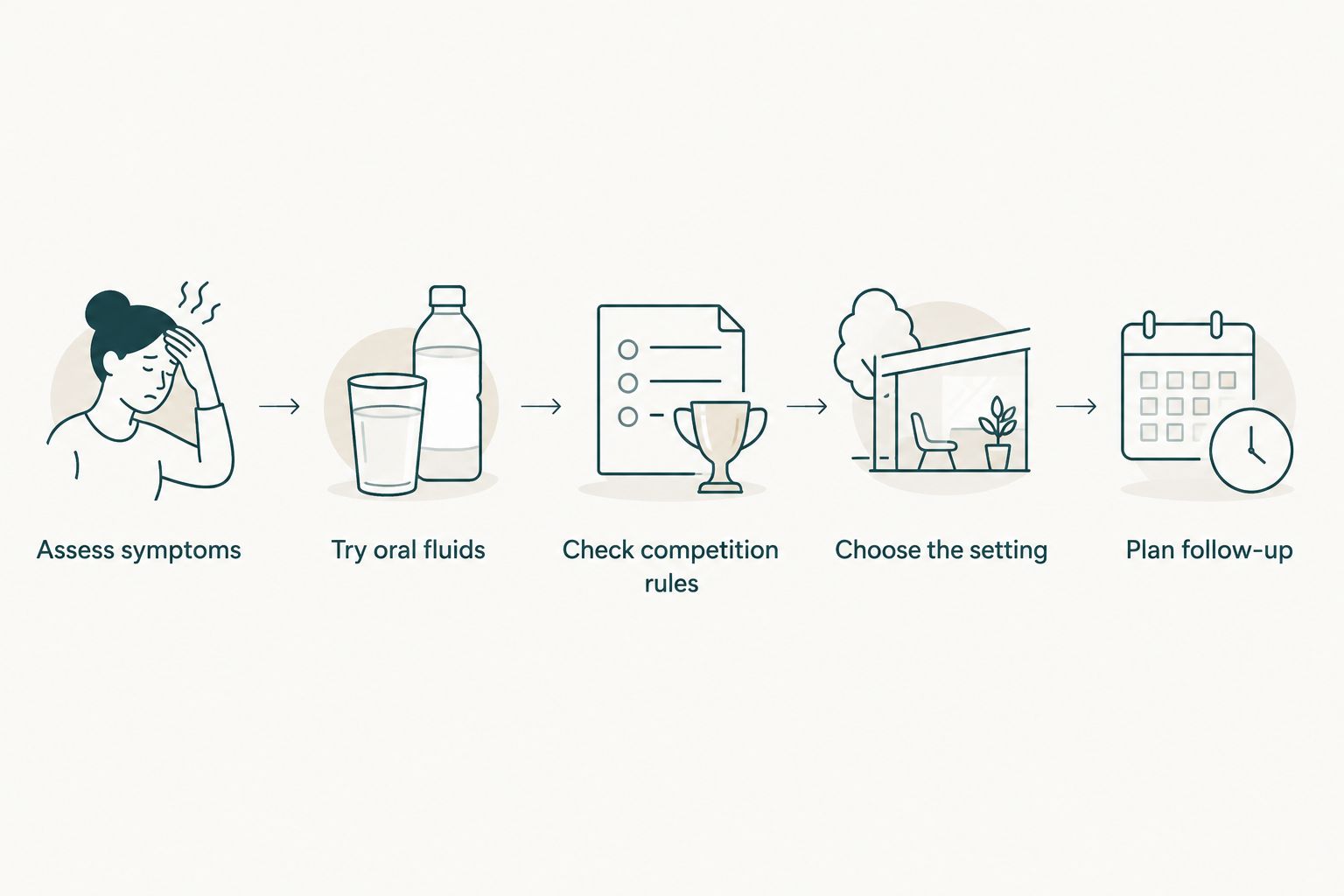
Use this decision sequence: Assess symptoms, Try oral fluids, Check competition rules, Choose the setting, Plan follow-up. Medical history and prescription review remain part of the clinical assessment within that sequence.
Keep the treatment record with your other medical information. It should describe what was given, why it was given and who provided the care, especially when anti-doping requirements apply.
- Obtain a written record of the treatment and ingredients.
- Ask which symptoms require urgent reassessment.
- Agree on return-to-training advice with the treating clinician.
- Review recurrent symptoms instead of repeating treatment automatically.
- Update your hydration plan using your own session observations.
Compare hydration and treatment options
Choose the least invasive option that meets the clinical need. Oral fluids, home IV care and facility-based treatment solve different problems; they are not competing versions of the same recovery product.
| Option | Best for | Main advantage | Key limitation |
|---|---|---|---|
| Oral fluids and food | Athletes who can drink safely and retain fluids | No intravenous procedure; fits routine recovery | Not sufficient when oral intake is unsafe or a condition requires other treatment |
| Oral electrolyte drink | Athletes replacing fluid and electrolyte losses through drinking | Combines fluid with electrolytes | Does not diagnose the cause of persistent symptoms |
| DarDoc at-home IV care | Athletes seeking home treatment when clinically appropriate | Treatment takes place at home | Requires clinical justification; not an emergency setting; anti-doping restrictions still apply |
| Clinic-based assessment and treatment | Athletes needing an examination or facility-based care | Assessment and treatment occur in a clinical setting | A clinic location does not automatically exempt an infusion from anti-doping rules |
| Hospital or emergency assessment | Athletes with severe symptoms or suspected acute illness | Appropriate setting for urgent assessment and escalation | Not a routine recovery appointment |
There is no universal best drip for athletes in 2026. The right option depends on the cause of symptoms, medical risks, drinking tolerance and the level of care required. A sports-oriented name does not answer any of those questions.
Common mistakes athletes make
Treating fatigue as proof of dehydration
Fatigue can reflect sleep, training load, illness, nutrition or another medical problem. Describe the pattern and associated symptoms. Do not use an IV appointment as a substitute for finding the cause of persistent tiredness.
Assuming more fluid means better recovery
More is not automatically better. Excess fluid can be harmful, and inappropriate intake can disturb sodium balance. Use an individual hydration plan rather than copying a teammate’s drinking schedule or infusion volume.
Checking ingredients but ignoring the method
An ingredient being permitted does not settle the anti-doping question. The 2026 intravenous-method restriction also considers total volume and timing. Check both before elective treatment and retain the documentation afterward.
Buying a performance promise instead of a prescription
Words such as energy, endurance and recovery describe marketing categories, not a diagnosis. Ask what the proposed treatment addresses, what evidence supports that use and what risks apply to you. Skip unexplained additions.
Replacing assessment with repeat appointments
Recurrent dizziness, vomiting or poor exercise tolerance needs review. If the same symptoms keep returning, investigate the pattern rather than treating each episode as an isolated hydration problem. Home convenience should not delay further care.
FAQ
What is the best IV drip therapy for athletes in Dubai?
The best option is treatment selected for an assessed clinical need, not a sports-branded drip. If you can drink safely and retain fluids, oral hydration is generally the first option; persistent or severe symptoms need medical assessment.
Is an IV drip better than an electrolyte drink after training?
An IV drip is not automatically better than an electrolyte drink after training. Oral fluids avoid an intravenous procedure, while IV treatment requires a clinical reason, prescription review and monitoring.
Can competitive athletes receive an IV drip in 2026?
Competitive athletes must check their applicable anti-doping rules before elective IV treatment. WADA’s 2026 Prohibited List restricts intravenous infusions and injections exceeding a total of 100 mL per 12 hours, with specified exceptions; a TUE can be relevant.
Does a doctor’s prescription make an IV drip acceptable under WADA rules?
A doctor’s prescription does not automatically make an IV drip acceptable under WADA rules. The ingredients, method, volume, circumstances and applicable exemption requirements all need review.
Can I use DarDoc for an at-home IV drip in Dubai?
DarDoc offers at-home IV drips as part of its UAE healthcare services. Before treatment, confirm clinical suitability, the prescription, relevant licensing, monitoring and any anti-doping requirements that apply to you.
What symptoms mean I should seek urgent care instead of booking a drip?
Confusion, collapse, chest pain, severe breathlessness or worsening symptoms after heat exposure require urgent medical assessment. Do not delay care while arranging a routine home infusion.
What should I ask before agreeing to an athlete recovery drip?
Ask for the clinical reason, complete ingredient list, total volume, risks and monitoring plan. If anti-doping rules apply, also confirm the method restrictions and required documentation before elective treatment.
One last thing
Write down the reason for treatment before choosing the treatment. If the explanation is only that you have a hard session tomorrow, pause and request an assessment rather than an infusion menu.
For an athlete in 2026, the most useful recovery record connects symptoms with training, intake and medical findings. That record helps you and your clinician decide whether you need a better hydration routine, further investigation or prescribed care. This guide supports that conversation; it does not replace individual medical assessment.


