There is a clinical pattern that has become familiar in UAE men's-health practice over the last five years. A man in his late thirties or early forties walks into a clinic complaining of fatigue, low libido, irritability, and a sense that his recovery from training is not what it was. He is tested. His total testosterone comes back at 350 ng/dL: within the laboratory's reference range, but at the lower end of the population distribution and well below where he was a decade ago. He is offered testosterone replacement therapy, accepts, and starts on a weekly injection protocol. Within six weeks he feels significantly better. Eighteen months later he and his wife are trying to conceive their second child, and they cannot. His sperm count, when tested, is essentially zero.
This is not a rare scenario. It is the predictable consequence of the way exogenous testosterone interacts with the body's reproductive axis, and it is the single most important clinical context for understanding why kisspeptin has become a topic of serious conversation in men's hormonal medicine. Kisspeptin is a peptide that stimulates the body's own testosterone production rather than replacing it. The fertility implications are different. The mechanistic implications are different. The decision tree that should govern which of the two interventions a particular patient receives is well-defined in the endocrinology literature but poorly translated into the consumer men's-health conversation. This article is about that decision tree, in the specific context of UAE men's-health practice in 2026.
How the male reproductive axis actually works
The conversation has to start with the underlying biology, because most of the misconceptions in this space flow from skipping it. The hypothalamic-pituitary-gonadal axis (HPG axis) is the regulatory architecture that produces testosterone in adult men. It has three components and a feedback loop, and understanding the architecture is the prerequisite for understanding what each intervention actually does.
The hypothalamus produces gonadotropin-releasing hormone (GnRH) in pulses. The pulse frequency and amplitude are the regulatory variable that drives the rest of the system.
GnRH travels through a short portal blood system to the anterior pituitary, where it stimulates the release of two gonadotropins: luteinising hormone (LH) and follicle-stimulating hormone (FSH).
LH stimulates the Leydig cells in the testes to produce testosterone. FSH stimulates the Sertoli cells, which support spermatogenesis. The two work in coordination. Testosterone is needed for spermatogenesis as well, at concentrations far higher inside the testes than in circulating blood.
Circulating testosterone provides negative feedback to both the hypothalamus (suppressing GnRH) and the pituitary (suppressing LH and FSH). The system is self-regulating: when testosterone is high, the upstream signals decline; when testosterone is low, they increase.
Three details of this architecture matter for the kisspeptin-versus-TRT conversation.
- The system is upstream-driven. GnRH from the hypothalamus is the variable that ultimately determines what the rest of the system produces. Anything that changes GnRH pulsing changes the whole downstream cascade.
- The system is feedback-regulated. Introducing testosterone from outside the body shuts the system down at the top. The hypothalamus stops releasing GnRH, the pituitary stops releasing LH and FSH, the testes stop producing testosterone and stop supporting spermatogenesis.
- Spermatogenesis depends on intratesticular testosterone, not circulating testosterone. Men on TRT have normal or supraphysiological circulating testosterone but very low intratesticular testosterone, which is why their sperm production typically falls dramatically and often to zero.
What TRT is, and what it does
Testosterone replacement therapy is the direct administration of exogenous testosterone, typically as a weekly intramuscular or subcutaneous injection of testosterone enanthate or cypionate, or as a daily transdermal gel, with the goal of raising circulating testosterone to a level that produces the symptomatic and clinical benefits associated with normal physiological testosterone.
The benefits, in men with confirmed hypogonadism, are well-documented and significant. Improved energy, libido, mood, body composition, bone density, and exercise capacity. The effects are typically perceptible within four to six weeks and stabilise over three to six months. For men with confirmed hypogonadism, particularly primary hypogonadism, where the testes themselves have failed and cannot produce testosterone in response to upstream signals, TRT is a well-evidenced, often life-changing intervention. It is not an experimental therapy. It is established medicine.
The cost, however, is the cost the article opened with. TRT introduces testosterone directly, which suppresses the body's own HPG axis. The hypothalamus stops sending the GnRH signal that drives the rest of the cascade. The testes shrink, often substantially. Spermatogenesis falls, often to zero. Restoration of natural production after stopping TRT is possible but is not guaranteed, takes months to years, and is incomplete in some men. The men who go on TRT and later try to conceive often need significant additional pharmacological intervention (hCG, clomiphene, sometimes long protocols of HPG axis restoration) to restart spermatogenesis, and the success rate is not 100 percent.
There are other considerations. TRT requires careful monitoring of haematocrit (red blood cell concentration), oestradiol, prostate-specific antigen, and lipid profile. Some men experience adverse effects on these parameters that require dose adjustment or, in some cases, discontinuation. TRT is also a long-term commitment in most cases. Once started, men typically stay on it indefinitely, because stopping returns them to the symptom picture that led them to start in the first place. None of these things make TRT inappropriate. They make it a serious therapy with serious considerations, and a man considering it should understand them clearly before starting.
What kisspeptin is, and what it does
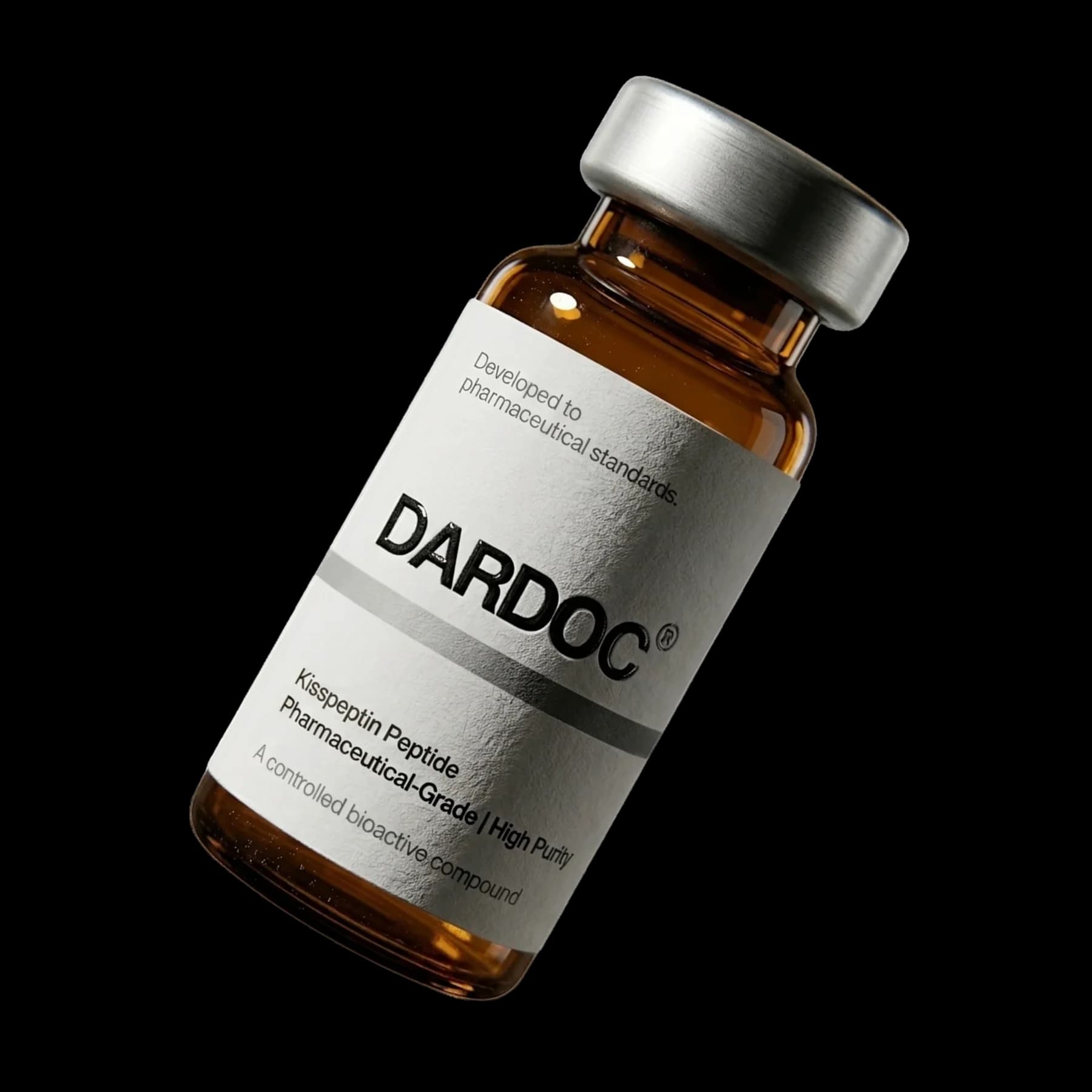
Kisspeptin is a peptide encoded by the KISS1 gene, originally identified as a metastasis suppressor in melanoma research and later recognised as the master regulator of the HPG axis [de Roux et al., Proceedings of the National Academy of Sciences, 2003]. The peptide acts at the hypothalamus, where it stimulates the GnRH neurons that drive the entire reproductive cascade. The discovery that kisspeptin signaling is required for normal puberty (patients with mutations in the KISS1 receptor have congenital absence of puberty) established the peptide as the upstream signal without which the HPG axis does not function.
In clinical use, kisspeptin acts as an upstream stimulus to the body's own reproductive cascade. Administered exogenously, it drives GnRH release, which drives LH and FSH release, which drives testicular testosterone production and spermatogenesis. The body produces its own testosterone, in response to its own regulatory signals, in the same pulsatile pattern as native physiology. The HPG axis is not bypassed. It is supported.
The mechanistic distinction from TRT is the most important single difference between the two interventions. TRT replaces testosterone from outside, shutting down the body's own production. Kisspeptin stimulates the body's own production, preserving and supporting the axis rather than replacing it. The result is a different clinical profile: more modest and more variable effects on circulating testosterone (because the body's own regulatory feedback still applies), but preserved testicular function, preserved spermatogenesis, and a much shorter recovery period if the protocol is stopped.
The clinical evidence base for kisspeptin in men's hormonal medicine is genuinely growing. There have been Phase I and Phase II human trials in men with hypogonadism, particularly secondary hypogonadism (where the testes are functional but the upstream signaling is impaired), with results consistent with the mechanism [Dhillo et al., Journal of Clinical Endocrinology and Metabolism, 2007]. Kisspeptin protocols have produced meaningful elevations in LH, FSH and testosterone in men with secondary hypogonadism, with the changes occurring within hours of administration and persisting through ongoing therapy. The trials have not yet produced the kind of large-scale, long-duration data that would push kisspeptin into mainstream guideline-endorsed therapy, but the underlying biology is real and the clinical signal is real.
Primary versus secondary hypogonadism: where each intervention fits
This is the section of the article that determines which intervention is appropriate for a particular man, and it is the section most consistently skipped in consumer men's-health marketing. The clinical decision depends on what is actually causing the low testosterone, and the workup that establishes this is the prerequisite for any rational treatment decision.
Primary hypogonadism. The testes themselves are not producing adequate testosterone despite normal or elevated upstream signaling. Diagnostic picture: low testosterone, elevated LH and FSH (the pituitary is trying to drive the testes harder, but the testes are not responding). Causes include Klinefelter syndrome, testicular trauma, testicular surgery, mumps orchitis, and several other conditions that have damaged or impaired the testes. In primary hypogonadism, kisspeptin is not the right intervention because the testes cannot respond to upstream signaling regardless of how strong that signaling is. TRT is the established treatment, and the fertility implications of TRT are less of a consideration in this population because spermatogenesis is already significantly impaired.
Secondary hypogonadism. The testes are functional, but the upstream signaling, at the hypothalamus or pituitary, is impaired. Diagnostic picture: low testosterone, low or low-normal LH and FSH (the pituitary is not driving the testes adequately, despite the fact that the testes would respond if it did). Causes include hypothalamic dysfunction (functional, drug-induced, or structural), pituitary disorders (including some pituitary adenomas and post-radiation effects), obesity-related axis suppression, opioid-induced suppression, and the broad category of "adult-onset secondary hypogonadism" that has no single identifiable cause but is increasingly common in middle-aged men. In secondary hypogonadism, kisspeptin is mechanistically appropriate because the testes can respond if the signaling is restored.
Mixed and ambiguous presentations. Many real-world men, particularly in their forties and fifties, present with low testosterone, normal-range LH and FSH, and no obvious primary or secondary cause. The picture is sometimes called "functional secondary hypogonadism" or "compensated late-onset hypogonadism." This is the largest and most clinically ambiguous group, and it is also the group most commonly offered TRT in consumer men's-health practice. The decision about whether kisspeptin is appropriate in this group is more nuanced and depends on the specific picture, the patient's goals, and particularly on whether fertility preservation is a consideration.
The single most important clinical takeaway here is that the workup matters. A total testosterone reading on its own is not sufficient information to choose between kisspeptin and TRT. LH and FSH levels, prolactin, sometimes pituitary imaging, and a thorough history are what tell the clinician what kind of low testosterone the patient actually has. A clinic that offers TRT on the basis of a single testosterone reading without working up the cause is operating in a way that can produce avoidable harm, particularly fertility-related harm in younger men who may want to conceive.
The fertility question, in detail
Fertility preservation is the single most defensible reason to consider kisspeptin over TRT, and it deserves a clear treatment because it is the consideration most often glossed over in the consumer men's-health conversation.
On TRT, sperm production typically falls dramatically. The decline begins within weeks of starting the protocol, and within three to six months most men have substantially reduced sperm counts. A meaningful proportion become azoospermic (zero detectable sperm) within twelve months. The fertility impact is the predictable consequence of the HPG axis suppression that TRT produces, and it is consistent across the major TRT protocols regardless of route or specific testosterone ester used.
Restoration of fertility after stopping TRT is possible but not guaranteed. Spontaneous recovery of spermatogenesis typically takes six months to two years and is incomplete in some men. Pharmacological assistance (hCG to stimulate the testes directly, clomiphene or enclomiphene to drive the pituitary, sometimes recombinant FSH) can accelerate and improve the recovery, but the process is not trivial and the success rate is not 100 percent. Men in their forties and fifties who have been on TRT for several years may find that fertility restoration is particularly difficult.
On kisspeptin, the picture is fundamentally different. Because kisspeptin works upstream, it stimulates LH and FSH together, and FSH is what drives spermatogenesis. The testes continue to produce testosterone in response to LH stimulation, and intratesticular testosterone, which is what actually supports spermatogenesis, remains at appropriate levels. The HPG axis is preserved rather than suppressed. Discontinuation of kisspeptin returns the system to its pre-protocol baseline within weeks rather than months or years, because the regulatory architecture has not been shut down.
For a man in his thirties or early forties who has not completed his family, this is not a marginal consideration. It is potentially the determining factor in the decision between the two interventions. A man who chooses TRT in his late thirties without understanding the fertility implications may discover, two or three years later, that the family planning he intended is now substantially harder to achieve. A man who chooses kisspeptin under the same circumstances has not made the same trade-off, and his fertility profile during the protocol is much closer to his pre-treatment baseline.
Speak to a DarDoc physician
Effect size and clinical reliability: the honest comparison
It would be dishonest to leave the comparison after the fertility section without addressing the consideration that runs in the other direction: TRT produces more reliable, more predictable, and typically larger effects on circulating testosterone and on the symptomatic outcomes that men care about.
TRT effect size. Within four to six weeks of starting a typical TRT protocol, circulating testosterone is in the mid-to-upper end of the reference range, and most men report substantial improvements in energy, libido, mood and recovery. The response rate is high, the effect size is large, and the predictability is what has made TRT the standard intervention in confirmed hypogonadism.
Kisspeptin effect size. The response is more variable. Men with secondary hypogonadism who have intact testicular function typically respond meaningfully, with measurable elevations in LH, FSH and testosterone within hours of administration. The magnitude of testosterone elevation is typically more modest than what TRT produces (because the body's own regulatory feedback still applies) and the symptomatic response is more variable. Some men respond robustly. Others respond modestly. The variability is part of working with the body's own regulatory architecture rather than overriding it.
This is a real trade-off and not a marketing problem to be talked around. A man whose primary goal is the most reliable possible relief of hypogonadal symptoms, who has completed his family, and who has no specific reason to preserve the HPG axis, may reasonably choose TRT and be well served by it. A man whose fertility matters or who has secondary hypogonadism with intact testicular function may reasonably choose kisspeptin and accept the more variable effect size in exchange for the preserved axis. Neither choice is wrong. The right choice depends on the patient's specific picture and goals, and a thoughtful clinic will frame both options honestly rather than push one over the other.
Other interventions in the same space
Kisspeptin and TRT are not the only options for men with low testosterone. Several other interventions sit in adjacent territory and deserve mention because they sometimes overlap with the same patient population.
hCG (human chorionic gonadotropin). Mimics LH, stimulating the testes directly to produce testosterone. Used in some protocols as a stand-alone treatment for secondary hypogonadism, in fertility restoration protocols after TRT, and sometimes alongside TRT to maintain testicular function and partial spermatogenesis. Like kisspeptin, hCG preserves intratesticular testosterone and supports fertility, although it acts at a different point in the cascade. The clinical evidence base is older and more developed than kisspeptin's, and hCG has its own established place in male endocrinology.
Clomiphene and enclomiphene. Selective oestrogen receptor modulators that work by blocking oestrogen feedback at the hypothalamus and pituitary, which increases GnRH and LH/FSH output and consequently testosterone production. Like kisspeptin, they work upstream and preserve the axis. The mechanism is different from kisspeptin's (they remove a brake rather than apply an accelerator), but the practical effect on the system is similar. Enclomiphene in particular has accumulated meaningful clinical use in men with secondary hypogonadism who want to preserve fertility.
Lifestyle and underlying-condition treatment. The most underappreciated intervention. Many men with adult-onset low testosterone have identifiable contributing factors (significant overweight, untreated sleep apnoea, chronic alcohol use, opioid medications, severe under-recovery from training, micronutrient deficiencies) that produce reversible HPG axis suppression. Addressing these can produce meaningful testosterone restoration without any pharmacological intervention. A clinic that does not include this conversation in the workup is doing the patient a disservice.
The decision tree for a man with low testosterone, then, is not a simple one. It depends on what kind of hypogonadism he has, what his goals are (symptomatic relief, fertility preservation, both), what underlying contributing factors are present, and what his risk tolerance is for various trade-offs. The clinically honest version of the men's-health consultation includes a genuine workup, an honest conversation about all of the available options including the lifestyle ones, and a treatment decision that follows from the workup rather than the marketing.
The UAE clinical reality
The UAE men's-health market in 2026 has its own specific shape, and the kisspeptin-versus-TRT conversation has to be situated in it. A few patterns are worth being explicit about.
TRT is widely available, sometimes too easily. The growth of men's-health-focused clinics across Dubai and Abu Dhabi has been substantial over the last five years. TRT is the most-prescribed intervention in this space, and the workup quality is variable. Some clinics do thorough endocrinological assessment before prescribing. Others test only total testosterone, see a number at the lower end of the reference range, and proceed to a TRT script. The latter pattern produces avoidable fertility harm, which is one reason the kisspeptin conversation has become more relevant in UAE men's-health practice specifically.
Fertility planning in the expat population. The expat population that drives a significant portion of UAE men's-health practice is often in a specific life stage: career-established, married or partnered, planning families on a timeline that fits their relocation cycles. Many of these men are in their late thirties and forties when they encounter the low-testosterone conversation, and many are not yet finished with their fertility goals. The fertility implications of TRT are particularly relevant in this demographic.
Regulatory and prescription considerations. TRT in the UAE is regulated as a controlled prescription medication. Kisspeptin sits in the compounded peptide category alongside other peptide protocols. Both are legitimate prescription pathways, but they sit in different regulatory frames, and the workup and prescribing standards for TRT are typically more developed in the UAE clinical infrastructure than for kisspeptin protocols. A clinic offering kisspeptin should be able to evidence the same regulatory standards (licensed clinic, licensed compounding pharmacy, documented physician prescription, cold-chain delivery) that apply to all compounded peptide therapy in the UAE.
Side effects and safety
Both interventions have side-effect profiles that warrant explicit discussion before starting.
Kisspeptin side effects. Generally mild at therapeutic doses. The most commonly reported issues are local injection-site reactions, occasional mild headaches, and rare reports of mild flushing. The peptide does not produce the cardiovascular and haematological effects associated with supraphysiological androgen exposure because it works through the body's own regulatory architecture and the resulting testosterone elevations are within physiological ranges. The longer-term safety profile is less characterised than TRT's, simply because kisspeptin has been in clinical use for less time and at smaller scale.
TRT side effects. More extensively characterised but also more substantial. Polycythaemia (elevated red blood cell concentration) requiring monitoring and sometimes therapeutic phlebotomy. Oestradiol elevation that can produce gynaecomastia and other oestrogen-related effects in some men. Lipid profile changes. Effects on prostate parameters that warrant ongoing monitoring. Acne and skin changes, particularly in the early months of therapy. Mood effects that are typically positive but can in some men include irritability or aggression. The cardiovascular implications of long-term TRT remain a subject of active research and the literature has been mixed; recent large trials have generally found no increased cardiovascular risk in well-monitored men, but the question is not fully settled.
The honest summary is that kisspeptin has a milder and more reversible side-effect profile, and TRT has a more characterised and more substantial one. Both can be used safely in the right patient with appropriate monitoring. Both can produce harm in the wrong patient or with inadequate oversight.
Who each intervention is, and isn't, for
The clinical decision tree, summarised.
Kisspeptin is most appropriate for. Men with secondary hypogonadism (low testosterone with low or low-normal LH and FSH, intact testicular function on examination and history). Men in their thirties and forties who have not completed their fertility goals and want to preserve spermatogenesis. Men with mixed or ambiguous presentations who prefer to start with the more reversible and axis-preserving intervention. Men for whom TRT is otherwise appropriate but for whom fertility considerations weigh heavily.
TRT is most appropriate for. Men with primary hypogonadism (low testosterone with elevated LH and FSH, indicating testicular failure). Men with confirmed hypogonadism who have completed their families and have no fertility concerns. Men with secondary hypogonadism who have tried upstream interventions (kisspeptin, clomiphene, hCG) and have not achieved adequate symptomatic response. Men whose primary goal is the most reliable possible relief of hypogonadal symptoms and who have weighed the trade-offs.
Neither intervention is appropriate for. Men whose low testosterone has a clearly reversible underlying cause (significant overweight, untreated sleep apnoea, opioid medications, chronic severe under-recovery) that should be addressed first. Men with active or recent prostate cancer. Men with untreated polycythaemia. Men whose total testosterone is within normal range and whose symptoms have causes other than hypogonadism. The pre-treatment workup is what distinguishes between these scenarios, and skipping it is the most common source of inappropriate prescribing in this space.
Where DarDoc sits on this question
DarDoc prescribes both kisspeptin and TRT, within the appropriate clinical framework, and the choice between them in any specific patient is a clinical decision that follows from the workup. We are not a kisspeptin-only practice. TRT is established medicine, well-evidenced, and the right intervention for a meaningful share of the men who present with hypogonadal symptoms, particularly those with primary hypogonadism, those who have completed their families, and those for whom upstream interventions have been tried without adequate symptomatic response. We will prescribe TRT in those situations, with the monitoring infrastructure and ongoing oversight that TRT requires.
Our clinical preference, in the specific subset of men where both interventions are mechanistically viable, is to start with the upstream approach. The reason is not that TRT is wrong; it is that the trade-offs of TRT (HPG axis suppression, suppressed spermatogenesis, the long-term commitment to the therapy, the difficulty of restoration) are real and durable, and they are particularly significant in the demographic that drives the bulk of UAE men's-health practice: men in their thirties and forties, often expat, often not yet finished with their fertility goals. For this group, beginning with kisspeptin or another upstream intervention preserves more of the patient's biological optionality. If the upstream approach produces adequate symptomatic response, the patient retains a fully functional reproductive axis. If it does not, TRT remains available as the next step, with the patient having gone in fully informed about what that step costs.
This article is not a recommendation for kisspeptin over TRT in any specific patient. It is a clinical comparison of two interventions that address overlapping but not identical patient populations, and a statement of the clinical reasoning that we apply when both are viable. Some men reading this article will conclude that kisspeptin is the right next step for their specific situation. Others will conclude that TRT is the better fit. Both conclusions can be reasonable, depending on the specifics. What the article advocates for, if it advocates for anything, is a proper workup before any decision, an honest conversation about both options before starting either one, and a default toward the more reversible intervention in the patients for whom both are clinically appropriate.
The bottom line
Kisspeptin and TRT are different interventions with different mechanisms, different patient archetypes, and different risk-benefit profiles. TRT is direct hormone replacement that overrides the HPG axis; it produces reliable, predictable, often life-changing symptomatic relief at the cost of suppressed endogenous production, suppressed spermatogenesis, and a long-term commitment to the therapy. Kisspeptin is upstream stimulation that supports the HPG axis; it produces more modest and more variable effects on circulating testosterone, but preserves testicular function, preserves fertility, and is more reversible if the protocol is stopped.
The clinical decision between them depends primarily on whether the hypogonadism is primary (testicular failure, where kisspeptin is not appropriate) or secondary (upstream signaling failure, where kisspeptin is mechanistically the right intervention), and secondarily on whether fertility preservation matters. For men in their thirties and forties who have not completed their fertility goals, the fertility implications of TRT are the single most important consideration in the decision, and the consumer men's-health conversation often does not give them the weight they deserve. For men who have completed their families and whose primary goal is the most reliable possible symptomatic relief, TRT remains the established and well-evidenced choice. For men in mixed or ambiguous presentations, the decision is more nuanced and depends on the specifics of their picture, their goals, and their risk tolerance.
If you are weighing this decision, the first conversation is not about which intervention. It is about what kind of hypogonadism you actually have (which requires a proper workup including LH, FSH and a thorough history), what your goals are, and what trade-offs you are willing to make. Those conversations belong with a DHA-, DoH-, or MOHAP-licensed clinician who knows the literature, the regulatory frame and your specific situation. This article is educational. It is not medical advice for your specific situation.