Instead of repeating hospital instructions from memory during your first night home, use a written maternity discharge to newborn night nurse handover that connects the discharge team, parents and receiving nurse. This 2026 workflow covers the records, feeding instructions, safety checks and escalation plan to prepare before arranging mother and newborn care through DarDoc.
TL;DR- The maternity discharge to newborn night nurse handover needs written feeding instructions, follow-up appointments and escalation contacts.
- DarDoc offers mother and newborn care at home in Dubai and Abu Dhabi; confirm the required nursing scope directly.
- Newborn night care supports the discharge plan; it does not replace paediatric follow-up or urgent medical assessment.
- Keep safe sleep, maternal recovery and the next caregiver’s handover in the same care record.
Why this matters
A maternity discharge summary and a night-care plan serve different purposes. The summary records what happened in hospital; the night-care plan tells the receiving caregiver what to do, what to document and when to seek help.
The safest handover transfers clinical instructions, not just a list of baby-care tasks. A request to handle feeds and settling leaves important questions unanswered: who wakes the parent, what feeding support is needed, and which symptoms require medical review?
For families planning care in 2026, separate household preferences from clinical instructions. Preferences describe how you want the night organised. Clinical instructions come from the treating team and must remain identifiable in the record.
Before you start
- Gather the records and consent. Keep the baby’s discharge summary, feeding plan, prescriptions, follow-up details and relevant maternal instructions together. Agree which records the receiving nurse needs and how you will share them securely.
- Confirm the caregiver’s role. Ask the provider to confirm the assigned professional’s current licence, newborn-care experience, permitted tasks and escalation arrangements. Check the applicable DHA or DoH authorisation for the location and service; a job title alone does not establish clinical scope.
- Resolve the feeding gotcha before discharge. Night support does not automatically mean the breastfeeding parent sleeps through feeds. Ask the maternity team how overnight feeding should work, whether the baby needs waking, and when the parent must participate. Do not let a household sleep preference replace an individual feeding instruction.
Have the essentials ready before the nurse arrives: prescribed supplies, feeding equipment appropriate to the agreed plan, nappies, a thermometer and a separate infant sleep space. Keep medicines in their original packaging with the current instructions.
Discharge record and clinical instructions
The first configuration unit is the clinical record. Complete it with the maternity team before leaving hospital, rather than asking the receiving caregiver to reconstruct missing instructions at night.
- Request the discharge documents. Obtain the baby’s summary and the relevant maternal instructions. Check that identification details match and that the receiving caregiver can read the documents.
- Clarify unresolved instructions. Ask the discharging clinician to explain unclear wording, outstanding results, planned reviews and any special monitoring. Write down who owns each follow-up task.
- Confirm the feeding plan. Record the feeding method, any prescribed supplementation, instructions about waking for feeds, and the signs that should prompt a call. Keep the original written plan alongside your household summary.
- Reconcile medicines. Match the medicine name, strength, dose and timing on the prescription with the supplied packaging. Ask the prescribing team or pharmacist to resolve discrepancies; do not calculate a replacement dose yourself.
- Separate maternal and newborn instructions. Label each person’s medicines, restrictions, symptoms to watch and follow-up appointments. Sharing a household does not make their clinical records interchangeable.
For a 2026 handover, you can use the following document fields. These are suggested headings for your own record, not provider software labels:
| Record field | What belongs here | Why it matters overnight |
|---|---|---|
| Feeding instructions | The current written plan and who issued it | Prevents conflicting feeding decisions |
| Medicines | Prescriber instructions and last administration | Reduces missed or duplicated doses |
| Follow-up | Appointment details and outstanding actions | Keeps overnight support connected to clinical review |
| Escalation contacts | Treating team, provider contact and emergency route | Makes the next action clear |
| Parent involvement | When to wake a parent and who makes decisions | Prevents assumptions about consent and feeding |
Expected result: the receiving nurse can identify the current instructions without relying on a tired parent’s memory. Any unanswered clinical question has a named person responsible for resolving it.
Receiving nurse and home-care boundaries
The second configuration unit is responsibility. Agree who does what before treating the overnight arrangement as ready.
- Describe the actual care need. Explain the baby’s discharge instructions and the mother’s recovery needs. Distinguish routine care support from prescribed clinical tasks or monitoring.
- Confirm the assigned professional. Ask who will attend, what qualifications apply to the requested tasks, and how a replacement caregiver receives the same handover. Do not assume all newborn-care roles are interchangeable.
- Agree parent involvement. Specify who can consent to care, who should be woken for feeds and who receives updates. Name an alternative responsible adult if the main contact cannot respond.
- Define escalation ownership. Ask how the nurse contacts clinical support and what happens if a concern exceeds home-care scope. Emergency symptoms require emergency services, not a routine message thread.
- Prepare the care environment. Identify the baby’s sleep space, handwashing facilities, supplies and record location. Keep infant feeding supplies separate from maternal medicines and other household products.
DarDoc home nursing is best suited to families in Dubai and Abu Dhabi seeking mother and newborn care at home. For this workflow, confirm the requested overnight duties and clinical responsibilities directly rather than treating the service category as proof of a particular arrangement.
The benefit of home support is practical help within the agreed care plan. The limit is equally important: home nursing does not replace hospital assessment, paediatric follow-up or specialist feeding advice when those are needed.
Expected result: parents and the receiving nurse share the same understanding of duties, decision-making and escalation. Nobody has to negotiate clinical boundaries during a difficult feed.
First-night record and morning handover
The third configuration unit is a shared record that follows the baby into the next caregiver’s care. Keep entries factual and tied to the discharge instructions.
- Review the plan together. At arrival, walk through the discharge documents, feeding instructions, medicines and follow-up actions. Identify changes since leaving hospital before routine care begins.
- Check the sleep space. Put the baby on their back for every sleep on a firm, flat infant sleep surface. Keep pillows, loose bedding and soft objects out; room-sharing does not mean bed-sharing.
- Record care as it happens. Note feed times and relevant feeding observations, nappy changes, medicines given under the prescription, and concerns raised. Record times accurately rather than reconstructing them at the end.
- Escalate changes promptly. Follow the discharge plan for feeding concerns, jaundice, temperature or other symptoms. Record whom you contacted and the instructions received.
- Give a morning handover. Summarise what happened, which concerns remain open and what the next caregiver needs to do. Keep the factual record available for the treating clinician.
A practical 2026 care record should show the date, caregiver and current plan clearly. Keep entries in one agreed place; scattered messages make it harder to distinguish an observation from an instruction.
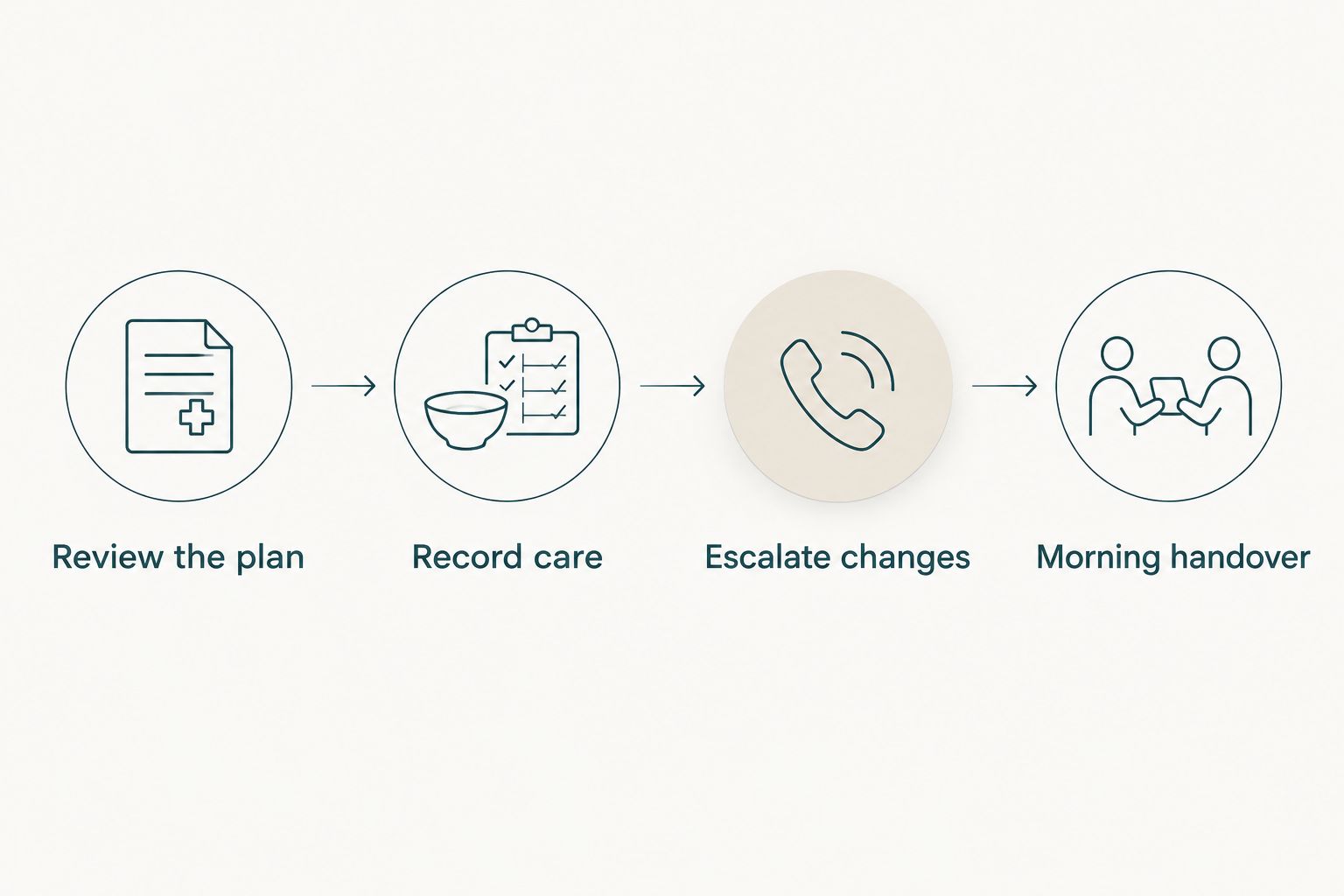
Expected result: the next caregiver receives a usable account of the night, not simply reassurance that everything was fine. The record also helps the clinician interpret concerns in context.
Updated instructions after a newborn review
Use a second handover whenever a clinician changes the feeding plan, medicines, monitoring or follow-up. This is an update workflow, not a reason to repeat the entire discharge process.
- Obtain the revised instruction. Ask the treating clinician to document the change and clarify when it takes effect.
- Mark the previous instruction as superseded. Retain it as history, but make the current version unmistakable. Do not leave conflicting plans side by side without explanation.
- Brief every relevant caregiver. Ask the receiving nurse and parent to explain the new instruction back in their own words. Resolve differences before the next care task.
- Check the next handover. Confirm that the morning summary and upcoming shift both refer to the revised plan.
This matters when care spans several people. A correct instruction is ineffective if the next person follows an older screenshot.
Expected result: every caregiver uses the same current plan, with the change traceable to the treating clinician.
Troubleshooting the discharge-to-night-care handover
The discharge documents contradict each other
Ask the discharging team to reconcile them. Do not choose whichever instruction seems easier, and do not ask the night caregiver to resolve a prescribing conflict independently. Record the clarified instruction and its source.
The baby is not feeding as expected
Check the written escalation instructions and seek prompt clinical advice for a change in feeding, particularly when the baby is difficult to wake or appears unwell. Do not respond by improvising a new feeding schedule or changing prescribed supplementation.
Parents and the caregiver disagree about safe sleep
Use the infant safe-sleep guidance, not personal experience, as the baseline. Return the baby to their own firm, flat sleep surface on their back; never use a sofa or armchair as an infant sleep space.
A symptom cannot wait for the morning review
A temperature of 38°C or higher in a baby under 3 months needs urgent medical assessment. Breathing difficulty, blue or grey colouring, or unresponsiveness requires emergency help; call 999 for an ambulance in the UAE. Do not delay urgent care while waiting for a provider reply.
The mother becomes unwell during the shift
Do not let attention to the newborn obscure maternal symptoms. Heavy bleeding, chest pain, breathing difficulty, collapse or a seizure requires emergency assessment. Keep maternal discharge warnings visible and establish who stays with the baby while help is arranged.
Customize your workflow
Build the 2026 workflow around the actual discharge instructions rather than adding tasks because they sound reassuring. More observations are not a substitute for a clear response plan. Ask the treating clinician what needs monitoring, how to record it and what action each concerning finding requires.
- Best for breastfeeding support: organise caregiver duties around the agreed feeding plan. Help with settling and nappies supports the parent, but it does not automatically remove overnight feeding participation.
- Best for shared caregiving: use one current care record and a named handover recipient. The benefit is continuity; the constraint is that every caregiver must update the same record consistently.
- Best for maternal recovery needs: include the mother’s instructions alongside, but separately from, the baby’s plan. Confirm the professional scope required rather than assuming newborn support includes all maternal clinical care.
If relatives also need help, arrange their responsibilities separately. An overnight newborn assignment should not quietly expand into unrelated household nursing tasks without a new assessment of duties.
FAQ
How do I move from maternity discharge to newborn night nurse care?
Transfer the written discharge instructions to the receiving nurse, confirm professional scope, and agree feeding, safe-sleep and escalation arrangements. Review the plan together at arrival and require a morning handover.
Can a newborn night nurse replace paediatric follow-up?
No. Newborn night care supports the discharge plan but does not replace scheduled paediatric reviews, screening or urgent medical assessment.
Will I need to wake up if I am breastfeeding?
Follow the individual feeding plan agreed with your maternity team. Overnight support can cover other care tasks, but it does not automatically remove the breastfeeding parent’s participation.
What should I check before arranging home newborn nursing in Dubai or Abu Dhabi?
Confirm the assigned professional’s current licence, newborn-care experience, permitted tasks and escalation arrangements. Ask how the provider handles clinical questions and changes of caregiver.
What temperature needs urgent assessment in a newborn?
A temperature of 38°C or higher in a baby under 3 months needs urgent medical assessment. Do not wait until the morning handover to seek help.
What should happen if the feeding plan changes after discharge?
Obtain the revised instruction from the treating clinician and mark the older plan as superseded. Brief every caregiver before the revised instruction is used.
Does DarDoc provide mother and newborn care at home?
DarDoc offers mother and newborn care at home in Dubai and Abu Dhabi. Confirm the specific nursing duties, overnight requirements and professional scope directly.
One last thing
Ask the receiving caregiver to explain the escalation plan back to you. Knowing where the discharge summary sits is not the same as knowing what to do when the baby seems unwell.
Before the first night of your 2026 plan, ask: who gets called, what cannot wait, and who looks after the baby if the mother needs urgent care? Clear answers reveal whether the handover is ready to use.