The most-asked question we get from prospective patients is some version of "how much does peptide therapy cost?" It arrives in WhatsApp messages, in DMs on Instagram, at the start of consultation calls, and in the comments on every clinic's website. It is a fair question. It is also one that no honest clinic can answer in a single number, because peptide therapy is not a single product. The price depends on the protocol, the duration, the specific peptide, the supplier, and the level of medical oversight involved. Quoting a flat figure on a webpage tends to mean one of three things: the clinic is offering a single off-the-shelf protocol that may or may not be the right protocol for the patient, the clinic is using a loss-leader price that does not include necessary clinical oversight, or the clinic is comfortable with looser cost transparency than a thoughtful patient should be.
This article is about how peptide therapy is actually priced in Dubai and Abu Dhabi in 2026: what the typical price ranges look like, what those numbers actually pay for, why the difference between AED 600 a month and AED 2,500 a month is real and significant, and how to think about whether a given price represents good value for your specific situation. The goal is not to advocate for a specific clinic. It is to make the cost conversation legible enough that you can have it with any clinic you are considering.
The honest answer: a range, not a number
Pharmaceutical-grade, physician-supervised peptide therapy in the UAE typically falls in the following price ranges. These are illustrative. Every clinic is slightly different, every protocol is slightly different, and the exact number depends on the specific peptide and the duration of the cycle.
Single-peptide protocols. Most monotherapy protocols, a single peptide for a defined indication, such as BPC-157 for tendon recovery or Ipamorelin for sleep and recovery, fall between AED 1,200 and AED 2,800 per month of treatment. The variation reflects the cost of the specific peptide, the dose, and the duration of the cycle.
Stack protocols. Combined protocols using two or more peptides, the Wolverine Stack (BPC-157 plus TB-500) for soft-tissue recovery, the CJC-1295 plus Ipamorelin combination for GH-axis support, the Glow Stack for skin quality, typically fall between AED 2,200 and AED 4,600 per month. The price reflects the cost of the additional peptides and any additional clinical oversight.
Specialty peptides. Some peptides are more expensive to source and produce than others. Thymosin Alpha-1, for example, tends to sit at the upper end of the range. Topical formulations such as GHK-Cu serum follow different pricing logic from injectable peptides and are typically billed per bottle rather than per month.
Initial consultation. Few UAE clinics, including DarDoc, offer the initial physician consultation at no charge, on the basis that the consultation is a screening step rather than a treatment in itself. Some clinics charge between AED 300 and AED 800 for the initial consultation. Either model is defensible; the question is whether the consultation includes a proper review of medical history, current medications, treatment goals and any indicated laboratory work.
Laboratory work. Some peptide protocols require baseline blood work before starting and follow-up testing during the protocol. Where indicated, laboratory work typically adds AED 400 to AED 1,500 to the initial cost depending on the breadth of the panel. Not every protocol requires laboratory work, and a clinic that mandates the most expensive panel for every patient should be questioned.
These figures are for pharmaceutical-grade, clinically supervised therapy from a UAE-licensed compounding pharmacy with cold-chain delivery. The grey-market alternative, vials purchased online from research-grade suppliers, with no clinical oversight, no batch testing and no cold-chain, typically costs between AED 200 and AED 600 per vial. The price difference is real and worth understanding.
What the price actually pays for
The most useful way to think about peptide therapy pricing is to break the cost into its constituent parts. Every reputable UAE clinic is paying for the same set of inputs, and the variation in final price reflects how those inputs are weighted, not whether they exist.
The peptide itself. The active pharmaceutical ingredient, the peptide raw material, is produced in a cGMP-certified facility, typically in the United States, Europe, or a small number of Asian facilities that meet international pharmaceutical manufacturing standards. cGMP-certified raw materials cost meaningfully more than research-grade equivalents, sometimes by an order of magnitude. The cost reflects the certification, the testing, the documentation and the regulatory oversight that goes into producing them.
Compounding by a licensed UAE pharmacy. The peptide is reconstituted, filtered, dispensed into sterile vials, sealed, labelled and tested by a licensed UAE compounding pharmacy operating under MOHAP and EDE oversight. The pharmacy is itself subject to inspection, must follow specific compounding standards, and must perform batch-level testing for sterility, potency and endotoxins. The per-vial cost is higher than research-grade compounding because the pharmacy carries the regulatory and quality-control overheads.
Cold-chain logistics. Peptides are sensitive biological molecules that degrade in heat and light. The product moves from the compounding pharmacy to the patient under temperature control at 2 to 8 degrees Celsius, with monitoring at each stage. The UAE summer makes this more expensive to maintain than equivalent logistics in cooler climates, and the cost is built into the price.
Physician oversight. The prescription is written by a physician licensed in the relevant emirate, after a documented consultation. The physician is available during the protocol for follow-up, dose adjustment, and management of any adverse reactions. Where the protocol requires laboratory monitoring, the physician reviews the results and adjusts accordingly.
Clinic operating costs. The clinic itself (premises, equipment, support staff, insurance, regulatory compliance) has fixed costs that get amortised across the prescriptions it produces. A clinic in a premium location in DIFC or Saadiyat Beach has higher operating costs than a clinic in Mirdif, and that difference shows up in the price.
A useful frame for evaluating any quoted price is to ask the clinic to break down what is included. A reputable clinic should be able to explain which costs are included in the headline figure (the peptide, the compounding, the delivery, the follow-up) and which costs are billed separately (the consultation, the laboratory work, repeat prescriptions). A clinic that cannot or will not break down the price is a clinic that is making the cost conversation harder than it needs to be.
Why 'cheaper online' is the wrong question
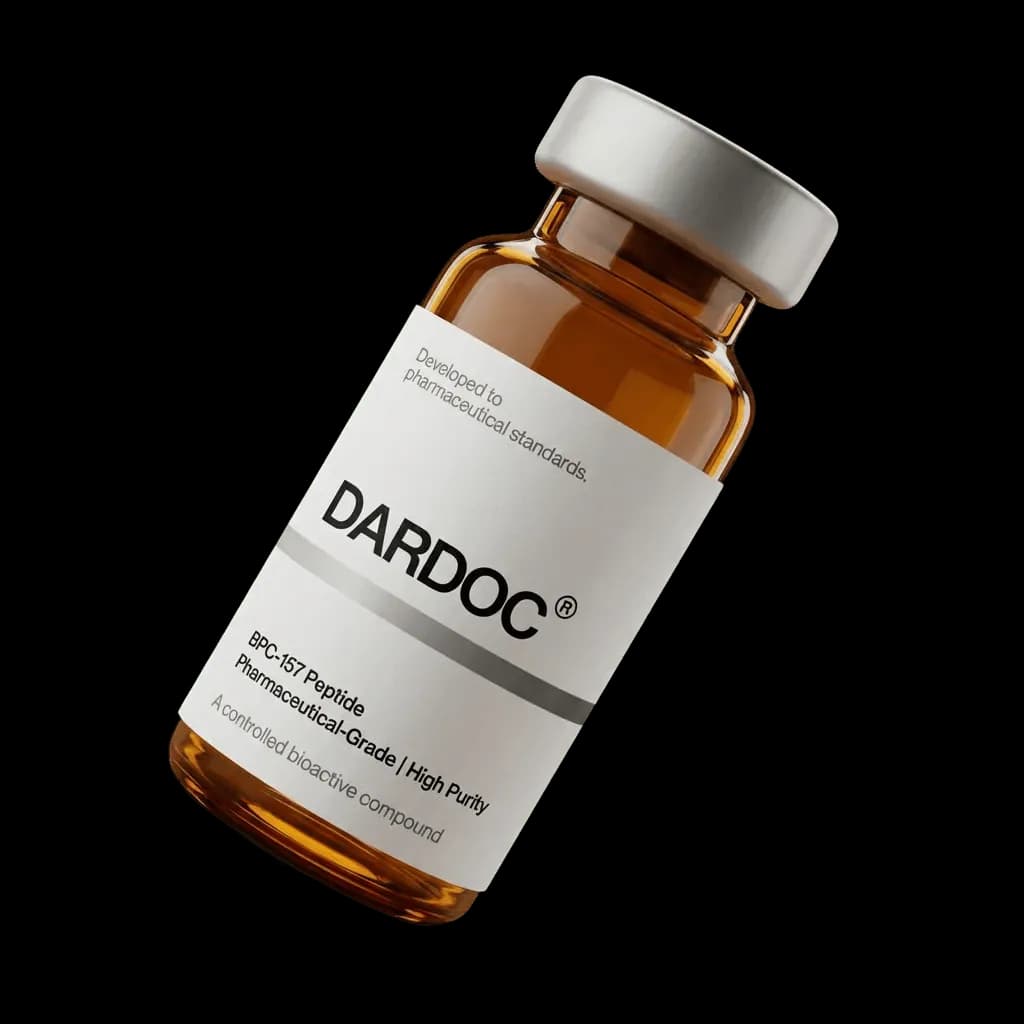
The cost gap between pharmaceutical-grade clinical therapy and research-grade online peptides is one of the first things prospective patients notice, and it is one of the most consistently misunderstood aspects of the peptide market. A vial of "BPC-157" purchased from an online vendor for AED 250 is not the same product as a vial of BPC-157 prescribed by a UAE-licensed physician and compounded by a UAE-licensed pharmacy for AED 1,500. The price difference is not arbitrary.
We have written separately about the difference between research-grade and pharmaceutical-grade peptides at the molecular level: what each term actually means, what it implies about identity, purity, sterility and potency, and how to read a Certificate of Analysis. The short version is that the framework that protects the patient (cGMP-certified raw material, licensed compounding, batch-level testing, cold-chain delivery, physician oversight) costs money to maintain, and the cost shows up in the price. The grey-market alternative is cheaper because it skips most of those frameworks.
The clinically honest version of the cost conversation is this: the price difference between online peptides and clinically supervised peptides is the safety margin. It is the cost of every quality-control step, every regulatory framework, and every clinical oversight mechanism that the grey market does not maintain. Whether the safety margin is worth paying for depends on how you think about risk, and on whether you trust an unverified vial enough to inject it. There is no objectively correct answer to that question, but there is a clinically honest one. The objectively correct question is not "why is it more expensive?" It is "what am I getting for the price difference?"
Speak to a DarDoc physician
How protocol design affects total cost
The headline monthly figure is one part of the cost. The other part is the structure of the protocol: how long it runs, whether it cycles, whether it requires laboratory monitoring, and whether it is a one-time intervention or a long-term programme. A clinically thoughtful protocol is shaped by the patient's needs, not by a default cycle length, and the total cost of treatment depends on the design.
Acute injury or recovery protocols. Soft-tissue recovery protocols using BPC-157, TB-500 or the Wolverine Stack typically run for four to twelve weeks for a specific indication. The total cost is the monthly figure multiplied by the number of months, plus any laboratory work and follow-up consultation. A patient with a partial rotator cuff tear who completes a twelve-week protocol might spend between AED 5,000 and AED 12,000 in total, depending on the specific stack and the clinic.
GH-axis recovery and sleep protocols. CJC-1295 plus Ipamorelin and similar protocols typically run for eight to ten weeks, followed by a break of several months before any repeat cycle. The total cost is the cycle cost, not an annualised figure. Patients sometimes assume the cost is open-ended; for most reasonable protocols, it is not.
Longevity and cellular health protocols. Epitalon and similar peptides are typically used in short, infrequent cycles, once every six months in the case of Epitalon. The total annualised cost is often lower than patients assume.
Topical aesthetic peptides. GHK-Cu serum and scalp foam are billed per bottle and used in cycle-on, cycle-off patterns over months. The total annualised cost depends on the cycling pattern and on whether the topical is used alongside an injectable protocol.
Maintenance protocols. Some patients move from an initial cycle to a maintenance pattern after the first response. Maintenance is typically less frequent and less expensive than the initial cycle, and a clinic that cannot articulate what maintenance looks like is a clinic that is leaving the patient on an open-ended protocol that may not be necessary.
The total cost of treatment is the more useful figure to focus on. A clinic that can quote you a per-month price but cannot quote you a per-protocol total is a clinic that is asking you to take the cost conversation in pieces rather than as a whole.
Insurance and peptide therapy in the UAE
The straightforward answer is that compounded peptide therapy is, in most cases, not covered by UAE health insurance. The reason is that compounded peptides are by definition not approved drugs. They are individually compounded for specific patients on physician prescription, and most insurance policies cover approved drugs and approved indications, not compounded medications and off-label use.
There are exceptions. Some peptides used in approved indications, for example, sermorelin in some growth-hormone deficiency contexts, or tesamorelin in HIV-associated lipodystrophy, may be covered when prescribed within the approved indication. Some premium private health insurance policies have broader compounding coverage. A patient with a specific medical indication that overlaps with a peptide protocol should ask their insurer in writing rather than assume coverage either way.
For most patients in the UAE, peptide therapy is an out-of-pocket health expense. That fact is part of the cost conversation, and it is worth being explicit about it before starting a protocol. The clinic should not be the source of the answer; the patient's insurer is.
Red flags in peptide pricing
Some pricing patterns are reliable indicators that something is off in the offering. A patient considering peptide therapy in the UAE should be alert to the following:
Prices that are dramatically below the typical range. A monthly peptide protocol quoted at AED 500 from a clinic in 2026 is not pharmaceutical-grade therapy. It is either research-grade peptides being represented as something else, a compounded product whose source cannot be verified, or a loss-leader offer that does not include the clinical oversight required to use the product safely. The cost of cGMP-certified raw materials alone makes pharmaceutical-grade therapy at that price genuinely difficult to provide.
Prices that bundle peptides into broader "wellness packages." Some clinics market peptide therapy as part of an annual membership that includes IV drips, vitamin injections, aesthetic procedures and other services. Bundling is not necessarily problematic, but it can obscure the cost of the peptide component and make it harder to evaluate whether you are paying a reasonable price for what you are actually getting. Ask for an itemised breakdown.
Pressure to commit to long packages. A clinic that pushes a six-month or twelve-month commitment up front, with no provision for review or adjustment, is operating on a sales model rather than a clinical model. A reasonable protocol has a defined initial cycle, a defined review point, and a clear plan for what happens at that review.
Prices that do not include the consultation, the laboratory work or the follow-up. A monthly figure that excludes everything around the prescription is not a useful figure. A clinic should be able to give you a total-protocol estimate that includes the prescription, any indicated laboratory work, the consultation and any follow-up appointments.
Refusal to provide a written quote. A clinic that quotes verbally but resists putting the cost in writing is a clinic that is leaving itself room to revise the figure later. A written quote, with itemised costs, is the baseline that any patient should expect.
How to think about whether the cost makes sense for you
The cost question is not, on its own, a clinical question. It is a personal question that depends on your specific situation. A useful framework has three parts.
The clinical case. Is there a defensible clinical reason to be on this protocol? Has it been considered alongside the conservative-care alternatives that should usually come first? Is the protocol appropriate to your specific health profile? If the answer to any of these is no or unclear, the cost question is premature. The clinical case has to be made before the cost question becomes interesting.
The expected outcome. What does success look like, and at what timescale? A protocol with no defined endpoint is one whose value cannot be evaluated against its cost. A reasonable protocol defines the expected response, the review point, and the criterion for continuing or stopping.
The opportunity cost. Money spent on peptide therapy is money not spent on other health investments. A patient with limited budget for health expenditure should be honest about the trade-offs. Sometimes the higher-leverage investment is sleep, structured strength training, a competent physiotherapist, or a different intervention entirely. A good clinic will tell you when that is the case, even though it costs them business.
The clinically honest version of the cost question is whether the protocol, at its quoted price, represents reasonable value for the specific clinical case in your specific situation. The price is a piece of information, not a verdict.
The bottom line
Peptide therapy in the UAE is not a single product with a single price. The typical cost ranges between AED 1,200 and AED 4,500 per month for pharmaceutical-grade, physician-supervised therapy, with significant variation by peptide, protocol and clinic. The price reflects the cost of cGMP-certified raw materials, licensed UAE compounding, cold-chain delivery, physician oversight and clinic operating costs. The grey-market alternative, research-grade peptides purchased online, is cheaper because it skips most of those frameworks, and the price difference is the safety margin.
The total cost of treatment is the more useful figure than the monthly price. A reasonable protocol has a defined cycle length, a defined review point, and a clear plan for what comes after the initial response. A clinic that cannot quote you a total-protocol figure, in writing, with itemised costs, is a clinic that is making the cost conversation harder than it needs to be.
The cost question is fair. The honest answer is more textured than a single number. If you are considering peptide therapy, ask the questions in this article, get the answers in writing, and decide based on the total picture rather than the headline figure. This article is educational. It is not medical advice for your specific situation.