A 36-year-old former rugby player walks into a Dubai sports-medicine clinic on a Tuesday morning. He plays in a casual touch-rugby league at a school field in Mirdif on Friday evenings, runs the Dubai Marina boardwalk three times a week, and has had a left hamstring that has been "never quite right" since a partial tear eight months ago. He has done the eccentric Nordic curls. He has had two rounds of platelet-rich plasma at a clinic on Sheikh Zayed Road. He arrives with a screenshot from an Instagram account run by an ex-pro from somewhere unverifiable, recommending TB-500 at a dose he has already worked out himself. His question is short: "Is this a thing?"
It is, in a way, a thing. TB-500 is one of the two peptides, alongside BPC-157, that drives the bulk of the soft-tissue recovery conversation in active-expat circles in the UAE. The marketing around it is loud, the cell-biology underneath it is genuinely interesting, and the clinical evidence base sits in an honest grey zone that any thoughtful physician has to be straight about. This is an evidence review, not a sales piece. The goal is to give you the temperature a careful clinician brings to the room when this conversation comes up.
Where the name comes from
The first thing to say about TB-500 is that the name is veterinary. The peptide marketed as TB-500 was originally developed and sold for use in racehorses, where it is used off-label by some trainers to support recovery from soft-tissue injury and is on the World Anti-Doping Agency prohibited list for human and equine athletic competition [WADA Prohibited List, 2024]. The compound that ended up in human peptide forums under the name TB-500 is a synthetic peptide marketed on the basis of being a fragment, or in some preparations the full sequence, of a much better-studied human protein called Thymosin Beta-4.
That distinction matters more than people realise. "Thymosin Beta-4" is the language of the cell-biology literature, where the molecule has been studied for decades. "TB-500" is the language of the supplement market, where the naming is loose and the active ingredient varies by manufacturer. Any honest clinical conversation about this peptide has to keep both names in view, because the evidence cited under one is not always describing the same molecule sold under the other.
What Thymosin Beta-4 actually is
Thymosin Beta-4 is a 43-amino-acid protein found in essentially every cell of the human body, with particularly high concentrations in platelets and in wound fluid [Goldstein et al., Nature Reviews Molecular Cell Biology, 2005]. It was first isolated from calf thymus in 1981, which is where the name comes from, although the protein turned out to be far more widespread than the thymus origin suggested. It is one of the most-studied actin-sequestering proteins in cell biology, and it sits at a pivotal point in how cells move, divide and reorganise after injury.
The mechanistic story has several parts and they all matter. Thymosin Beta-4 binds G-actin (monomeric actin), regulating the equilibrium between G-actin and F-actin (the filament form). That equilibrium is what allows a cell to remodel its cytoskeleton, and cytoskeletal remodeling is what allows a cell to migrate. Cell migration, in turn, is the rate-limiting step for repair cells getting to an injury site [Goldstein et al., 2005]. Beyond the actin story, Thymosin Beta-4 has been shown to upregulate laminin-5 (a basement membrane protein involved in epithelial repair), modulate inflammatory cytokine signaling, and promote the migration and differentiation of endothelial progenitor cells [Bock-Marquette et al., Nature, 2004]. It also has angiogenic properties, formation of new blood vessels, although less prominently than BPC-157.
Put together, the molecule appears to do three things that matter for tissue repair. It helps repair cells migrate to the injury site. It supports the early reorganization of the cytoskeleton in healing tissue. And it contributes, modestly, to the new blood-vessel formation that injured tissue depends on. That is a coherent and biologically interesting profile, and it explains why the molecule has been pursued seriously in clinical research.
TB-500 is not the same thing as Thymosin Beta-4
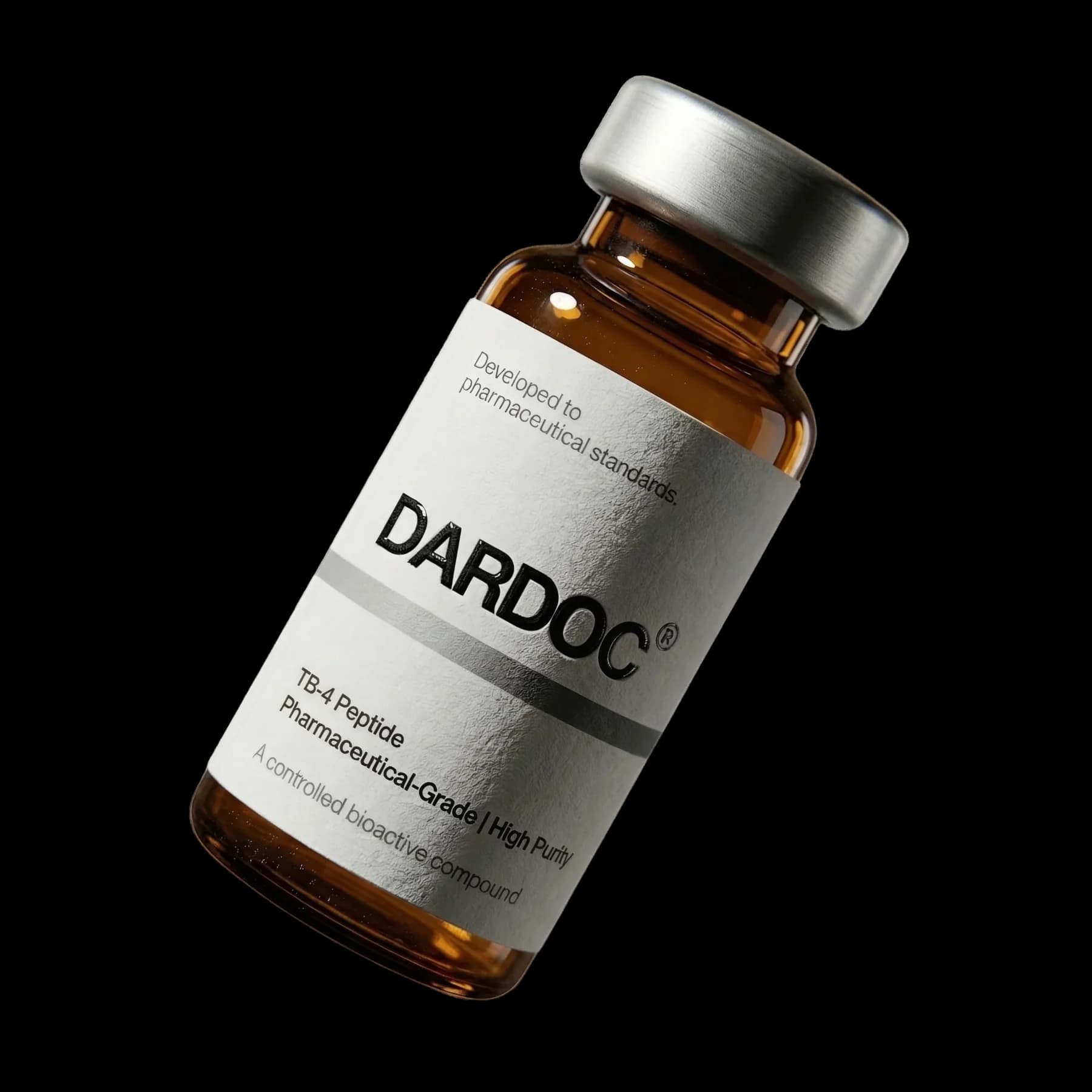
Here is where the honest version of this article diverges from the marketing version. The peptide sold in vials labelled TB-500 is, in most preparations, not the full 43-amino-acid Thymosin Beta-4 protein. It is most commonly a shorter active fragment built around the LKKTETQ sequence, the actin-binding domain of the parent protein. The fragment retains some of the parent molecule's actin-related activity but does not fully replicate the broader signaling profile that Thymosin Beta-4 has in its complete form.
Some compounded preparations do contain full-length Thymosin Beta-4. Others contain the shorter fragment. The labelling in the supplement market is inconsistent, the product naming is loose, and the end-user typically cannot verify which version is in the vial without a mass spectrometry assay. This is one of the central reasons the regulatory and supply-chain conversation matters for this peptide more than people assume. "TB-500" purchased online and "TB-500" prescribed by a UAE physician working with a licensed compounding pharmacy may not be the same molecule. They should be.
The evidence ladder
As with BPC-157, the Thymosin Beta-4 evidence base is a pyramid with a wide preclinical bottom and a narrow clinical top. The shape of the pyramid is, however, slightly different.
- Animal models. A substantial preclinical literature in rodents covering cardiac repair, corneal healing, dermal wound healing, central nervous system injury and skeletal muscle repair. Effect sizes vary by model, and independent replication outside any single research group is broader than for BPC-157.
- Cell-biology and mechanistic literature. The actin-sequestering, cell-migration and laminin-5 stories are well-characterised at the bench and have been replicated across multiple independent labs over more than two decades.
- Phase II human trials. Several. Indications include dry eye disease (where a topical formulation showed improvement in symptoms and signs), pressure ulcer healing, and acute myocardial infarction. Results have been mixed but generally favourable on the relevant endpoints [Sosne et al., Clinical Ophthalmology, 2015].
- Phase III randomized controlled trials. None completed, in any indication. There is no large, blinded, placebo-controlled human trial of Thymosin Beta-4, and certainly not of the TB-500 fragment, for any orthopaedic or sports-medicine application.
What this means in practice. A clinician who tells you TB-500 is "clinically proven" for tendon healing is wrong. A clinician who tells you the molecule has no real biology behind it is also wrong. Thymosin Beta-4 has more independent mechanistic replication than BPC-157 and arguably a closer-to-the-ground clinical evidence base in non-orthopaedic indications. For tendon, ligament, and muscle injury specifically, the human evidence is preclinical-heavy and case-series based, in the same way BPC-157's is.
The soft-tissue indications, plainly
The indications for which TB-500 / Thymosin Beta-4 is most commonly discussed in clinic are partial muscle tears (hamstring, calf, gastrocnemius), chronic tendinopathy (Achilles, patellar, rotator cuff), ligament sprains in their post-acute phase, and post-operative tissue healing as an adjunct to standard care. The mechanistic case is strongest for injuries where impaired cell migration to the injury site is plausibly part of the problem, chronic tendinopathy and partial muscle tears in older athletes are the archetypes [Goldstein et al., 2005].
Two indications get less attention than they probably deserve. Cardiac repair, where Thymosin Beta-4 has been investigated in trial settings on the basis of its effects on endothelial progenitor cell migration, is interesting but not relevant to the off-label sports-medicine conversation. Corneal and ophthalmic healing has its own developed literature and is a separate clinical conversation. The peptide that ends up in an Instagram screenshot in a UAE patient's hand is almost always being discussed for hamstrings and tendons, and that is the conversation this article is about.
Why this matters in the UAE specifically
The active-expat patient in the UAE has a particular injury distribution that the soft-tissue peptide conversation maps onto with unusual neatness. Three patterns drive most of it.
Partial muscle tears in the 35-to-50-year-old recreational athlete. Hamstring and calf tears in the casual football leagues at sports cities and school grounds across Dubai and Abu Dhabi. Trail-running calf strains in the Hatta and Wadi Showka populations. Touch-rugby and 5-a-side football tears in the corporate Friday-evening leagues. The post-acute phase of these injuries, six to twelve weeks in, with the patient frustrated by a stalled recovery, is where TB-500 walks into the conversation.
Chronic tendinopathy in active expats. The padel-driven epicondylitis, the CrossFit-driven supraspinatus and biceps tendon irritation, the running-driven Achilles and patellar tendinopathy. These are the same patient populations driving the BPC-157 conversation, and TB-500 is most often discussed alongside BPC-157 rather than as an alternative.
Post-operative recovery in elective orthopaedic patients. Increasingly common in the UAE, where the elective orthopaedic volume is high and patients are motivated to compress their return-to-sport timeline. The conversation here belongs to the operating surgeon, not to the patient's gym contact.
None of these patterns is unique to the UAE. The density and the typical patient profile, a 35-to-50-year-old professional with high training volume, low warm-up culture, good private healthcare access and a high tolerance for off-label conversations, is what gives the TB-500 question a particular weight in a Dubai or Abu Dhabi clinic.
Speak to a DarDoc physician
Routes of administration
Three routes appear in the literature, with very different evidence weight.
- Subcutaneous injection. The route used in the majority of preclinical work for systemic indications and the basis for any clinical protocol that takes the existing evidence seriously. Easy to dose, predictable absorption, the standard in compounded human use.
- Intramuscular injection. Used in some protocols for localised muscle injury, on the theory that delivery closer to the site of injury concentrates effect. The supporting evidence is largely empirical rather than trial-based.
- Topical and ophthalmic. Has its own developed literature for dry eye and corneal healing but is not part of the soft-tissue recovery protocol conversation. Topical TB-500 for tendon or muscle injury is not a defensible clinical use in 2026.
Treatment length and what "success" should look like
Most documented protocols for soft-tissue recovery using TB-500 / Thymosin Beta-4 run between 4 and 12 weeks, with the upper end reserved for chronic or complex injuries [Goldstein et al., 2005]. Acute injuries, a partial hamstring tear at six weeks post-injury, for example, typically sit at the shorter end. Chronic tendinopathy that has plateaued on twelve months of conservative care typically sits at the longer end. Open-ended use is not supported by the evidence base, and a protocol with no defined endpoint is a protocol that cannot be evaluated.
A reasonable plan defines what a positive response looks like at week four, week eight and week twelve. That might be a return-to-loading milestone, a pain-on-loading score that has improved by a defined threshold, an ultrasound or MRI follow-up at the appropriate interval, or a functional milestone such as a return to a specific training threshold. It should be defined before the first injection, not after. A clinic that puts you on TB-500 with no defined outcome and no review point is not running an injury-recovery protocol. It is running a subscription.
Side effects and safety
Across the available preclinical and human trial literature, Thymosin Beta-4 has a generally mild side-effect profile at therapeutic doses. The most consistently reported issues are local injection-site reactions and rare transient flu-like symptoms, with no serious adverse events at typical clinical doses [Sosne et al., 2015]. Allergic reactions are uncommon but possible.
The honest caveats are familiar. There is no long-term human safety data for daily subcutaneous use of either Thymosin Beta-4 or the TB-500 fragment at five or ten years. The angiogenic and cell-migration-promoting properties are the proposed mechanism for benefit and also the theoretical concern in patients with a personal or strong family history of malignancy. Anything that promotes cell migration and new blood vessel formation is a theoretical concern in the context of a tumour's biology, and the responsible default is caution. Patients with active or recent malignancy, a strong family history that warrants a different conversation, active autoimmune disease, or who are pregnant or breastfeeding should not be prescribed this peptide outside a research setting.
The MOHAP, DHA and DoH regulatory reality
TB-500 / Thymosin Beta-4 is not an FDA-approved drug. The FDA has issued guidance classifying many compounded peptides as falling outside the bulk-substances list eligible for compounding by 503A pharmacies in the United States [FDA Guidance on Compounded Peptides, 2023]. It is also on the World Anti-Doping Agency prohibited list, which means competitive athletes subject to WADA testing should not use it without a therapeutic-use exemption [WADA Prohibited List, 2024]. That is not a clinical prohibition for non-competitive patients, but it is a frame the prescribing physician needs to know about and discuss with any patient who participates in tested sport.
In the UAE, TB-500 sits in the compounded category. A licensed clinic working with a licensed UAE compounding pharmacy can, in principle, prescribe and dispense it for off-label use after a documented physician consultation. Three things should be true of any UAE clinic that prescribes it. The clinic should be DHA-, DoH-, or MOHAP-licensed and able to evidence it. The compounding pharmacy should be UAE-licensed and operating under MOHAP and EDE oversight, with batch-level testing for sterility, potency and endotoxins. The supply chain should be cold-chain controlled at 2-8°C from compounding to administration. If any one of those three is missing, what you are buying is a vial of something, of unknown content, with unknown quality control.
The World Health Organization has flagged the Eastern Mediterranean as a hotspot for substandard and falsified medical products [WHO, 2017], and TB-500 is particularly easy to mislabel because the active ingredient varies even in legitimate preparations. The cheapest vial on offer is almost always the one that has skipped at least one of those three controls. The price difference is the safety margin.
Who TB-500 is, and isn't, for
A reasonable case for considering TB-500 / Thymosin Beta-4 looks like this. A patient with a documented soft-tissue injury, partial muscle tear, chronic tendinopathy, post-acute ligament injury, confirmed where appropriate on ultrasound or MRI. The patient has plateaued on a properly executed course of conservative care: structured physiotherapy, eccentric loading, activity modification, and where appropriate platelet-rich plasma or other standard interventions. The patient has no malignancy history, no active inflammatory or autoimmune condition that would change the calculus, and is not pregnant or breastfeeding. The patient is not subject to anti-doping testing without an appropriate therapeutic-use exemption. The conversation includes informed consent that the evidence is preclinical-heavy and that the protocol is off-label.
An unreasonable case looks like this. Prophylactic use in a healthy athlete with no underlying injury. Use in any patient with active or recent malignancy, or a strong family history that warrants a different conversation. Use in pregnancy or breastfeeding. Use in a child or adolescent. Use as a substitute for a proper diagnostic workup, including imaging, when imaging is indicated. Use to train through an injury rather than to recover from one. Use in a competitive athlete subject to WADA testing without a therapeutic-use exemption.
The single most common mistake in the TB-500 conversation is the same as the BPC-157 conversation: reaching for the peptide before the basics have been done. Most soft-tissue injuries improve with structured loading, time and discipline. The peptide question belongs at the end of the conservative-care conversation, not the beginning.
The bottom line
TB-500 is the marketing name for a compound sold as either a fragment or the full sequence of Thymosin Beta-4, a well-studied 43-amino-acid signaling protein with a respectable cell-biology pedigree and a real but preclinical-heavy clinical evidence base in soft-tissue recovery. The molecule's mechanistic story, actin-sequestering, cell-migration support, modest angiogenesis, laminin-5 upregulation, is independently replicated and interesting. The phase III randomized human trial in tendon or muscle injury does not exist. The peptide is not FDA-approved. It is on the WADA prohibited list. It carries the regulatory and supply-chain caveats that come with any compounded research-grade peptide therapy in the UAE.
It is reasonable to consider for the right patient, after the basics, with a licensed physician, a licensed compounding pharmacy, cold-chain integrity, a defined endpoint, awareness of WADA implications where relevant, and explicit informed consent. It is not reasonable as a shortcut, a prophylactic, or a vial bought from someone who knows someone at a gym.
If you are thinking about TB-500 for a specific injury, the first conversation is not about the peptide. It is about your diagnosis, what you have already tried, and whether the basics have been properly done. The second conversation is about whether the peptide is a sensible adjunct in your specific situation. Those conversations belong with a DHA-, DoH-, or MOHAP-licensed clinician who knows the literature, the regulatory frame and your medical history. This article is educational. It is not medical advice for your specific situation.