How long does it take to see results from peptide therapy?
How long does it take to see results from peptide therapy? Timing depends on the medicine and goal. Learn what to track and when to ask for a review.

There is no single answer to how long does it take to see results from peptide therapy: the timeline depends on the exact medicine, the condition being treated, and what you count as a result. في 2026, a responsible estimate must distinguish an early symptom change from a measurable clinical outcome; for experimental peptides, a reliable human treatment timeline has not been established.
TL;DR- How long does it take to see results from peptide therapy? The exact medicine and treatment goal determine the answer.
- Semaglutide has human weight-management evidence; experimental recovery peptides do not share its established treatment timeline.
- Track measurable outcomes and side effects separately. Feeling different does not prove that treatment is working.
- DarDoc provides home and online healthcare for UAE families; medication decisions need an individual clinical assessment.
لماذا يهم هذا؟
فحص A promise of results within a fixed window means little unless it names the peptide, dose, diagnosis, and outcome. Less hunger, a change on the scales, a hormone result, and a healed tendon are different endpoints. Evidence for one cannot establish the timeline for another.
Before starting treatment in the UAE, separate the medical question from the regulatory question. The guide to whether peptide therapy is legal في الإمارات explains the checks to discuss with a provider. A clinic offering a treatment does not, by itself, establish its approval status or effectiveness.
For a treatment decision in 2026, ask for evidence about the exact medicine and intended use—not peptide therapy as a category.
How long does it take to see results from peptide therapy?
The useful answer is a medicine-specific review plan, not a universal countdown. Prescription peptide medicines with established clinical uses have dosing schedules and human trial outcomes. Experimental compounds advertised for recovery or anti-ageing do not automatically have comparable evidence.
| Medicine or compound | What the evidence supports | What the timeline does not establish |
|---|---|---|
| Semaglutide for weight management | Human trials measure weight change during sustained treatment alongside lifestyle support | A trial endpoint is not the date every patient first notices a benefit |
| BPC-157 for tendon recovery | Preclinical research does not establish a reliable human tendon-healing timetable | Animal findings cannot justify a promised recovery date in people |
| CJC-1295 or ipamorelin for recovery | Hormone-related findings do not establish a dependable timeline for better recovery, sleep, or body composition | A laboratory change does not prove a patient-important benefit |
These are evidence comparisons, not treatment recommendations. Do not choose a peptide because its advertised timeline is shorter. Choose an appropriate treatment only after a clinician has established the diagnosis, assessed suitability, and explained the evidence and risks.
What counts as seeing results?
Use an outcome that matches the reason for treatment. For weight management, that includes weight trends and relevant health measures. For an injury, it includes function, symptoms, and examination findings—not simply whether an injection produced a sensation.
An early subjective change can be useful information, but it is not proof of lasting benefit. A good review asks whether the change is meaningful, whether it persists, and whether treatment remains safe.
Semaglutide: a staged dose schedule, not an instant
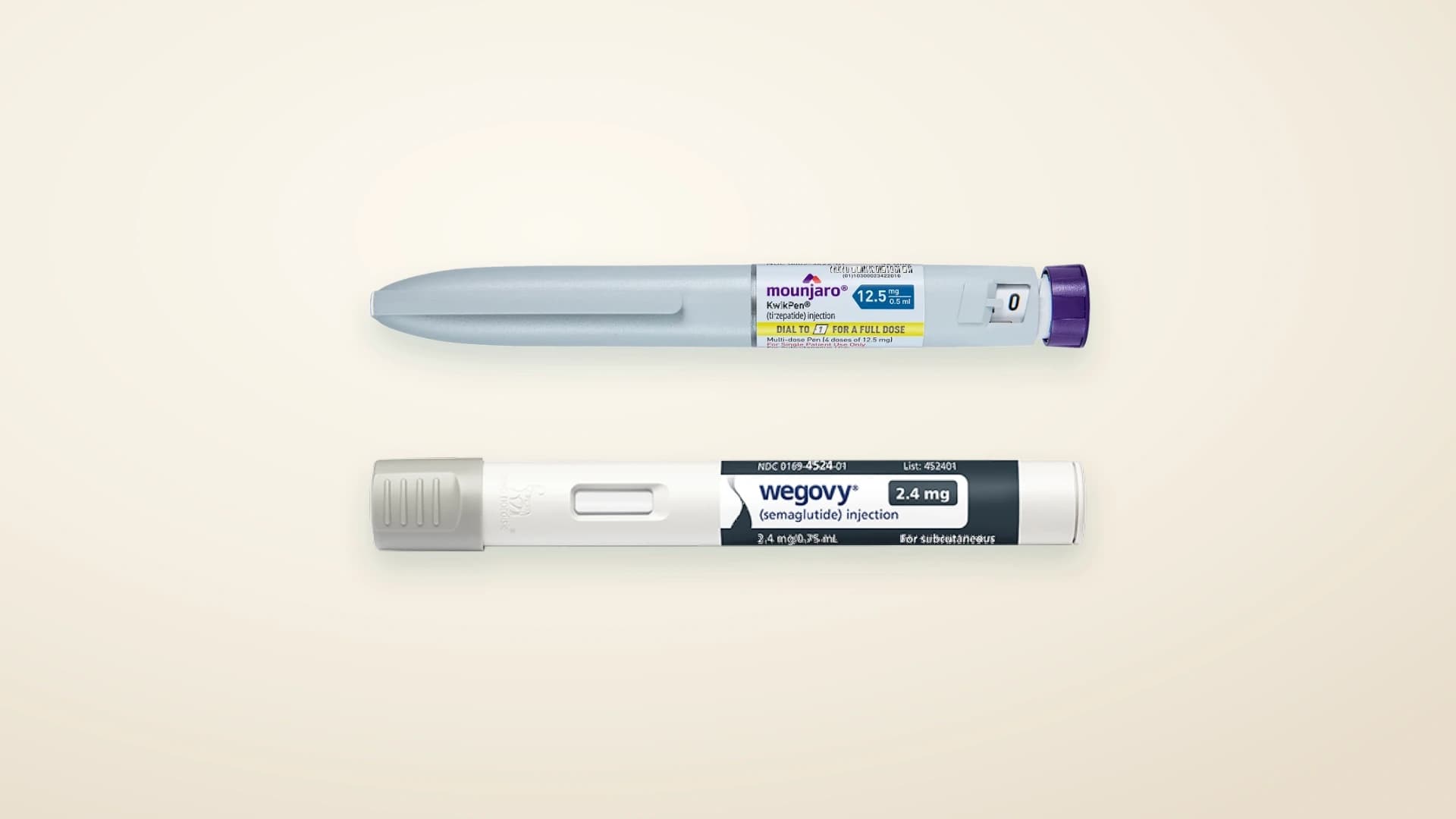
Semaglutide is a peptide-based medicine, but its evidence should not be applied to unrelated compounds sold under the same broad label. Its weight-management studies evaluate a specific medicine, population, dosing regimen, and clinical outcome.
The prescribing information for the standard once-weekly injectable Wegovy schedule uses 4-week dose stages, with escalation toward the maintenance dose over 16 weeks. These are dosing intervals, not guaranteed result deadlines. Your prescriber determines whether escalation is appropriate; side effects can require a different plan.
في the New England Journal of Medicine's STEP 1 trial, adults with overweight or obesity without diabetes received semaglutide or placebo alongside lifestyle intervention. The main weight-change assessment was at 68 أسبوعاً. That endpoint shows the duration over which the study assessed treatment; it does not mean results begin only at that point.
The practical distinction is important: appetite change, weight change, and the full treatment assessment need not happen together. Lack of an immediate visible difference is not a reason to increase your dose yourself.
الأنسب لـ: patients whose clinician has established that semaglutide is appropriate for weight management. Its strength is human clinical evidence; its limitations include adverse effects, contraindications, and variation in individual response.
BPC-157: no established human tendon-healing timeline
There is no reliable basis for promising that BPC-157 will repair a human tendon within a stated number of days or weeks. Preclinical findings are not a substitute for adequate human trials showing meaningful healing, improved function, and acceptable safety.
A tendon problem also needs a diagnosis. Pain can arise from different structures, and reduced pain does not necessarily mean that injured tissue has healed or is ready for unrestricted loading.
If you are considering BPC-157, ask the clinician to identify the human evidence for your specific condition and explain the uncertainties. An advertised recovery schedule is not clinical evidence. Do not let an injection plan replace appropriate examination, rehabilitation, or specialist review.
The proposed benefit is recovery support, but that claim lacks an established human treatment timetable. That uncertainty is a reason for caution, not a reason to keep extending treatment until something changes.
عدد النتائج: CJC-1295 and ipamorelin: hormone changes are not recovery
A compound affecting growth-hormone signalling does not automatically deliver better sleep, faster recovery, or improved body composition. Those outcomes require their own clinical evidence, measured in the people who would receive treatment.
This distinction matters when a provider presents a laboratory result as proof that treatment is working. A hormone measurement can show a biological effect without establishing that you are healthier, stronger, or recovering faster.
Ask which outcome the proposed treatment is meant to improve and how that outcome will be assessed. Do not accept a hormone change as a substitute for demonstrated clinical benefit. A dependable result timeline for a combined recovery protocol cannot be inferred from its mechanism alone.
Why the time to results varies
A useful timeline explains the reasons for variation rather than using them to excuse indefinite treatment. These factors belong in the discussion before you start:
- Exact medicine: different peptides act on different targets. Evidence and timelines do not transfer between compounds.
- Treatment goal: appetite, body weight, pain, physical function, and laboratory measurements represent different outcomes.
- الجرعة schedule: gradual escalation can delay assessment at a maintenance dose while helping manage tolerability.
- Starting condition: the diagnosis, its severity, and other health conditions affect how treatment should be assessed.
- Other treatment: nutrition, rehabilitation, activity, and other medicines can affect the outcome and make attribution difficult.
- Tolerance and adherence: missed doses, adverse effects, or a clinician-directed pause change the treatment course.
These factors do not make every outcome unpredictable. They explain why an individual review plan is more useful than a generic promise.
How should you track whether treatment is working?
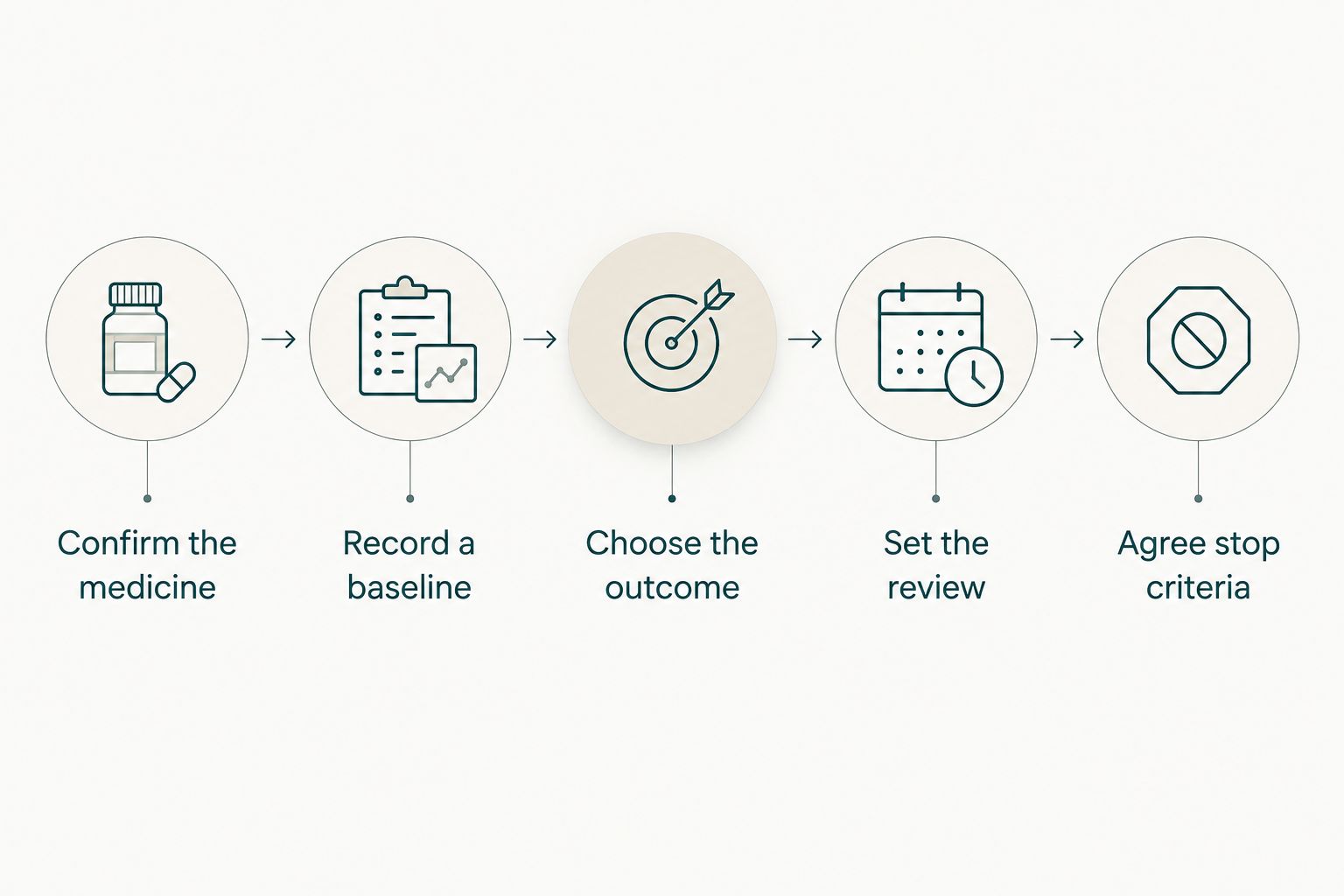
For a treatment plan started in 2026, record the starting point before judging progress. Without a baseline, ordinary fluctuations can look like improvement or failure.
- Confirm the medicine. Record the exact name, formulation, prescribed dose, and reason for treatment. A broad label such as recovery peptide is insufficient.
- Record a baseline. Choose measures relevant to the diagnosis, such as a weight trend, symptom record, or functional assessment.
- Choose the outcome. Agree what meaningful improvement would look like. Avoid vague targets such as feeling optimised.
- Set the review. Ask when the prescriber will assess benefit, adverse effects, adherence, and whether the dose remains appropriate.
- Agree stop criteria. Establish what requires earlier contact, a pause, or a change in treatment. Do not invent your own escalation schedule.
The review should assess both benefit and burden. An improvement that comes with unacceptable adverse effects does not automatically justify continuing treatment.
Keep benefit and side effects in separate records
Record a suspected benefit alongside its practical effect: what changed, whether it lasted, and what you could do differently. Record adverse effects separately, including their relationship to a dose or dose change.
This helps your clinician distinguish treatment response from tolerability. Nausea is not evidence of successful weight management, and injection-site discomfort is not evidence of tissue repair.
Does feeling better after the first dose prove it is working?
No—feeling better after the first dose does not establish a lasting treatment benefit. Symptoms fluctuate, expectations affect perception, and other changes in your routine can influence how you feel.
Tell your clinician about the change, but assess it against the agreed outcome. Continue monitoring rather than treating a single good day as proof that the treatment is effective or safe.
Should you increase the dose if results seem slow?
No—slow results are not a reason to increase the dose without your prescriber. The correct next step is to review the medicine, dose schedule, adherence, treatment goal, and adverse effects.
For an experimental peptide, more exposure does not resolve uncertainty about effectiveness. A clinician should also reconsider whether the diagnosis or treatment choice needs to change.
When should you stop waiting and seek medical advice?
Do not wait for a routine review if you develop a concerning reaction. Difficulty breathing, swelling of the face or throat, or collapse requires emergency assessment. Severe or persistent abdominal pain, repeated vomiting, or signs of an injection-site infection also require prompt medical attention.
For a non-urgent lack of progress, contact the prescriber at the agreed review point. Ask whether the treatment has had an adequate assessment and whether continuing is justified. A moving deadline without a clear clinical explanation is not a monitoring plan.
What should you ask a UAE provider before starting?
Check the clinician's licence with the relevant authority, such as DHA in Dubai or DoH in Abu Dhabi. Separately ask about the exact medicine's local regulatory status, source, intended use, and monitoring requirements. Clinician licensing does not establish approval for every compound a clinic discusses.
في 2026, your consultation should still answer the basic questions: What is being treated? What evidence supports this medicine? What outcome will be measured? What happens if it does not help?
DarDoc is best suited to UAE families seeking home and online healthcare. فحص DarDoc's stated services include GLP-1 weight-loss treatment and at-home bloods; that does not establish that every peptide discussed here is offered or appropriate for you. You can review دار دوك for its healthcare services without assuming a particular peptide prescription will follow.
أسئلة شائعة
How long does it take to see results from peptide therapy?
There is no single peptide-therapy timeline: the exact medicine, condition, dose schedule, and measured outcome determine the answer. Experimental recovery peptides do not have the same established human evidence as prescription medicines studied for specific indications.
Will I notice peptide therapy working after the first injection?
A change after the first injection does not prove a lasting clinical benefit. Record what changed and discuss it with your prescriber rather than using that experience to adjust your dose.
Does peptide therapy work faster at a higher dose?
A higher dose does not guarantee faster or better results and can increase risk. Follow the prescribed schedule and ask for a review if progress differs from the agreed plan.
How long should I wait for BPC-157 to heal a tendon?
A reliable human tendon-healing timeline for BPC-157 has not been established. Tendon symptoms need an appropriate diagnosis and a treatment plan supported by evidence for that condition.
فحص Are CJC-1295 and ipamorelin results proven by a hormone?
فحص A hormone alone does not prove improved recovery, sleep, or body composition. Those benefits require assessment of the actual clinical outcomes, not only a biological response.
Are weight-loss peptides and recovery peptides equally well studied?
No—evidence is specific to the medicine and indication. Semaglutide has human weight-management trials; those findings do not establish the effectiveness or safety of BPC-157 or a recovery-peptide combination.
Can DarDoc help with weight-management care in the UAE?
DarDoc's stated services include GLP-1 weight-loss treatment and home and online healthcare in the UAE. An individual assessment is needed to decide whether medication is appropriate and what monitoring is required.
نقطة أخيرة
A study's final measurement date is not a countdown to your first result. It tells you when researchers assessed an outcome, not when every participant improved.
Before accepting any peptide-therapy plan in 2026, ask for the exact medicine, the intended outcome, the evidence, and the review criteria in writing. A clear answer gives you something more useful than a promised date: a way to judge whether treatment deserves to continue.