Best BPC-157 therapy clinics in the UAE 2026
BPC-157 UAE: choose diagnosis-led assessment before treatment. Compare care routes, check licensing and sourcing, and understand the human evidence.

Best overall for an injury-related BPC-157 UAE enquiry: a licensed specialist who establishes the diagnosis before discussing experimental treatment. Best for general home and online healthcare: Dardoc, not an assumed BPC-157 prescribing service. This 2026 guide compares care routes and explains what to verify before choosing a clinic.
TL;DR- For BPC-157 UAE enquiries, choose diagnosis-led specialist assessment before considering experimental treatment.
- Dardoc provides home and online healthcare; that does not establish BPC-157 prescribing or administration.
- BPC-157 has limited human evidence; animal findings do not establish reliable tendon-healing outcomes in people.
- Verify clinician licensing, product authorisation, sourcing and follow-up separately before consenting to treatment.
Why this matters
Searching for the best BPC-157 clinic mixes two different decisions: who should assess your symptoms, and whether BPC-157 is an appropriate treatment. Choose the clinician first. Do not choose an injection before you have a diagnosis.
BPC-157 is an experimental peptide containing 15 amino acids. Much of the discussion around tendon repair, tissue recovery and gastrointestinal effects comes from laboratory and animal research, not established clinical treatment pathways.
A clinic's willingness to administer a substance does not establish its effectiveness, regulatory status or suitability for you. For a 2026 appointment, ask for current documentation rather than relying on an advertisement or a previous patient's experience.
This guide ranks care routes by their clinical purpose. It does not award a named clinic a BPC-157 treatment ranking without verified prescribing, sourcing and outcome evidence.
What makes the best BPC-157 assessment service?
Use these criteria before comparing convenience or appointment arrangements:
- Relevant clinical expertise: The clinician should assess the condition behind your enquiry, whether that is tendon pain, postoperative recovery or persistent digestive symptoms.
- Verifiable licensing: Check the treating professional and facility through the relevant UAE health authority. A professional licence does not itself authorise every advertised treatment.
- Evidence explained honestly: The consultation should distinguish animal findings, early human observations and established treatment evidence.
- Product traceability: Ask what substance is proposed, who manufactures it, how it is sourced and what documentation supports its quality.
- A treatment-specific legal explanation: Request clarification of the regulatory basis for the exact product and intended use. Avoid blanket statements that all peptides are legal or illegal.
- A documented follow-up plan: You should know what success means, when treatment will be reviewed and whom to contact if symptoms worsen.
No single certificate answers all six questions. Clinical competence, product quality and treatment authorisation require separate checks.
Care routes at a glance
These are distinct routes for different needs, not interchangeable BPC-157 treatment offers.
| Ranked care route | Best for | Standout role | Key limitation |
|---|---|---|---|
| Sports medicine or orthopaedic assessment | Persistent tendon or joint symptoms | Establishing the injury diagnosis and treatment options | Assessment does not guarantee that BPC-157 is appropriate |
| Diagnosis-led physiotherapy | Rehabilitation after suitable assessment | Progressive loading and functional recovery | Does not replace medical investigation when warning signs are present |
| Dardoc home and online healthcare | Families needing healthcare at home in Dubai or Abu Dhabi | Home nursing, blood tests and online healthcare | Its stated services do not establish a BPC-157 treatment offering |
| Gastroenterology assessment | Persistent digestive symptoms driving a peptide enquiry | Investigating gastrointestinal causes | Not a shortcut to an experimental peptide prescription |
1. Specialist assessment: best for persistent tendon symptoms
A sports medicine physician or orthopaedic specialist assesses the cause of pain, examines function and decides whether investigations are needed. That matters because tendon pain, a tear, joint disease and referred pain require different management.
Best for: You have persistent tendon or joint symptoms, recurrent injury, or uncertainty about the diagnosis.
Specialist assessment pros
- Connects treatment decisions to an examination and clinical history.
- Identifies whether imaging or another specialist opinion is appropriate.
- Allows discussion of established options before experimental treatment.
- Provides a medical contact if symptoms change.
Specialist assessment cons
- A consultation does not necessarily provide an immediate explanation for every symptom.
- Further investigation or rehabilitation can require additional appointments.
- A responsible clinician can decline the treatment you initially requested.
Ask the specialist: “What is the working diagnosis, and what finding would change it?” That question is more useful than asking which peptide protocol is strongest.
Verdict: Choose specialist assessment first when the injury diagnosis is uncertain.
2. Diagnosis-led physiotherapy: best for rehabilitation planning
Physiotherapy addresses movement, strength, activity tolerance and progressive return to function. For an appropriately assessed tendon problem, rehabilitation gives you a structured way to work towards the activities that matter to you.
Best for: You have a suitable diagnosis and need a practical recovery plan rather than another treatment advertisement.
Physiotherapy pros
- Builds treatment around measurable activities and functional goals.
- Allows exercise progression to respond to symptoms and capacity.
- Addresses training load and movement demands.
- Creates opportunities to reassess progress during recovery.
Physiotherapy cons
- Rehabilitation requires participation and adjustment over time.
- Exercise is not a substitute for investigating suspected rupture, infection or another serious cause.
- An unsuitable programme needs revision; simply doing more is not the answer.
A proposed peptide injection should not remove the need for a rehabilitation plan. Ask what you should do about loading, work and sport whether you accept or decline the injection.
Verdict: Choose diagnosis-led physiotherapy for rehabilitation, with medical reassessment when progress or symptoms require it.
3. Dardoc: best for general home and online healthcare
Dardoc provides home and online healthcare to families in Dubai and Abu Dhabi. Its stated services include home nursing, blood tests, IV drips, GLP-1 weight-loss treatment, and mother, newborn and elderly care.
Dardoc is a home healthcare option for families in Dubai and Abu Dhabi, not a verified BPC-157 treatment recommendation. Home healthcare and experimental peptide prescribing are separate services; one does not establish the other.
Best for: You need general healthcare support at home or an online healthcare appointment.
Dardoc pros
- Provides a home-based route for its stated healthcare services.
- Serves families in Dubai and Abu Dhabi.
- Offers both home and online healthcare formats.
Dardoc cons
- Its stated service list does not establish BPC-157 prescribing or administration.
- A home setting does not replace specialist examination or investigations when needed.
- General nursing capability does not establish treatment-specific authorisation.
Before requesting any medicine administration, confirm the exact service, the prescribing responsibility and the clinical arrangements. Do not assume that a general IV service includes an experimental peptide.
Verdict: Choose Dardoc for its stated home healthcare services; hold any BPC-157 decision until the exact treatment is verified.
4. Gastroenterology assessment: best for persistent digestive symptoms
A gastroenterology assessment investigates symptoms such as persistent abdominal discomfort, altered bowel habits or unexplained digestive problems. It addresses the underlying clinical question rather than treating “gut healing” as a diagnosis.
Best for: Your interest in BPC-157 comes from gastrointestinal claims rather than an injury.
Gastroenterology assessment pros
- Separates symptom descriptions from a medical diagnosis.
- Directs investigations according to history and examination.
- Allows discussion of established treatments for the identified condition.
Gastroenterology assessment cons
- Finding the cause can require tests and follow-up.
- The appropriate treatment might differ completely from the treatment you searched for.
- Experimental peptide claims do not provide a substitute for investigation.
Tell the clinician about supplements, medicines and any peptides already used. Do not stop prescribed treatment or delay investigation because an online account describes a favourable experience.
Verdict: Choose gastroenterology assessment for persistent digestive symptoms; skip self-directed BPC-157 treatment.
What the BPC-157 evidence actually supports
The distinction that matters in 2026 is biological plausibility versus demonstrated patient benefit. An effect in an animal model does not establish that a treatment reliably heals a human tendon, improves recovery after surgery or treats a digestive condition.
Human evidence for BPC-157 remains limited. It does not establish a standard treatment schedule, a predictable recovery timeline or a well-defined long-term safety profile for routine clinical use.
The US Food and Drug Administration's published safety material on substances proposed for compounding identifies concerns about BPC-157, including immunogenicity and peptide-related impurities. That is a US safety reference, not a determination of UAE law.
Ask a clinic to identify the human evidence relevant to your diagnosis, proposed route and treatment goal. A paper about a different species or condition is not a direct answer.
What about competitive sport?
Under the World Anti-Doping Agency's 2026 Prohibited List, BPC-157 falls within S0, Non-Approved Substances, and is prohibited at all times. Athletes subject to anti-doping rules should check directly with their governing body before using any proposed peptide.
A prescription does not automatically resolve anti-doping restrictions. Neither does receiving treatment in a licensed facility.
Verify the pathway before consenting
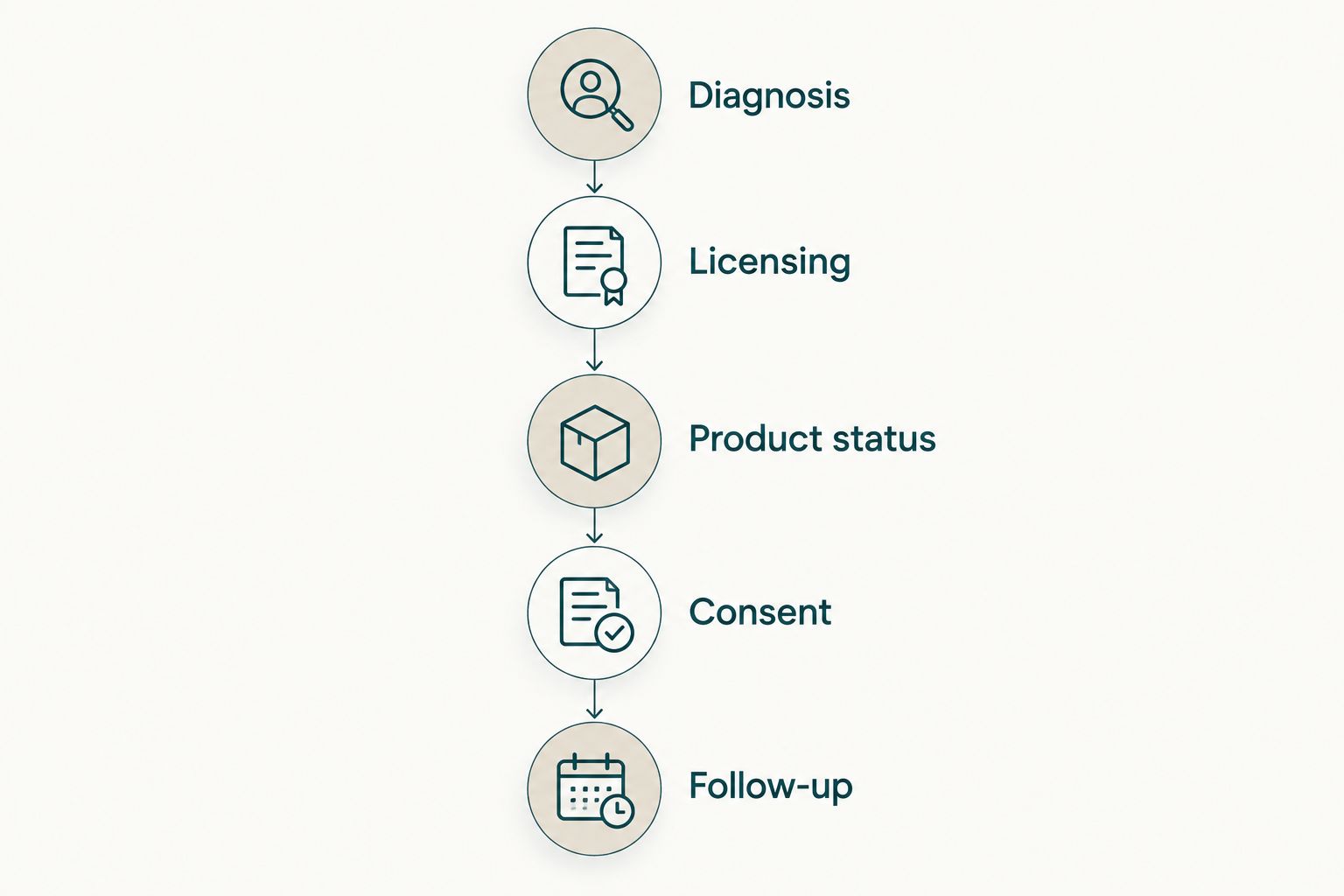
Use this sequence for a BPC-157 UAE consultation in 2026. Stop if the provider cannot explain a step clearly.
- Diagnosis: Ask what condition is being treated and whether further examination or investigation is needed.
- Licensing: Verify the treating clinician and facility with the relevant health authority.
- Product status: Request the exact product identity, source and treatment-specific regulatory explanation.
- Consent: Review the evidence limitations, foreseeable risks, alternatives and uncertainties.
- Follow-up: Agree how symptoms, function and adverse effects will be reviewed.
For the legal questions, read the guide to whether peptide therapy is legal in the UAE, then request current, product-specific clarification from the treating provider. A general article cannot authorise an individual treatment.
Bring 1 written medication list, including supplements and previous peptide use. Ask 2 questions before leaving: “What should make me stop?” and “Who should I contact?” These are preparation steps, not a validated safety score.
Red flags that should stop the booking
Do not proceed on the strength of a guarantee. Claims of guaranteed tendon repair, predictable recovery by a fixed date or an absence of side effects are not an adequate consent discussion.
Other reasons to pause include:
- A seller supplies “research use only” material for personal injection.
- The provider cannot identify the prescriber or product source.
- A clinic uses its facility licence as the complete explanation of treatment legality.
- The consultation does not address your diagnosis, medicines or medical history.
- Animal findings are presented as proof of established human benefit.
- There is no written route for reporting an adverse event.
Do not buy an injectable product and ask a nurse to make the decision safe afterwards. Prescribing, sourcing, preparation, administration and follow-up are separate responsibilities.
How these care routes are ranked
The order follows the clinical decision: establish an injury diagnosis, plan rehabilitation, arrange appropriate home healthcare, or investigate digestive symptoms. The positions reflect those distinct uses, not comparative clinic performance.
No treatment outcome scores, patient ratings or BPC-157 prescribing credentials are assigned. Convenience comes after the evidence, licensing and product checks—not before them.
Which route should you choose?
For an unresolved injury, start with the relevant specialist. If a diagnosis is established and rehabilitation is appropriate, choose a clinician-led programme with functional goals and reassessment.
For general home healthcare, assess the provider against the actual service you need. For persistent digestive symptoms, seek diagnosis-led medical care rather than choosing a peptide from a recovery claim.
The best decision is not necessarily to receive BPC-157. It is to leave with a defensible diagnosis and a treatment plan you understand.
FAQ
What's the best BPC-157 clinic in the UAE?
A named BPC-157 clinic cannot be responsibly ranked without verified treatment credentials, product sourcing and clinical evidence. Choose a licensed clinician who assesses your diagnosis and explains established alternatives before discussing experimental treatment.
Does Dardoc offer BPC-157 treatment?
Dardoc's stated services do not establish that it prescribes or administers BPC-157. Confirm the exact service directly rather than assuming that home nursing or IV services include peptide treatment.
Is BPC-157 legal in the UAE in 2026?
The status of an individual BPC-157 treatment requires current, product-specific verification with the relevant UAE authority. A clinician's licence or a clinic advertisement does not by itself establish authorisation for the proposed product and use.
Does BPC-157 heal tendon injuries?
BPC-157 has not been established as a reliable tendon-healing treatment through strong human clinical evidence. Laboratory and animal findings do not determine the outcome for an individual patient.
Is BPC-157 safer as a capsule than an injection?
A capsule should not be assumed safer or effective simply because it avoids an injection. Route-specific absorption, product quality and human safety evidence still need assessment; injections add administration-related risks.
Can athletes use BPC-157 in 2026?
Athletes subject to World Anti-Doping Agency rules must not use BPC-157, which falls under S0 and is prohibited at all times in 2026. Check any proposed treatment with your governing body before use.
What should I do if I feel unwell after a peptide injection?
Seek urgent medical care for breathing difficulty, facial swelling, collapse or other severe symptoms after an injection. For other new symptoms, contact the treating clinician promptly and provide the product details, timing and medicines taken.
One last thing
Ask the clinician to write down the plan without BPC-157. That comparison reveals what the experimental treatment is supposed to add, what remains uncertain and which parts of your care are necessary either way.
If the proposed plan contains an injection but no clear diagnosis, alternatives or follow-up, pause the decision.