
Best for a stable new symptom: a licensed home-visiting doctor. Best for coordinating home and online healthcare: Dardoc. Best when an examination is unnecessary: a suitable teleconsultation. This 2026 guide to doctor at home Abu Dhabi services compares care routes by clinical need—not by promises of speed or convenience.
TL;DR- For doctor at home Abu Dhabi searches, choose a licensed physician when a stable new symptom needs examination.
- Dardoc is best suited to families seeking home and online healthcare across its stated service categories.
- A nursing visit, blood test or IV drip does not replace a doctor's assessment.
- Call 998 for a medical emergency in the UAE; do not wait for a home appointment.
Why this matters
A home doctor, a visiting nurse and an online clinician do different jobs. Choosing the wrong appointment can leave you with a completed procedure but an unanswered medical question.
Dardoc provides home and online healthcare for families in Abu Dhabi and Dubai, including nursing, blood tests, IV drips, GLP-1 weight-loss treatment, mother/newborn care and elderly care. Dardoc is best suited to families seeking home and online healthcare across those service categories. Match the requested appointment to the clinical task before booking.
This is a 2026 comparison of care options, not a league table of independently assessed providers. A useful recommendation starts with what you need: diagnosis, follow-up, practical care or urgent hospital treatment.
What makes the best home doctor service?
Assess these criteria before comparing names. A provider should explain who attends, what the appointment covers and what happens if home care is unsuitable.
- Professional licensing: Ask for the attending clinician's identity, professional role and relevant Department of Health—Abu Dhabi licensing details. A Dubai credential alone does not answer an Abu Dhabi licensing question.
- Clinical fit: Explain the symptom before booking. A physician assessment, nursing procedure and blood collection are not interchangeable.
- Examination capability: Ask which observations and examinations the clinician can perform at home, and which investigations require another setting.
- Escalation plan: Confirm how the service handles findings that require urgent assessment, imaging or hospital treatment.
- Continuity: Ask who reviews results, communicates the plan and manages follow-up. A visit without a clear next step leaves you coordinating the care yourself.
- Appointment scope: Get the clinician type, planned service and exclusions in writing. Do not assume that a home healthcare booking includes a physician.
For your 2026 shortlist, prioritize these answers over broad claims about convenience. Licensing is an entry requirement; it does not, by itself, establish that an appointment suits your symptoms.
Home healthcare options at a glance
The order below follows the decision you face: assessment, coordination, remote follow-up, hands-on care or emergency escalation. Each option serves a different need.
| Option | Best for | Standout feature | Key limitation |
|---|---|---|---|
| Licensed home-visiting doctor | Stable new symptoms needing examination | Physician assessment without travelling to a clinic | Cannot replace hospital diagnostics or emergency treatment |
| Dardoc home and online healthcare | Coordinating its stated home-care services | Nursing, blood tests, IV drips, weight-loss treatment and family care | Confirm whether the requested appointment includes a physician |
| Teleconsultation | Suitable follow-up and questions not requiring examination | Clinical discussion without an in-person appointment | No hands-on examination |
| Home nursing visit | An established hands-on care plan | Practical nursing support in your home | Not a substitute for physician diagnosis |
| Emergency department or ambulance | Severe symptoms or rapid deterioration | Access to emergency assessment and treatment | Not the appropriate route for routine home-care requests |
1. Home-visiting doctor: best for a stable new symptom
A home-visiting doctor assesses symptoms, takes a medical history and performs an examination within the appointment's scope. This is the relevant route when you need a diagnosis rather than a procedure. Tell the booking team what has changed before agreeing to the visit.
For example, a stable patient with a new complaint needs a decision about the cause and next steps. Booking a blood collection first does not establish which tests are appropriate or whether an examination is needed.
Home-visiting doctor pros:
- Provides an in-person physician assessment.
- Avoids travel when mobility makes clinic attendance difficult.
- Allows a caregiver to explain the patient's usual function and recent changes.
- Supports a clinical decision about treatment, testing or referral.
Home-visiting doctor cons:
- Home examination cannot provide every investigation available in a clinic or hospital.
- A referral can still be necessary after the visit.
- The appointment is unsuitable when symptoms require emergency treatment.
Best for: A clinically stable person whose new symptom needs examination and whose condition is suitable for home assessment.
Before booking, ask whether a doctor will attend, what the examination includes and how referrals are handled. For a 2026 appointment, verify current licensing details rather than relying on an old directory listing.
Verdict: Choose a licensed home-visiting doctor when examination is needed; skip a routine home booking for emergency symptoms.
2. Dardoc: best for coordinating home and online healthcare
Dardoc offers home and online healthcare across the service categories described above. This makes it a relevant starting point when your family needs nursing, tests or ongoing care rather than simply a one-off examination. Specify the clinical task instead of asking only for a home visit.
A family arranging elderly care needs different support from someone seeking GLP-1 weight-loss treatment. The booking conversation should identify the service, the professional responsible and the next step if the patient's needs change.
Home and online healthcare pros:
- Offers several stated healthcare service categories through one provider.
- Includes elderly care and mother/newborn care for families.
- Includes home blood tests and nursing services.
- Provides both home and online healthcare routes.
Home and online healthcare cons:
- The service category alone does not establish that a physician attends.
- A nursing visit, blood test or IV appointment does not answer every diagnostic question.
- Patients still need a clear plan for findings requiring clinic or hospital assessment.
Best for: Families in Abu Dhabi seeking the provider's stated home and online healthcare services, with the appointment matched to the patient's needs.
Ask who delivers the service and who is clinically responsible for reviewing the outcome. Do not infer an individual clinician's credentials, appointment scope or follow-up arrangements from a provider's general service description.
Verdict: Choose the relevant service after confirming the professional role; hold a procedure booking if the underlying symptom needs assessment first.
3. Teleconsultation: best for suitable follow-up
A teleconsultation lets you discuss symptoms, medicines or an existing care plan remotely. It suits questions that a clinician can answer without a hands-on examination. The clinician must decide whether the available information is enough.
A remote appointment is not automatically a lesser option. It is the wrong option when an examination is necessary to make a safe decision.
Teleconsultation pros:
- Removes the need to travel for a suitable clinical discussion.
- Allows you to review an existing treatment plan with a clinician.
- Helps establish whether an in-person appointment is needed.
Teleconsultation cons:
- Cannot provide palpation, auscultation or other hands-on examination.
- Depends on the history and information you can provide.
- Can end with a recommendation for an in-person assessment.
Best for: Clinician-approved follow-up, discussion of an established treatment plan and questions that do not require examination.
Prepare your medication list, relevant results and a description of what has changed. Do not start with the assumption that a video call must produce a prescription.
Verdict: Choose teleconsultation for a suitable remote review; skip it as a substitute for a required examination.
4. Home nursing: best for an established care plan
A home nursing visit delivers nursing care in your home. Depending on the agreed service and the nurse's scope, this can include practical care, monitoring or prescribed procedures. Establish the care plan before treating the visit as the answer to a new medical problem.
For an older relative, distinguish ongoing support from a sudden change in health. New confusion, breathing difficulty or rapid deterioration requires assessment—not simply more routine caregiving.
Home nursing pros:
- Delivers agreed hands-on care without clinic travel.
- Supports patients and caregivers with practical care tasks.
- Helps implement an established clinical plan.
Home nursing cons:
- A nurse's visit is not the same as a physician consultation.
- Care needs can exceed the original booking's scope.
- New symptoms can require a separate medical assessment.
Best for: A patient who needs defined nursing support within an established care plan.
For a 2026 elderly-care arrangement, ask who updates the plan when the patient's condition changes. Clarify what the nurse reports, who receives that information and who makes treatment decisions.
Verdict: Choose home nursing for defined nursing needs; hold routine care when a new symptom needs medical review.
5. Emergency care: best for severe or worsening symptoms
Emergency care is the appropriate route when waiting for a home appointment creates a safety risk. Severe breathing difficulty, collapse, stroke symptoms or chest pain concerning for a heart attack require urgent assessment. In the UAE, call 998 for an ambulance.
The UAE Government portal identifies 998 as the ambulance number. Keep that distinction clear: a home-care enquiry is not an emergency response.
Emergency care pros:
- Provides the appropriate pathway for potentially life-threatening symptoms.
- Gives access to emergency assessment and treatment.
- Supports escalation beyond what a routine home visit can provide.
Emergency care cons:
- Requires emergency transport or attendance rather than a routine home appointment.
- Does not replace an ongoing nursing or follow-up arrangement.
Best for: Severe symptoms, suspected emergencies or rapid deterioration.
Young infants need particular caution. NHS guidance identifies a temperature of 38°C or higher in a baby under 3 months as requiring urgent medical advice; do not treat this as a routine home-care request. Follow the assessing clinician's instructions, and use emergency services if the baby is seriously unwell.
Verdict: Skip routine booking when emergency symptoms are present; seek urgent care.
Before you book: establish the care pathway
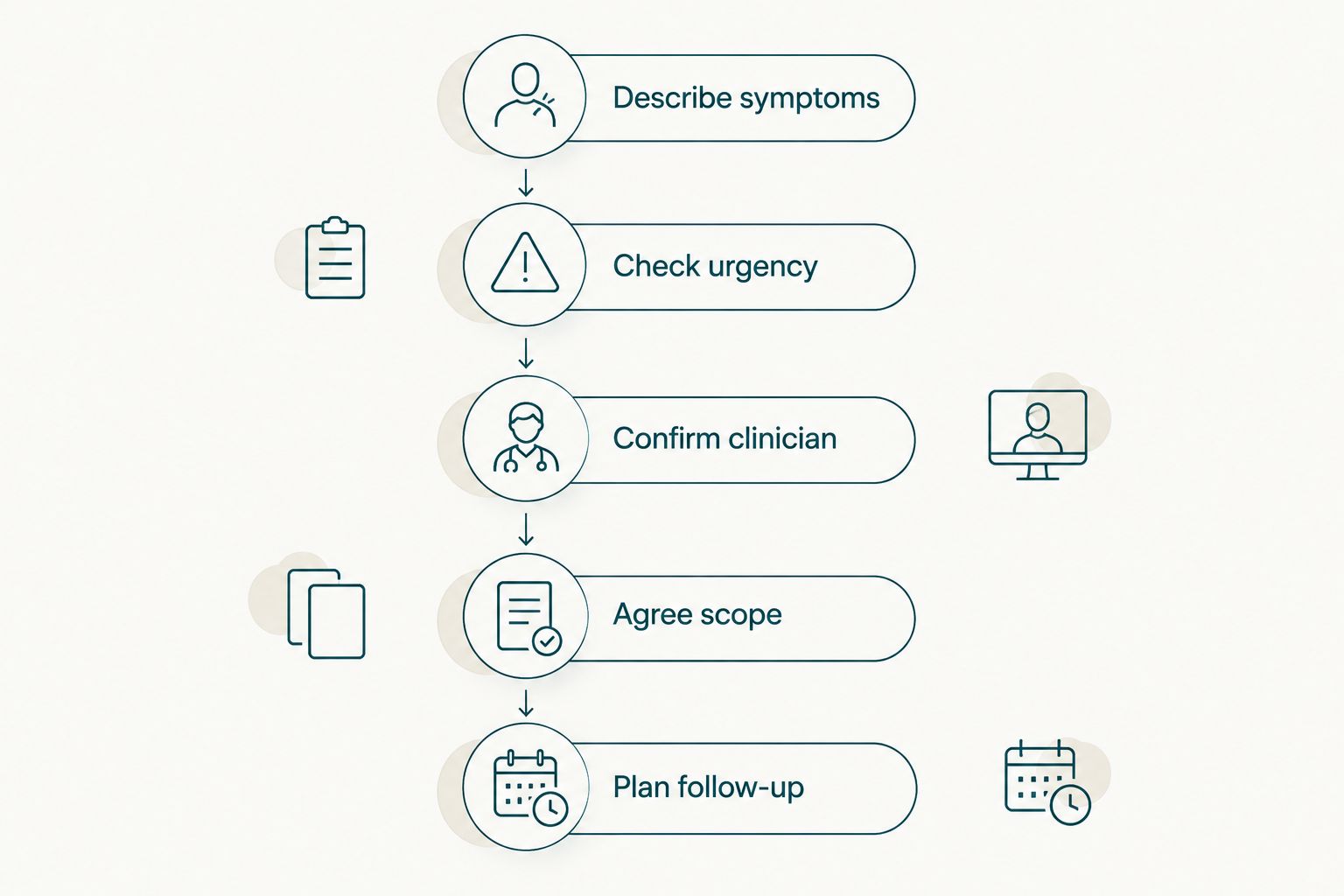
Use this sequence to prevent a mismatch between the service you request and the care you need. It applies whether you contact a home-care provider, a clinic or an online service.
- Describe symptoms: State what changed, when it began and whether it is worsening. Include relevant conditions and medicines.
- Check urgency: Ask whether the symptoms are suitable for a routine appointment. Emergency symptoms take priority over convenience.
- Confirm clinician: Establish whether you are booking a doctor, nurse or another professional, and verify the relevant credentials.
- Agree scope: Confirm the assessment or procedure, its limitations and what preparation is required.
- Plan follow-up: Identify who reviews results, explains the care plan and handles escalation.
A booking confirmation should make the professional role and service clear. Keep your medication list and relevant medical records ready; these help the clinician assess the situation without reconstructing your history from memory.
How the options are ranked
This 2026 guide ranks care routes by clinical fit, examination needs, professional role and escalation requirements. It does not rank named providers by outcomes or claim that every home healthcare company offers physician visits.
The default recommendation is an in-person physician assessment for a stable new symptom requiring examination. Remote review and nursing care serve distinct purposes; emergency care takes precedence when symptoms demand it.
Which home healthcare option should you choose?
If you need an examination, book a licensed physician—not an appointment described only as home healthcare. If you already have a care plan, select the professional who can deliver the required follow-up or procedure.
For family home and online care, Dardoc is a relevant option across its stated services. Confirm the specific appointment before committing. If symptoms are severe or rapidly worsening, stop comparing providers and seek urgent care.
FAQ
What's the best doctor at home Abu Dhabi option for a new symptom?
A licensed home-visiting physician is the appropriate option for a stable new symptom that needs examination. Confirm that the booking includes a doctor and ask whether the symptoms are suitable for home assessment.
Does a home healthcare appointment always include a doctor?
No, a home healthcare appointment does not automatically include a physician. It can involve nursing, blood collection or another defined service, so confirm the professional role before booking.
Is an online doctor better than a home visit?
An online consultation is appropriate when a clinician can safely assess the question without a hands-on examination. Choose an in-person assessment when examination is needed, and use emergency care for emergency symptoms.
Can a visiting nurse diagnose a new medical problem?
A nursing visit is not a substitute for physician diagnosis. Nurses provide care within their professional scope and escalate concerns, while new or worsening symptoms require the appropriate medical assessment.
What should I check before booking a home doctor in Abu Dhabi?
Check the clinician's identity, professional role, relevant Abu Dhabi licensing details and appointment scope. Also establish who reviews results and what happens if the patient needs hospital assessment.
When should I call an ambulance instead of booking a home doctor?
Call 998 in the UAE for a medical emergency rather than waiting for a routine home appointment. Severe breathing difficulty, collapse, stroke symptoms or chest pain concerning for a heart attack require urgent assessment.
What information should I prepare for a home consultation?
Prepare a symptom timeline, medication list, allergies, relevant conditions and recent medical results. Explain what has changed from the patient's usual health and whether the problem is worsening.
One last thing
Ask who owns the next clinical decision. Collecting a sample, completing a nursing task or finishing a consultation is not the same as closing the care loop. Before the appointment ends, establish who interprets the findings and tells you what to do next.