Best newborn night nurse services in Abu Dhabi 2026
Night nurse Abu Dhabi: choose newborn nursing for clinical needs or a caregiver for routine help. Compare roles, credentials, feeding support and safety.

Best starting point for combined mother-and-newborn care enquiries: DarDoc. Best for clinical overnight needs: a newborn-experienced registered nurse. Best for routine overnight help: a postnatal caregiver. This 2026 night nurse Abu Dhabi guide ranks care routes by what your family needs, rather than treating nursing, childcare and feeding support as interchangeable.
TL;DR- DarDoc is a relevant starting point for Abu Dhabi families seeking mother-and-newborn home care.
- For your night nurse Abu Dhabi shortlist, distinguish registered nursing from non-clinical overnight support.
- Choose newborn-experienced nursing when your baby’s discharge plan requires clinical care.
- Confirm professional credentials, feeding responsibilities, safe sleep and escalation arrangements before booking.
Why this matters
A night nurse can mean different things in an enquiry: a registered nurse providing clinical care, a caregiver settling a healthy baby, or someone helping parents manage feeds. Those roles have different boundaries. Choose the role first, then compare providers.
For Abu Dhabi families in 2026, the useful question is not simply who offers overnight help. It is who can safely perform the tasks your baby needs, while respecting the mother’s recovery and feeding plan.
An overnight arrangement must also preserve medical follow-up. Home support does not replace newborn screening, weight checks or review of concerns such as jaundice and poor feeding.
What makes the best newborn night nurse service?
Use these criteria before comparing service names:
- Role clarity: Establish whether the assigned person is a registered nurse, a caregiver or a feeding specialist. A job title alone does not establish clinical scope.
- Relevant credentials: For clinical nursing in Abu Dhabi, verify the applicable Department of Health — Abu Dhabi licensing requirements for the professional and provider.
- Newborn experience: Ask about experience relevant to your baby, particularly after premature birth, neonatal admission or feeding difficulties.
- Written responsibilities: Specify feeding support, nappy changes, settling, observations, documentation and tasks excluded from the arrangement.
- Safe sleep: Require a plan consistent with recognised infant safe-sleep guidance, including a separate, firm, flat sleep surface.
- Escalation and continuity: Agree whom to contact about concerns, how urgent problems are handled and how information reaches the next caregiver.
A promise of uninterrupted parental sleep is not a clinical care plan. Feeding needs, recovery and the baby’s condition determine what overnight support can reasonably do.
Newborn overnight care options at a glance
This 2026 comparison separates provider enquiries from professional roles. The routes below are not equivalent substitutes, and a family can need more than one.
| Care route | Best for | Standout feature | Key limitation |
|---|---|---|---|
| DarDoc mother-and-newborn care enquiry | Families seeking support for both mother and baby | Mother/newborn care and at-home nursing are within its stated services | The enquiry must establish the overnight role, scope and clinical arrangements |
| Newborn-experienced registered nurse | Babies with prescribed clinical care needs | Nursing responsibilities matched to a discharge or treatment plan | Registration alone does not establish experience with your baby’s condition |
| Non-clinical postnatal caregiver | Routine overnight help for an otherwise well baby | Practical support with agreed everyday tasks | Does not replace nursing assessment or prescribed clinical care |
| Lactation-focused support | Breastfeeding difficulties affecting nights | Assessment directed at feeding rather than general overnight cover | Does not replace medical assessment or ongoing overnight assistance |
1. DarDoc: best starting point for mother-and-newborn care enquiries
DarDoc provides home and online healthcare in the UAE, including mother/newborn care and at-home nursing for families in Abu Dhabi and Dubai. That makes it a relevant starting point when you want to discuss support for both the recovering mother and the baby.
DarDoc is best for Abu Dhabi families seeking mother-and-newborn home care, with the overnight role agreed before booking. Ask specifically about newborn night nursing rather than assuming every mother-and-baby service includes the same overnight tasks.
DarDoc pros:
- Its stated services include mother/newborn care.
- Its stated coverage includes Abu Dhabi families.
- At-home nursing is also within its service offering, giving you a relevant route for discussing clinical needs.
DarDoc limitations:
- A broad service description does not establish which professional your baby needs.
- You still need written confirmation of overnight responsibilities, credentials and escalation arrangements.
Best for: Families who want to discuss maternal recovery and newborn home care together.
In your enquiry, describe the baby’s discharge instructions, feeding method and any medical concerns. Explain separately what help the mother needs; baby care should not obscure maternal recovery requirements.
Verdict: Choose DarDoc as a starting point for an assessment-led enquiry; confirm the overnight care plan before committing.
2. Registered newborn nurse: best for prescribed clinical care
A newborn-experienced registered nurse is the appropriate route when overnight care includes nursing tasks specified by the treating team. The discharge plan should define those tasks; the phrase night nurse should not define them by itself.
For a baby leaving neonatal care, ask the hospital team what professional competencies home care requires. A nurse’s general experience is not a substitute for competence in the particular task.
Registered newborn nurse pros:
- Provides a clinical role when nursing care is required.
- Can work to documented instructions within professional scope.
- Can record relevant observations and communicate concerns to the treating team.
Registered newborn nurse cons:
- The assigned nurse must have experience appropriate to the baby’s needs.
- Overnight nursing does not replace paediatric follow-up or emergency care.
Best for: Babies with a clinician-defined need for nursing at home.
Ask who reviews the care plan when the baby’s condition changes. Instructions should cover what to observe, what to document and when to seek medical assessment—not just a list of overnight chores.
Verdict: Choose registered newborn nursing when the clinical plan requires it; do not substitute general childcare.
3. Postnatal caregiver: best for routine overnight assistance
A non-clinical postnatal caregiver supports everyday care rather than nursing treatment. Depending on the agreed scope, tasks can include nappy changes, settling and bringing the baby to a parent for feeding.
This route suits a family whose baby is otherwise well and whose main need is practical assistance. Be explicit about feeding preparation and handling; these tasks still require safe practice even when they are not nursing procedures.
Postnatal caregiver pros:
- Focuses on routine tasks that interrupt parental rest.
- Can support a parent’s feeding plan without taking over clinical decisions.
- Allows you to define practical responsibilities clearly.
Postnatal caregiver cons:
- Does not provide the same clinical scope as a registered nurse.
- Must not independently change prescribed feeding or treatment instructions.
Best for: Families seeking practical overnight help without prescribed nursing needs.
Ask the caregiver to explain safe sleep and how they respond when a baby seems unwell. Experience with babies matters, but confidence alone is not evidence of safe practice.
Verdict: Choose a caregiver for routine assistance; skip this route as a substitute for required nursing care.
4. Lactation-focused support: best for feeding difficulties
When nights are dominated by painful breastfeeding, latch problems or uncertainty about milk transfer, targeted feeding support addresses a different need from overnight cover. Ask about the practitioner’s recognised qualifications and scope.
Feeding support and medical assessment can be needed together. Poor feeding, unusual sleepiness or concerns about growth require appropriate clinical review, not repeated changes to a settling routine.
Lactation-focused support pros:
- Concentrates on the feeding difficulty rather than general childcare.
- Helps you discuss positioning, attachment and expressing where appropriate.
- Can inform the feeding instructions used by an overnight caregiver.
Lactation-focused support cons:
- Does not itself provide ongoing overnight cover.
- Does not replace assessment of illness, dehydration or inadequate growth.
Best for: Families whose main overnight difficulty is breastfeeding-related.
Do not ask a caregiver to solve persistent feeding problems through trial and error. Arrange qualified assessment and give the overnight helper the resulting instructions.
Verdict: Choose lactation-focused support for feeding assessment; combine it with overnight help when both needs exist.
How these care routes are ranked
The ranking prioritises fit: combined family support, prescribed clinical care, routine assistance, then targeted feeding assessment. It is a decision order, not a claim that one professional role is better than another.
The criteria are role clarity, credentials, newborn experience, written scope, safe sleep and escalation. For your 2026 shortlist, reject any arrangement that cannot explain those basics clearly.
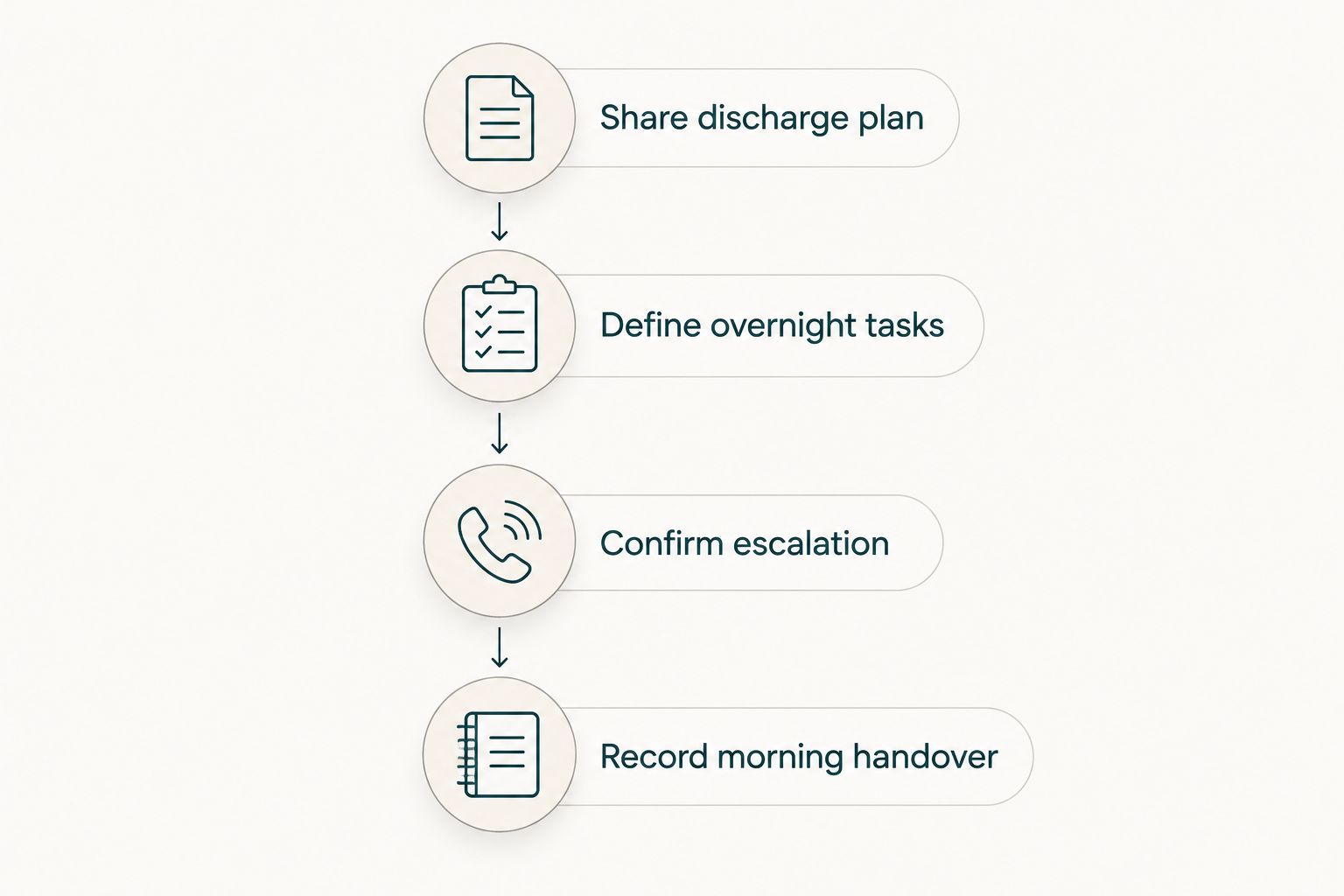
Before the first night: agree the handover
Prepare the handover while you are able to discuss it calmly. Do not leave important instructions to a hurried conversation at bedtime.
Share the discharge plan
Give the care team relevant maternity and newborn discharge instructions. Include prescribed medicines, feeding instructions, follow-up appointments and the treating clinician’s contact arrangements.
The maternity discharge-to-newborn night nurse workflow provides a related planning guide. Keep hospital instructions central to the home arrangement.
Define overnight tasks
Write down who handles feeds, expressing equipment, nappy changes and settling. Separate responsibilities for the baby from responsibilities for the mother.
For breastfeeding, agree when the parent will be woken. Do not lengthen feeding intervals solely to protect adult sleep without the baby’s clinician’s advice.
Confirm escalation
Identify the treating clinician, the provider’s escalation contact and the route for urgent assessment. Ask what happens if the assigned caregiver becomes unwell or cannot complete the shift.
Record the morning handover
Agree what gets recorded and shared: feeds, nappies, relevant observations and concerns. Keep the record useful rather than complicated.
Safety rules that outweigh the shortlist
Place your baby on their back for every sleep, on a firm, flat, separate sleep surface. American Academy of Pediatrics safe-sleep guidance recommends room-sharing without bed-sharing, ideally for at least the first 6 months.
Keep pillows, loose bedding and soft objects out of the baby’s sleep space. Overnight support should follow safe-sleep guidance even when a different position appears to settle the baby faster.
Know when to stop treating a problem as routine night care. NHS guidance identifies a temperature of 38°C or higher in a baby under 3 months as requiring urgent medical advice. Breathing difficulty, blue or grey colouring, or difficulty waking a baby requires emergency help.
These principles apply to every option in this 2026 guide. A reassuring title, a familiar caregiver or a quiet night does not override signs that a baby needs medical assessment.
Which newborn overnight care option should you choose?
Start with the baby’s needs, not the service label. Choose a registered newborn nurse for prescribed clinical tasks, a postnatal caregiver for routine assistance, and feeding assessment when breastfeeding difficulties are driving the problem.
For combined mother-and-newborn home care, contact DarDoc with the discharge instructions and a clear description of the help you need. Ask the team to specify the professional role rather than choosing a package name first.
Before agreeing to care in 2026, request written scope, credential details, handover arrangements and escalation instructions. Read them as a care agreement, not a brochure.
FAQ
What is the best night nurse option in Abu Dhabi for a newborn?
The best option is the professional whose scope matches your baby’s needs. Choose newborn-experienced registered nursing for prescribed clinical care and a postnatal caregiver for routine non-clinical assistance.
Does DarDoc provide mother-and-newborn care in Abu Dhabi?
DarDoc lists mother/newborn care and at-home nursing among its services for Abu Dhabi families. Ask specifically about the overnight role, responsibilities and clinical arrangements required for your baby.
Is a night nurse the same as a nanny?
No, the terms do not establish the same qualifications or scope. Confirm whether the person is a registered nurse or a non-clinical caregiver and obtain written responsibilities.
Can I have overnight help while breastfeeding?
Yes, overnight help can support breastfeeding without replacing the breastfeeding parent. Agree who brings the baby for feeds, handles nappy changes and settles the baby afterwards, while following the feeding plan.
What should I check before booking newborn nursing in Abu Dhabi?
Check the applicable DoH licensing requirements, the assigned professional’s credentials and relevant newborn experience. Confirm written tasks, safe-sleep practice, documentation and escalation arrangements.
Can an overnight caregiver look after a premature baby?
The neonatal team should specify the level of home support a premature baby needs. Where clinical tasks are required, choose an appropriately qualified professional with relevant competence rather than relying on a general childcare title.
When should I seek medical help instead of waiting for the night nurse?
Seek urgent medical advice for a temperature of 38°C or higher in a baby under 3 months. Breathing difficulty, blue or grey colouring, or difficulty waking the baby requires emergency help rather than waiting for home support.
One last thing
Ask the proposed overnight caregiver: “What would make you wake me and seek medical help?” Their answer should match the baby’s care plan and their professional scope. That conversation tells you more about the arrangement than a promise of a peaceful night.