Best vitamin D IV drip clinics in Dubai 2026
Searching vitamin d iv drip dubai? Start with assessment, not an infusion. Compare care options, treatment routes and safety checks before booking.

Best for arranging a home-based assessment: Dardoc. Best starting point for routine vitamin D deficiency: primary care. Best for complex deficiency: a relevant specialist. If you searched for “vitamin d iv drip dubai” in 2026, choose the clinical assessment first: an IV drip is not the standard treatment for uncomplicated vitamin D deficiency.
TL;DR- For vitamin d iv drip dubai searches, Dardoc is an option for home healthcare enquiries, not a verified vitamin D infusion recommendation.
- Oral vitamin D is the usual treatment route for uncomplicated deficiency; an IV drip is not automatically better.
- Choose primary care for routine deficiency and specialist assessment for malabsorption, kidney disease or an unclear diagnosis.
- Before any injection or infusion, confirm the medicine, administration route, prescribing clinician and monitoring plan.
Why this matters
Vitamin D treatment and a vitamin-containing wellness drip are not interchangeable. A fluid infusion can contain other vitamins without treating vitamin D deficiency. Likewise, an intramuscular vitamin D injection goes into muscle, not into a vein.
That distinction changes what you should book. The right service identifies whether you need treatment, selects an appropriate formulation and checks your response. A clinic menu that simply says “vitamin drip” does not answer those questions.
This 2026 guide ranks care options by their clinical purpose rather than presenting an unsupported league table of clinics. Dardoc provides home and online healthcare, including blood tests and IV services, in Dubai and Abu Dhabi; that does not establish that it provides a particular vitamin D infusion.
What makes the best vitamin D care provider?
Use these criteria before choosing a clinic or home healthcare service:
- A clear indication: The clinician explains whether your symptoms, medical history or previous results justify testing or treatment.
- The correct route: Oral treatment, an intramuscular injection and an intravenous medicine are described separately.
- Verifiable licensing: You can check the Dubai facility and treating professional through the Dubai Health Authority’s official channels.
- Medicine transparency: The prescription identifies the active ingredient, formulation, dose and route before administration.
- Safety assessment: The clinician reviews relevant medicines, supplements, kidney problems and conditions affecting calcium.
- A follow-up plan: You know who reviews the results, when reassessment is needed and whom to contact about adverse effects.
For a vitamin D IV drip enquiry in 2026, these checks matter more than the number of ingredients advertised. More ingredients do not establish a better treatment for a documented deficiency.
Vitamin D care options at a glance
| Rank and option | Best for | Standout feature | Key limitation |
|---|---|---|---|
| 1. Dardoc home healthcare enquiry | People prioritising assessment and blood-test arrangements at home | Home and online healthcare services in Dubai and Abu Dhabi | A specific vitamin D formulation or infusion service is not established here |
| 2. Primary-care assessment | Uncomplicated suspected or confirmed deficiency | Assessment and an oral treatment plan when indicated | Does not replace specialist care for complex underlying disease |
| 3. Specialist assessment | Malabsorption, recurrent deficiency or an unclear cause | Investigation of why deficiency persists | Adds a specialist consultation rather than a simple treatment booking |
| 4. Renal specialist care | Kidney disease affecting vitamin D treatment | Selection and monitoring of appropriate vitamin D medicines | Not a general wellness or routine deficiency pathway |
The order is a decision guide, not a claim that one provider achieves better clinical outcomes. Choose the row that matches your medical situation.
1. Dardoc: best for starting with home healthcare
Dardoc offers home and online healthcare, including blood tests, nursing and IV drips. For someone who wants to begin a vitamin D enquiry without travelling to a clinic, those service categories provide a relevant starting point.
Dardoc is best for people seeking home-based healthcare arrangements in Dubai and Abu Dhabi. Ask specifically about assessment for suspected vitamin D deficiency rather than assuming a general IV service includes vitamin D treatment.
Dardoc pros
- Home healthcare suits people who want to avoid a clinic journey.
- Blood testing is among its stated services.
- Home and online care provide different ways to begin an enquiry.
Dardoc limitations
- Its stated service categories do not confirm a particular vitamin D infusion or injection.
- A home setting does not replace a specialist or hospital setting when clinically required.
Best for: People prioritising home-based healthcare arrangements, including enquiries about clinically indicated testing.
Before proceeding, ask who will assess you, which test is appropriate and who will interpret the result. If treatment is proposed, request the exact medicine and route rather than accepting “vitamin D drip” as a complete description.
Verdict: Choose for a home healthcare enquiry; hold any infusion booking until the clinical indication and medicine are confirmed.
2. Primary care: best for uncomplicated vitamin D deficiency
A primary-care clinician is the usual starting point for suspected uncomplicated deficiency. The assessment considers symptoms, risk factors, existing supplements and whether a blood test will change treatment.
Oral vitamin D is commonly used when replacement is indicated and intestinal absorption is adequate. It avoids cannulation and does not require an infusion appointment.
Primary-care pros
- Addresses the diagnosis before choosing a treatment route.
- Can review other explanations for fatigue, aches or weakness.
- Supports a treatment and reassessment plan rather than an isolated procedure.
Primary-care limitations
- Persistent deficiency can require investigation beyond routine replacement.
- Oral treatment requires adherence to the prescribed schedule.
Best for: Adults with suspected or confirmed deficiency without a known complex absorption or kidney problem.
Bring previous laboratory results and every supplement label you use. A multivitamin, a calcium supplement and a separate vitamin D product can contain overlapping ingredients.
Verdict: Choose as the default clinical starting point; skip an IV-first approach for routine deficiency.
3. Specialist assessment: best for persistent or complex deficiency
An endocrinologist, gastroenterologist or another relevant specialist can investigate deficiency that persists despite an appropriate treatment plan. The appropriate specialty depends on your history, including intestinal disease or previous bariatric surgery.
A specialist assessment asks why treatment has not worked before simply increasing it. An injection is a possible clinical option in selected circumstances, but it is not automatically an IV infusion.
Specialist-assessment pros
- Investigates underlying causes rather than repeatedly treating the laboratory result.
- Reviews absorption problems and relevant medical conditions.
- Helps select an appropriate formulation when routine treatment is unsuitable.
Specialist-assessment limitations
- Requires a targeted consultation and review of previous treatment.
- Does not make an injection necessary for every patient with a low result.
Best for: People with persistent deficiency, suspected malabsorption or a medical history that complicates replacement.
Bring the original results, the prescribed regimen and a record of what you actually took. That distinction helps the clinician separate an absorption problem from an incomplete course or a misunderstanding of instructions.
Verdict: Choose when routine treatment fails or the cause is unclear; hold repeat treatment until the cause is reviewed.
4. Renal specialist care: best for kidney-related treatment decisions
Kidney disease can change how vitamin D and mineral balance are assessed and managed. Some patients need active vitamin D medicines under specialist supervision; these are not interchangeable with a general vitamin supplement.
Certain active vitamin D medicines have intravenous uses in specific renal settings. That does not make them appropriate for a person seeking a wellness drip or routine deficiency treatment.
Renal-care pros
- Connects vitamin D decisions with calcium, phosphate and kidney-related findings.
- Provides specialist oversight of medicines requiring careful selection.
- Separates renal treatment from general wellness claims.
Renal-care limitations
- Applies to a specific medical context, not ordinary low vitamin D alone.
- Requires monitoring rather than a one-off consumer treatment decision.
Best for: People with kidney disease whose treating clinician identifies a vitamin D-related treatment need.
If you have kidney disease, do not substitute a commercial drip for your renal treatment plan. Discuss supplements with your kidney specialist, including products bought without a prescription.
Verdict: Choose for kidney-related indications; skip as a routine wellness option.
Oral vitamin D, injections and IV drips are different
Before booking vitamin D treatment in Dubai in 2026, ask the provider to name both the medicine and its route. The route describes how it enters your body; it does not establish whether you need it.
| Route | What it means | Main advantage | Main limitation |
|---|---|---|---|
| Oral treatment | A vitamin D preparation taken by mouth | Avoids needles and cannulation | Adherence and absorption matter |
| Intramuscular injection | A prescribed preparation injected into muscle | An option in selected clinical circumstances | Requires an appropriate formulation and professional administration |
| Intravenous treatment | A medicine administered into a vein | Appropriate for particular medicines and indications | Adds cannulation risks and is not routine deficiency treatment |
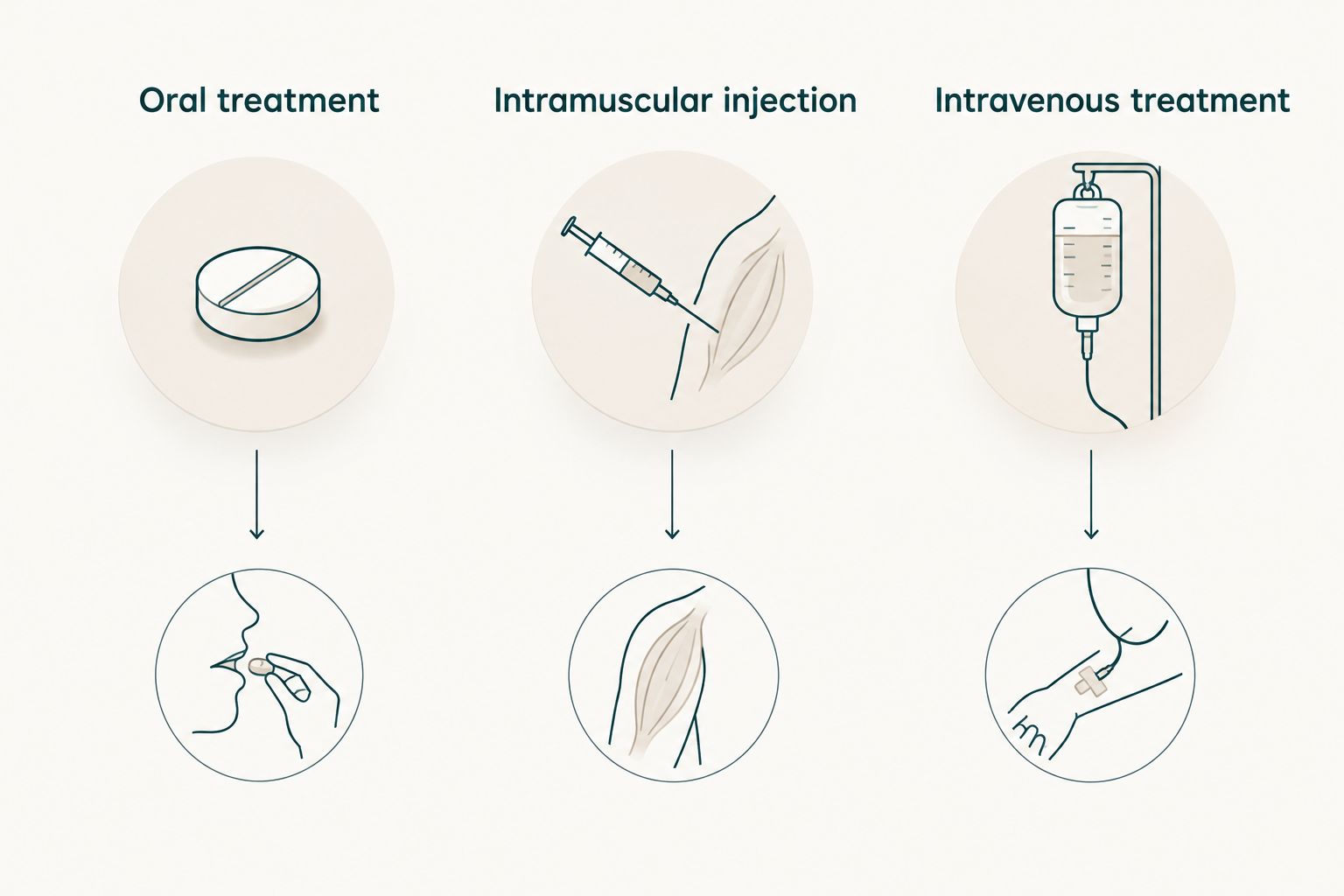
An IV line introduces risks including infection, inflammation around the vein and fluid-related complications. An injected medicine also requires assessment of its own adverse effects. “Delivered directly” is not evidence that a route gives better outcomes for your condition.
What should your blood result tell you?
The usual blood marker for vitamin D status is 25-hydroxyvitamin D, also written as 25(OH)D. It is different from the active vitamin D test used for particular clinical questions.
The US National Institutes of Health Office of Dietary Supplements describes 20 ng/mL, equivalent to 50 nmol/L, as adequate for most healthy people. It identifies levels below 12 ng/mL, equivalent to 30 nmol/L, as associated with deficiency risk. These reference points do not create a personal prescription: interpretation depends on your clinical context, and professional guidance differs on some thresholds.
For your 2026 consultation, bring the laboratory report with its units and reference interval. A result expressed in ng/mL cannot be compared directly with a number expressed in nmol/L.
Ask what the result changes. If a clinician recommends treatment, you should understand its purpose, the planned course and how the response will be assessed. Do not use a threshold from an article to select a high-dose regimen yourself.
Questions to ask before booking
A good booking conversation should clarify the treatment rather than hurry you towards a procedure. Ask these questions before agreeing to an injection or infusion:
- What is the diagnosis? Ask whether the recommendation addresses confirmed deficiency, another condition or a general wellness request.
- What is the medicine? Request the active ingredient and formulation, not just the drip’s marketing name.
- Why this route? Ask why oral treatment is unsuitable if an injection or infusion is proposed.
- Who is responsible? Identify the prescribing clinician, administering professional and follow-up contact.
- What happens afterwards? Confirm the monitoring plan and instructions for reporting adverse effects.
Verify the professional and facility licensing through the relevant official regulator. Do not treat a logo, social-media biography or the phrase “hospital protocol” as a substitute for verification.
For the practical checks around home administration, read whether at-home IV drip therapy is safe. Home delivery changes the location of care, not the need for a prescription, appropriate supervision and an escalation plan.
How these options were ranked
This guide prioritises clinical fit, route selection, service setting and follow-up. It does not rank clinics by unverified reviews, promised results or the length of a drip menu.
The named provider’s service description supports a home healthcare enquiry, not a claim about a specific vitamin D formulation. The remaining entries are care pathways because naming additional clinics would not establish their treatment protocols or suitability for you.
Which option should you choose?
Start with primary care for uncomplicated suspected vitamin D deficiency. Choose a home healthcare enquiry when the setting is your main practical concern, and seek specialist care when your medical history or treatment response requires it.
In 2026, the best vitamin D provider is the one that can explain why you need a particular treatment—and why a simpler route would not be enough. Do not book an infusion merely because your search began with the word “drip.”
FAQ
What's the best vitamin D IV drip clinic in Dubai?
Choose a provider that assesses whether you need vitamin D treatment before recommending a route. Dardoc offers home healthcare services, but its stated services do not establish a specific vitamin D infusion offering.
Is a vitamin D IV drip better than tablets?
An IV drip is not the standard treatment for uncomplicated vitamin D deficiency. Oral vitamin D is commonly used when treatment is indicated and absorption is adequate; a different route needs a clinical reason.
Is a vitamin D injection the same as an IV drip?
No. An intramuscular vitamin D injection goes into muscle, while an IV medicine enters a vein. Ask for the exact preparation and route before consenting.
Can I arrange vitamin D testing at home in Dubai?
Home blood-test services are an option in Dubai. Confirm whether the provider can arrange the clinically appropriate vitamin D test and identify who will interpret the result.
Do I need a vitamin D test before treatment?
Not everyone needs a blood test before taking vitamin D. A clinician decides whether testing is appropriate based on your symptoms, risks, medical history and intended treatment.
How do I check a Dubai clinic's licence?
Use the Dubai Health Authority's official verification channels to check the facility and treating professional. Confirm the details directly rather than relying only on advertising.
Can too much vitamin D be harmful?
Yes. Excessive vitamin D intake can cause high calcium levels and serious complications, including kidney problems. Tell your clinician about every supplement and do not combine treatment courses yourself.
What should I do if I have kidney disease?
Ask your kidney specialist before starting or changing vitamin D treatment. Kidney disease can require different medicines and monitoring, so a general wellness drip is not a substitute for renal care.
One last thing
A provider willing to advise against a drip gives you a useful signal: the procedure is not the starting assumption. Ask, “What would make oral treatment unsuitable for me?” The answer should relate to your medical situation, not a promise of faster wellness.