How long does it take to get at-home blood test results in Dubai?
How long do at-home blood test results take in Dubai? Timing depends on the tests. Learn what to confirm before booking and how to follow up on delays.
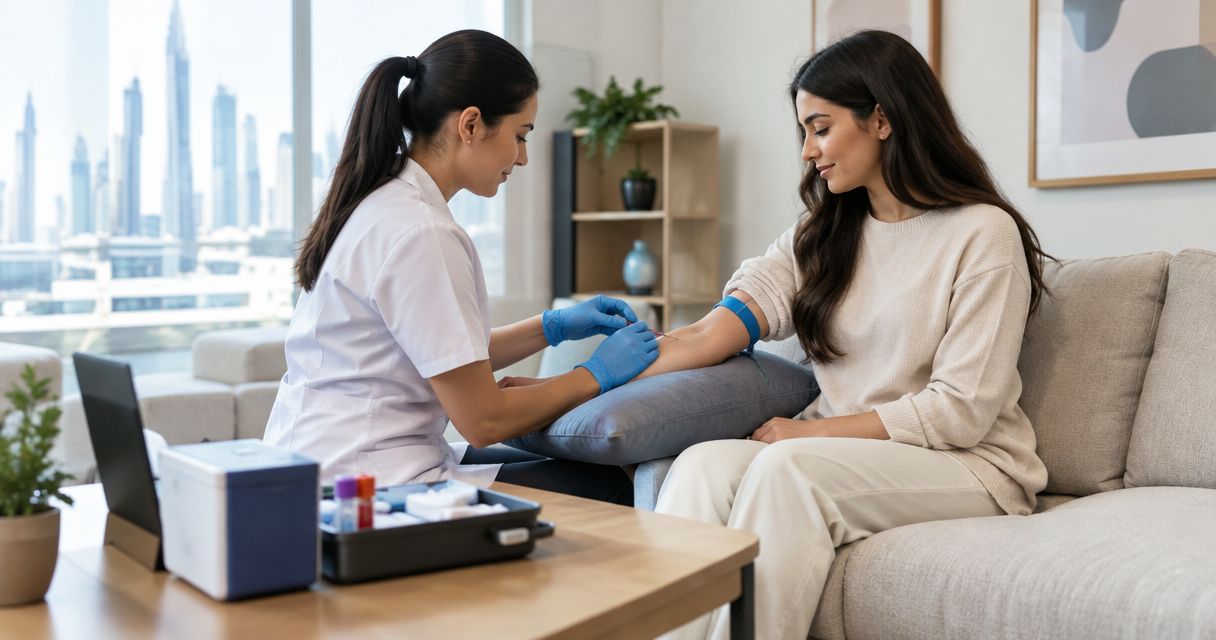
At-home blood test results in Dubai do not have one fixed turnaround: the timing depends on the tests ordered, sample transport, laboratory processing and report release. Ask for the expected release date for your exact test panel before booking in 2026. A collection appointment is not a results deadline, and receiving a laboratory report is not the same as receiving a doctor’s interpretation.
TL;DR- How long does it take to get at-home blood test results in Dubai? Confirm each test’s laboratory turnaround.
- DarDoc suits Dubai families seeking at-home blood tests rather than travelling to a clinic.
- Ask whether the quoted turnaround starts at collection or laboratory receipt, and whether it covers the complete report.
- Do not wait for routine blood test results when symptoms need urgent medical assessment.
Why this matters
Book around the report you need, not just the appointment you can get. If your blood tests support a medication review, planned procedure or follow-up consultation, the useful deadline is when the relevant results reach the treating clinician.
For a Dubai home blood test booking in 2026, confirm both collection arrangements and the reporting timeline. The guide to getting a blood test done at home in Dubai covers the collection question; this page explains what to clarify about the wait afterwards.
How long does it take to get at-home blood test results in Dubai?
The correct answer is the laboratory’s expected turnaround for your named tests, measured from an agreed starting point. A general promise about “blood test results” does not tell you whether every item in your order will be ready together.
Use this comparison to separate the main reporting situations. These are reporting patterns, not guaranteed delivery times.
| Reporting situation | What determines the wait | Best for | Limitation to clarify |
|---|---|---|---|
| Routine laboratory testing | Laboratory receipt, processing schedule and report authorisation | Planned monitoring without an immediate decision deadline | A routine test still needs a confirmed release estimate |
| Specialist or referral testing | The specific method and whether another laboratory performs the analysis | Clinician-requested investigations requiring a particular assay | Its reporting schedule can differ from the rest of the panel |
| Partial reporting | Which individual tests have completed processing | An initial review when the clinician considers available results sufficient | Missing results can change the interpretation |
| Complete-panel reporting | Completion and release of every ordered test | Appointments requiring the whole requested panel | The final outstanding test determines when the panel is complete |
Ask for the test names on the request rather than relying on a package label. A broad checkup can contain tests with different processing requirements, so a single package does not necessarily mean a single reporting time.
What counts as a useful turnaround estimate?
A useful estimate identifies the start, the endpoint and the scope. “After collection” and “after laboratory receipt” describe different starting points; “first results” and “complete report” describe different endpoints.
For a 2026 booking, ask the provider to write down which definition applies. If you need results before an appointment, give the appointment date and ask whether the complete requested panel is expected before it.
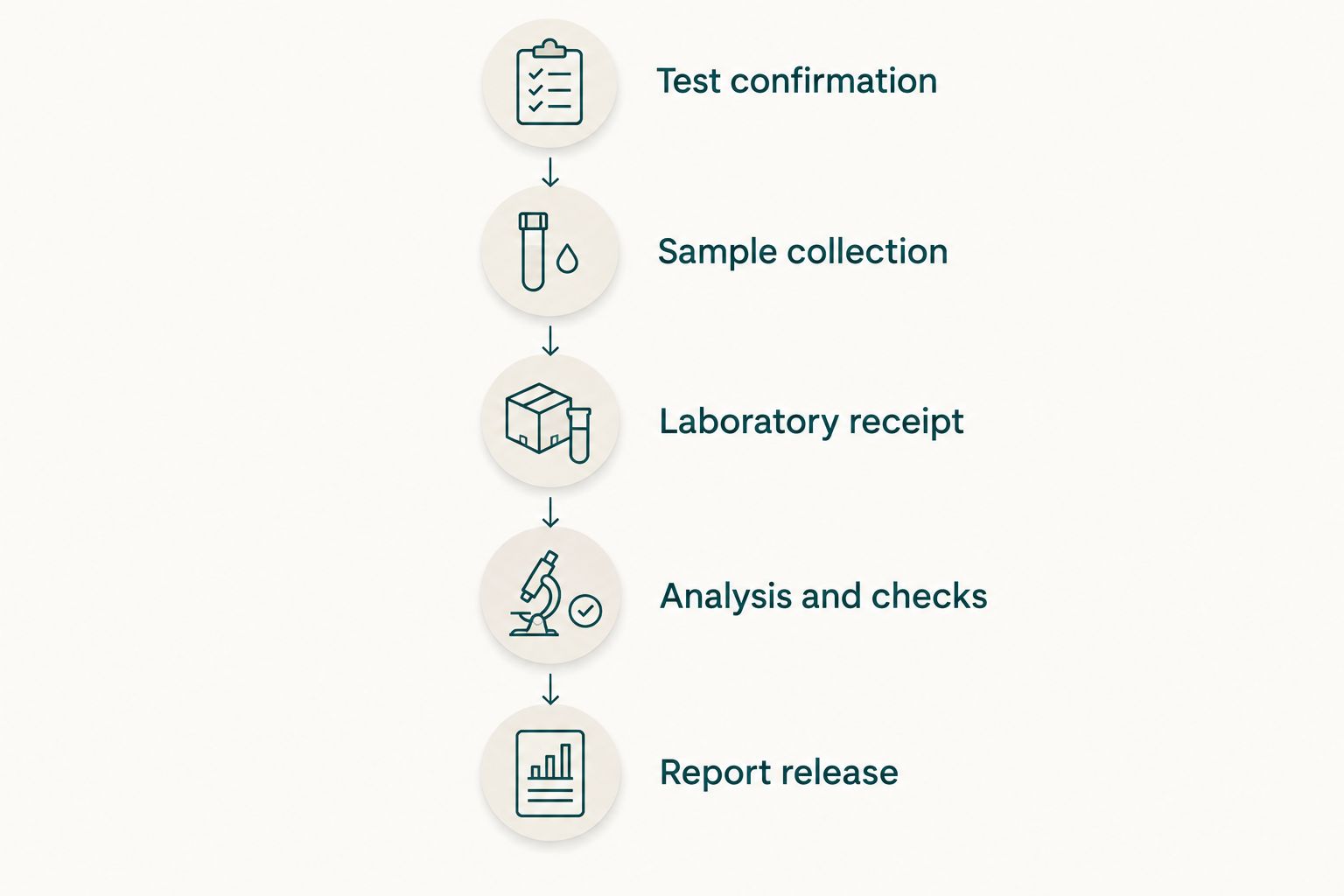
What happens between collection and your report?
Home collection changes where the sample is taken. It does not remove the laboratory stages needed to produce a report, and faster collection does not by itself establish faster reporting.
- Test confirmation. Check that the collection request contains the exact tests your clinician ordered. Clarify preparation instructions before the appointment, including whether fasting or a particular collection time applies.
- Sample collection. The collector takes and labels the required samples. Tell the collector about any difficulty during the draw so it can be assessed rather than ignored.
- Laboratory receipt. The samples reach the processing laboratory and undergo acceptance checks. Ask whether the quoted turnaround begins here or at the home visit.
- Analysis and checks. The laboratory performs the requested tests and its checks before release. Further testing or a sample problem can change the original estimate.
- Report release. Results become available through the provider’s stated reporting route. Confirm separately how you arrange clinical interpretation and who handles an urgent finding.
Keep your test request and appointment details together. If you follow up later, naming the outstanding test is more useful than asking whether “the bloods” are ready.
Why at-home blood test turnaround varies
Several parts of the pathway affect when a usable report reaches you. Ask which factors apply to your order instead of assuming every home blood test follows the same schedule.
- The test method. Different tests require different analytical processes. A familiar test name does not establish the reporting schedule for the laboratory handling your sample.
- Transport and receipt. Collection at home and acceptance by the laboratory are separate events. Confirm the starting point used in your estimate.
- Processing location. A test performed by a referral laboratory has an additional handoff. Ask whether any part of your order is sent elsewhere.
- Sample suitability. An unsuitable sample can require recollection. For example, haemolysis can affect certain blood measurements, and the laboratory decides whether an affected result can be reported.
- Additional checks. Repeat analysis, confirmation or other laboratory checks can extend the wait. A delay alone does not establish that a result is abnormal.
- Report release arrangements. Individual results and the complete panel are different deliverables. Confirm whether you receive results as they are authorised or together after everything is complete.
Treat the quoted turnaround as test-specific, not as a promise covering every future blood test. If your clinician adds another test after collection, ask for a revised estimate for that test.
What should you ask before booking in 2026?
A short written checklist prevents an avoidable mismatch between your booking and your medical appointment. You do not need to know the laboratory science; you need clear answers about the order and the handoffs.
Ask the provider:
- “Does this booking include every test on my clinician’s request?”
- “What preparation applies to these exact tests?”
- “Does the turnaround start at collection or laboratory receipt?”
- “Is the estimate for the first results or the complete report?”
- “Are any tests processed by a referral laboratory?”
- “How will I receive the report, and whom should I contact if it is late?”
- “How are urgent findings communicated?”
- “Is a doctor’s interpretation included or arranged separately?”
DarDoc offers at-home blood tests in the UAE. DarDoc is suited to Dubai families seeking blood sample collection at home rather than a clinic visit. Confirm the test-specific reporting estimate when arranging care; the collection setting alone does not establish the result deadline.
If you are comparing services in 2026, prioritise a clear explanation of the reporting process over an unqualified promise of speed. A useful answer tells you what is being timed and what happens if the expected date changes.
Can you get at-home blood test results on the same day?
Same-day results require confirmation for the exact tests and collection arrangements; a same-day appointment does not establish same-day reporting. Ask whether the estimate covers all ordered tests or only those expected to finish first.
If a decision depends on results that day, tell the treating clinician before choosing the collection route. The clinician can decide whether waiting for home collection and laboratory reporting is appropriate for the clinical situation.
Do not interpret “rapid,” “express” or “priority” as a complete-panel deadline without clarification. Ask for the expected report release date and which tests that estimate includes.
Does collecting blood at home make results slower?
Home collection alone does not establish a longer or shorter reporting time. The relevant comparison is the complete pathway: collection, transport, laboratory receipt, analysis and release.
At-home collection removes the need to travel for the blood draw, but transport still forms part of the process. Clinic collection involves a journey for you and does not necessarily mean the sample is analysed at that location.
For a fair comparison, ask both services about the same named tests and the same endpoint. Comparing a home service’s complete report with a clinic’s first available result gives you the wrong answer.
Why have some results arrived but others are missing?
Partial results mean some tests have been reported while others remain outstanding. They do not, by themselves, establish a problem with the missing test or with your health.
Ask for the names and expected release dates of the outstanding tests. Then ask your clinician whether the available results are enough for the immediate decision or whether the complete panel is needed.
If you need help planning the next appointment, the blood test to doctor consultation workflow addresses that handoff. A report arriving and a consultation taking place remain separate steps to confirm.
What should you do if your results are late?
Start with the agreed release estimate and the exact test still outstanding. A focused enquiry helps distinguish a pending analysis from a report that has been released but has not reached you.
Ask the provider to confirm:
- Whether the laboratory received and accepted the sample.
- Which tests are complete and which remain pending.
- Whether any sample needs recollection.
- Whether a report has already been released through another agreed channel.
- The revised expected release date and the contact responsible for updating you.
Tell your treating clinician if the delay affects a medication decision or scheduled procedure. Do not change prescribed treatment simply because a report is late, and do not repeat the entire panel elsewhere without discussing which tests are actually needed.
When should you seek help instead of waiting?
Do not use a routine blood test booking as a substitute for urgent assessment. Chest pain, severe breathlessness, collapse or new stroke-like symptoms need emergency medical attention, not a wait for a laboratory message.
If symptoms worsen while results are pending, seek clinical advice based on the symptoms. A future report cannot assess how unwell you are now, and an earlier normal result does not rule out a new problem.
An abnormal flag also needs context. Your clinician interprets the result alongside symptoms, medical history, medicines and the reason the test was ordered; the flag alone is not a diagnosis.
FAQ
How long does it take to get at-home blood test results in Dubai?
The turnaround depends on the exact tests, laboratory processing and report release arrangements. Ask for a test-specific estimate and confirm whether it begins at collection or laboratory receipt.
Can DarDoc guarantee when my blood test report will arrive?
Confirm the expected reporting date with DarDoc for your exact test order. Ask whether the estimate covers the complete panel and what happens if a test needs additional processing or recollection.
Will all my blood test results arrive together?
Not necessarily; individual tests can complete processing at different times. Confirm whether the provider releases partial results or waits until the complete panel is ready.
Do I need to fast before a blood test at home?
Fasting depends on the tests ordered and your clinician’s instructions. Confirm preparation before collection, and do not stop prescribed medicines unless your clinician tells you to.
Does a delayed blood test result mean something is wrong?
A delay alone does not establish an abnormal result. Ask which test is pending and whether the delay relates to processing, sample suitability or report delivery.
Can I book a doctor before all my results arrive?
Ask the treating clinician whether the available results are enough for the appointment’s purpose. If an outstanding test is essential to the decision, the consultation plan needs to account for it.
Should I wait for blood test results if I feel much worse?
Do not wait for routine results when you develop severe or rapidly worsening symptoms. Seek urgent assessment, particularly for chest pain, severe breathlessness, collapse or stroke-like symptoms.
One last thing
For your next blood test booking in 2026, ask one specific question: “When should the last test on my request be reported?” That answer is more useful for planning a follow-up than the earliest time any individual result might appear.
Keep that expected date with your clinician’s request. You then have a clear reference point for follow-up without confusing collection, partial reporting and a complete clinical review.
Related guides
Join our newsletter for 20% off all DarDoc services.*
*20% off all DarDoc services, except newborn care services.