Instead of repeatedly sending your insurance details after each blood test, organize your Daman insurance home blood test billing around a benefit check, an agreed billing route and a complete document record before collection. This is an administrative workflow for 2026, not a software connection or a promise that your policy covers home testing.
TL;DR- Daman insurance home blood test billing starts with policy verification, not an appointment booking.
- DarDoc provides at-home blood tests; confirm insurance arrangements before scheduling collection.
- Check laboratory testing and home collection separately; approval for one does not establish approval for both.
- Choose direct billing only after confirmation; reimbursement requires a separate claim process.
Why this matters
A home blood test involves more than taking a sample. Your billing record needs to connect the patient, the clinical request, the collection arrangement and the laboratory service to the correct insurance policy.
DarDoc is best for families seeking at-home healthcare in Dubai and Abu Dhabi. For blood test billing, start with DarDoc and ask which insurance arrangements apply to your appointment before you authorize the visit. Home healthcare provision does not itself establish participation in your Daman plan.
For your 2026 appointment, keep 2 separate confirmations: whether the requested laboratory tests are covered and whether collecting the sample at home is covered. A general answer about blood tests does not resolve the home-collection question.
Before you start
- Prepare your membership and appointment details. Have the patient's Daman membership information, policy details, requested tests and intended collection address ready. Use the provider's verified channel for sensitive documents.
- Prepare the clinical request. Have the doctor's order or referral if one has been issued. Ask whether the insurer requires clinical information or authorization before collection; do not assume a booking confirmation is sufficient.
- Identify the billing entities. Ask who performs collection, who processes the sample and who issues the invoice. The non-obvious gotcha is that a provider's insurance arrangement does not automatically establish the laboratory's arrangement or coverage for a separate collection charge.
Keep 3 document groups: membership and benefit records, clinical requests and approvals, and invoices and claim correspondence. These are organizational categories, not a statement of Daman's document requirements.
Do not send a full medical history when the recipient only needs a membership check. Ask which documents are required, who will receive them and how to submit them securely.
Membership and benefit verification
The first configuration unit is your eligibility record. You are connecting a particular patient and requested service to a particular policy, not connecting an insurance brand to a healthcare brand.
- Identify the patient. Give the billing team the patient's name and membership information through its verified channel. Check that the appointment is attached to the person receiving the blood test, especially when several family members share an account.
- Identify the requested service. Provide the test names from the clinical request. State explicitly that you want collection at home and give the intended emirate and address.
- Ask the coverage questions separately. Request confirmation for laboratory testing, home collection and any other separately billed service. Ask about exclusions, member contributions and authorization requirements that apply to your policy.
- Confirm the billing entities. Ask which provider and laboratory names will appear on the billing record and whether the proposed arrangement supports direct billing for your membership.
- Record the response. Save the written answer or record the call reference, date and department. If the answer is unclear, resolve it before booking rather than treating silence as approval.
Expected result: You have a patient-specific benefit response that addresses both the tests and home collection, with unresolved questions clearly identified.
For a 2026 visit, use confirmation tied to the current policy and proposed appointment. An older invoice shows how a previous visit was handled; it does not establish how the next one will be handled.
Billing route selection
Choose 1 billing route for the proposed appointment before collection: confirmed direct billing or a reimbursement claim after payment. Neither route creates coverage where the policy excludes the service.
| Billing route | Best for | Advantage | Limitation | What to confirm |
|---|---|---|---|---|
| Direct billing | Patients whose provider and insurer confirm an eligible arrangement | The provider submits eligible charges through the agreed insurance process | It does not remove policy exclusions or member contributions | The relevant entities, requested services and authorization status |
| Reimbursement | Patients whose policy confirms eligibility for a patient-submitted claim | You can organize the claim around the invoice and supporting documents | You pay the provider first; reimbursement remains subject to claim assessment | Claim eligibility, required documents, submission method and deadline |
- Request an explicit route. Ask the billing team whether this appointment is direct billed or paid by you for possible reimbursement. Avoid an answer that only says insurance is accepted.
- Clarify your responsibility. Ask which charges remain your responsibility under the proposed route. Request a written breakdown without assuming laboratory testing and collection are treated identically.
- Resolve authorization. If authorization is required, establish who requests it and what evidence confirms the outcome. Do not describe a submitted request as an approved request.
- Confirm the invoice arrangement. Establish who issues the invoice and which services it will itemize. For reimbursement, ask Daman which invoice and supporting records your policy requires.
- Keep the agreement with the appointment record. Save the selected route and the confirmation together so the collector, billing team and patient are working from the same arrangement.
Expected result: You know how the appointment will be billed, which questions remain open and which documents you need afterward.
DarDoc's at-home blood test service removes the need to attend a collection appointment elsewhere. The billing limitation is separate: you still need confirmation of the insurance route, and this guide does not establish a Daman direct-billing arrangement.
Appointment and document preparation
Prepare the appointment only after the benefit and billing questions are resolved. A clear document trail is more useful than a folder full of unrelated screenshots.
- Match the request. Check the patient's details, requested tests and collection location against the confirmed appointment. If the clinician changes the test request, ask whether the billing or authorization record needs updating.
- Follow test-specific preparation. Obtain preparation instructions from the clinician or laboratory. Do not assume every blood test needs fasting, and do not stop prescribed medicines based on a billing guide.
- Confirm collection scope. Check what the home visit includes and which organization handles sample processing. Ask how you receive the results and whom you contact for clinical interpretation.
- Create the document record. Keep the request, relevant authorization, appointment confirmation and billing agreement together. Separate clinical documents from general booking messages.
- Check the completed invoice. After the service, review the patient's name, service date, provider identity and itemized services. Ask the issuer to correct an error; do not alter an invoice yourself.
Expected result: The appointment record and final invoice describe the same patient, tests and collection arrangement.
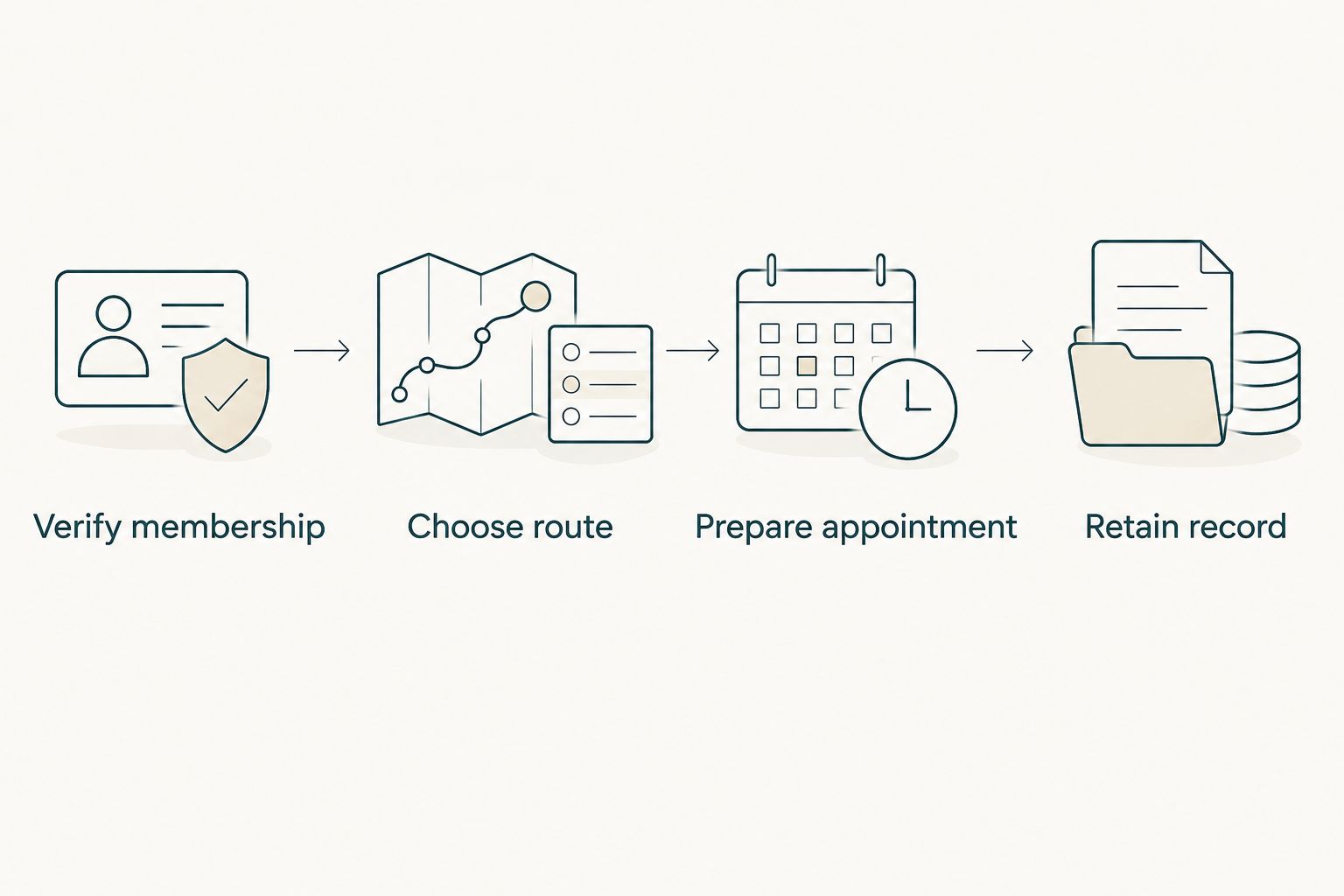
The 2026 workflow is straightforward: verify membership, choose the route, prepare the appointment and retain the completed record. Each stage has a different purpose; booking is not the same as benefit verification.
Claim submission and reconciliation
The last configuration unit is the payment record. For reimbursement, submit through the channel Daman specifies for your policy. For direct billing, check the final patient-facing charges against the agreed arrangement.
- Get the exact checklist. Ask which claim form, invoice, payment evidence, clinical request and other supporting documents are required. Obtain the submission deadline from Daman rather than using a deadline from another patient's claim.
- Submit an internally consistent record. Check that the patient, dates and services match across the documents. If supporting evidence needs correction, request a corrected document from its issuer.
- Save submission evidence. Keep the claim reference or acknowledgment and a copy of what you submitted. Record any request for further information alongside the original claim.
- Review the assessment. Compare the assessment with the services billed. If something is excluded or reduced, ask for the specific reason and applicable policy explanation.
- Close the record. Retain the final assessment, payment evidence and unresolved correspondence. For direct billing, request clarification if the patient-facing charges differ from the confirmed arrangement.
Expected result: You can identify what was submitted, what was assessed and what remains unresolved without reconstructing the appointment from messages.
Repeat blood test workflow
For repeat monitoring in 2026, reuse the folder structure, not the coverage answer. A new test request, policy change, laboratory change or collection arrangement needs its own check.
- Reuse the administrative record: Keep membership details and contact references accessible, then verify they remain current.
- Replace the clinical request: Use the clinician's current instructions rather than assuming an earlier order covers a new appointment.
- Recheck the billing route: Ask whether the same arrangement applies to the new tests and service date.
- File the new outcome separately: Keep each appointment's invoice, authorization and claim assessment distinguishable.
Best for ongoing monitoring: This variant reduces repeated document gathering without treating earlier approval as permanent coverage. Its limitation is deliberate: it preserves the checks that matter when the clinical request changes.
If a clinician requests repeat tests, ask about the schedule and purpose directly. Insurance approval is an administrative decision, not a recommendation about how often you need testing.
Troubleshooting
The answer covers blood tests but not home collection
Ask a narrower question: does the response include collecting the sample at your address? Request separate confirmation of the collection service and laboratory tests before accepting the billing arrangement.
The provider accepts insurance but cannot confirm your route
Ask about your specific membership, requested services and billing entities. Insurance acceptance is not a patient-specific billing confirmation. Leave the route unresolved until the responsible team answers those details.
The invoice does not match the clinical request
Ask the clinician or billing issuer to explain the difference. If a document contains an error, request a corrected version and keep the correspondence; do not change test names or diagnoses to make a claim appear eligible.
A submitted claim is returned or declined
Read the stated reason before resubmitting. For a document issue, obtain the missing or corrected record; for a coverage decision, request the policy basis and ask what review process applies. Repeating the same submission does not resolve the underlying issue.
Customize your workflow
Make the billing record usable by the person who will manage follow-up. If you organize healthcare for a parent or another family member, confirm the patient's consent and any representative requirements before sharing medical documents or discussing claims.
For DarDoc home healthcare appointments involving several services, ask for clarity about each service rather than assuming one confirmation covers the entire visit. Keep clinical decisions with the treating professional and billing decisions with the relevant billing and insurance teams.
Add a short appointment summary to each record: patient, requested tests, collection arrangement, billing route and outstanding questions. This is a practical handover document, not a substitute for the clinician's request or insurer's assessment.
FAQ
How do I connect Daman insurance to home blood test billing?
Connect the appointment administratively by verifying your benefits, confirming the provider and laboratory arrangement, and agreeing the billing route before collection. Daman insurance home blood test billing is not established by entering a membership number into a booking.
Does Daman cover every blood test collected at home?
Do not assume every home blood test is covered. Ask Daman about your specific policy, requested tests and home-collection service, and obtain any required authorization before the appointment.
Can DarDoc bill Daman directly for my blood test?
Confirm the arrangement with DarDoc and Daman before booking. The availability of at-home blood tests does not establish direct-billing eligibility for your membership or requested services.
What documents do I need for a reimbursement claim?
Use the document checklist Daman gives you for your policy and claim. Ask specifically about the itemized invoice, payment evidence, doctor's request, authorization and any claim form before submitting.
Can I reuse approval for my next blood test?
Do not treat a previous approval as automatic approval for a new appointment. For repeat testing in 2026, confirm whether the current request, service date and collection arrangement need a new check.
What should I do if my home blood test claim is declined?
Request the specific reason and the policy basis for the decision. Correct document errors through the issuer, and ask Daman which review process applies if you disagree with the assessment.
One last thing
Keep the coverage response, not just the insurance card. A card identifies the membership; the response explains how the proposed appointment should be handled. Before collection, make sure that response addresses the home visit as well as the laboratory tests.