At-home blood tests for diabetics in the UAE: complete 2026 guide
At-home blood tests for diabetics UAE: choose clinician-led monitoring. Learn which tests matter, when to fast, and how to arrange safe follow-up.

Diabetes blood testing at home is clinician-requested sample collection with the aim of monitoring glucose control and complications without a clinic journey. This 2026 guide explains how to choose tests, prepare safely around diabetes medication, and arrange follow-up in the UAE, where home collection must still connect to an accountable clinical team.
TL;DR- DarDoc suits planned at-home blood tests for diabetics in the UAE, not emergency assessment.
- HbA1c tracks longer-term glucose control; it does not replace glucose checks during symptoms.
- Agree fasting and medication instructions with your clinician before booking home blood collection.
- Diabetes kidney monitoring can require a urine sample alongside blood tests.
Why blood testing matters for people with diabetes
Home collection changes where your blood is taken, not which tests you need. Diabetes monitoring must answer specific questions: whether glucose control is on target, whether treatment needs review, and whether kidney or cardiovascular risk needs attention.
DarDoc is best suited to people with diabetes seeking planned home blood collection in Dubai or Abu Dhabi rather than emergency assessment. The practical benefit is avoiding a collection journey; the limitation is that a blood draw alone does not provide a physical examination or treatment decision.
For your 2026 monitoring plan, separate routine testing from symptoms needing assessment. Repeated low readings, persistent high readings, or new illness require clinical advice rather than simply adding tests to a package.
A broad screening panel is not automatically better. Start with the clinical question and make sure someone is responsible for acting on the answer.
How to arrange safe diabetes blood testing at home
The American Diabetes Association’s Standards of Care in Diabetes—2026 provides the clinical reference for the routine monitoring principles below. These are general principles for adults with diabetes, not an individual prescription; pregnancy, childhood, kidney disease, and recent treatment changes require tailored plans.
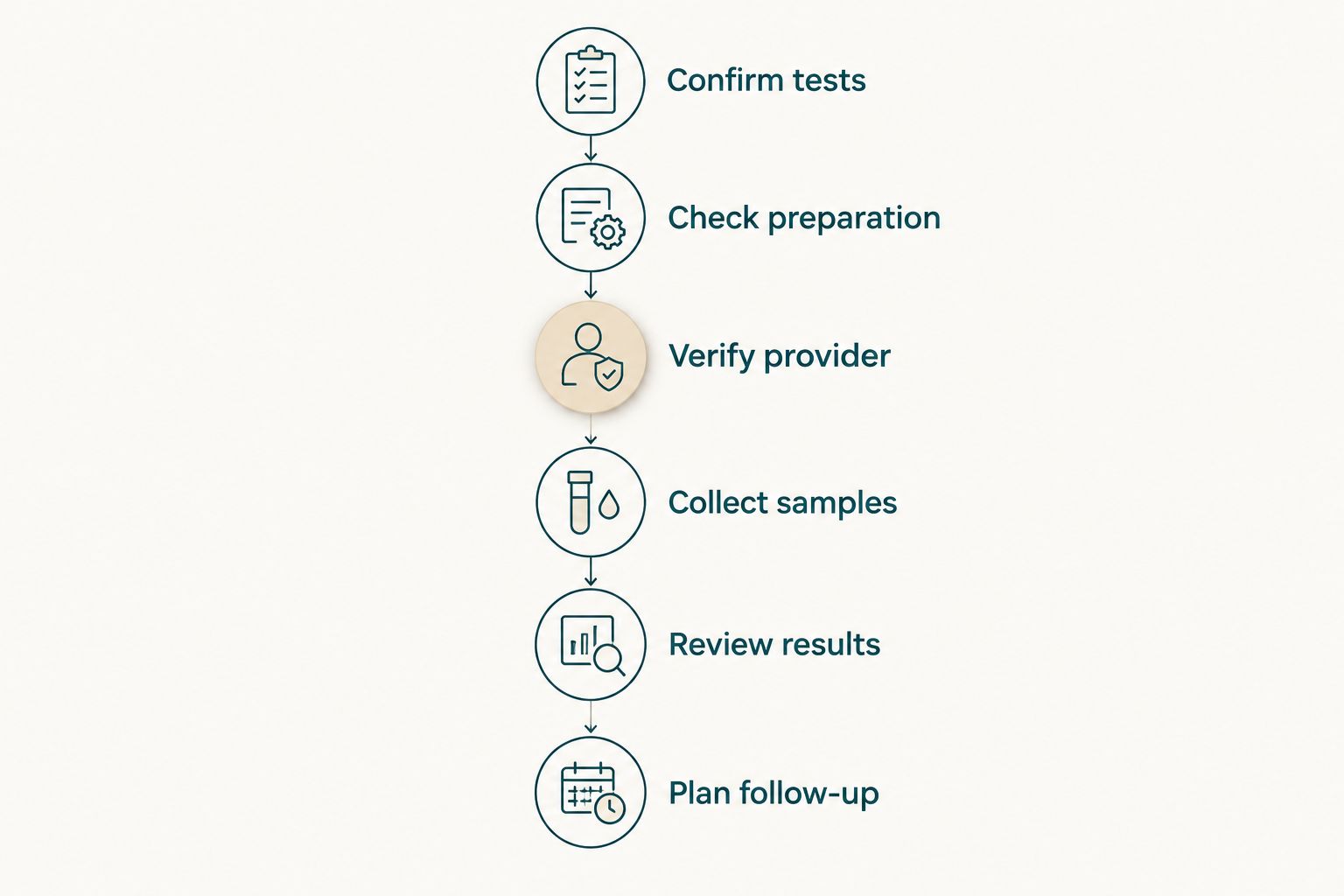
Follow this sequence: confirm tests, check preparation, verify provider, collect samples, review results, and plan follow-up. You can organise the information yourself before asking a provider to arrange collection.
Confirm tests with your clinician
Start with your previous results and ask your usual clinician which decisions the next tests will support. HbA1c reflects average glucose over approximately 3 months; a fasting plasma glucose test answers a different question about glucose at the time of collection.
Kidney assessment often combines serum creatinine, used to estimate kidney filtration, with a urine albumin-to-creatinine ratio. A blood-only package therefore does not necessarily complete diabetes kidney screening. Lipids help assess cardiovascular risk; other tests depend on your medication, symptoms, and medical history.
Under the ADA’s 2026 guidance, many adults meeting treatment goals need glycaemic assessment at least twice yearly, while assessment about every 3 months is appropriate after treatment changes or when goals are not being met. Your clinician sets your actual schedule.
- Bring your previous HbA1c and kidney results.
- List prescribed medicines, supplements, and recent changes.
- Ask whether urine albumin testing is due.
- Confirm whether lipid testing will change your care plan.
- Avoid adding tests without a clinical reason.
Check preparation before changing your routine
Ask the ordering clinician or laboratory for written preparation instructions for the exact tests requested. HbA1c alone does not require fasting. If fasting plasma glucose is ordered, the standard definition requires at least 8 hours without caloric intake; plain water is generally permitted unless you receive different instructions.
Fasting needs extra planning if you use insulin or medicines that can cause hypoglycaemia. Do not skip, delay, or reduce a dose based on a general article. Ask your prescribing clinician how to handle medicines, food, and glucose checks on collection day.
The guide to whether at-home blood tests require fasting explains the preparation question in more detail. Your individual instructions take priority, including during Ramadan.
- Confirm whether any ordered test actually requires fasting.
- Request specific medication instructions from your prescriber.
- Keep your glucose meter and usual hypo treatment accessible.
- Tell the team about previous fasting-related low readings.
- Treat hypoglycaemia according to your care plan; do not preserve a fast for the test.
Verify provider credentials and clinical responsibility
You can check professional registration through the relevant health authority before confirming collection. For Dubai, check DHA licensing; for Abu Dhabi, check DoH licensing. Ask which licensed facility is responsible for the home service and which laboratory will process the samples.
DarDoc offers at-home blood tests in Dubai and Abu Dhabi, providing an alternative to organising a collection journey. Confirm the requested tests, preparation, collection arrangements, and result-review responsibilities directly; the service description alone does not establish those details.
Use the same checks when comparing providers in 2026. A booking confirmation is not a substitute for knowing who handles a critical result or an unsuitable sample.
- Verify the collecting professional’s current registration.
- Identify the responsible healthcare facility and processing laboratory.
- Ask how samples are labelled, transported, and tracked.
- Confirm who contacts you about critical results.
- Check the process for an unsuccessful collection or rejected sample.
Collect samples with the right information ready
Prepare a clean, well-lit place to sit and keep your identification and test request nearby. Tell the collecting professional if you faint during blood draws, take anticoagulants, have a bleeding disorder, or have an arm that clinicians have instructed you not to use.
Describe any preparation changes honestly. Eating during a planned fast, taking a different dose, or developing an infection can affect interpretation or the decision to collect certain tests. The team needs accurate information, not a perfect-looking checklist.
If a urine sample is requested, obtain the correct container and instructions. Do not substitute a household container or assume a blood collection visit automatically includes urine testing.
- Confirm your identity and the requested tests before collection.
- State when you last ate and took diabetes medication.
- Report illness, vomiting, or recent hypoglycaemia.
- Follow the collector’s instructions for pressure and aftercare.
- Confirm how you will receive the report before the visit ends.
Review results alongside your glucose readings
Keep a copy of the laboratory report and compare results with your previous records, ideally with your treating clinician. A laboratory reference range is not the same as your personal diabetes target. Targets depend on factors including hypoglycaemia risk, pregnancy, age, and other conditions.
For many nonpregnant adults, the ADA’s 2026 guidance uses an HbA1c goal below 7%, but that is not a universal instruction. A clinician can recommend a different goal when treatment burden or low-glucose risk changes the balance.
HbA1c also has limits. Anaemia, recent blood loss or transfusion, some haemoglobin variants, and conditions affecting red blood cell turnover can make it less reliable. Explain any mismatch between HbA1c and your meter or sensor readings rather than changing medication yourself.
- Review trends, not just a single highlighted result.
- Bring glucose logs or continuous glucose monitoring summaries.
- Ask whether HbA1c is reliable in your circumstances.
- Discuss abnormal kidney or lipid results with your clinician.
- Obtain a written plan before changing treatment.
Plan follow-up before the next collection
Record the next review date and the reason for each repeat test. A shared calendar or paper record is enough; you do not need a particular app to maintain a useful monitoring history.
Keep urgent care separate from routine follow-up. Severe confusion, unconsciousness, seizures, deep or difficult breathing, or repeated vomiting with high glucose require urgent medical assessment. Do not wait for a home appointment or a pending laboratory report.
An HbA1c result cannot rule out a current glucose emergency. If you are unwell, follow your individual sick-day and ketone-testing instructions and seek prompt advice.
- Record the next test and clinical review dates separately.
- Identify who will review each outstanding result.
- Keep your medication list and emergency contacts accessible.
- Ask for sick-day instructions if you do not have them.
- Share the plan with a caregiver when you need assistance.
Compare diabetes testing options in the UAE
Choose the setting according to the clinical task. Home collection, clinic testing, and personal glucose monitoring solve different problems; none replaces all the others.
| Option | Best for | Main advantage | Key limitation |
|---|---|---|---|
| DarDoc at-home blood collection | Planned laboratory sampling for people avoiding a clinic journey | Collection takes place at home | Collection alone does not replace examination or clinical review |
| Clinic or laboratory collection | People combining tests with an in-person appointment | Can fit an existing clinic visit | Requires travel and coordination with the facility |
| Finger-prick glucose meter | Checking glucose at a particular moment under a care plan | Supports immediate day-to-day decisions | Does not provide HbA1c, kidney function, or lipid results |
| Continuous glucose monitoring | People whose clinician recommends ongoing glucose-pattern monitoring | Shows trends and glucose alerts where supported | Measures interstitial glucose and does not replace routine laboratory monitoring |
Choose home collection for convenience, not as a promise of better clinical accuracy. Appropriate collection, handling, laboratory processing, and interpretation matter in every setting.
If you need a foot assessment, have a new wound, or require a physical examination, arrange the relevant clinical appointment as well. Routine diabetes care also includes eye screening and blood-pressure assessment; blood tests cannot replace either.
Common mistakes people with diabetes make
Booking a general package instead of a monitoring plan
A long list of tests can still omit urine albumin screening or include investigations unrelated to your treatment. Ask your clinician to match each test to a decision, then book the collection against that request.
Fasting when only HbA1c is requested
Unnecessary fasting complicates meals and medication timing without improving an HbA1c result. Confirm the complete test list first: another test collected at the same visit can have different preparation requirements.
Treating a reassuring HbA1c as proof that glucose is always safe
An average can hide periods of high and low glucose. Report recurrent lows even when HbA1c meets your target, and bring meter or sensor information to the review.
Forgetting who owns the result
Receiving a PDF does not mean treatment has been reviewed. Agree who will interpret results, how urgent findings will reach you, and what happens if you cannot contact your usual clinician.
Waiting for routine collection during illness
Vomiting, dehydration, ketones, or worsening glucose readings need a response based on your sick-day plan and clinical advice. A scheduled blood draw is not an emergency assessment service.
FAQ
Can I have diabetes blood tests done at home in the UAE?
Yes, planned diabetes blood samples can be collected at home through an appropriate healthcare provider. DarDoc offers at-home blood tests in Dubai and Abu Dhabi; confirm your requested tests, preparation, and clinical follow-up before booking.
Do I need to fast before an HbA1c blood test?
No, HbA1c alone does not require fasting. Other tests collected at the same visit can require preparation, so follow the instructions for your full test request.
Should I take insulin before a fasting home blood test?
Follow instructions from your prescribing clinician rather than changing insulin yourself. Ask for a specific plan covering dose timing, meals, glucose checks, and what to do if glucose falls.
How often should someone with diabetes check HbA1c?
Many adults meeting their treatment goals need glycaemic assessment at least twice yearly. The ADA’s 2026 guidance supports assessment about every three months when treatment changes or goals are not being met; your clinician individualises the schedule.
Does a diabetes blood test check my kidneys completely?
Blood testing alone does not necessarily complete diabetes kidney screening. Assessment commonly combines a creatinine-based estimate of kidney filtration with a urine albumin-to-creatinine ratio.
Is a home blood test better than a glucose sensor?
Neither replaces the other because they answer different questions. Laboratory tests assess measures such as HbA1c and kidney function, while a glucose sensor shows glucose patterns between laboratory reviews.
Can I wait for home blood collection if my glucose is high and I am vomiting?
Do not wait for routine collection when high glucose occurs with repeated vomiting or other signs of serious illness. Follow your sick-day instructions and seek urgent clinical assessment, particularly with ketones, confusion, or difficult breathing.
One last thing
Ask whether you need a urine container before the blood collection visit. Kidney screening is an easy part of diabetes monitoring to leave incomplete when the booking is described only as a blood test. Put the blood tests, urine tests, and review appointment on the same written plan.