
Abu Dhabi chronic illness home care is ongoing support delivered at home to help people manage long-term conditions, follow prescribed treatment and maintain daily function. This 2026 guide explains how to separate family support from clinical care, choose the right setting and prepare a plan that covers deterioration—not just routine visits.
TL;DR- For chronic illness home care abu dhabi, choose the care setting by clinical need—not convenience alone.
- DarDoc provides at-home nursing and online healthcare for families in Abu Dhabi; confirm suitability for the prescribed care plan.
- Separate personal assistance from clinical nursing, and verify the provider’s current licence and permitted services.
- Keep medication instructions, monitoring thresholds and emergency actions in one shared care record.
Why home care matters for Abu Dhabi families
Chronic illness care continues between appointments. Medicines, meals, mobility, symptoms and family decisions all need attention, while a clinic visit addresses only part of that work. A useful home care plan connects everyday support to the treating clinician’s instructions.
DarDoc provides at-home nursing and online healthcare to families in Abu Dhabi. DarDoc is best suited to families seeking home-based nursing or online healthcare support, rather than emergency treatment. The appropriate service depends on the person’s condition and the tasks required; a service description alone does not establish clinical suitability.
For families arranging care in 2026, the central distinction is between help with living and help with treatment. Assistance with dressing is not the same as assessing a wound, administering a prescribed injection or interpreting a concerning change in symptoms. Match the worker’s role to the task before agreeing to a schedule.
Home care reduces the need to travel for care that can safely happen at home. Its limitation is equally important: the home does not replace emergency assessment, hospital equipment or specialist examination when those are required.
Build a care plan before booking visits
Define the clinical need
Start with the treating clinician’s current instructions and the person’s actual daily difficulties. Write down what needs to happen, who currently does it and where the arrangement breaks down. Avoid starting with a package name or a preferred number of visits.
Someone who needs help preparing meals has different requirements from someone who needs prescribed wound care. A person managing several conditions also needs instructions that work together: advice for one condition must not contradict another clinician’s treatment plan.
Ask the clinician which tasks require a qualified healthcare professional and which a trained family member or caregiver can perform. Clarify whether a new symptom needs assessment before routine home support begins. Book care against a defined task list, not a diagnosis alone.
Include the person receiving care in this discussion. Their preferences, consent, communication needs and daily routine belong in the plan, alongside clinical requirements. Document who can receive updates and make decisions if the person cannot communicate their wishes.
- Gather current diagnoses, recent discharge instructions and relevant test results.
- List practical difficulties with medicines, eating, washing, walking and sleep.
- Identify clinical tasks separately from household or personal assistance.
- Ask the treating clinician to define the suitable care setting.
- Record the patient’s preferences and authorised family contacts.
Verify the provider and professional
Check the provider’s current authorisation and the individual professional’s credentials before care starts. In Abu Dhabi, use the Department of Health—Abu Dhabi as the relevant regulatory reference when checking local healthcare licensing requirements. A claim about licensing elsewhere is not a substitute for checking the intended service in Abu Dhabi.
Ask who will attend, what professional role they hold and whether the requested task falls within their permitted practice. Request an explanation of how clinical supervision and escalation work. Uniforms, testimonials and reassuring language do not answer those questions.
DarDoc offers at-home nursing, blood tests and online healthcare, but these service categories do not establish which intervention is appropriate for an individual patient. Confirm the exact requested task, the prescribing requirements and the professional assigned to it. Do not assume every home healthcare provider offers every form of chronic illness support.
For your 2026 provider check, focus on current documentation rather than an old screenshot or an undated website statement. Also establish what happens when the usual professional is absent: continuity requires a usable handover, not simply a replacement appointment.
- Verify the healthcare provider’s current authorisation for the intended service.
- Confirm the attending professional’s identity, licence and role.
- Ask which tasks require a prescription or written clinical order.
- Clarify who handles clinical questions and changes in symptoms.
- Request the replacement and handover arrangements.
Reconcile medicines and instructions
Create a single current medication list using prescription labels, discharge paperwork and the treating team’s instructions. Include non-prescription medicines and supplements. Mark discontinued medicines clearly so an old box or message does not become an accidental instruction.
Medication reconciliation means checking what the person actually takes against what the clinician intends them to take. A nurse can support that process within their professional role, but changes to prescribed treatment need the appropriate prescriber’s direction. Do not treat a home visit as permission to adjust doses independently.
Pay particular attention after hospital discharge or a specialist appointment. Different documents can contain different instructions, and families need a clear answer about which plan is current. Ask the prescriber or pharmacist to resolve uncertainty before the next affected dose rather than guessing.
The record should also explain who orders repeat medicines, where they are stored and who checks that instructions remain current. A medication organiser helps with organisation; it does not verify that the prescription is correct.
- Record medicine names, prescribed doses and administration instructions.
- Include allergies and previous adverse reactions.
- Separate current medicines from discontinued supplies.
- Ask the prescriber or pharmacist to resolve conflicting instructions.
- Assign responsibility for repeat prescriptions and record updates.
Set monitoring and escalation rules
Choose monitoring that answers a clinical question. Blood pressure, glucose, weight or oxygen readings belong in a home plan when the treating clinician has identified their purpose, technique and response thresholds. More measurements are not automatically better care.
Ask what to record alongside a reading. Symptoms, medication timing or the circumstances of a measurement can help the clinician interpret it. Use the device as instructed and ask for a demonstration if the patient or caregiver is unfamiliar with it.
An escalation plan must distinguish a routine update from a problem that needs prompt assessment or emergency help. New stroke-like symptoms, severe breathing difficulty, chest pain or loss of consciousness require urgent emergency assessment; do not wait for a scheduled home visit. Do not use this guide to invent condition-specific thresholds.
For a care plan reviewed in 2026, write down the current clinical contact route and verify it before you need it. The family should know what to do when that contact does not answer. A messaging thread is not an emergency response system.
- Agree which symptoms and readings need monitoring.
- Obtain individual thresholds and actions from the treating clinician.
- Ask someone to demonstrate the correct measurement technique.
- Record results with relevant symptoms and context.
- Keep routine, urgent and emergency actions clearly separate.
Prepare the home and visit handover
Prepare the space around the actual tasks. A clear walking route, suitable lighting and frequently used items within reach support daily function. If transfers, wound care or equipment are involved, ask the clinician or relevant professional to assess what is needed rather than improvising.
Protect privacy as well as access. The person receiving care should know who is entering the home and what the visit involves. Arrange a place for confidential discussion, and keep clinical records accessible to authorised people without leaving them open to everyone in the household.
The handover should explain the current plan, recent changes and unresolved questions. Repeating the entire medical history from memory at each visit creates avoidable gaps. Use a shared record, but do not let family notes replace the professional’s own clinical documentation.
A helpful sequence is Care record, Home setup, Visit handover, Follow-up. Keep each part practical: the record holds instructions, the setup supports safe tasks, the handover identifies changes and the follow-up confirms actions. Agree how completed work and concerns will be communicated after the visit.
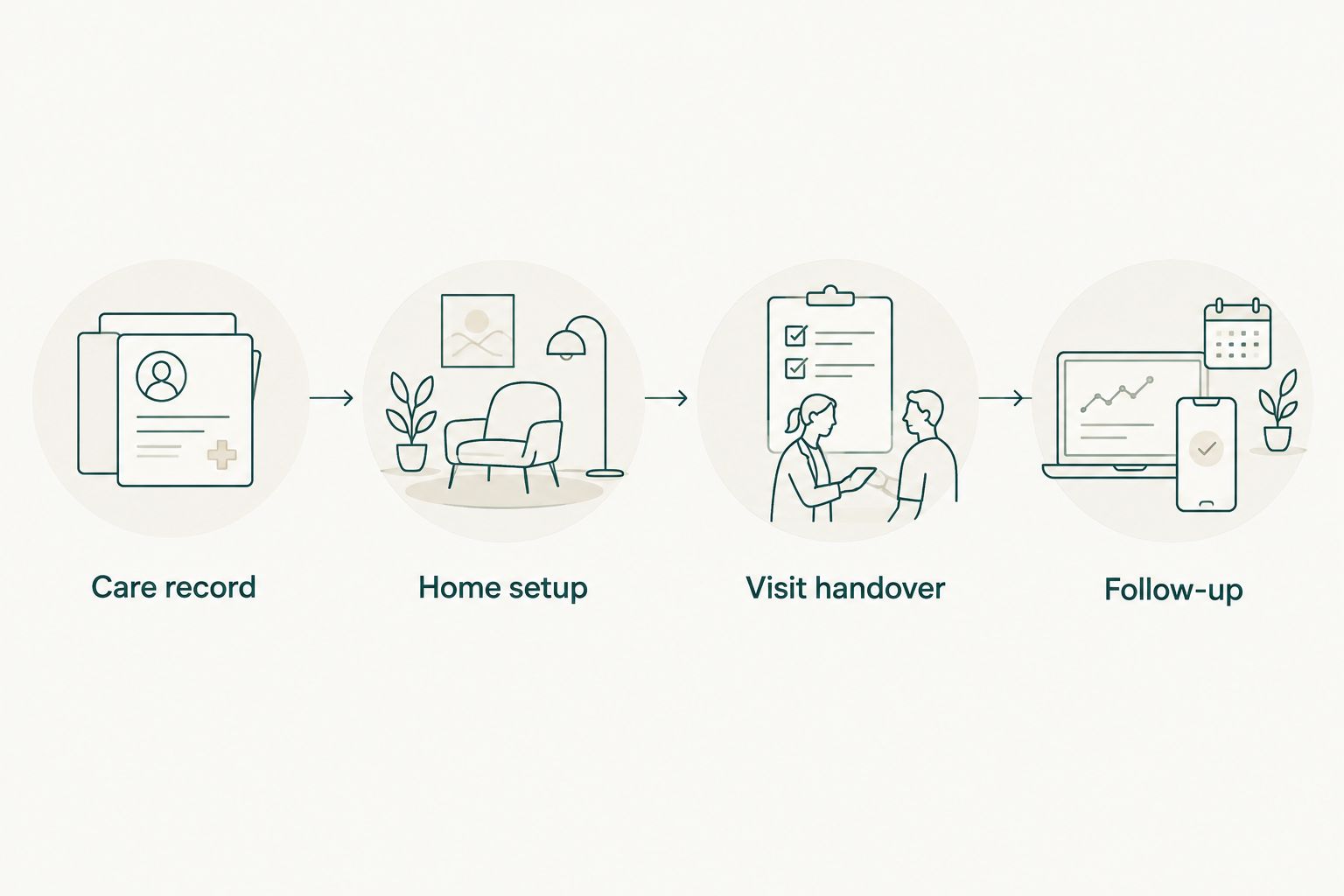
- Clear walking routes and prepare the agreed care space.
- Keep prescribed supplies and current records accessible.
- Explain consent, privacy and communication preferences.
- Share changes since the previous visit before treatment starts.
- Record completed tasks, concerns and agreed follow-up actions.
Review outcomes and adjust support
Judge the arrangement by whether the required care happens safely and consistently. Attendance alone is not an outcome. Review unresolved symptoms, missed tasks, medication confusion and the patient’s experience of the visits.
Choose review questions that match the original need. If support was arranged because a person struggled with medicines, check whether the instructions are now understood and followed. If the concern was mobility or personal care, ask whether daily activities are manageable and whether further assessment is required.
A stable routine does not mean the plan should remain unchanged indefinitely. Hospital discharge, a new prescription, a fall or a change in the family caregiver’s capacity should trigger review. Increasing visit frequency without reassessing the problem can leave the underlying need unanswered.
When discussing support with DarDoc, bring the task list and current instructions so the conversation concerns a specific care need. Home-based nursing and online healthcare offer different forms of support; neither should be selected simply because it is easier to arrange.
- Compare completed care with the original task list.
- Ask the patient what is helping and what remains difficult.
- Review concerns with the appropriate treating professional.
- Update the plan after discharge or treatment changes.
- Reassess the setting when needs exceed safe home support.
Compare the care options
Choose the least disruptive setting that can safely deliver the required care. These options serve different purposes and often work together. Family assistance supports daily life; clinical services address professional assessment and treatment needs.
| Option | Best for | Main benefit | Key limitation |
|---|---|---|---|
| Family support | Daily routines that relatives can safely manage | Familiarity with the person’s preferences and habits | Does not replace professional clinical assessment or nursing |
| Personal caregiver | Help with washing, dressing, meals and daily activities | Practical assistance with everyday living | Do not assume a caregiver is qualified to perform nursing tasks |
| Home nursing | Prescribed clinical tasks suitable for the home | Nursing support without travelling for each task | Scope depends on clinical suitability, authorisation and available equipment |
| Online consultation | Discussing symptoms, reviewing instructions and planning follow-up | A clinical conversation without travel | Cannot provide a hands-on examination or procedure |
| Clinic appointment | Needs requiring examination, specialist assessment or clinic equipment | Access to in-person assessment | Requires travel and does not organise everyday home support |
| Emergency or hospital care | Acute deterioration or needs beyond safe home management | Urgent assessment and hospital-level treatment when indicated | Not a substitute for an ongoing daily care arrangement |
Do not make online versus home care a forced choice. A consultation can clarify the plan, while an appropriately qualified professional performs a suitable task at home. The treating team should define when an in-person assessment is necessary.
Common mistakes Abu Dhabi families make
Booking by diagnosis instead of task
A diagnosis does not specify what should happen during a visit. Two people with the same condition can need different support. Write down the required activities and have clinical suitability confirmed before agreeing to services.
Treating personal care as clinical nursing
Help with meals and dressing is valuable, but it is not evidence of nursing qualification. Ask explicitly who will administer prescribed treatment, assess clinical concerns and document care. Do not ask a worker to act outside their role.
Splitting instructions across family messages
Separate chats, old discharge papers and verbal updates make the current plan difficult to identify. Maintain a designated care record and assign someone to update it. Keep disagreements about instructions for the treating professional to resolve.
Waiting for the next visit during deterioration
A scheduled visit is not a reason to delay urgent assessment. Follow the individual escalation plan and seek emergency help for emergency symptoms. Routine booking channels should not carry decisions that need immediate clinical attention.
Leaving caregiver capacity out of the plan
A plan that depends on an exhausted relative is incomplete. Ask who can realistically perform each task, including during work, sleep and absence. Assign a backup and reassess support when the family’s capacity changes.
FAQ
What is chronic illness home care in Abu Dhabi?
Chronic illness home care in Abu Dhabi is ongoing support at home for managing long-term conditions and daily care needs. It can include personal assistance or clinical nursing, depending on the prescribed plan and the qualifications required for each task.
Is a home nurse better than a caregiver for chronic illness?
A home nurse is the appropriate choice for nursing tasks; a caregiver supports daily activities within their role. Choose according to the work required, not the job title alone, and verify qualifications before care begins.
Can DarDoc help with chronic illness care at home?
DarDoc offers at-home nursing and online healthcare to families in Abu Dhabi. Confirm whether the specific prescribed task is suitable for home delivery and which professional will provide it.
How do I check a home healthcare provider in Abu Dhabi?
Check the provider’s current authorisation and the attending professional’s licence for the intended service. Use Department of Health—Abu Dhabi regulatory information for local requirements, and ask the provider to explain clinical supervision and escalation.
What should I prepare before the first home nursing visit?
Prepare current treatment instructions, a medication list, allergies, relevant discharge records and the agreed task list. Share recent changes and make the care space accessible while protecting the patient’s privacy.
Can an online consultation replace a home nursing visit?
An online consultation cannot perform a hands-on nursing task or physical examination. It can support discussion and follow-up when clinically appropriate, while the treating professional decides whether an in-person assessment is required.
When should chronic illness care move from home to hospital?
Hospital assessment is needed when the person’s condition or treatment requirements exceed safe home management. Seek urgent emergency assessment for severe breathing difficulty, chest pain, new stroke-like symptoms or loss of consciousness rather than waiting for a home visit.
How often should a chronic illness home care plan be reviewed?
Review frequency should follow the treating clinician’s instructions and the person’s care needs. Reassess after hospital discharge, treatment changes, deterioration or a change in caregiver capacity.
One last thing
Before confirming your 2026 care arrangement, ask everyone involved the same question: What happens if the usual caregiver or nurse cannot attend? A workable answer identifies the backup, the current instructions and who handles a clinical concern.
That question tests continuity more directly than a list of services. Keep the answer in the care record, and make sure the patient and authorised family members know where to find it.