Instead of chasing a laboratory report and then arranging a separate appointment, plan your blood test to same day doctor consultation workflow around sample collection, confirmed result timing, and a clinician’s review. This 2026 guide shows you how to coordinate those steps without treating same-day results or an appointment as guaranteed.
TL;DR- DarDoc suits UAE families arranging home blood tests and online healthcare; confirm result timing and consultation arrangements before booking.
- A blood test to same day doctor consultation workflow needs a confirmed report deadline and a clinician review plan.
- Book around laboratory reporting, not just blood collection; some tests require longer processing.
- Keep symptoms, medicines, and the complete laboratory report together for the doctor consultation.
Why this matters
Blood collection, laboratory reporting, and medical interpretation are separate events. A morning blood draw does not establish when your report will be ready, and receiving a report does not mean a clinician has reviewed it.
DarDoc is best for UAE families seeking home blood tests and online healthcare. You can use DarDoc as the starting point for arranging care in Dubai or Abu Dhabi, then confirm the details for your specific test and consultation.
The useful question in 2026 is not simply whether you can have blood taken today. Ask whether the tests you need can be reported before the consultation, who will interpret them, and what happens if reporting takes longer.
This workflow helps you organise that handoff. It does not replace clinical triage, determine which tests you need, or promise that every investigation can be completed within one day.
Before you start
- Confirm the clinical purpose and preparation. Have the requesting clinician’s instructions, the test names, and any preparation requirements. Do not fast, stop medicines, or change supplements unless you have been instructed to do so.
- Prepare 3 records. Keep your test request, current medicines and supplements, and previous relevant results together. Have your identification and a reliable way to receive the report and attend the consultation.
- Check the reporting clock. Ask whether the quoted turnaround starts at collection, laboratory receipt, or another processing stage. Also ask whether your report will arrive in parts; a partial report is the gotcha that can leave a booked review without the information it needs.
For a dependent adult, confirm consent and whether a caregiver can join the discussion. For a child, arrange the appropriate clinician and parent or guardian involvement before collection.
Do not use this pathway to delay urgent care. Chest pain, severe difficulty breathing, fainting, or stroke symptoms require emergency assessment rather than waiting for a blood test or online appointment. In the UAE, call 998 for an ambulance.
Clinical request and preparation
The first configuration unit is your clinical request: why the test is needed, what has been requested, and what the doctor needs to know. Use a personal note rather than relying on memory.
The bold labels below are suggested headings for your own appointment notes, not names of booking-system buttons or fields.
- Write Reason for testing. Describe your symptoms or monitoring purpose, when the issue started, and any change that prompted the request. Distinguish a new problem from a routine follow-up.
- Record Requested tests. Copy the names from the clinician’s request. Do not add a broad panel just because it sounds more thorough; test selection should follow the clinical question.
- Complete Medicines and supplements. Include prescription medicines, non-prescription products, and relevant recent changes. Tell the requesting clinician about anything you take rather than deciding yourself what to stop.
- Confirm Preparation instructions. Ask about food, drink, medicine timing, exercise, and collection timing where relevant to your requested tests. Follow the instructions for your investigation, not a generic fasting checklist.
- Add Previous results. Keep the original reports with dates, units, and reference ranges. A remembered description such as borderline is not a substitute for the report.
Expected result: you have a clear test request and a preparation plan that the collecting professional and reviewing clinician can understand.
For your 2026 appointment record, include the actual collection date rather than labelling the investigation today. That makes the timeline clear if the consultation moves or another clinician takes over.
Collection and reporting schedule
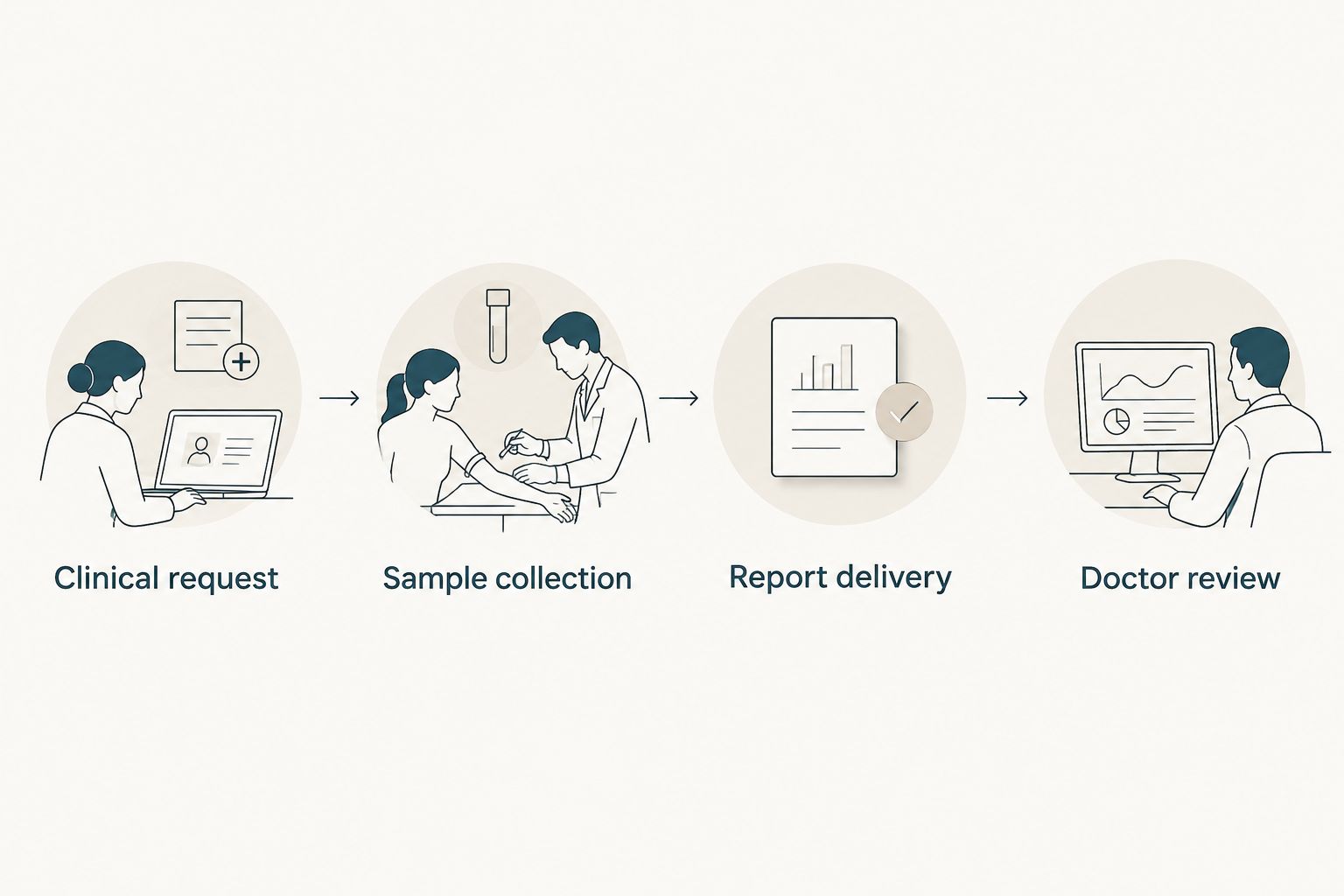
The next configuration unit is the handoff between the collection visit and the laboratory. Set 2 checkpoints: confirmation of the expected reporting window before booking, and confirmation of report status before the consultation.
- Ask which requested tests have the reporting window you need. Separate the expected timing for each test if the laboratory does not issue everything together.
- Confirm your collection details. Give the correct location, contact information, and any access instructions needed for a home visit. Check that the arrangement matches your preparation requirements.
- Establish Report delivery. Ask how you will receive the complete report and whether you must send it to the reviewing clinician yourself. Do not assume that separate teams or systems share it automatically.
- Record Delay plan. Ask whom to contact if the report is incomplete or not received by the expected time. Establish whether the consultation should proceed without it or be rearranged.
- Keep the collection details. Record the collection date and time, and retain any paperwork provided. Do not turn an estimated reporting window into a confirmed deadline in your own notes.
Expected result: you know when to check for the report, how it reaches the doctor, and what to do if the timing changes.
A same-day pathway works only when its clinical and operational dependencies line up. Confirm the report handoff before making the consultation depend on it.
Doctor review and consultation plan
For DarDoc blood tests and online healthcare, confirm the collection and consultation arrangements separately. This guide describes a patient coordination process, not a verified automatic connection between booking, laboratory, and consultation systems.
Choose the review sequence according to the clinical question. These are appointment-planning options, not substitutes for a clinician’s assessment of urgency.
| Review sequence | Best for | Benefit | Limitation |
|---|---|---|---|
| Consultation after the report | Clinician-requested tests with a confirmed reporting window | The clinician can discuss the available results during the appointment | Delayed or incomplete reporting can disrupt the review |
| Consultation before testing | Unclear symptoms or uncertainty about which tests are needed | The clinician can decide what investigation is appropriate | Result interpretation requires a subsequent review |
| Consultation with partial results | Situations where the clinician advises an earlier discussion | Available findings and symptoms can be assessed together | Outstanding tests can change the plan or require further discussion |
- Confirm the appointment’s purpose. State whether you need test selection, interpretation of completed results, or advice while some results remain outstanding.
- Arrange 1 review appointment around the confirmed reporting window, if the clinician agrees that waiting is appropriate. An appointment time alone does not establish that the report will be ready.
- Send the complete report through the channel the provider specifies. Include all pages, your symptom summary, current medicines, and relevant previous results. Use the provider’s designated channel rather than a public group or shared account.
- Verify receipt before the appointment. Ask whether the clinician can access the report and whether any requested tests are still missing.
- Prepare your questions. Ask what the findings mean in your situation, whether further investigation is needed, and what symptoms should prompt earlier assessment.
Expected result: the reviewing clinician has the available report and clinical context, and you know whether the appointment will cover complete or partial findings.
The same-day decision in 2026 should follow the report status and your clinical needs. Do not postpone assessment of worsening symptoms solely to wait for a complete panel.
Follow-up record and escalation instructions
The final configuration unit is the written plan after the consultation. A discussion is not complete until you understand what to do next.
- Record Clinical interpretation. Summarise what the clinician explained, including which findings need action and which require context or monitoring. Ask for clarification if a term is unfamiliar.
- Capture Next action. Write down any additional investigation, referral, treatment instruction, or planned review. Follow the clinician’s directions rather than making changes from a highlighted result alone.
- Confirm Outstanding results. Identify what has not yet been reported and who will review it when it arrives. Do not assume that the earlier appointment automatically closes the investigation.
- Save Safety instructions. Record the symptoms or developments that require urgent assessment and the contact route for non-emergency questions.
- Keep Follow-up timing with the report. Use the interval specified by the clinician; there is no single repeat-testing schedule that fits every investigation.
Expected result: you have an actionable care plan, responsibility for outstanding findings is clear, and your records are ready for the next clinician.
If the explanation and the written instructions differ, ask the provider to clarify. Your own summary is useful, but it should not override the clinician’s documented advice.
When another result arrives after the consultation
A second workflow is useful when the laboratory issues findings in stages. Rather than restarting the entire booking process blindly, reconnect the new report with the existing clinical plan.
- Save the updated report with its issue date. Keep the earlier version so you can distinguish newly reported findings from results already discussed.
- Send the update through the agreed clinical channel. State that it follows an earlier consultation and identify the tests that were previously outstanding.
- Ask whether the clinician needs another appointment or can provide the next instruction through the provider’s usual process. Do not assume that an administrative acknowledgement is a medical review.
- Add the response to your follow-up record. If no review arrangement was established, contact the provider to clarify responsibility.
Best for: patients whose requested investigations are reported in stages. The benefit is continuity; the limitation is that an additional discussion remains necessary when the clinician needs more information.
Keep this 2026 follow-up record with the original consultation notes. A new report can change the care plan, so the earlier discussion should not be treated as the final answer to findings that were not yet available.
Troubleshooting
The report is not ready before the appointment
Contact the provider before the consultation and confirm which results are outstanding. Ask the clinician whether to proceed with the available information or rearrange the review; do not cancel clinical assessment of concerning symptoms on your own.
You received only part of the report
Check the requested test list against the report. Send the available pages and identify what is missing, rather than presenting the partial report as complete.
The clinician cannot access your attachment
Use the original report file and the provider’s specified submission method. Confirm receipt; an unreadable screenshot or an attachment sent to the wrong channel does not complete the handoff.
A result is flagged outside its reference range
Ask the clinician to interpret it alongside symptoms, medicines, and previous findings. A flagged result alone does not establish a diagnosis; if the laboratory or clinician gives urgent instructions, follow them immediately.
Your symptoms worsen while you wait
Seek assessment according to the symptoms and any safety instructions already given. Severe symptoms need emergency care, not a faster booking in the same routine workflow.
Customize your workflow
Adapt the process to the person receiving care, not just the test. For an older relative, decide who holds the records, who has permission to receive information, and who will join the consultation. The elderly home care guide for Abu Dhabi is a related starting point for broader care planning.
For medication monitoring, tell the clinician which treatment is being reviewed and when it changed. Do not use a blood result alone to decide whether to start, stop, or switch treatment.
For repeat investigations in 2026, reuse your record headings while updating symptoms, medicines, collection dates, and reports. Carrying forward an old medication list without checking it defeats the purpose of the workflow.
DarDoc provides home and online healthcare, but confirm the clinician’s credentials, test-specific preparation, reporting arrangements, and follow-up responsibility for your appointment. Those details matter more than an unqualified same-day label.
FAQ
Can I go from a blood test to a same day doctor consultation?
Yes, when the required report is ready and a clinician appointment has been confirmed. Blood collection alone does not guarantee same-day reporting or review; confirm both arrangements before making one depend on the other.
Should I book the doctor before or after the blood test?
Book a clinician first if you do not know which tests you need. For tests already requested by a clinician, plan the result-review appointment around the laboratory’s confirmed reporting window.
Do I need to fast before a home blood test?
Fast only when instructed for your specific tests. Ask the requesting clinician or collecting provider about preparation, and do not stop medicines without clinical advice.
What should I send the doctor before the consultation?
Send the complete laboratory report, the reason for testing, your current medicines and supplements, and relevant previous results. Use the provider’s designated submission channel and confirm that the clinician can access the documents.
Can the doctor review my results if some tests are still missing?
The clinician can assess available findings and decide whether an earlier discussion is appropriate. Identify the outstanding tests and agree who will review them when they arrive.
Does an abnormal blood result mean I have a disease?
A result outside the laboratory reference range does not by itself establish a diagnosis. A clinician interprets it with your symptoms, medical history, medicines, and other findings.
What if I feel worse while waiting for the report?
Seek medical assessment rather than waiting for the scheduled report review. For severe symptoms such as chest pain, severe breathing difficulty, or stroke symptoms, call 998 for an ambulance in the UAE.
Does DarDoc guarantee this entire workflow on the same day?
Confirm the timing of each requested test and the consultation directly with DarDoc. This guide is a coordination plan, not a guarantee of same-day laboratory reporting, appointment timing, or clinical review.
One last thing
Ask who owns the next action before the consultation ends. Receiving a report, forwarding it, and having it medically reviewed are different events; your record should show which has actually happened.
Keep the original laboratory file alongside the care plan. A cropped image can remove the units, reference ranges, or collection details that the next clinician needs.