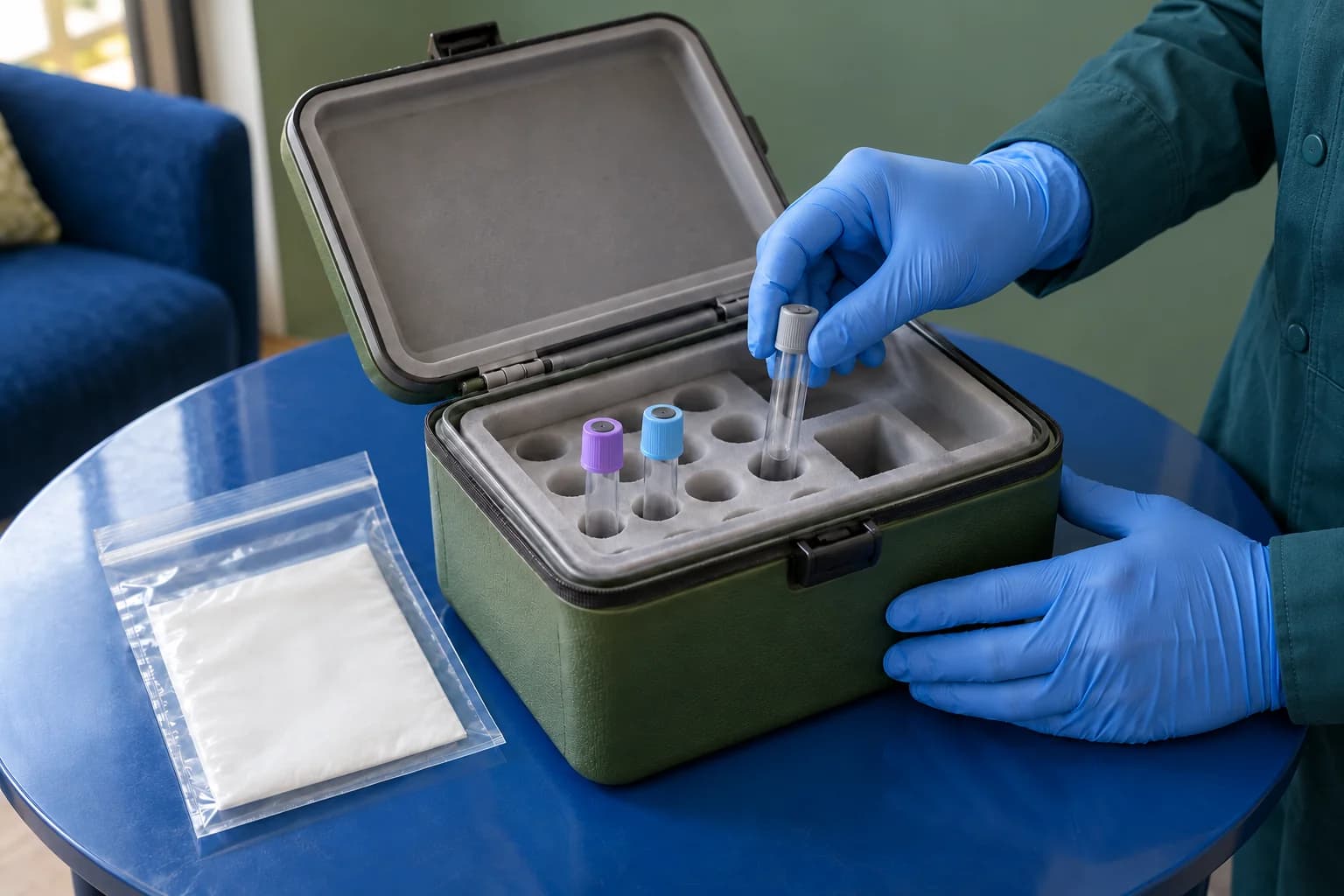
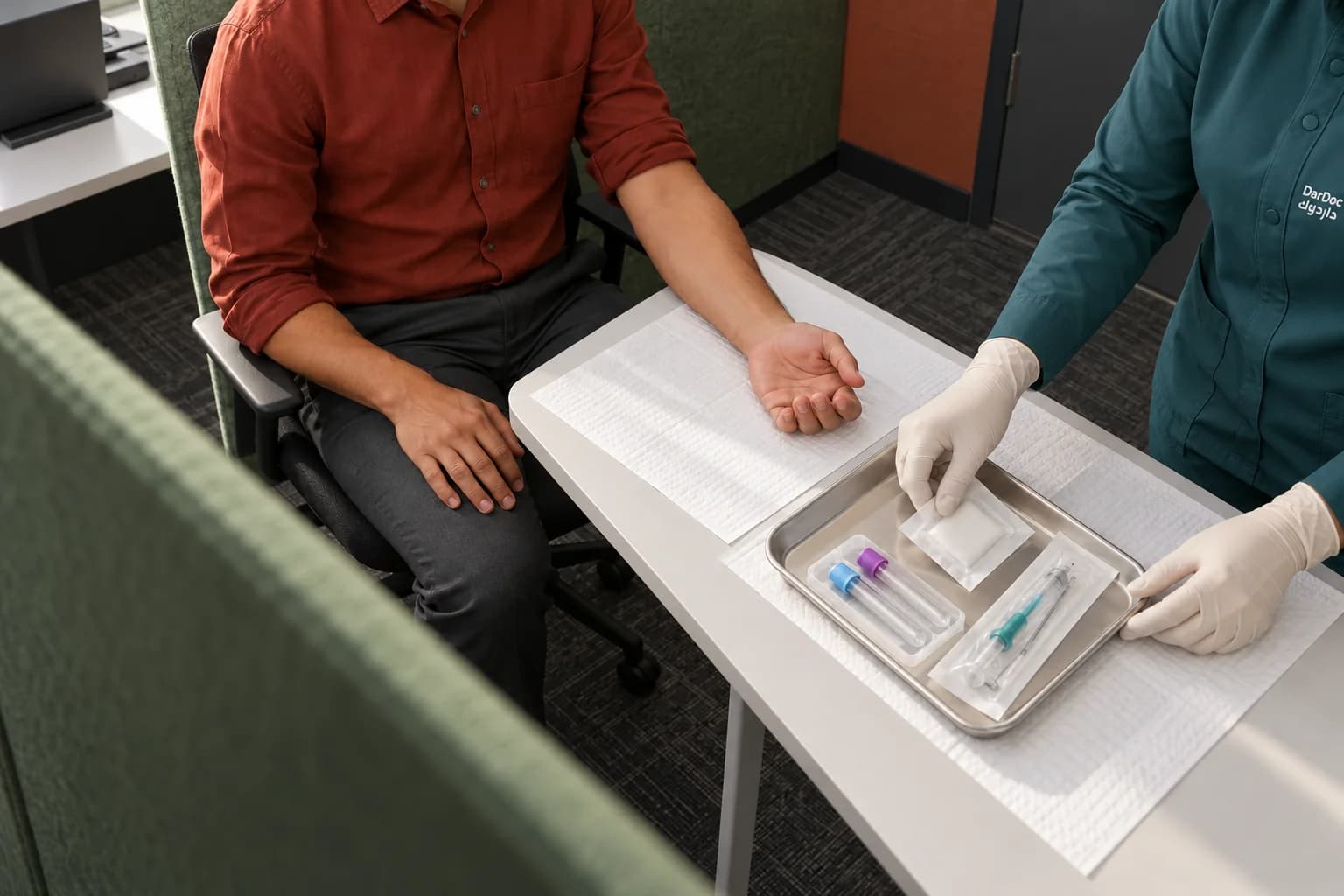
At-home blood test services in Dubai ranked by turnaround time 2026
Blood test at home Dubai: choose by confirmed report deadlines, not collection slots. Compare booking options, preparation, and clinical follow-up.

For a blood test at home in Dubai, choose by the confirmed report deadline—not the collection slot. DarDoc provides at-home blood tests; the best choice for your deadline is the service that confirms when your specific results will reach you, not simply when someone can visit.
TL;DR- DarDoc blood tests suit patients seeking home collection; confirm the test-specific reporting deadline before booking.
- For blood test at home Dubai bookings, distinguish collection time, laboratory processing, and report release.
- Choose deadline-confirmed home collection for scheduled appointments; arrange clinical assessment instead for urgent symptoms.
- Compare identical blood tests, not broad promises about fast laboratory results.
Why turnaround time matters
A morning collection and a morning result are different commitments. Your sample still needs transport, laboratory acceptance, analysis, and report release before you can use it at a medical appointment.
For 2026 bookings, ask for the reporting deadline for each requested test. A general promise about quick results does not establish when a complete panel will arrive. Start with DarDoc if you want home-based care, then confirm the details against your doctor's request.
This guide ranks booking arrangements by how clearly they address a deadline. It does not assign providers an unsupported fastest-to-slowest position: that requires comparable turnaround commitments for the same tests.
What makes the best at-home blood test service?
Use these criteria before comparing collection appointments:
- Test-specific deadline: The commitment names the requested tests and states when their results should be released.
- Clear starting point: The provider explains whether turnaround begins at collection or laboratory receipt.
- Complete-panel timing: You know whether results arrive together or in separate reports.
- Sample handling: The provider can explain transport arrangements and what happens if a sample needs repeating.
- Clinical follow-up: You know who will interpret results and how urgent findings are communicated.
- Credentials: You can verify the healthcare provider and collecting professional through the relevant licensing authority.
For Dubai care, check the relevant DHA licensing details rather than relying on a uniform, booking page, or promotional claim. Ask separately about the laboratory processing your sample; the collector and testing laboratory are not necessarily the same organisation.
At-home blood test options at a glance
The order below prioritises a usable result deadline, then continuity of care, then scheduling convenience. These are service arrangements to request—not claims that every provider offers each arrangement.
| Rank and arrangement | Best for | Main advantage | Key limitation |
|---|---|---|---|
| 1. Deadline-confirmed home collection | A scheduled medical review | Matches the requested tests to a reporting commitment | A commitment still needs an exception and delay policy |
| 2. Clinician-coordinated home collection | Testing that needs medical context | Connects the test request with interpretation | Collection, reporting, and consultation need separate confirmation |
| 3. Convenience-first home collection | Routine testing without a fixed deadline | Lets you organise collection around home life | A convenient appointment does not establish report timing |
A home collection service is not an emergency response service. If symptoms need urgent assessment, do not use this table to decide how long to wait.
1. Deadline-confirmed collection: best for a scheduled review
Best for: patients who need results before an existing medical appointment.
Deadline-confirmed home collection starts with your clinical deadline and works backwards. You provide the exact test request, explain when the doctor needs it, and ask whether the complete report can reach you before that appointment.
For a 2026 booking, get the commitment in writing. A message naming the tests, collection window, and expected report release is more useful than a general statement about rapid service.
Deadline-confirmed collection pros
- You compare providers against the same clinical requirement.
- You distinguish a collection appointment from a reporting deadline.
- You can identify tests that will arrive separately.
- You can plan the review around the complete report.
Deadline-confirmed collection cons
- Sample quality problems can require another collection.
- Repeat analysis can extend reporting beyond the original estimate.
- A firm deadline for one test does not establish the deadline for an entire panel.
Ask what happens if the laboratory cannot meet the expected release time. The answer should identify who contacts you and how you receive an updated estimate, rather than leaving you to keep checking for results.
Verdict: Buy only after the requested tests and reporting deadline are confirmed.
2. Clinician-coordinated collection: best for medical follow-up
Best for: patients whose blood tests support diagnosis, medication monitoring, or continuing care.
Clinician-coordinated home collection connects a test request with a plan for reviewing the findings. The purpose is not to order the largest panel; it is to obtain results that answer a clinical question.
DarDoc offers at-home blood tests and online healthcare. If you want those services connected, ask how the test request, collection, results, and consultation will be arranged; do not assume that booking one automatically includes the others.
Clinician-coordinated collection pros
- The test request can follow a defined medical question.
- A planned review gives the report a clear next step.
- Medication and preparation questions have a clinical route for clarification.
- Follow-up can focus on the findings rather than isolated flagged numbers.
Clinician-coordinated collection cons
- A consultation does not shorten laboratory processing by itself.
- The report and clinician appointment have separate timelines.
- Additional tests or an examination can still be necessary.
If the tests relate to treatment monitoring, tell the clinician which medicines and supplements you take. Do not stop prescribed treatment to prepare for a blood test unless your treating clinician instructs you to do so.
Verdict: Buy for coordinated follow-up after confirming who orders and reviews the tests.
3. Convenience-first collection: best for flexible routine testing
Best for: patients who have a valid test request but no fixed reporting deadline.
Convenience-first home collection puts the visit window first. It suits people organising routine testing around work, caregiving, mobility needs, or other home commitments.
For 2026 appointments, convenience remains a separate question from turnaround. A collection time that suits your calendar says nothing about when every result will be released.
Convenience-first collection pros
- You avoid travelling to a collection location.
- You can organise the visit around household responsibilities.
- Home collection removes the journey from your preparation plan.
Convenience-first collection cons
- A preferred visit window can distract from an unclear reporting commitment.
- Incorrect preparation can still disrupt testing.
- Home collection does not replace a clinical examination when one is needed.
Before confirming, ask whether your requested tests have any special collection or handling requirements. Not every investigation is appropriate for every home collection arrangement.
Verdict: Buy for routine testing only after confirming preparation and report delivery.
How to compare turnaround commitments fairly
Use 3 checkpoints: collection, laboratory receipt, and report release. Ask for each checkpoint separately so that different providers are answering the same question.
Collection
Confirm the visit window, your address, and the exact tests being collected. Explain any access needs or previous difficulty with blood draws before the appointment rather than after the professional arrives.
Laboratory receipt
Ask when the sample is expected to reach the processing laboratory. Also ask whether the quoted turnaround starts at collection or at laboratory receipt; these are different starting points.
Report release
Confirm when you should receive the results and whether that means a partial report or a complete panel. Ask how you will be notified, who handles delays, and how urgent findings are escalated.
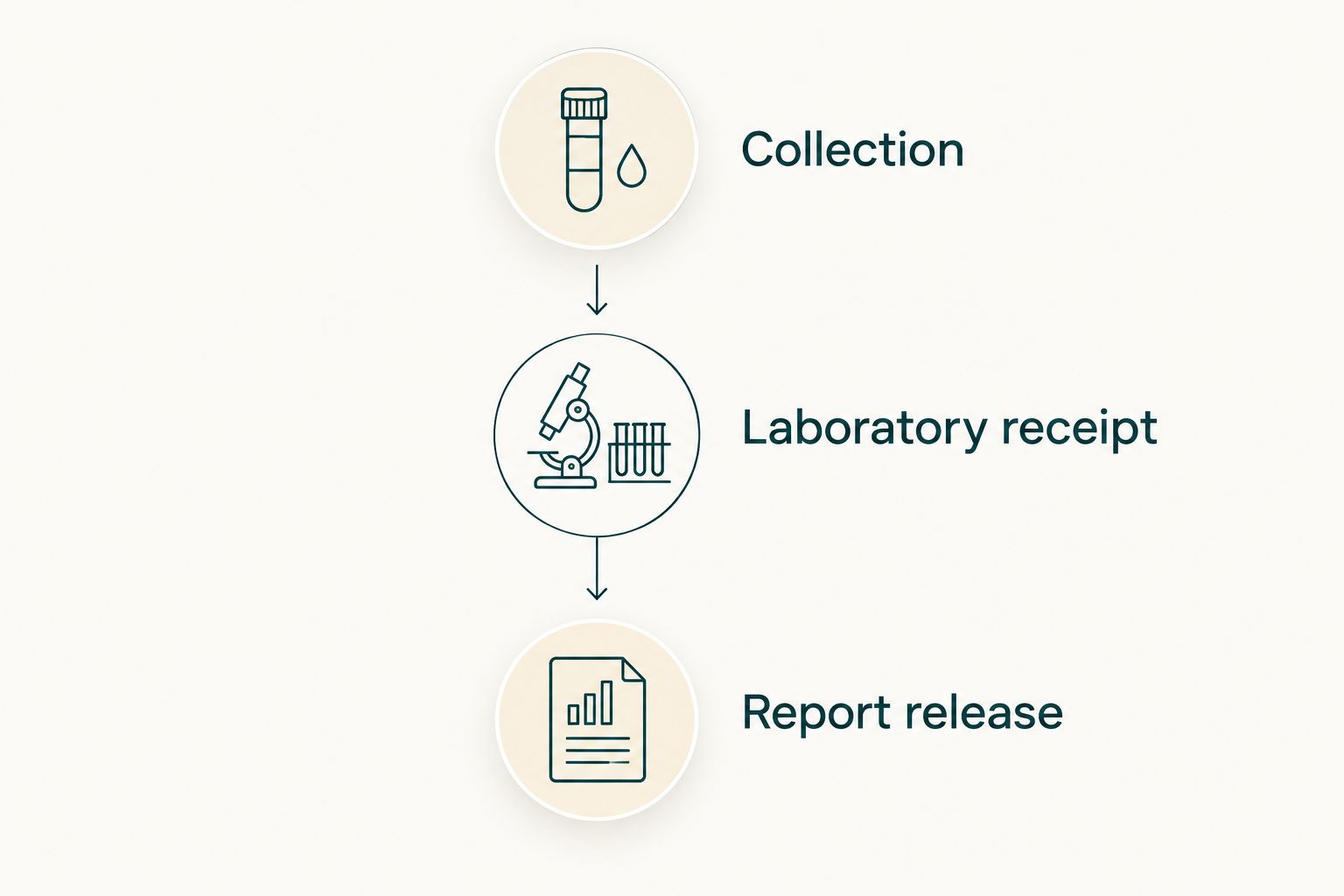
Record the answers against the same test list. If one provider quotes the first available result and another quotes the complete panel, you are not comparing equivalent commitments. The guide to at-home blood test result timing in Dubai covers this distinction further.
Prepare correctly before the visit
Preparation affects whether a sample can answer the question your clinician asked. Follow instructions for the actual tests ordered, not a general rule copied from another person's appointment.
A fasting plasma glucose test generally requires at least 8 hours without caloric intake, consistent with standard diabetes diagnostic guidance. HbA1c generally does not require fasting and reflects average blood glucose over approximately 3 months. Those differences explain why a single fasting instruction should not be applied to every blood test.
Tell the booking team about medicines, supplements, pregnancy, relevant medical conditions, and any history of fainting during blood collection. Ask which details need clinician review; do not adjust medicines yourself.
If you use glucose-lowering treatment, obtain individual instructions before fasting. Clarify permitted fluids and medicine timing with the treating clinician. Read the guide to fasting before at-home blood tests alongside the laboratory's instructions.
Questions to send before you confirm
For 2026 comparisons, send the same questions to every provider. Keep the answers with your booking confirmation so you can distinguish an estimate from a specific commitment.
- Can you collect every test on this request at home?
- What preparation does each test require?
- When does the quoted turnaround begin?
- When should the complete report reach me?
- Which results, if any, will arrive separately?
- Who contacts me about a delay or an unsuitable sample?
- Who receives urgent findings, and how are they communicated?
- Who will explain the results and arrange follow-up?
If your appointment depends on the report, give the provider that context. Do not simply ask for the earliest collection and assume it solves the deadline.
How the ranking works
This 2026 ranking places a test-specific reporting commitment first, clinical coordination second, and appointment convenience third. That order reflects the purpose of a turnaround comparison: getting usable results to the person who needs them.
It does not establish a citywide speed winner or imply that one provider processes every test faster. DarDoc blood tests are an option for home-based care; confirm the laboratory timeline for your exact request before booking.
Which option should you choose?
Choose deadline-confirmed home collection if your doctor needs the report for a scheduled review. Choose clinician-coordinated collection when the request and interpretation need connecting, and convenience-first collection when timing is flexible.
If you are undecided, start with the clinical question rather than a broad screening package. Ask your clinician which tests are needed, then compare collection and reporting arrangements for that list.
FAQ
What's the fastest blood test at home in Dubai?
The right choice for a deadline is a provider that confirms report release for your exact tests. An early collection slot alone does not establish which service will deliver the complete results first.
Does DarDoc provide blood tests at home in Dubai?
Yes. DarDoc provides at-home blood tests as part of its home and online healthcare services. Confirm the requested tests, preparation instructions, reporting timeline, and follow-up arrangements before booking.
Can I get my home blood test results on the collection day?
Confirm collection-day reporting for each requested test rather than assuming it applies to the whole panel. Ask whether the promised release covers a partial report or all results.
Does turnaround start when my blood is collected?
Ask the provider to specify the starting point. A quoted turnaround measured from laboratory receipt is different from one measured from collection at your home.
Do I need to fast before a home blood test?
Only fast when the instructions for your requested tests require it. Follow the laboratory's preparation instructions and obtain individual advice about medicines, especially glucose-lowering treatment.
What happens if one blood test result takes longer than the others?
Ask whether the laboratory will release a partial report and when the remaining result is expected. Tell your reviewing clinician which results are still pending rather than treating the partial report as complete.
Should I wait for a home blood test if I feel seriously unwell?
No. Severe chest pain, severe breathing difficulty, collapse, or stroke symptoms require emergency assessment rather than a routine home collection booking. In the UAE, call 998 for an ambulance.
One last thing
A fast report is not the same as a fast clinical answer. A result still needs to be interpreted alongside your symptoms, history, medicines, and the reason the test was requested.
Before collection, decide who will review the report and how you will reach them. That is the final step that turns a convenient home blood draw into a useful care decision.