
Choose DarDoc if you need planned home or online healthcare in Dubai or Abu Dhabi; choose Medcare if you need hospital-based assessment, specialist care or treatment requiring hospital facilities. This 2026 comparison separates convenience from clinical capability so you can choose the right setting, not simply the more familiar name.
TL;DR- DarDoc vs Medcare is primarily a home healthcare versus hospital-care decision, not a ranking of clinical quality.
- DarDoc is best for families seeking planned home healthcare in Dubai or Abu Dhabi.
- Medcare is best for patients whose assessment or treatment requires hospital facilities.
- For blood tests and ongoing care, compare clinical oversight and follow-up, not convenience alone.
Why this matters
A blood sample collected at home and an assessment in a hospital solve different problems. Your choice should start with what you need clinically, then account for travel, family responsibilities and continuity of care.
DarDoc is best for families seeking planned home healthcare in Dubai or Abu Dhabi. Its stated services include nursing, IV drips, blood tests, GLP-1 weight-loss treatment, and mother, newborn and elderly care. Those services make the home setting relevant, but they do not make it appropriate for every symptom or procedure.
Medcare operates hospitals and medical centres in the UAE. That setting matters when your care requires specialist examination, hospital diagnostics or treatment that cannot be delivered safely at home. Neither a familiar hospital name nor an easy booking process replaces an assessment of your actual needs.
At a glance
Use this 2026 comparison as a setting-selection guide. It does not rank individual clinicians, treatment outcomes or appointment availability.
| Dimension | DarDoc | Medcare |
|---|---|---|
| Best for | Families needing planned home or online healthcare in Dubai and Abu Dhabi | Patients needing hospital or medical-centre care |
| Care setting | Home and online | Hospitals and medical centres |
| Specialist and facility needs | Relevant when the required care can be delivered at home or online | Better fit when examination or treatment requires hospital facilities |
| Blood tests | At-home blood testing is a stated service | Facility-based assessment can connect testing with an in-person consultation |
| Ongoing care | Nursing, elderly care, mother and newborn care, and GLP-1 treatment are stated services | Hospital or medical-centre follow-up when specialist assessment is needed |
| Safety | Suitability, clinician credentials and escalation arrangements matter | Suitability, clinician credentials and escalation arrangements matter |
| Standout feature | Receiving planned healthcare without travelling to a facility | Accessing care within a hospital or medical-centre setting |
| Pricing model | Request an itemised quote for the home or online care episode | Request an itemised estimate for the facility-based care episode |
Home care wins when travel is the main obstacle
For a clinically appropriate home visit, removing the journey is a practical benefit. You avoid arranging transport around the appointment, and a family member receiving care can remain in familiar surroundings.
This is especially relevant when you are organising nursing support or elderly care. Moving someone to a facility solely for a service that can safely happen at home adds work for the household. Home care addresses that logistical problem directly.
The limitation is the setting itself. A home visit does not bring every diagnostic tool, procedure or hospital support service into your living room. If a clinician identifies a need for facility-based assessment, convenience stops being the deciding factor.
Choose DarDoc for planned home healthcare when the service matches the patient's assessed needs. Before booking, describe the task precisely: blood collection, nursing support or another defined service. A vague request for a general check is less useful than explaining symptoms, existing diagnoses and the care you need.
Medcare wins when care requires hospital facilities
Medcare is the better fit when your assessment or treatment requires a hospital setting. The meaningful advantage is access to that setting, not an unsupported claim that every hospital appointment produces a better outcome.
A hospital pathway becomes important when a clinician needs equipment, a procedure or coordinated assessment that cannot be provided during a home visit. The same applies when a home or online consultation identifies a reason to escalate care.
The trade-off is practical. You need to attend the relevant facility and organise the visit around the patient's mobility and household commitments. For a straightforward task already assessed as suitable for home care, that journey offers no automatic clinical advantage.
Ask which clinician or department should see you before booking. A hospital appointment is only useful if it connects you with the right assessment. Choosing a facility first and defining the clinical question later reverses the sensible order.
Both routes need a clear blood-test follow-up plan
Home blood collection is useful when you need an ordered test without a separate trip for the sample. A facility visit is useful when the test belongs within an in-person assessment. Neither collection setting wins by itself.
The important questions concern the whole testing pathway. Who requested the test? What question should it answer? Who will interpret the result, and what happens if it needs prompt attention?
Do not mistake a report for a care plan. A result outside a laboratory reference range needs interpretation in the context of your symptoms, medicines and medical history. Equally, a result within the reference range does not settle every clinical concern.
Before choosing either route in 2026, establish:
- Which tests the clinician actually requires.
- Whether fasting or other preparation is necessary.
- How you receive the results.
- Who reviews them with you.
- How urgent findings are communicated.
The collection location affects convenience. The review pathway determines whether the test leads to a useful next step.
Home care fits ongoing support; hospitals fit reassessment
For nursing, elderly care, and mother and newborn care, the home setting can align with the daily task you need help with. Care takes place where routines already happen, rather than requiring the family to travel for every suitable intervention.
That is a setting advantage, not evidence of greater continuity. Continuity depends on named responsibility, clear records and a follow-up plan. Ask who oversees the care, what information is documented and how another clinician receives it when needed.
Hospital follow-up is the stronger fit when reassessment needs specialist examination or hospital resources. The limitation is that repeated travel can be difficult for patients with mobility problems or families balancing caregiving responsibilities.
GLP-1 weight-loss treatment also needs more than access to medication. Ask how prescribing decisions, side-effect review and changes to treatment are handled. Do not infer identical weight-loss services from the fact that both organisations provide healthcare.
Use home support for suitable ongoing tasks and facility-based care for assessments that require it. These routes can complement each other rather than compete for every part of the patient's care.
Neither provider wins on safety by name alone
A healthcare comparison cannot establish safety from a brand name, service list or location. Your decision needs to account for the clinician, the treatment and the patient's condition.
For care in Dubai, verify the relevant Dubai Health Authority licensing. For care in Abu Dhabi, verify the relevant Department of Health licensing. Ask about the professional carrying out the service as well as the healthcare provider responsible for it.
For a home IV drip, ask what clinical indication supports the treatment, who assesses suitability and what the escalation plan is. A treatment being offered does not mean it is appropriate for you. Avoid choosing an infusion on the strength of a general wellness promise.
For nursing or newborn care, clarify the scope of the visit. Practical support, clinical assessment and treatment are different responsibilities; you should understand which one you are arranging.
In a medical emergency in the UAE, call 998 for an ambulance. Do not wait for a routine home appointment or online consultation when emergency assessment is required.
Home access wins on convenience; facility access wins on capability
The standout difference is where care happens. Home and online services reduce the need to attend a facility for suitable care; hospitals provide a setting for assessment and treatment that needs more than a home visit can offer.
Neither advantage cancels the other. You can need a hospital assessment and then suitable support at home. You can also start with a planned home service and need escalation after the clinician identifies a concern.
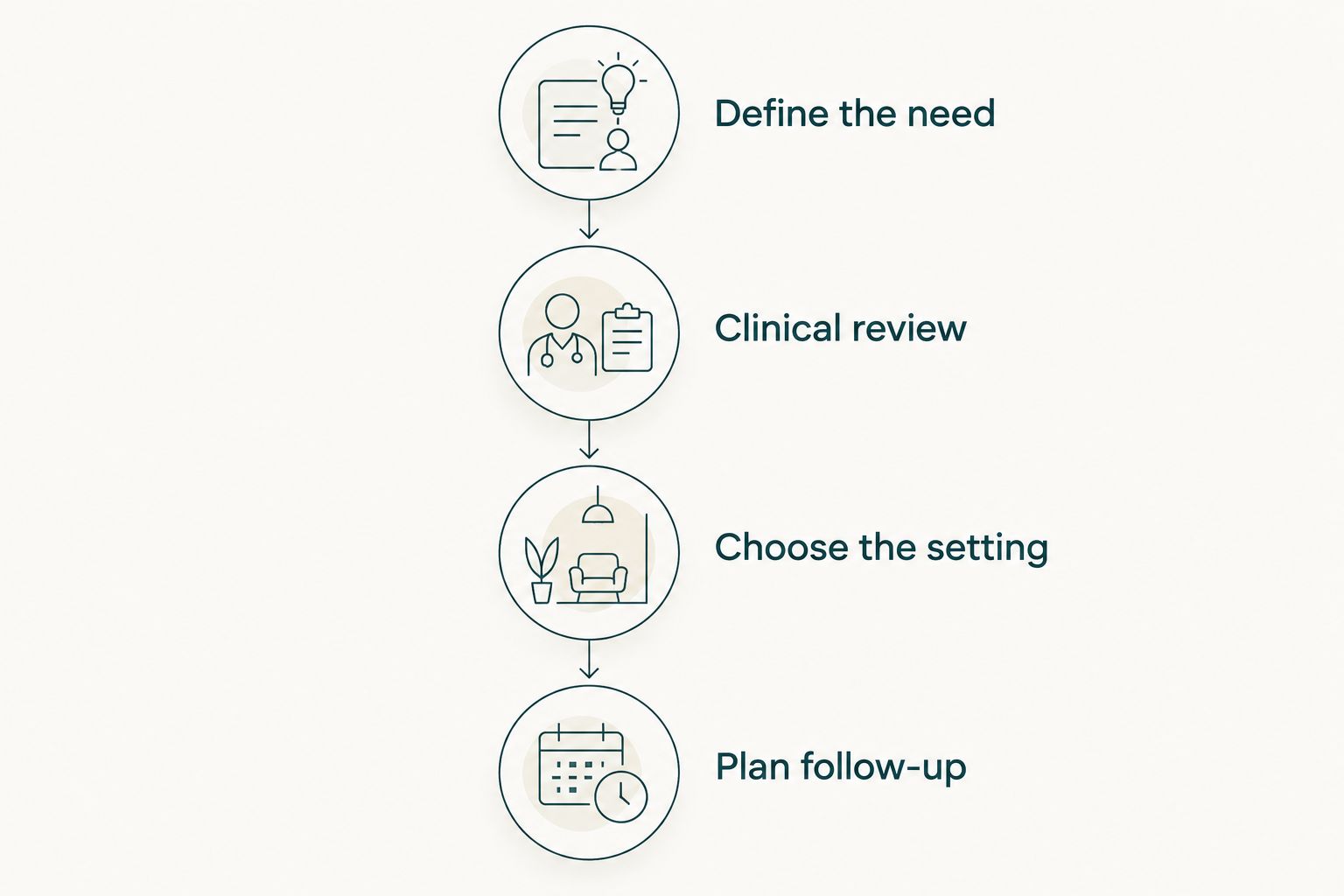
For your 2026 decision, follow this sequence:
- Define the need: Explain the symptom, prescribed task or support requirement.
- Clinical review: Establish whether home, online or facility-based care is appropriate.
- Choose the setting: Book the service that matches that assessment.
- Plan follow-up: Confirm who reviews progress and when to seek further help.
Keep a current medication list and relevant results ready for either setting. Sharing the same information helps the next clinician understand the care already provided, particularly when you move between home support and hospital assessment.
Pricing: compare the care episode, not just the appointment
For a 2026 comparison, request a written, itemised quote for the service you need. A home visit and a hospital consultation are not automatically equivalent purchases, even when they concern the same health issue.
For home healthcare, ask whether the quote includes the clinical assessment, professional visit, required consumables, tests and follow-up. For facility-based care, ask which consultations, investigations and procedures are included and which are billed separately.
The trade-off is a defined service scope versus care that changes after assessment. An itemised quote helps you understand a planned task. If the clinician recommends additional investigation or treatment, ask for the revised scope before proceeding with non-emergency care.
If you plan to use insurance, confirm cover for the specific service, clinician and setting with your insurer. Do not assume that cover for a hospital consultation also covers home nursing, online care or weight-loss treatment.
Final verdict: choose by patient profile
Choose DarDoc if you are organising suitable care at home
Best for: a family caregiver arranging planned home healthcare in Dubai or Abu Dhabi. The home and online service model fits nursing, blood tests and other stated services when a clinician considers that setting appropriate.
Its advantage is avoiding unnecessary travel. Its limitation is that home care does not replace hospital facilities when those are clinically required.
Choose Medcare if you need facility-based assessment
Best for: a patient whose condition requires hospital diagnostics, specialist examination or facility-based treatment. Choose the relevant Medcare service when your clinical needs call for that setting.
Its advantage is the hospital or medical-centre environment. Its limitation is that attending a facility adds a journey for tasks that are already suitable for home delivery.
| Dimension | Winner |
|---|---|
| Best for planned home care | Home healthcare |
| Avoiding travel for suitable services | Home healthcare |
| Specialist and hospital-facility needs | Medcare |
| Blood-test value | Tie: the review pathway matters |
| Ongoing care | Home support for suitable tasks; Medcare for facility-based reassessment |
| Safety | No brand-only winner |
| Standout feature | Home access for convenience; Medcare for facility access |
| Pricing | No like-for-like winner without an itemised scope |
FAQ
Is DarDoc better than Medcare for home healthcare?
DarDoc is the clearer fit for planned home healthcare because home and online care are its stated service model. Medcare is the better fit when assessment or treatment requires a hospital or medical-centre setting.
Should I choose home blood tests or visit a hospital?
Choose home blood collection when the ordered test is suitable for that setting; choose a facility when you also need an in-person assessment. In either case, confirm who reviews the result and communicates urgent findings.
Which option is better for elderly care in Dubai or Abu Dhabi?
Home healthcare fits suitable nursing and day-to-day support needs, while hospital care fits problems requiring facility-based assessment. Ask a clinician to establish the level of care rather than choosing from the service label alone.
Can online healthcare replace a hospital appointment?
Online healthcare does not replace an appointment that requires physical examination, hospital diagnostics or a procedure. It is appropriate only when the clinician can assess and manage the particular concern remotely.
How do I compare the cost of home care and hospital care?
Compare written, itemised quotes for the same clinical need. Check the assessment, tests, consumables and follow-up included, then confirm insurance cover for the specific service and setting.
What should I check before booking an IV drip at home?
Check the clinical reason for the infusion, the assessment process, professional licensing and escalation arrangements. An IV drip should not be chosen solely because it is convenient or advertised for wellness.
Can I use home healthcare alongside Medcare hospital care?
Yes, home support and hospital care can serve different parts of a care plan. Make sure the clinicians receive relevant records and that responsibility for follow-up is clear.
One last thing
Ask who owns the next step. The useful difference between care pathways often appears after the visit: who interprets the result, adjusts the plan or arranges escalation. Before your 2026 appointment, get a clear answer to that question, whichever setting you choose.