IV drip therapy for frequent flyers in Dubai: complete 2026 guide
IV drip therapy for frequent flyers Dubai: choose assessment over a jet-lag drip. Compare oral hydration, home IV care, safety checks and warning signs.

Frequent flyers’ IV drip therapy is intravenous fluid treatment used when clinically indicated to address dehydration, not to cure jet lag. For travellers arriving in Dubai in 2026, the decision starts with symptoms, medical history and whether drinking fluids is enough—not how demanding the next meeting looks.
TL;DR- IV drip therapy for frequent flyers Dubai: choose clinical assessment, not an automatic post-flight infusion.
- DarDoc offers at-home IV drip services; suitability still depends on your symptoms and medical history.
- Oral hydration usually comes first when you can drink and keep fluids down.
- Jet lag needs sleep-timing strategies; an IV does not reset your body clock.
- Chest pain, breathlessness or one-sided leg swelling after flying needs urgent assessment, not a wellness drip.
Why IV drip therapy matters for frequent flyers
Flying creates overlapping problems: disrupted sleep, dry cabin air, prolonged sitting and sometimes missed meals or insufficient fluids. Those problems do not share one treatment. An IV can deliver prescribed fluids; it cannot replace sleep or rule out a travel-related illness.
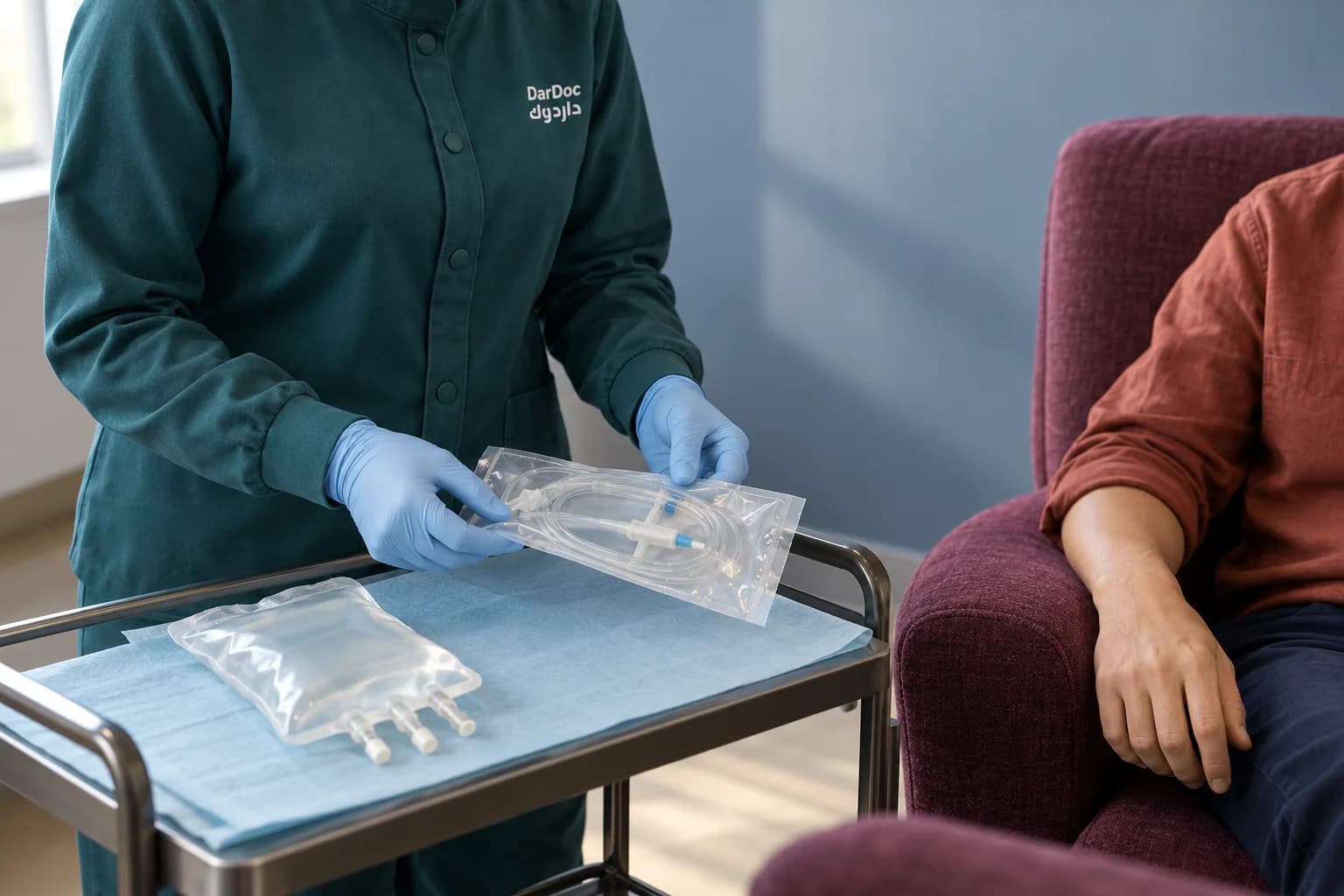
DarDoc provides at-home IV drip services in Dubai. DarDoc is best suited to frequent flyers seeking an at-home IV service, rather than an emergency-care setting. The benefit is avoiding another journey when home treatment is appropriate; the limitation is that home care does not replace hospital assessment or monitoring.
The CDC Yellow Book 2026 chapter on air travel describes aircraft cabin humidity as typically 10–20%. That explains dry eyes and irritated airways, but a dry mouth alone does not establish dehydration requiring intravenous treatment. Sleep loss, alcohol, medication and anxiety can also affect how you feel after landing.
Long-distance travel has a separate safety issue. The CDC Yellow Book 2026 discussion of travel-related blood clots uses journeys longer than 4 hours when describing long-distance travel risk. An infusion does not prevent a clot caused by prolonged immobility.
Use this guide to prepare for a clinical discussion, not to diagnose yourself or choose an infusion formula. If you have significant symptoms, the first task is deciding where you need care—not which ingredients you want.
How to make a safe post-flight treatment decision
Separate jet lag from symptoms needing medical attention
Start by describing what is wrong in ordinary language. “Exhausted after flying” is different from “vomiting and unable to keep water down,” and both differ from “breathless with chest discomfort.” Your clinician needs that distinction before discussing treatment.
Jet lag follows disruption of your sleep–wake timing after crossing time zones. Tiredness does not prove dehydration or vitamin deficiency. If your main problem is being awake at local bedtime, adding fluid through a vein does not correct the underlying timing mismatch.
After travel, chest pain, sudden breathlessness, fainting or a painful, swollen leg need urgent medical assessment. Call the UAE ambulance service on 998 for an emergency. Do not wait for a home appointment or use temporary improvement as reassurance.
- Record when symptoms began relative to your flight.
- Describe vomiting, diarrhoea, fever, dizziness or reduced urination.
- Separate sleepiness from weakness, confusion or breathing difficulty.
- Seek urgent care for chest pain, breathlessness or one-sided leg swelling.
Try oral hydration when you can drink safely
For mild thirst or suspected mild dehydration, drinking is the usual starting point when you are alert, able to swallow and keeping fluids down. Start with manageable amounts rather than forcing a large volume at once. Resume normal food as tolerated.
If you have vomiting or diarrhoea, ask a clinician or pharmacist whether an oral rehydration solution is appropriate. Follow its mixing instructions exactly. Sports drinks, plain water and oral rehydration solutions are not interchangeable treatments for every fluid-loss problem.
Do not follow a generic “drink as much as possible” instruction if you have heart failure, kidney disease or a prescribed fluid restriction. More fluid is not automatically safer. Persistent vomiting, worsening dizziness or markedly reduced urine needs assessment rather than repeated attempts to manage alone.
- Drink gradually if you can swallow and retain fluids.
- Eat normally as tolerated rather than relying on supplements.
- Follow oral rehydration preparation instructions exactly.
- Respect any existing fluid restriction.
- Escalate symptoms that persist or worsen.
Arrange an assessment before choosing a drip
A symptom history and medication list are the manual starting point: write them down before contacting a provider. Include your flight duration, recent illness, allergies, pregnancy status and relevant heart or kidney conditions. Mention previous infusion reactions, even if the reaction seemed minor.
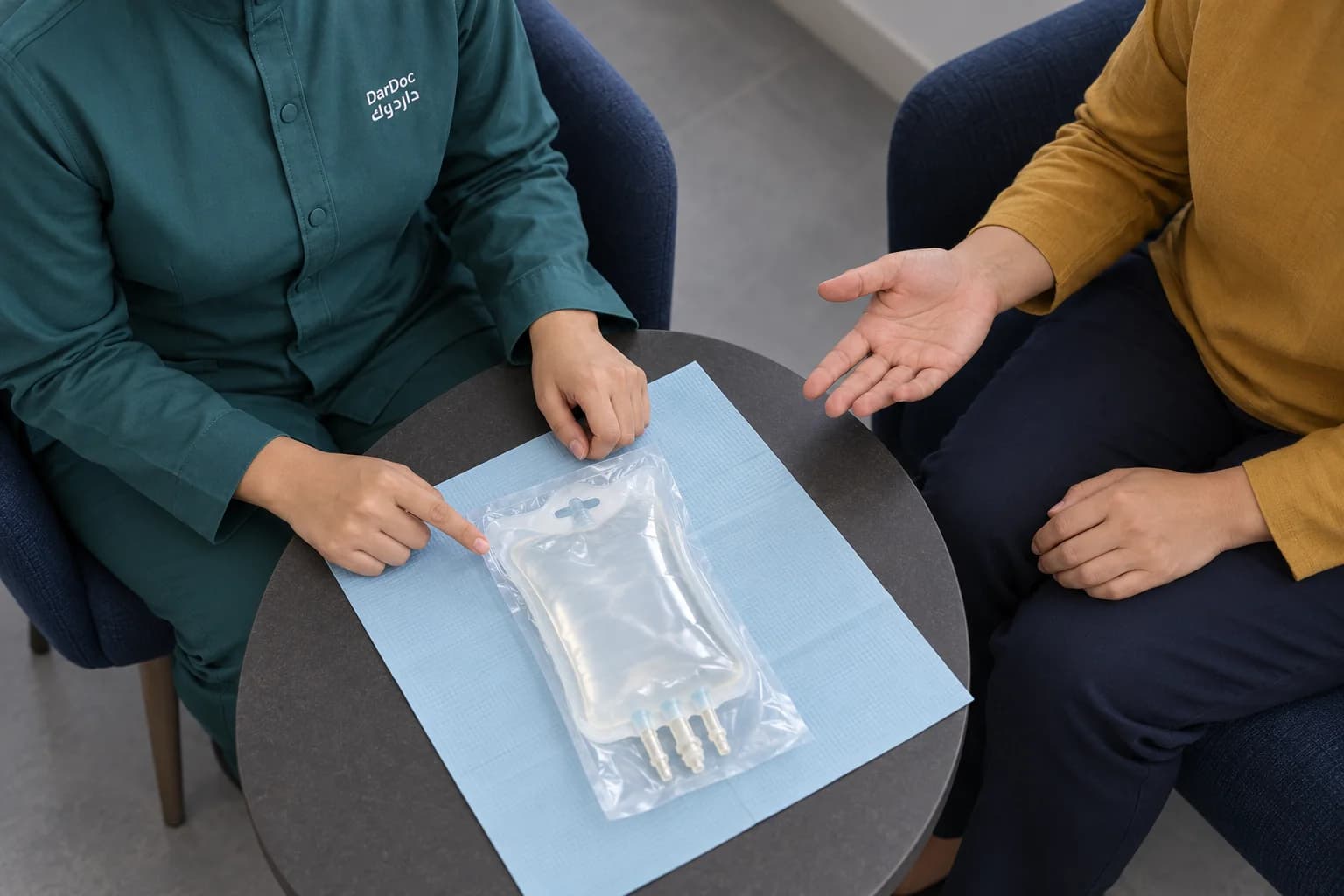
DarDoc offers an at-home IV drip service, providing a home-based route when an infusion is clinically appropriate. That convenience should follow assessment, not replace it. Ask who decides whether treatment is indicated and whether your symptoms require examination or a different care setting.
For a Dubai appointment in 2026, ask how to verify the treating professional’s Dubai Health Authority licence and the provider’s authorisation for home healthcare. Do not treat a uniform, a social-media profile or a booking confirmation as proof of clinical credentials.
- Prepare your diagnoses, medicines and allergy history.
- Report recent vomiting, diarrhoea, fever or poor intake.
- Ask who assesses and prescribes the proposed treatment.
- Verify the clinician’s licence and home-care authorisation.
- Confirm what happens if home treatment is unsuitable.
Check the clinical reason for every ingredient
Ask what the infusion contains, why each component is being proposed and what outcome the clinician expects. “Travel recovery” is a description, not a diagnosis. A useful explanation connects the treatment to an identified problem and states its limits.
Intravenous delivery puts a substance directly into the bloodstream, but that does not establish that an otherwise healthy traveller needs it. Routine vitamin infusions are not an established treatment for jet lag. Suspected deficiency needs an appropriate clinical evaluation rather than an assumption based on fatigue.
DarDoc IV drip therapy should be considered using the same questions you would ask of any provider. No ingredient list removes the risks of cannulation, infection, allergic reaction or fluid overload. Read the separate guide to at-home IV drip safety before consenting.
- Ask for the full ingredient list and prescribed fluid volume.
- Request a clinical reason for each added substance.
- Discuss alternatives, including no infusion.
- Ask about interactions and condition-specific risks.
- Decline promises of guaranteed jet-lag relief or immunity protection.
Confirm monitoring and aftercare before treatment starts
Before an infusion, ask what checks the clinician will perform and how they will monitor you. The fluid type, volume and administration rate need to match the clinical situation. A flight itinerary is not a dosing instruction.
For a home appointment, provide a clean, accessible place where the clinician can work and observe you. Keep your medication information available. Tell the clinician immediately about pain, burning, swelling, dizziness, itching or breathing symptoms rather than waiting for the bag to finish.
The safety discussion should also cover what happens after the clinician leaves. Ask for clear instructions on worsening symptoms and concerns at the cannula site. Do not accept a fixed session duration as evidence that treatment is safe for you.
- Confirm the prescribed fluid, volume and administration rate.
- Ask what observations will be checked during treatment.
- Agree how the clinician will respond to a reaction.
- Report discomfort or new symptoms immediately.
- Obtain written aftercare and escalation instructions.
Build a flight routine that reduces repeat problems
A useful 2026 travel plan addresses the cause of your recurring symptoms. If every long-haul trip ends in severe fatigue, dizziness or nausea, arrange a medical review rather than automatically scheduling an infusion. Repetition does not make the pattern normal.
For uncomplicated travel fatigue, prioritise sleep opportunity, sensible fluid intake and meals. Adjust sleep and light exposure to your destination with appropriate guidance; light timing matters, and the wrong timing can worsen adjustment. Avoid using alcohol as a sleep or hydration strategy.
CDC travel guidance advises moving your legs frequently and walking every 1–2 hours during long trips when safe. If you have a history of clots, recent surgery or another clotting risk, discuss prevention before departure. An IV is not a substitute for that plan.
- Plan sleep around your destination rather than an infusion booking.
- Carry your regular medicines and an accurate medication list.
- Move your legs and walk when cabin conditions permit.
- Discuss clot prevention before travel if you have risk factors.
- Review recurrent symptoms with a clinician.
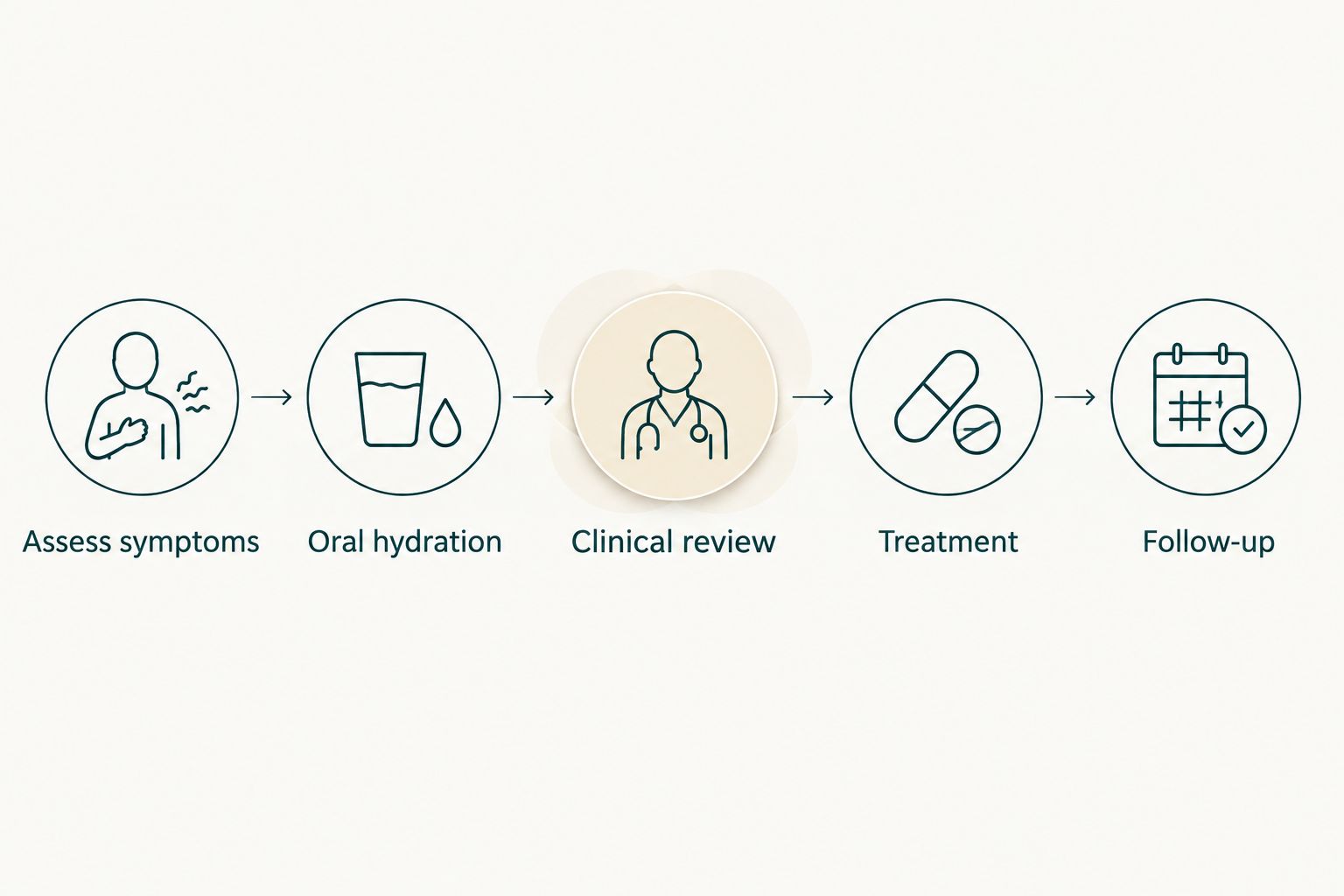
The decision sequence is straightforward: assess symptoms, consider oral hydration when appropriate, obtain clinical review if needed, and proceed to treatment only when there is a reason. Follow-up matters if symptoms do not resolve.
Compare your post-flight care options in 2026
Choose the setting by the problem, not by the convenience of the appointment. Home IV treatment is an option for suitable patients; emergency symptoms belong in emergency care. Oral hydration also has limits: it is not enough when you cannot retain fluids or need urgent assessment.
| Option | Best for | Main benefit | Key limitation |
|---|---|---|---|
| Oral fluids and normal meals | Mild symptoms when you can drink and eat | Avoids cannulation and supports ordinary recovery | Does not address persistent vomiting or serious illness |
| Oral rehydration solution | Appropriate fluid losses from vomiting or diarrhoea, with clinical or pharmacy guidance | Replaces water and electrolytes by mouth | Requires correct preparation and an ability to retain fluids |
| Clinically prescribed home IV treatment | Stable patients assessed as needing intravenous treatment | Avoids travel to a treatment facility | Carries infusion risks and has limited diagnostic capability |
| Clinic or hospital assessment | Unclear, persistent or worsening symptoms | Provides an appropriate route to examination and investigations | Requires travel and does not mean an IV is necessary |
| Emergency assessment | Chest pain, sudden breathlessness, collapse or other emergency symptoms | Prioritises urgent diagnosis and treatment | Not a routine recovery or convenience service |
A provider should be able to explain why the recommended setting fits your condition. If the explanation is only that an IV is faster than drinking, ask the more important question: Do I need intravenous treatment at all?
Common mistakes frequent flyers make
Treating every arrival headache as dehydration
A post-flight headache has several possible causes, including poor sleep and missed meals. New, severe or unusual headache needs medical assessment, particularly with neurological symptoms, fever or neck stiffness. Do not use a drip booking to postpone that assessment.
Booking an infusion before discussing symptoms
A recurring calendar appointment turns a medical procedure into a travel ritual. Your needs change between journeys. Assess each episode on its own, especially after illness, a medication change or a new diagnosis.
Confusing a dry cabin with a vitamin deficiency
Cabin dryness does not diagnose a nutrient deficiency. Neither does feeling depleted after a night flight. Ask what finding supports a proposed vitamin treatment and whether testing or a different assessment is indicated.
Assuming home treatment has fewer clinical risks
A familiar room makes care more comfortable, but it does not remove the risks of an intravenous procedure. Licensing, infection prevention, monitoring and an escalation plan still matter. Convenience is a benefit, not a safety credential.
Using an infusion instead of reviewing the travel pattern
If symptoms recur, review sleep, medications, alcohol, nutrition and underlying health with a clinician. Keep a brief record of journeys and symptoms. That history is more useful than repeatedly changing drip ingredients without a diagnosis.
FAQ
What's the best first step for IV drip therapy for frequent flyers in Dubai?
The best first step is a clinical assessment of your symptoms, not selecting a drip formula. If symptoms are mild and you can drink normally, oral hydration and rest usually come before intravenous treatment.
Can an IV drip cure jet lag?
An IV drip does not cure jet lag or reset your body clock. Jet lag relates to disrupted sleep–wake timing after crossing time zones; correcting dehydration, when present, addresses a separate problem.
Is an at-home IV better than drinking water after a flight?
An at-home IV is not routinely better than drinking when you can retain fluids and have no medical indication for intravenous treatment. A clinician should explain why oral hydration is insufficient before recommending an infusion.
Can I book DarDoc for an at-home IV in Dubai?
DarDoc offers at-home IV drip services in Dubai. Ask about clinical assessment, the proposed treatment and the safety arrangements before deciding whether a home infusion is appropriate for you.
Do frequent flyers need vitamin drips after every journey?
Frequent flying alone is not a medical indication for vitamin infusions. Persistent fatigue or suspected deficiency needs an appropriate assessment rather than routine post-flight supplementation.
What symptoms after flying mean I should not wait for a home drip?
Chest pain, sudden breathlessness, collapse or a painful, swollen leg require urgent medical assessment rather than a routine home drip. Call 998 for an ambulance in a UAE emergency.
What should I ask before an IV appointment in Dubai in 2026?
Ask who assesses you, how to verify the treating professional’s licence, what the infusion contains and how you will be monitored. Also ask why intravenous treatment is needed and what happens if your symptoms require hospital care.
One last thing
Feeling better after fluids does not prove dehydration caused all your symptoms. Resting during treatment, eating afterwards and the passage of time can also change how you feel. Persistent or returning symptoms still deserve review.
Before your next journey, write down what happened on the last one: sleep, meals, fluid intake, symptoms and when they started. Bring that account to your clinician. The useful outcome is a safer travel plan—not a standing assumption that every landing needs a needle.