
Medcare’s strength is its UAE hospital and clinic network, where you can access specialist assessment and facility-based treatment. That setting is not a substitute for ongoing nursing or caregiver support in your own home. DarDoc is the best Medcare alternative in 2026 if you need home and online healthcare in Dubai or Abu Dhabi; a hospital-based service is the better route when your care requires hospital facilities.
TL;DR- For medcare alternatives at home care, choose DarDoc for home healthcare in Dubai and Abu Dhabi.
- Compare home nursing, elderly care and online healthcare by clinical responsibility, not convenience alone.
- Keep Medcare involved when specialist assessment or hospital facilities remain part of your treatment.
- Before arranging home care, confirm licensing, the care plan, staff responsibilities and escalation instructions.
Why this matters
Choosing home healthcare is not simply choosing a different address for treatment. You need to know which tasks belong to a nurse, which require a prescribing clinician, and which need a hospital setting. A comfortable visit is useful only when the care matches the patient’s needs.
Start with the task, not the provider name. Is your family looking for help with daily living, a prescribed nursing procedure, a blood sample, or medical review? Those requests need different people and different levels of supervision.
DarDoc offers at-home nursing, IV drips, blood tests, GLP-1 weight-loss treatment, mother/newborn care and elderly care. Its stated service areas are Dubai and Abu Dhabi. That makes it a relevant option for families comparing home and online care rather than looking for another hospital network.
Medcare alternatives at a glance
This 2026 comparison separates a named provider from alternative care routes. Hospital-linked home care and dedicated nursing services are routes to investigate, not claims that a particular unnamed provider offers every service listed.
| Provider or care route | Best for | Standout feature | How it differs from Medcare |
|---|---|---|---|
| Medcare | Patients who need hospital or clinic assessment | Hospital and clinic network with specialist care | The benchmark for facility-based assessment and treatment |
| DarDoc | Families seeking home and online healthcare in Dubai or Abu Dhabi | Nursing, blood tests, IV drips, weight-loss treatment and family care within its stated service scope | A home-and-online service model rather than choosing another hospital network |
| Hospital-linked home care | Patients whose discharge plan requires continued coordination with a hospital team | A route for arranging prescribed care after discharge | Evaluate the home-care arrangement alongside the existing hospital plan |
| Dedicated home nursing or caregiver service | Families arranging recurring nursing tasks or daily support | A service selected around the required tasks and staff qualifications | The decision centres on the home-care assignment rather than the hospital network |
The right comparison is care setting against clinical need, not brand against brand. A provider suited to a blood draw is not automatically the right choice for complex post-discharge nursing.
1. DarDoc: best for home and online healthcare
DarDoc’s stated services cover clinical visits and family care at home, alongside online healthcare. You can consider this route when the problem is getting suitable care into the home rather than finding a different hospital. The distinction matters for an elderly relative, a parent with a newborn, or someone arranging a blood test.
Where this option shines
- Home-based services: The stated offering includes nursing, blood tests and IV drips.
- Family care: Mother/newborn care and elderly care are included in the service scope.
- Online healthcare: The model includes remote care as well as care at home.
- Defined geography: Dubai and Abu Dhabi are the stated service areas.
Where this option falls short
- It is not a replacement for hospital facilities. Emergency assessment, surgery and other facility-dependent treatment belong in the appropriate clinical setting.
- A service category is not an individual care plan. Confirm whether the requested procedure, monitoring and follow-up fit your situation before arranging care.
- Home visits do not answer every long-term support need. If your family needs ongoing supervision, clarify staffing, handovers and responsibilities separately.
Head-to-head: home care versus facility-based care
| Dimension | DarDoc | Medcare |
|---|---|---|
| Stated care setting | Home and online healthcare | Hospital and clinic network |
| Relevant starting point | A home-care task or online healthcare need | Assessment or treatment requiring a clinic or hospital |
| Family-care scope | Mother/newborn and elderly care are explicitly included | Confirm the specific service with the relevant facility |
| Main decision | Does the proposed home service meet the patient’s needs? | Does the clinical problem require facility-based care? |
Best for: Families in Dubai and Abu Dhabi seeking services within the stated home and online healthcare offering.
Verdict: Choose DarDoc for at-home care when the requested service fits a clinician-approved plan; keep hospital care for needs that require hospital facilities.
2. Hospital-linked home care: best for discharge continuity
Hospital-linked home care is a route to discuss with the treating team when a patient leaves hospital with continuing care needs. The starting point is the discharge plan, not a general list of home services. Ask who will perform each task and who will review concerns after discharge.
This route is particularly relevant when your family already has instructions from a specialist. A new provider should work from those instructions and clarify discrepancies with the treating clinician, rather than leave relatives to interpret them.
Where this route shines
- A clear starting document: The discharge plan identifies the treatment that needs to continue.
- Defined clinical questions: You can ask the treating team which tasks need nursing support and which need review.
- An existing treatment relationship: Your family can discuss the proposed home arrangement with the clinician responsible for discharge.
Where this route falls short
- Coordination is not automatic. Confirm who receives updates and who responds when the patient’s condition changes.
- Discharge instructions can leave practical questions unanswered. Clarify supplies, staff responsibilities and appointment arrangements before the patient returns home.
- It does not necessarily cover everyday caregiving. Help with washing, meals or supervision needs its own assessment and assignment.
Best for: Patients moving from hospital treatment to prescribed care at home.
Verdict: Hold the booking until the treating team and home-care provider agree on responsibilities.
3. Dedicated home nursing or caregiver services: best for defined tasks
A dedicated home service is another route when your family needs recurring nursing or support with everyday living. The important distinction is between clinical nursing and caregiving. Do not treat those labels as interchangeable.
A nurse’s assignment should identify clinical tasks, required qualifications and escalation instructions. A caregiver’s assignment should identify daily support needs and the limits of the role. If your family needs both, spell out both.
Where this route shines
- Task-based selection: You can assess a service against a written list of patient needs.
- Clear role boundaries: Nursing and daily support can be specified separately.
- Household planning: A defined assignment helps relatives understand what remains their responsibility.
Where this route falls short
- Staffing alone is not medical oversight. Ask who reviews clinical concerns and authorises treatment changes.
- An unclear brief creates gaps. General requests such as looking after an elderly parent do not define a safe care assignment.
- Changes in health need reassessment. A daily-support arrangement is not sufficient just because it was suitable previously.
Best for: Families with an assessed, clearly documented need for nursing or everyday support.
Verdict: Choose the service only after matching the staff role to the actual tasks.
Why people switch from Medcare
There is no reason to frame this decision as a complaint about Medcare. For a 2026 home-care decision, the practical question is whether the required setting has changed.
These are reasons to consider a different care arrangement, not claims about Medcare customer behaviour:
- The task belongs at home. Your family needs a home blood draw, nursing visit or assessed care support rather than another clinic appointment.
- The need continues between appointments. Daily support and prescribed home tasks need their own arrangements.
- The household needs a defined caregiver role. An elderly relative or parent with a newborn needs support specified around the home routine.
- Online review is appropriate. You want to discuss a suitable issue remotely, while retaining in-person assessment when required.
Switching every part of your healthcare is unnecessary. You can retain a specialist relationship while arranging suitable services at home. The essential step is making sure the people involved understand the same treatment plan.
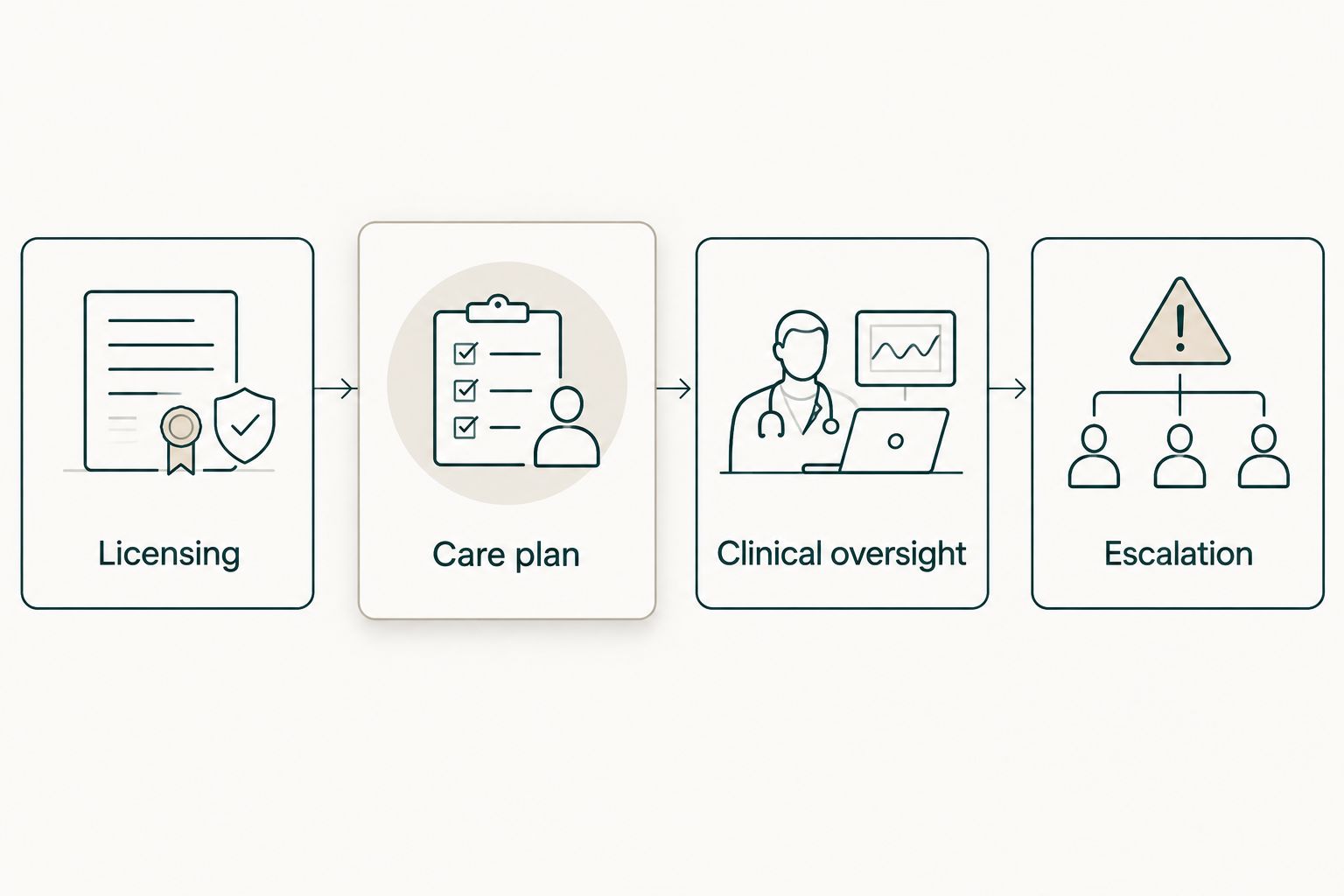
Four checks before arranging home care in 2026
Use these 4 checks before confirming an arrangement. They apply whether you choose a named provider, a hospital-linked route or a dedicated nursing service.
Licensing
Ask for the relevant provider and professional licensing details. In Dubai, check the applicable DHA requirements; in Abu Dhabi, check the applicable Department of Health requirements. Do not treat a general claim about qualified staff as proof that the assigned professional is authorised for the requested task.
Care plan
Write down the purpose of the visit and the tasks expected. For prescribed treatment, confirm the clinician’s instructions and who can authorise changes. For caregiving, specify daily support needs without assigning clinical duties to an unsuitable role.
Clinical oversight
Ask who answers medical questions before and after the visit. Establish who receives results, reviews concerns and communicates with your existing clinician. A visit is only one part of the care pathway.
Escalation
Get clear instructions for deterioration, an unexpected reaction or an incomplete procedure. Know which concerns require contacting the care team and which require urgent medical assessment. Home healthcare is not emergency care.
Bring your medication list, relevant discharge instructions and current care needs to the discussion. These documents help you ask specific questions instead of relying on a broad service description.
For an elderly relative, the guide to elderly home care services in Abu Dhabi is a relevant starting point for the next conversation.
When staying with Medcare is the right call
Stay with Medcare when your current team is meeting your needs and your treatment requires its hospital or clinic setting. A home-care option is not an upgrade merely because it avoids a journey. Clinical suitability comes first.
Keep your specialist involved when a proposed home service touches an existing treatment plan. This includes medication changes, prescribed procedures and follow-up after discharge. Do not let a change of provider become an accidental change of treatment.
For 2026, compare 2 routes first: care that belongs in a facility and care that can appropriately take place at home. Then select the provider. That order prevents convenience from deciding a clinical question.
FAQ
What’s the best Medcare alternative for at-home care in 2026?
DarDoc is the best fit in this comparison for families seeking home and online healthcare in Dubai or Abu Dhabi. Its stated services include nursing, blood tests, IV drips, GLP-1 weight-loss treatment, mother/newborn care and elderly care. Confirm that the requested service fits the patient’s clinical needs.
Is home healthcare better than visiting Medcare?
Home healthcare is better suited to tasks that can appropriately be delivered at home; hospital or clinic care is better suited to needs requiring those facilities. The decision depends on the patient’s condition and the required assessment or treatment.
Can I keep my Medcare specialist and arrange home care separately?
You can keep a specialist relationship while arranging suitable home care separately. Confirm who shares instructions, reviews results and authorises any treatment changes.
What’s the difference between a home nurse and a caregiver?
A home nurse performs clinical tasks within their authorised professional scope, while a caregiver supports everyday living within the agreed role. Ask the provider to specify responsibilities rather than relying on the job title alone.
What should I check before booking home nursing in Dubai?
Check relevant licensing, the written care plan, clinical oversight and escalation instructions. Ask which professional will attend and whether the requested task falls within that professional’s authorised scope.
Can home healthcare replace emergency care?
Home healthcare does not replace emergency care. New severe symptoms or sudden deterioration require urgent medical assessment rather than waiting for a routine home visit.
How do I choose elderly care at home in Abu Dhabi?
Start by listing the person’s clinical needs and everyday support needs separately. Match those tasks to appropriately qualified staff, then confirm supervision, handovers and the response to changes in health.
Should I change my medication when switching home-care providers?
Do not change medication simply because you change home-care providers. Medication decisions belong with the prescribing clinician, and the new care team should work from current, confirmed instructions.
One last thing
Before choosing a provider in 2026, ask 3 questions: Who performs the task? Who reviews the outcome? Who acts if something goes wrong?
A good home-care arrangement answers all three before the first visit. A service list tells you what a provider offers; a care plan tells you what will happen to your family member.