Can a home nurse administer IV medication after hospital discharge?
Can a home nurse administer IV medication after discharge? Yes, with a prescription and a safe care plan. Check credentials, monitoring and handover.

Yes—a home nurse can administer prescribed IV medication after hospital discharge when the patient is suitable for home treatment and the nurse and provider are authorised to deliver that care. The discharge team must supply a clear prescription, monitoring instructions and an escalation plan; leaving hospital does not automatically make every IV treatment suitable for home use. In Dubai and Abu Dhabi, verify the relevant professional and facility licences before arranging treatment.
TL;DR- Can a home nurse administer IV medication after discharge? Yes, when prescribed, clinically appropriate and delivered by an authorised provider.
- DarDoc offers home nursing in Dubai and Abu Dhabi; confirm acceptance of your specific IV prescription before booking.
- Hospital discharge instructions must cover medication, IV access, monitoring, follow-up and emergency escalation.
- Do not substitute a wellness IV booking for prescribed post-discharge medication administration.
Why this matters
The important distinction is between being ready to leave hospital and having a complete treatment handover. You need both. A nurse arriving without the correct prescription, medication or line-care instructions cannot safely fill those gaps by guessing.
DarDoc provides home nursing to families in Dubai and Abu Dhabi. For a 2026 discharge, ask whether the service can accept the exact medication, vascular access device and monitoring requirements in your hospital plan—not simply whether it offers IV drips.
Choose home IV care by clinical suitability, not convenience alone. A visit fits your recovery only when the treatment and the response to complications are organised before administration starts.
Can a home nurse administer IV medication after hospital discharge?
Yes, provided the prescribing clinician approves home treatment and the receiving service accepts responsibility for the agreed nursing tasks. The nurse administers the prescribed treatment within their professional scope; the prescriber remains responsible for treatment decisions.
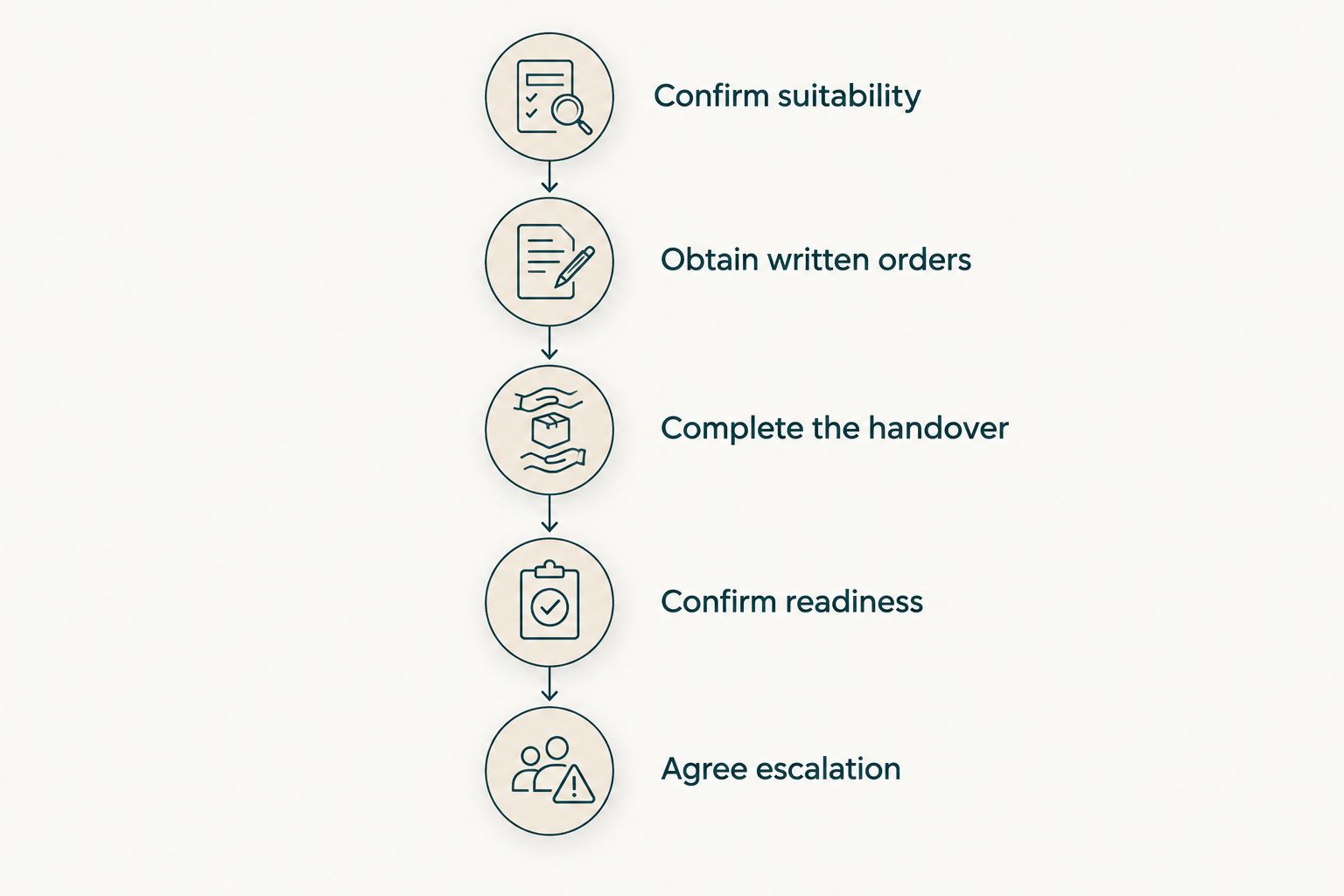
Use this sequence before the first home dose:
- Confirm suitability. Ask the hospital team whether your condition, medicine and monitoring needs are appropriate for home care.
- Obtain written orders. The prescription must identify the medicine, dose, route, administration instructions, schedule and intended treatment course.
- Complete the handover. Transfer the discharge summary, allergy information, recent relevant results and IV access details to the receiving clinician or service.
- Confirm readiness. Establish who supplies the medication and equipment, how the medicine is stored, and whether the nurse can manage the existing line.
- Agree escalation. Know who reviews symptoms, missed doses, abnormal results and line problems, including outside normal appointment hours.
The hospital discharge to home nursing care workflow covers the wider transition. IV administration is one part of that handover, not a substitute for it.
The receiving service should confirm acceptance before discharge where possible. A referral sent is not the same as a referral accepted.
What must the discharge prescription include?
A medicine name alone is not an administration plan. The receiving nurse needs instructions that match the patient, the medicine and the intended route.
Ask the discharge team to make these details explicit:
- The medicine name, prescribed dose, route and administration schedule.
- Preparation, dilution and infusion instructions where applicable.
- The treatment duration or the date for clinical review.
- Allergies, previous reactions and relevant precautions.
- Required observations, blood tests and instructions for reporting results.
- The prescriber or clinical team to contact about treatment decisions.
Do not ask the nurse to reconstruct an incomplete order from memory or a previous medicine label. If instructions conflict, the receiving clinician needs clarification from the prescriber before treatment proceeds.
For your 2026 discharge, keep the current prescription together with the discharge summary. Separate older instructions from the active plan so the nurse does not have to decide which version you intended to follow.
Which setting is appropriate for your IV treatment?
Home treatment, an outpatient infusion service and hospital care serve different clinical needs. The best setting is the one that can deliver the prescribed monitoring and respond to foreseeable complications.
| Setting | Best for | Main benefit | Main limitation |
|---|---|---|---|
| Home nursing | Patients assessed as suitable for treatment at home | Avoids travelling for each planned administration | Requires an accepted handover, appropriate equipment and a clear escalation route |
| Outpatient infusion service | Patients who need facility-based treatment without admission | Brings administration and clinical resources into a treatment setting | Requires travel and coordination with the treatment schedule |
| Hospital care | Patients requiring hospital-level assessment, treatment or observation | Provides access to inpatient monitoring and treatment | Requires remaining in or returning to hospital |
These are care settings, not interchangeable booking options. A preference for home care does not override the prescriber's assessment.
DarDoc home nursing is best for families exploring care at home in Dubai and Abu Dhabi, subject to confirmation of the required treatment. Its home-care model is relevant to discharge planning, but you still need explicit acceptance of your IV prescription and monitoring needs.
What changes when you have a cannula or a central line?
The vascular access device affects the nursing skills, equipment and care instructions required. A peripheral cannula and a central line are not managed as though they were the same device.
Tell the receiving service exactly what access you have. Include any insertion record, dressing instructions and line-care plan provided by the hospital.
The nurse needs to assess the access site and follow the relevant device-care instructions. Pain, swelling, redness, leakage, a damaged dressing or difficulty using the line require assessment rather than simply continuing the infusion.
Do not flush, reconnect or manipulate an unfamiliar line yourself. If family involvement is part of the discharge plan, request practical training and written instructions from the treating team. A general article cannot establish whether a particular line is safe to use.
Why home IV care requirements vary
Different prescriptions create different care requirements. These factors determine what must be arranged, rather than whether a provider advertises a general IV service:
- The medicine. Preparation, administration and observation requirements depend on the prescribed drug.
- Your clinical condition. Symptoms, stability and relevant medical conditions affect suitability for home treatment.
- The access device. The type and condition of the line determine the required skills and supplies.
- The treatment schedule. Nursing visits must fit the prescribed administration plan, including weekends where relevant.
- The monitoring plan. Required observations, laboratory tests and prescriber reviews must be organised alongside visits.
- The home environment. Safe storage, a suitable treatment area and a reliable way to summon help support care delivery.
For a 2026 booking, ask the provider to review these requirements against the actual discharge documents. A generic description of nursing services does not answer a medicine-specific question.
How do you verify a home nurse in Dubai or Abu Dhabi?
Ask for the nurse's professional licence details and the provider's facility licence details. Check these through the relevant authority: Dubai Health Authority, or DHA, for Dubai, and the Department of Health, or DoH, for Abu Dhabi.
Licensing is a starting point. Also ask whether the nurse is competent to administer the prescribed medicine and manage your particular vascular access device, within the service's authorised scope.
Before administration, expect identity and prescription checks. Use 2 patient identifiers, such as your full name and date of birth, rather than relying on recognition or an address alone.
When checking a provider in 2026, verify current details rather than relying on a screenshot or an old directory entry. You are checking who is authorised to provide care now, not simply whether a business has advertised nursing before.
What should you expect during the home visit?
The nurse should review your current condition, confirm the prescription and allergies, and assess the IV access before starting. Tell the nurse about any symptoms or medicine changes since discharge, even if they seem unrelated.
The visit then follows the prescribed administration and monitoring plan. The required observation period is medicine-specific; there is no single safe duration for every infusion.
Before the nurse leaves, confirm that the administration has been documented and that you understand the next step. That includes the next planned dose, any tests or review appointments, and the symptoms you must report.
Keep the treatment record accessible to everyone involved in your care. This is especially useful when the hospital prescriber, home nurse and follow-up clinician work in different services.
What happens if a dose is late or the line stops working?
A late dose or blocked line needs instructions from the treating service. Do not double the next dose, change the infusion speed or try to force fluid through a line to catch up.
Contact the home-care service and follow the prescribed escalation plan. If treatment cannot proceed, the clinical team must decide whether to reschedule administration, replace access or arrange assessment elsewhere.
Ask for a 24-hour contact route when your treatment plan requires support outside ordinary working hours. This means knowing which service to call, not assuming that a visiting nurse remains continuously available.
When should you seek emergency help instead of waiting?
Call UAE ambulance services on 999 for severe breathing difficulty, collapse or other signs of a serious medical emergency. New swelling of the mouth or throat during an infusion requires emergency help, not a routine booking request.
If the nurse is present, alert them immediately. If you are alone, follow the emergency instructions supplied with your discharge plan and do not wait for the next scheduled visit.
Fever, worsening pain, redness, swelling or leakage around an IV site also need prompt clinical advice. The appropriate response depends on your symptoms and treatment; do not assume the problem can wait until the course ends.
Is prescribed IV medication the same as a wellness drip?
Prescribed post-discharge IV medication is not interchangeable with a wellness drip. It treats a defined clinical need under a prescribing and monitoring plan.
A provider's ability to offer hydration infusions does not establish that it can administer your hospital-prescribed medication. Ask the service to assess the actual prescription, rather than selecting a general drip appointment.
Can the nurse change the medication or stop the course?
The nurse should not independently rewrite the prescribing plan. A concern about a reaction, an unclear order or an unsafe line requires escalation to the responsible clinician.
A clinician can decide whether treatment should change or stop. Feeling better is not an instruction to shorten the course, and feeling worse is not an instruction to increase the dose.
Can you leave hospital before home nursing is confirmed?
Confirm the receiving service and next-dose arrangements before leaving whenever possible. If arrangements remain incomplete, tell the discharge team rather than assuming the first available home visit will fit your prescription.
For discharge planning in 2026, the practical question is who has accepted responsibility for the next administration. Get that answer in writing with the contact details and treatment instructions.
FAQ
Can a home nurse administer IV medication after discharge in Dubai?
Yes, when the medicine is prescribed, home treatment is clinically appropriate, and the nurse and provider are authorised to deliver the care. The receiving service must accept the prescription and monitoring requirements.
Can DarDoc give the IV medication listed on my discharge summary?
Ask DarDoc to review the exact prescription before booking. DarDoc offers home nursing in Dubai and Abu Dhabi, but acceptance of a specific IV medicine is not established by a general service description.
Do I need a prescription for IV medication at home?
Yes, prescribed IV medication requires a valid prescribing plan. The receiving nurse also needs clear administration instructions, relevant clinical information and an escalation contact.
Can I go home with an IV line still in place?
Yes, when the treating team approves discharge with that device and arranges appropriate ongoing care. You need line-care instructions and a plan for assessment, maintenance and removal.
Can a family member give the IV medication instead of a nurse?
Do not assume a family member can administer the medication. Any patient or caregiver administration must be explicitly agreed by the treating team, with suitable training and support.
What should I do if I miss a home IV dose?
Contact the treating service for instructions rather than doubling the next dose or changing the infusion speed. The response depends on the medicine and your prescribed schedule.
Who do I call for a serious reaction during a home infusion?
Call UAE ambulance services on 999 for severe breathing difficulty, collapse or other signs of a serious emergency. Alert the attending nurse immediately if they are present.
One last thing
The most useful discharge question is: who acts on the next problem? Ask who reviews an abnormal blood result, who answers a missed-dose call and who decides when the IV course ends.
A scheduled nurse visit answers who administers treatment. A safe handover also answers who makes the next clinical decision.