How do you arrange elderly home care in Abu Dhabi?
How do you arrange elderly home care in Abu Dhabi? Start with a needs assessment, verify licensing, and agree on a written care plan before booking.

Arrange elderly home care in Abu Dhabi by documenting your relative’s daily and medical needs, checking the provider’s Department of Health – Abu Dhabi credentials, and agreeing on a written care plan before care starts. Match the worker’s qualifications to the tasks, confirm the schedule and full service scope, and establish who handles clinical concerns. This 2026 guide explains that process; urgent illness needs medical assessment, not a routine home-care booking.
TL;DR- How do you arrange elderly home care in Abu Dhabi? Assess needs, verify credentials, and approve a written care plan.
- Department of Health – Abu Dhabi credentials matter for clinical home care; verify the facility and assigned professional.
- Dardoc offers elderly care and at-home nursing in Abu Dhabi; confirm the proposed care scope before booking.
- Choose personal care for daily support and qualified home nursing for prescribed clinical tasks.
Why this matters
Book against your relative’s needs, not a service label. “Elderly care” does not tell you whether the person attending can help with washing, manage a prescribed wound-care plan, or recognise when a doctor needs to intervene.
For your 2026 shortlist, start with how to verify a home-nursing provider in Abu Dhabi. A familiar company name does not replace checking the credentials and responsibilities of the professional assigned to your relative.
Include your relative in the decision wherever possible. Their consent, preferred language, privacy and daily routine belong in the plan alongside diagnoses and medicines.
How do you arrange elderly home care in Abu Dhabi?
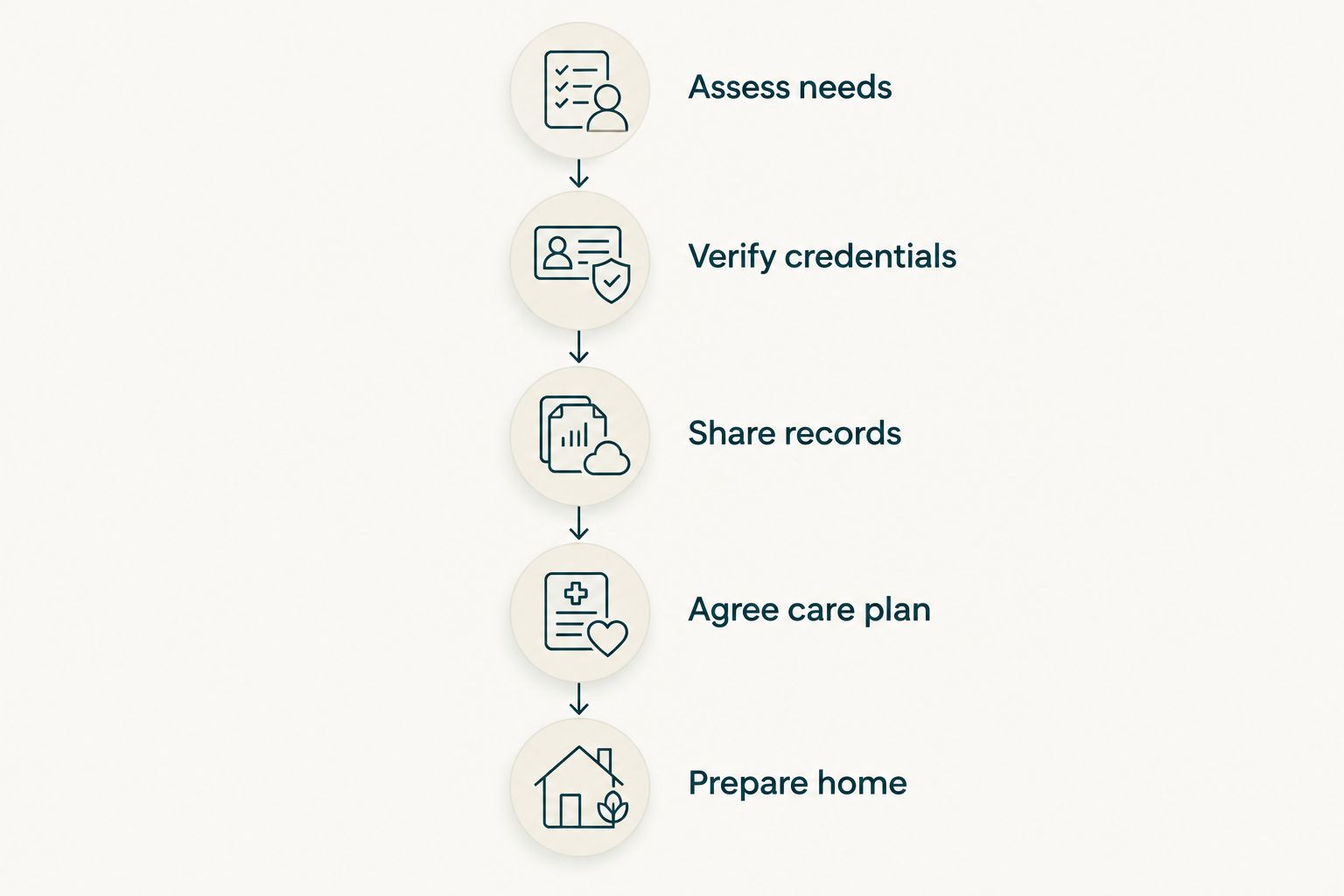
Follow this sequence before confirming a start date. If your relative is leaving hospital, involve the discharge team before arranging the first home visit.
1. Write down what help is actually needed
Describe a normal day, including getting out of bed, bathing, dressing, meals, toileting, walking and sleep. Record where your relative needs prompting, supervision or physical assistance rather than simply writing “needs help.”
Add medical needs separately: prescribed treatments, wounds, recent falls, memory changes, swallowing difficulties and any devices already in use. Describe the task first; ask the provider which professional is qualified to perform it.
2. Separate personal support from clinical care
Ask whether the proposed worker is a caregiver, a nurse or another healthcare professional. Those roles are not interchangeable, and a job title alone does not establish competence for a particular task.
| Care arrangement | Best for | Main benefit | Limitation to clarify |
|---|---|---|---|
| Personal care support | Help with washing, dressing, meals and daily routines | Focuses on everyday assistance | Does not replace qualified nursing for clinical procedures |
| Home nursing | Prescribed clinical care and nursing assessment | Matches medical tasks to professional nursing care | Does not automatically include continuous household or personal support |
| Combined support | Relatives with both daily-living and clinical needs | Separates practical assistance from nursing responsibilities | Requires a clear handover and named responsibility for each task |
Use the table to describe what you need, not to diagnose your relative. A clinical assessment should resolve uncertainty about the appropriate level of care.
3. Verify the provider and assigned professional
For clinical home care in Abu Dhabi, ask for the provider’s relevant Department of Health – Abu Dhabi facility licence details and the assigned professional’s applicable credentials. Check their current status through the regulator’s official channels.
Confirm that the proposed work falls within the professional’s authorised role. A Dubai credential alone is not evidence of authorisation for the specific Abu Dhabi service you are arranging.
4. Share the records needed for a safe assessment
Prepare the current medication list, known allergies, relevant diagnoses, recent discharge summary and existing treatment instructions. Include the prescribing doctor’s details and any upcoming appointments.
Ask the provider how to submit health records securely. Do not send identity documents or medical reports to an unverified personal contact merely because that person offers to arrange care.
5. Agree on a written care plan
The plan should identify tasks, visit frequency, responsible professionals, clinical instructions and escalation contacts. It should also state what the service does not include.
Ask how staff record visits, report changes and hand over to replacements. An instruction such as “monitor closely” is incomplete unless everyone knows what to observe and whom to contact.
6. Confirm the service agreement and payment process
Request an itemised written quotation and clarify assessment, visits, equipment, consumables and any separately arranged services. Ask about cancellation terms, replacement cover and the process for changing the schedule.
If you plan to use insurance, check the exact service with the insurer before treatment. A provider accepting an insurer does not establish that your relative’s policy covers the proposed care.
7. Prepare the home and first handover
Tell the provider about stairs, building access, pets, bathroom layout and the space available around the bed. Ask the assessing clinician whether transfers or personal care require equipment or additional assistance.
At the first visit, review the care plan with your relative and the attending professional. Confirm the next visit and the contact route for both routine questions and clinical concerns.
Personal care: best for everyday assistance
Personal care suits someone who needs support with daily activities rather than a clinical procedure. Discuss bathing, dressing, toileting, eating, companionship and movement around the home individually.
The benefit is practical help matched to the person’s routine. The limitation is clinical scope: do not assume that a caregiver can administer prescribed treatments, assess a deteriorating wound or make medication decisions.
Ask about relevant experience, communication and safe assistance with movement. If your relative needs lifting, describe the situation accurately; do not expect a worker to improvise a transfer that has not been assessed.
Home nursing: best for prescribed clinical tasks
Home nursing is the appropriate discussion when your relative needs nursing assessment or prescribed care, such as wound management. The nurse needs clear clinical instructions and access to the relevant medical history.
The benefit is professional clinical input at home. The limitation is that a scheduled nursing visit does not automatically cover the hours between visits, personal companionship or household work.
Ask who reviews progress and who can change the treatment plan. A family member should not have to decide whether a clinical procedure remains appropriate when the patient’s condition changes.
Combined support: best for overlapping care needs
Combined support suits a relative who needs both everyday assistance and scheduled clinical care. Assign each task explicitly so the caregiver, nurse and family understand their separate responsibilities.
The benefit is coverage of different needs without treating every task as interchangeable. The limitation is coordination: missed messages between workers can leave a medicine instruction, mobility restriction or new symptom unaddressed.
Use a shared care record with appropriate access controls. Identify who updates it and who receives urgent changes rather than relying on scattered messages across family conversations.
Why elderly home-care arrangements vary
Your relative’s condition and home situation determine the appropriate plan. For a 2026 care review, discuss these factors rather than choosing solely by the length of a visit:
- Clinical complexity: Prescribed procedures and unstable symptoms need different oversight from routine personal support.
- Mobility: Walking assistance, transfers and stairs affect staffing and equipment decisions.
- Memory and communication: Confusion, distress, hearing difficulties and language preferences affect how care is delivered.
- Timing: Daytime help does not address needs that occur overnight or between visits.
- Family involvement: Record what relatives can reliably do and what requires professional support.
- Home environment: Bathroom access, bed position and safe movement routes affect the practical care plan.
A longer visit is not automatically a better plan. Match attendance to the tasks and the periods when your relative cannot safely manage without help.
What should you ask before the first visit?
Use this 2026 booking checklist during the assessment. Ask for answers in the care plan or service agreement, not only in a telephone conversation.
- Who is attending, and what is their professional role?
- Which tasks are included and specifically excluded?
- Who provides clinical supervision and reviews concerns?
- What happens if the assigned worker is absent?
- How are medicines, visit notes and changes in condition recorded?
- What requires a doctor’s instruction before staff proceed?
- How do you request a reassessment or change the schedule?
- What happens outside the agreed attendance hours?
Clarify medication responsibilities particularly carefully. Reminding someone to take a medicine is different from administering it or deciding to change the dose; the plan must distinguish those actions.
For overnight support, ask whether the arrangement involves scheduled checks, an awake worker or another clearly described attendance model. “24-hour care” describes a period of coverage, not the worker’s qualifications or permitted tasks.
Where does Dardoc fit into elderly home care?
Dardoc is best suited to families seeking elderly home care and at-home nursing in Abu Dhabi. Its stated services include both categories, so describe your relative’s practical and medical needs when making an enquiry through Dardoc.
That service scope is a reason to discuss the case, not a substitute for assessment. Confirm the proposed professional, credentials, clinical oversight, attendance schedule and exclusions before accepting a plan.
The limitation is straightforward: a home-care enquiry does not establish suitability for a particular condition. Ask the provider to explain whether home care meets your relative’s needs or whether further medical assessment is required first.
Do you need a doctor’s referral for elderly home care?
A doctor’s referral is not the same requirement for every type of elderly home care. Ask the provider what assessment or documentation is required for the proposed service, and ask your insurer separately about authorisation.
For prescribed clinical treatments, obtain the relevant medical instructions rather than relying on a family description. The provider should explain which documents are needed before treatment starts.
Can you arrange elderly care before hospital discharge?
Yes, start the arrangement before discharge so the home-care provider can review the discharge instructions and planned support. Ask the hospital team what must be ready at home and who will manage follow-up.
Make sure the receiving team understands medicine changes, mobility restrictions, wound instructions and warning signs. A confirmed booking does not replace a clinical handover.
What if your relative needs help overnight?
Overnight needs require a specific attendance and escalation plan. Explain whether the concern is toileting, wandering, pain, prescribed care or repeated requests for assistance; those are different care tasks.
If you are considering support across 24 hours a day and 7 days a week, ask how shifts, breaks and handovers work. Do not assume that one person’s presence means uninterrupted, awake clinical supervision.
When should you seek urgent help instead?
Do not wait for a home-care assessment when your relative has severe breathing difficulty, chest pain, suspected stroke symptoms or becomes unresponsive. In the UAE, call 998 for an ambulance.
A sudden change in confusion, mobility, alertness or ability to eat also needs prompt clinical advice. Tell the assessing professional what changed and when; do not label a new symptom as “just old age.”
FAQ
How do I start arranging elderly home care in Abu Dhabi?
Start by listing your relative’s daily support needs, medical tasks and current medicines. Ask a provider to assess those needs, verify the relevant credentials and agree on a written care plan before the first visit.
Is a caregiver the same as a home nurse?
A caregiver and a home nurse are different roles. Personal support does not establish qualification to perform clinical procedures; confirm the assigned worker’s authorised scope and responsibilities.
How do I check a home-care provider’s licence in Abu Dhabi?
Ask for the relevant Department of Health – Abu Dhabi facility licence details and the assigned professional’s applicable credentials. Verify their current status through the regulator’s official channels rather than relying only on promotional material.
Will insurance cover elderly home care in Abu Dhabi?
Coverage depends on your policy and the specific service proposed. Ask the insurer about eligibility, required clinical documents, prior authorisation and the billing process before care begins.
Can Dardoc provide elderly home care in Abu Dhabi?
Dardoc offers elderly care and at-home nursing in Abu Dhabi. Confirm the assessed care needs, proposed professional, service scope and clinical oversight before agreeing to an arrangement.
What documents should I prepare for an elderly home-care assessment?
Prepare the current medication list, allergies, relevant diagnoses, recent discharge summary and treatment instructions. Ask the verified provider how to submit those records securely.
Can I change the care plan if my parent’s needs change?
Request a reassessment when your parent’s condition, mobility or support needs change. Confirm who updates the written plan and whether the change requires a different professional or medical review.
One last thing
For your 2026 care plan, write down what happens between visits. A careful nursing visit does not resolve an unsafe transfer later that evening or uncertainty about whom to call overnight.
Before agreeing to care, ask: who is responsible when nobody from the service is in the home? A clear answer exposes gaps that a visit schedule alone cannot show.