How to connect Nextcare insurance to at-home IV drip billing
Nextcare insurance IV drip billing needs service-specific checks. Confirm home-care benefits, authorization and your billing route before booking.

Instead of repeatedly sending your insurance card when arranging an at-home drip, organize Nextcare insurance IV drip billing around a written eligibility check, any required authorization, and a documented billing route. Confirm the exact treatment and home setting before the visit; sharing a card alone does not establish cover.
TL;DR- Nextcare insurance IV drip billing starts with confirming benefits, the home setting, and the provider’s billing arrangements.
- DarDoc provides at-home IV drips; confirm insurance arrangements separately before booking.
- Direct billing and reimbursement are different routes, and neither establishes treatment eligibility.
- Keep the prescription, authorization decision, itemized invoice, and payment evidence together for the relevant treatment episode.
Why this matters
An insurance card identifies your membership. It does not, by itself, confirm that a particular IV infusion, provider, or home visit falls within your benefits.
For a 2026 booking, ask about your current policy rather than relying on an earlier appointment. A previous payment decision is not confirmation for a different treatment or a renewed policy.
DarDoc is best suited to families seeking at-home healthcare in Dubai and Abu Dhabi, not a guarantee of insurance coverage. Its services include at-home IV drips, but the billing arrangement needs separate confirmation. Start with DarDoc for the care enquiry and use the workflow below to establish the insurance position.
Before you start
- Prepare your membership details: Have your current insurance card, policy information, and access to the contact channel shown on your card or policy documents. Use the secure document-sharing method the recipient specifies.
- Prepare the clinical request: Gather the prescription or treatment plan, if issued, and the proposed provider, home location, and visit date. Ask the treating clinician to describe the actual infusion and its clinical purpose.
- Check the home-setting distinction: Ask explicitly whether the benefit applies at home. Confirmation about an infusion in a clinic does not answer whether the same treatment, nursing attendance, and supplies are covered at your address.
This is an administrative workflow, not a software connection. Do not look for an assumed insurance-linking button or upload sensitive records to an unverified form. Use the channels confirmed by your provider and insurance administrator.
Membership and benefit verification
Establish the policy and treatment match
- Identify the patient using 2 identifiers, such as the full name and membership number. Check that the details match across the prescription and insurance records.
- Contact the member-support channel listed in your insurance documents. Ask whether your membership is active for the proposed treatment date.
- Describe the service precisely: a clinician-prescribed IV infusion administered at home, including the medicine or fluid when known. Do not substitute a promotional drip name for the clinical description.
- Ask whether the relevant benefit covers the infusion, the home setting, nursing administration, and consumables. Request separate answers where the components are assessed separately.
- Record the response date and enquiry reference. Ask for written confirmation of the applicable conditions and exclusions.
Expected result: You have a documented answer about the proposed service, or a clear list of information needed before eligibility can be assessed.
For your 2026 enquiry, use a short checklist rather than asking only whether IV drips are covered. Ask which policy benefit applies, whether a referral or prescription is required, whether home administration is eligible, and whether authorization must precede treatment.
A clinician’s prescription establishes the treatment request; it does not establish the insurance decision. Keep those decisions separate throughout the process.
Billing route and provider confirmation
Choose the route before the appointment
- Ask the provider whether it can bill your specific plan directly for the proposed at-home service. Give the membership and treatment details needed for that check through its approved channel.
- If direct billing is not confirmed, ask your insurance administrator whether reimbursement is permitted for that provider, treatment, and setting.
- Request the documentation requirements for the applicable route. Establish who submits any authorization request and who submits the eventual claim.
- Ask for written confirmation of any patient responsibility and excluded components. Do not interpret a general statement about insurance acceptance as confirmation for your appointment.
- Save the agreed route with the clinical request. Keep 1 patient record per treatment episode to avoid mixing documents from different visits.
Expected result: You know whether the proposed appointment follows direct billing, an eligible reimbursement route, or a route without confirmed insurance funding.
| Billing route | Best for | Advantage | Limitation |
|---|---|---|---|
| Confirmed direct billing | Patients whose provider and plan support the exact service | The provider handles the covered claim through the agreed arrangement | Requires service-specific confirmation; patient responsibility can still apply |
| Reimbursement, if permitted | Patients whose policy allows them to submit an eligible claim after payment | Allows a documented claim through the policy’s reimbursement process | You pay first, and reimbursement remains subject to the policy and claim assessment |
Choose a billing route only after eligibility is checked. Reimbursement is not a workaround for an excluded treatment, and direct billing is not evidence that every component is covered.
For the distinction between treatment eligibility and payment arrangements, read whether insurance covers at-home IV drip therapy in Dubai.
Authorization and claim documentation
Match the approved request to the delivered care
- Ask the treating clinician to supply the prescription and supporting clinical information requested for assessment. Clinical descriptions must reflect the patient’s actual condition and proposed treatment.
- Establish whether prior authorization is required. If it is, have the responsible party submit the request before the appointment and obtain the written decision.
- Check any authorization against the patient, provider, treatment, home setting, visit count, and validity period stated in the decision. Ask about anything absent or unclear.
- Before treatment, ask the provider to confirm that the planned service matches the assessed request. Report any change in the prescription or location before proceeding on the assumption of cover.
- After treatment, request the itemized invoice and relevant treatment documentation. For reimbursement, retain payment evidence and submit the documents through the method specified in your policy instructions.
- Track the claim reference and assessment outcome. If an explanation is unclear, request the reason in writing before resubmitting documents.
Expected result: The clinical request, insurance decision, delivered service, and claim documents describe the same treatment episode.
Use 3 checkpoints in your 2026 record: before booking, before administration, and after invoicing. At each checkpoint, compare the current treatment details with the latest written insurance response.
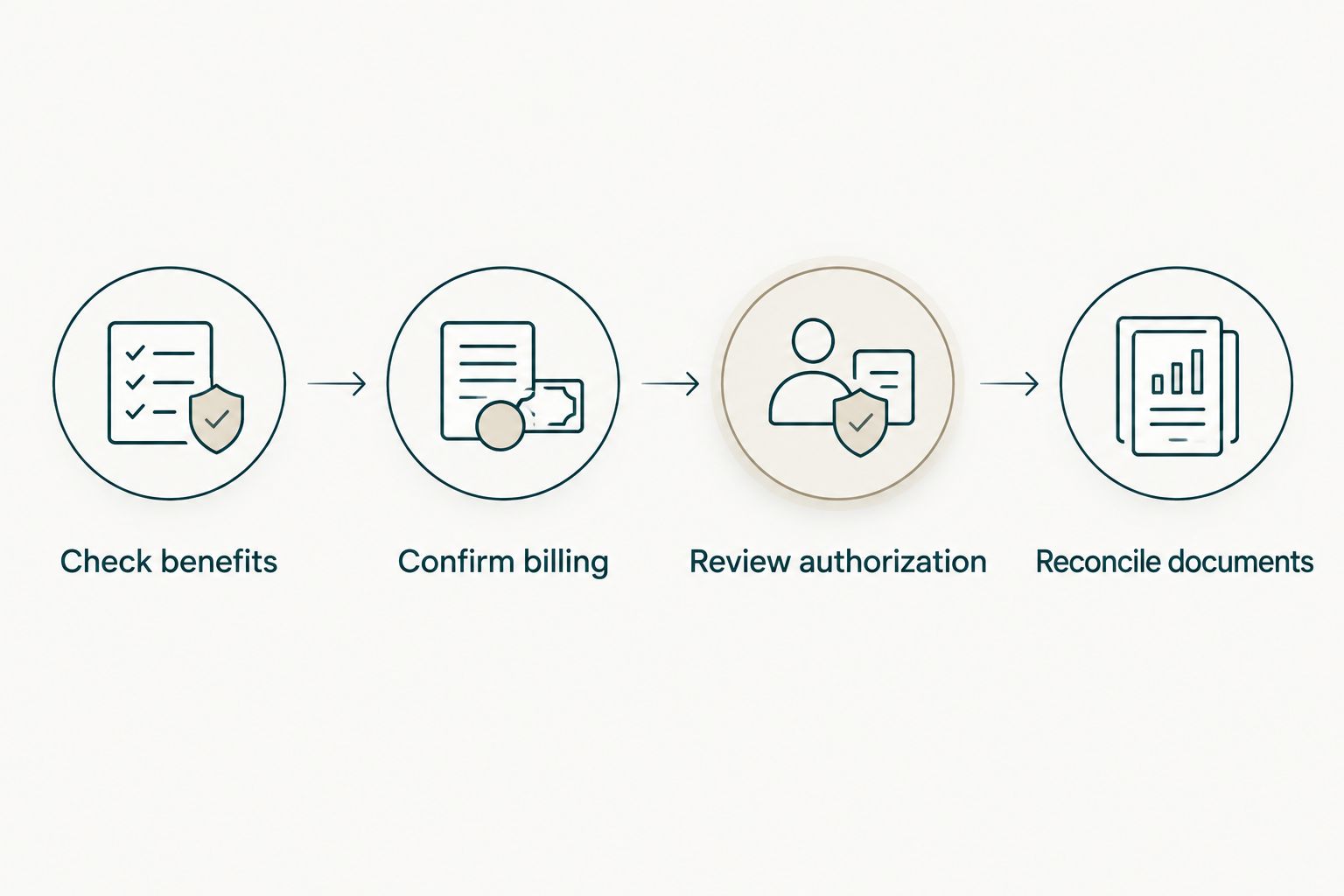
The sequence matters: establish benefits, confirm the billing route, resolve authorization requirements, then reconcile the treatment documents. Missing confirmation is a reason to ask another question—not to assume approval.
Keep the handoff clear
Assign the following tasks explicitly: Check benefits, Confirm billing, Review authorization, and Reconcile documents. Ask who owns each task and where the written response will be stored.
You do not need to interpret medical coding yourself. Ask the provider to resolve clinical or coding queries with the assessing party, while you retain the correspondence and confirm the patient details.
When the prescription or visit schedule changes
Repeat the relevant checks whenever the clinician changes the infusion, administration plan, or home-visit schedule. Do not treat an existing authorization as open-ended permission for a different service.
- Obtain the revised clinical request from the treating clinician.
- Tell the provider which details changed and supply the existing enquiry or authorization reference.
- Ask whether the change requires a revised authorization or a new eligibility assessment.
- Obtain the applicable written decision before assuming that the revised appointment follows the earlier billing arrangement.
Expected result: Your billing record follows the current prescription rather than an outdated plan.
For a course spanning a policy renewal in 2026, verify the benefits applicable to each treatment date. Also check the scope of any authorization rather than assuming it covers the whole course.
A vitamin infusion’s advertised purpose is not a coverage category. Comparing vitamin C IV therapy costs with your policy’s eligibility decision answers different questions: a treatment’s cost does not establish medical necessity or insurance entitlement.
Keep the clinician’s explanation of the indication separate from promotional descriptions. Never ask anyone to change the diagnosis or treatment description simply to obtain payment.
Troubleshooting
Your card is accepted, but the home infusion is not confirmed
Ask what “accepted” means for this appointment: membership recognition, provider participation, or approval of the proposed service. Request confirmation covering the treatment and home setting, not just the card.
Fix: Pause the insurance assumption until the written response identifies the applicable service and conditions. You can then make an informed booking decision.
Authorization exists, but the invoice describes something different
Compare the prescription, decision, treatment record, and itemized invoice. Look for differences in patient details, medicine or fluid, administration service, location, and treatment date.
Fix: Ask the provider to investigate and correct genuine documentation errors. Do not request a replacement description that misrepresents the care delivered.
A reimbursement claim needs more documents
Request a precise list of what is missing and the applicable submission instructions. Sending the same incomplete bundle again does not address the request.
Fix: Assemble the requested clinical report, prescription, invoice, payment evidence, or other specified records. Keep copies and the submission reference together.
A claim is declined or only partly accepted
Ask for the written assessment and policy basis. Separate an administrative error from a benefit exclusion or a decision about clinical eligibility; the next action depends on the reason.
Fix: Correct factual errors through the stated process. For a disputed decision, follow the complaint or appeal instructions in your policy rather than repeatedly submitting an unchanged claim.
Customize your workflow
For recurring care, maintain a simple appointment log with the treatment date, prescription version, authorization reference, billing route, and claim status. Keep health information in a secure location with access limited to the people involved.
If a family member coordinates appointments, ask what consent or representative documentation is needed before discussing clinical or insurance details. Being the person who books the visit does not automatically settle access to another adult’s records.
For DarDoc at-home IV drip enquiries, use the contact page to ask which clinical documents are needed and whether your proposed insurance arrangement can be supported. Keep the request specific to your membership, prescribed treatment, and home location.
Before confirming a 2026 appointment, request the provider’s applicable facility and clinician licensing details and ask how clinical assessment and escalation are handled. Administrative approval is not a substitute for a clinician deciding that home treatment is appropriate.
FAQ
How do I connect Nextcare insurance to at-home IV drip billing?
Start by confirming eligibility for the exact infusion, home setting, and proposed provider, then establish the billing route and any authorization requirements. Sharing an insurance card alone does not confirm coverage.
Does a Nextcare card mean my home IV drip is covered?
A Nextcare card alone does not confirm coverage for a home IV drip. Ask for a service-specific assessment under your current policy, including nursing administration and any separately assessed components.
Can DarDoc bill my insurance directly for an IV drip?
Confirm the billing arrangement with DarDoc for your specific plan and proposed treatment before booking. DarDoc offers at-home IV drips, but that service offering does not itself establish direct-billing eligibility.
Do I need authorization before an at-home infusion?
Ask your insurance administrator whether your proposed infusion requires prior authorization. If authorization is required, obtain the decision before treatment and check its scope and conditions.
Can I claim reimbursement if direct billing is unavailable?
You can pursue reimbursement only if your policy permits it for the treatment, provider, and setting. Confirm eligibility and document requirements before paying; submitting a claim does not guarantee payment.
What documents should I keep for an IV drip claim?
Keep the prescription, relevant clinical report, insurance correspondence, itemized invoice, and payment evidence where applicable. Follow the document list supplied for your particular claim rather than assuming every policy uses the same requirements.
Does approval for one infusion cover repeat home visits?
Approval for an infusion does not establish cover for unlimited repeat visits. Check the authorized treatment, visit count, validity period, and whether changes require reassessment.
One last thing
The most useful confirmation names the service—not just the insurance card. Ask for a written response that identifies the prescribed treatment, home setting, billing route, and outstanding conditions. That gives you a concrete record to compare with the appointment and invoice.