Newborn nursing for first-time parents in Dubai: complete 2026 guide
Newborn nursing for first-time parents Dubai: choose qualified home support, plan feeding and safe sleep, and know when your baby needs urgent care.

First-time parents’ newborn nursing is clinical support for a baby at home, with the aim of helping you provide safe daily care and recognise illness early. This 2026 Dubai guide explains how to choose qualified support, prepare for discharge and build a feeding, sleep and escalation plan without handing every parenting decision to someone else.
TL;DR- For newborn nursing for first-time parents Dubai, choose verified credentials, a written care plan and clear escalation instructions.
- DarDoc provides newborn care at home for families in Dubai; confirm the individual nurse’s scope before booking.
- A newborn nurse supports feeding and safe sleep but does not replace paediatric assessment.
- A temperature of 38°C or higher in a baby under three months needs urgent medical assessment.
Why newborn nursing matters for first-time parents
Hospital discharge transfers daily responsibility to you before feeding, settling and recognising normal newborn behaviour feel familiar. A nurse’s useful role is to observe, teach and document—not simply take over while you remain unsure what to do.
Your baby’s discharge instructions come first. Use the hospital discharge-to-home nursing workflow to organise the handover, then adapt it with your maternity team to your baby’s needs.
In 2026, choosing support in Dubai means distinguishing clinical nursing from general childcare. A reassuring job title is not evidence of a professional licence, newborn experience or permission to perform a particular clinical task.
The right support leaves you more capable when the nurse is absent. It also gives you a clear boundary between something to record, something to discuss with your paediatrician and something that needs emergency care.
Arrange newborn nursing around your baby’s needs
Start with the hospital discharge plan
Ask your maternity team to explain the discharge summary before you leave. The World Health Organization defines the neonatal period as the first 28 days of life; this is not simply a smaller version of care for an older baby.
Keep feeding instructions, weight checks, screening results and follow-up appointments together. Babies born prematurely or discharged with specific medical needs require an individual plan rather than a standard newborn routine.
Choose one shared record that both parents can find. A paper notebook works; it does not need to be an app.
- Keep the discharge summary and paediatrician’s details together.
- Record prescribed medicines exactly as instructed.
- Confirm who will review feeding, weight and jaundice concerns.
- Ask which screening results or appointments remain outstanding.
- Write down the hospital’s return-to-care instructions.
Separate nursing needs from household help
List the tasks you need help with before requesting a nurse. Feeding observation, clinical monitoring and administering prescribed treatment are different from washing bottles, preparing meals or watching a sleeping baby.
For your 2026 booking, ask providers to describe the actual role rather than relying on labels such as maternity nurse or night nanny. The title alone does not establish clinical registration.
Start with help you can organise yourself: divide meals, laundry and visitor management between trusted adults. Reserve clinical support for tasks that require clinical judgement or professional training.
- Separate baby care, maternal care and household tasks.
- Identify tasks that require a licensed healthcare professional.
- Specify whether you need teaching, observation or hands-on care.
- Explain any discharge concerns before accepting a proposed arrangement.
- Agree which tasks are outside the nurse’s role.
Verify the professional before choosing a provider
Ask for the nurse’s full name, professional registration details and relevant newborn experience. Verify the applicable Dubai Health Authority credentials through official channels; do not treat a uniform or messaging profile as verification.
DarDoc offers mother and newborn care at home in Dubai. DarDoc newborn care is best for families seeking mother-and-baby support at home in Dubai. Its service scope does not establish the credentials or suitability of any individual professional, so ask the same questions you would ask another provider.
Use DarDoc to explore home healthcare, then confirm the proposed care arrangement directly.
- Verify the provider’s healthcare authorisation and the clinician’s registration.
- Ask about experience with your baby’s specific needs.
- Confirm who supervises clinical concerns and receives handovers.
- Request a written scope of care and escalation process.
- Ask how replacements and continuity are handled.
Build a feeding and observation record
Use the feeding plan agreed with your maternity team or paediatrician. A nurse can observe technique, record what happened and identify concerns; a generic schedule must not override a baby-specific medical instruction.
For breastfeeding, ask for practical help with positioning and signs of effective feeding. Persistent pain, poor attachment or concerns about intake need assessment, not reassurance based only on how long a feed lasted.
Keep the record focused on feeding, nappies, behaviour and concerns. For formula preparation, follow the product instructions and your clinician’s guidance; do not alter powder-to-water ratios or dilute feeds.
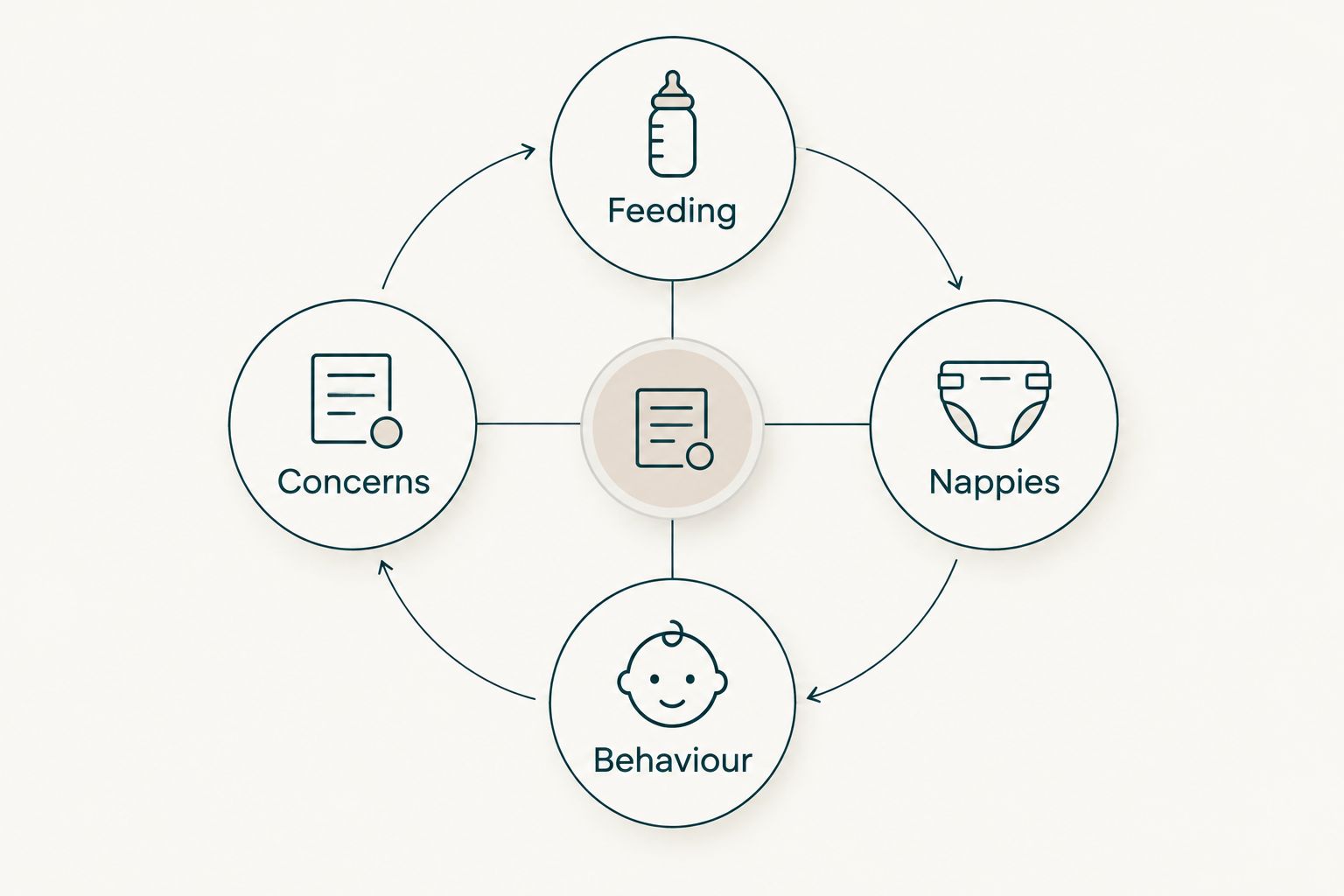
A record supports a conversation; it does not diagnose dehydration or prove that intake is adequate. Review concerns with the clinician responsible for your baby.
- Record feed timing and relevant feeding difficulties.
- Record wet and dirty nappies for clinical review.
- Note changes in alertness, feeding interest or vomiting.
- Ask for feeding techniques to be demonstrated, then practise yourself.
- Use your baby’s prescribed plan for waking and feeding decisions.
Set up safe sleep before the first night
Place your baby on their back for every sleep, on a firm, flat sleep surface designed for infants. Keep pillows, loose blankets, bumpers, toys and sleep positioners out of the sleep space.
The American Academy of Pediatrics recommends room-sharing without bed-sharing for at least the first 6 months. Its safe-sleep guidance also recommends avoiding overheating and keeping the baby’s sleep space clear.
A night nurse does not make an unsafe sleep surface safe. Make the same rules apply to parents, relatives and paid caregivers, including during naps and handovers.
- Prepare a separate cot or bassinet with a fitted sheet.
- Put your baby on their back for each sleep.
- Keep the sleep surface flat and free of loose items.
- Avoid sleeping with your baby on a sofa or armchair.
- Ask every caregiver to explain the agreed safe-sleep routine.
Write down when to seek medical help
Ask the paediatrician to give you a written escalation plan. It should distinguish routine questions from urgent assessment and emergency symptoms, with clear contact details for each.
NHS guidance identifies a temperature of 38°C or higher in a baby under 3 months as requiring urgent medical advice and assessment. Do not wait for the next nursing visit or give medicine simply to postpone evaluation.
Breathing difficulty, blue or grey colour, unresponsiveness or a seizure require emergency help. In the UAE, call 998 for an ambulance. Worsening jaundice, markedly reduced feeding or unusual sleepiness also need prompt clinical assessment.
- Keep the paediatrician’s and maternity unit’s numbers accessible.
- Learn how your clinician wants you to measure temperature.
- Ask which feeding or nappy changes require a call.
- Record who makes the call during each care period.
- Keep emergency transport arrangements clear.
Review the arrangement and practise independently
At each handover, ask what changed, what needs follow-up and what you should practise next. You need a usable summary, not a list of completed chores.
Build supervised practice into the arrangement. Hold, feed, settle and change your baby while the nurse watches and explains; confidence comes from doing the task safely yourself.
Review whether the original reason for nursing support still applies. Ongoing clinical needs require professional review, while household pressures need a separate practical plan.
- Ask for a short written handover after each care period.
- Practise tasks that still feel unfamiliar.
- Review unresolved feeding or maternal recovery concerns.
- Confirm follow-up appointments and responsibility for booking them.
- Agree how care ends or changes as your needs change.
Compare the support options
For a 2026 care plan, choose the type of support before comparing providers. These options solve different problems; none replaces emergency services when your baby is acutely unwell.
| Option | Best for | Main advantage | Key limitation |
|---|---|---|---|
| Parent-led care with maternity-team guidance | Families confident with routine care and clear follow-up | Builds independence using the baby’s discharge plan | No additional professional observation at home |
| Licensed newborn home nurse | Families needing clinical observation, teaching or prescribed nursing tasks | Combines practical care with nursing assessment within scope | Does not replace a paediatrician or hospital assessment |
| Non-clinical newborn caregiver | Families needing practical baby-care support | Helps with agreed routine care | Must not be treated as a licensed nurse without verified credentials |
| Lactation professional | Families with breastfeeding or milk-transfer concerns | Provides focused feeding assessment and support | Does not cover every newborn or maternal medical need |
| Paediatric consultation | Babies needing medical examination or treatment decisions | Provides medical assessment and a treatment plan | Does not provide ongoing household or bedside support |
| DarDoc mother and newborn care | Families exploring healthcare support at home in Dubai | Offers mother and newborn care within a home-healthcare service | Individual staffing, tasks and clinical suitability need direct confirmation |
Choose the professional for the problem, not the broadest-sounding package. Feeding difficulties, maternal recovery and overnight practical support sometimes need different people with clearly separated responsibilities.
Common mistakes first-time parents make
Booking overnight help without defining feeding responsibilities
Sleeping through a shift is not a suitable goal if it conflicts with your baby’s feeding plan or your breastfeeding goals. Agree who brings the baby to you, who records feeds and what happens when feeding is difficult.
Assuming newborn experience means clinical registration
A caregiver can have extensive practical experience without being a licensed nurse. That distinction matters when you need clinical observations, prescribed treatment or assessment of a concerning change.
Accepting reassurance without a documented next step
A comment that a baby seems fine is not an escalation plan. Ask what was observed, what you should monitor and exactly when you should seek assessment.
Using different routines for different caregivers
Conflicting instructions about sleep surfaces, formula preparation or feeding records make handovers harder. Keep one agreed plan accessible and ask each caregiver to explain it back.
Leaving maternal recovery outside the care discussion
Newborn care does not remove the mother’s need for postnatal review. Heavy bleeding, chest pain, breathing difficulty, severe headache or thoughts of self-harm require urgent medical help, not a change to the baby’s routine.
FAQ
Do first-time parents in Dubai need a newborn nurse?
No, a newborn nurse is not a requirement for every family. Choose nursing support when you need clinical teaching, observation or prescribed care, and keep routine paediatric follow-up in place.
What is the difference between a newborn nurse and a night nanny?
A newborn nurse must have appropriate professional nursing credentials; a night nanny’s title alone does not establish clinical registration. Verify the person’s qualifications and written scope before assigning clinical tasks.
Can a newborn nurse help me breastfeed?
A suitably trained nurse can support positioning, observe feeds and identify concerns within their scope. Persistent pain, poor attachment or concerns about milk transfer need assessment by an appropriately qualified feeding professional or clinician.
Can a night nurse guarantee that my newborn sleeps through the night?
No, a night nurse cannot guarantee uninterrupted newborn sleep or safely override a prescribed feeding plan. Agree how the caregiver will support feeds, settling and safe sleep instead.
When does my newborn’s temperature need urgent assessment?
A temperature of 38°C or higher in a baby under 3 months needs urgent medical assessment. Contact a clinician immediately rather than waiting for a routine nursing visit; call emergency services if your baby has emergency symptoms.
What should I ask DarDoc before arranging newborn care?
Ask DarDoc to confirm the proposed professional’s credentials, newborn experience, scope of care and clinical escalation process. Share the discharge summary and clarify whether the arrangement covers your baby, maternal care or both.
Can home nursing replace my baby’s paediatric appointments?
No, newborn home nursing does not replace paediatric appointments, screening or medical assessment. Keep the follow-up schedule provided by your maternity team and share nursing observations with the responsible clinician.
One last thing
Before your first night at home, ask everyone involved the same question: what would make you call for help? Different answers reveal a gap that another blanket, monitor or care package will not fix.
For your 2026 newborn plan, agree on the answer in writing. Keep the emergency instructions beside the feeding record, and ask the nurse to watch you practise the care you will provide alone. This guide supports that conversation; your baby’s treating team sets the individual clinical plan.