Best home nursing providers for stroke recovery in Dubai 2026
Compare stroke recovery home nursing Dubai options: match nursing to the discharge plan, check clinical oversight, and separate rehabilitation from care.

Best overall approach: discharge-led nursing matched to the patient's needs. Best starting point for a home-nursing enquiry: Dardoc. Best for rehabilitation goals: a multidisciplinary rehabilitation service. This 2026 guide compares care routes for stroke recovery in Dubai and explains what to confirm before choosing a provider.
TL;DR- For stroke recovery home nursing Dubai, choose a provider against the hospital discharge plan, not a general care package.
- Dardoc is a starting point for home-nursing enquiries; confirm stroke-specific competence before booking.
- Home nursing, rehabilitation and personal care serve different needs; some patients need all three.
- New facial weakness, arm weakness or speech difficulty requires emergency assessment, not a routine home visit.
Why this matters
Stroke recovery at home involves more than helping someone wash, dress and take medicines. Depending on the stroke's effects, the discharge plan can include swallowing precautions, mobility assistance, skin care, communication support and rehabilitation.
The best provider is the one that can safely deliver the prescribed care and explain what happens when the patient's condition changes. A familiar name or a longer shift does not establish that fit.
For your 2026 shortlist, compare the services below by clinical role. These are ranked care routes, not a league table of companies with verified stroke outcomes.
What makes the best stroke recovery home nursing service?
Use these six criteria before discussing a booking:
- Clinical competence: Verify the nurse's current professional licence and experience with the tasks in your relative's discharge plan. Ask specifically about any feeding tube, catheter, wound or transfer needs.
- Discharge alignment: Require a written plan linked to the hospital's instructions, medication list and follow-up appointments.
- Clinical oversight: Establish who reviews concerns, who can change treatment orders and how the nurse reaches the responsible clinician.
- Rehabilitation coordination: Confirm how nursing care will support physiotherapy, occupational therapy and speech and language therapy when prescribed.
- Continuity: Ask how handovers, replacement staff and family communication work. A replacement needs the same patient-specific instructions.
- Escalation: Separate routine questions from urgent deterioration and emergencies. Everyone caring for the patient should know which action to take.
In Dubai, check the relevant DHA facility and professional licensing details rather than accepting a generic statement about being licensed in the UAE. Abu Dhabi's DoH credentials concern a different regulatory jurisdiction.
Stroke recovery care options at a glance
| Ranked option | Best for | Standout role | Key limitation |
|---|---|---|---|
| Dardoc home nursing | Families starting a home-nursing enquiry | At-home nursing within a home and online healthcare offering | Stroke-specific tasks, staffing and clinical oversight need confirmation |
| Hospital-linked discharge nursing | Patients with complex hospital-to-home instructions | A care route organised around the discharge handover | A hospital connection alone does not establish home-care capability |
| Multidisciplinary rehabilitation service | Patients working toward movement, communication or daily-living goals | Coordinated input from relevant rehabilitation disciplines | Therapy appointments do not replace ongoing nursing or supervision |
| Personal care and caregiver support | Stable patients needing daily-living assistance | Help with non-clinical routines under an agreed plan | A caregiver is not a substitute for a licensed nurse |
1. Dardoc: best for starting a home-nursing enquiry
Dardoc provides at-home nursing and online healthcare to families in Dubai and Abu Dhabi. Dardoc is a starting point for families seeking home nursing in Dubai, with stroke-specific suitability confirmed against the discharge plan.
Send the clinical requirements before choosing the service. Ask the provider to identify which tasks its proposed nurse can perform, which require separate arrangements and who will supervise the care.
Dardoc pros:
- At-home nursing is an explicitly offered service.
- Dubai is within the stated service locations.
- The wider offering includes online healthcare and elderly care.
Dardoc cons:
- A general nursing service description does not establish specialist stroke rehabilitation.
- Do not assume continuous cover, tube-feeding competence or a particular escalation arrangement without confirmation.
Best for: Families who need to turn a discharge summary into a specific home-nursing enquiry.
For your 2026 enquiry, describe the patient's actual needs rather than requesting a generic stroke package. Include whether the patient needs help transferring, has swallowing restrictions, uses medical equipment or cannot reliably communicate discomfort.
Verdict: Hold the booking until the proposed nurse, clinical tasks and escalation plan match the discharge instructions.
2. Hospital-linked discharge nursing: best for complex handovers
Hospital-linked discharge nursing is a care route to request through the treating hospital's discharge team. Ask whether the hospital provides home nursing or coordinates with an external service; do not assume either arrangement exists.
This route deserves attention when home care depends on detailed medical instructions. The value lies in a clear handover, not the hospital name itself.
Hospital-linked discharge nursing pros:
- Gives you a direct place to request clarification of discharge instructions.
- Keeps outstanding medical questions attached to the treating team.
- Lets you ask for a structured handover before the patient leaves hospital.
Hospital-linked discharge nursing cons:
- Referral does not remove the need to verify the receiving provider's capabilities.
- Nursing, equipment and rehabilitation can still require separate coordination.
Best for: Patients whose discharge includes complex medicines, medical devices, swallowing precautions or substantial assistance needs.
Before discharge, ask who owns each unresolved issue. A nurse should not have to guess whether an old medication instruction remains valid or which feeding instructions apply at home.
Use the hospital discharge-to-home nursing workflow to organise the handover questions.
Verdict: Choose this route when clinical complexity makes a direct hospital-to-home handover the priority.
3. Multidisciplinary rehabilitation: best for functional recovery goals
A multidisciplinary rehabilitation service brings together the relevant rehabilitation disciplines around the patient's assessed needs. Depending on those needs, input can include physiotherapy, occupational therapy and speech and language therapy.
Rehabilitation and nursing are not interchangeable. Therapy addresses specific recovery goals; nursing delivers prescribed clinical care and supports safe daily routines.
Multidisciplinary rehabilitation pros:
- Connects treatment to practical goals such as transfers, dressing or communication.
- Brings discipline-specific assessment to problems that need more than general assistance.
- Gives families instructions for supporting prescribed activities between appointments.
Multidisciplinary rehabilitation cons:
- Therapy sessions do not provide continuous supervision.
- Separate nursing is still needed when the patient has clinical care requirements.
Best for: Patients whose main unmet needs involve mobility, communication, swallowing assessment or everyday function.
For a 2026 rehabilitation shortlist, ask each service to name the disciplines involved and explain how progress is reviewed. Avoid promises that every patient will walk independently or recover by a fixed date.
Verdict: Choose rehabilitation for assessed recovery goals, alongside nursing when clinical needs remain.
4. Personal care support: best for stable daily-living needs
Personal care support helps with everyday routines rather than independently managing clinical treatment. It fits a different role from nursing, even when both services take place at home.
Consider this route when the clinical team has identified which activities a trained caregiver or family member can safely support. Define the boundaries in writing.
Personal care support pros:
- Focuses assistance on washing, dressing and other agreed daily routines.
- Supports family members who cannot provide all hands-on care themselves.
- Can sit alongside nursing and rehabilitation without replacing either.
Personal care support cons:
- A caregiver cannot substitute for a nurse when a task requires licensed clinical practice.
- New symptoms or changing needs require reassessment, not simply more caregiver hours.
Best for: Clinically stable patients whose assessed needs are primarily non-clinical assistance and supervision.
If feeding assistance is required, follow the patient's swallowing plan. Do not assume that helping someone eat is straightforward after a stroke, or that a caregiver can safely improvise food textures.
Verdict: Choose personal care for assessed daily-living needs; skip it as a substitute for prescribed nursing.
How the options are ranked
The order prioritises finding appropriate nursing, securing the hospital handover, addressing rehabilitation goals and separating non-clinical assistance. The criteria are competence, discharge alignment, oversight, rehabilitation coordination, continuity and escalation.
There is no universal winner across those roles. A patient with substantial nursing and rehabilitation needs requires a combined plan, not a choice between the two.
Turn the discharge plan into a safe home-care brief
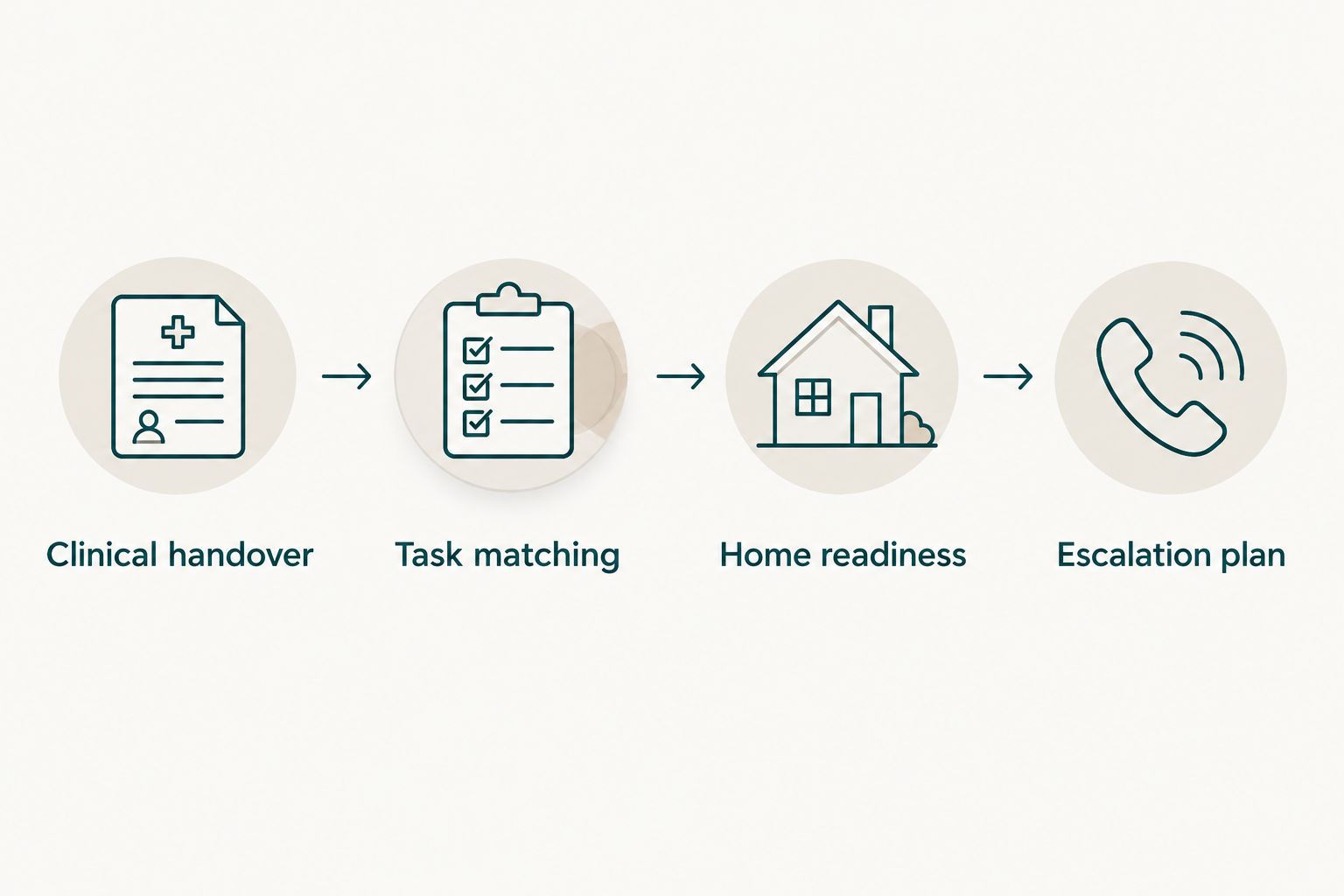
For a 2026 booking, prepare one care brief that each shortlisted provider answers. Use these four steps in order.
Clinical handover
Collect the discharge summary, current medication list, allergies, follow-up instructions and relevant therapy recommendations. Ask the hospital to clarify conflicting instructions before care transfers home.
Task matching
List what the patient needs help with and separate clinical tasks from personal assistance. Ask the provider to confirm the proposed professional's scope for each task rather than accepting a general assurance about experience.
Home readiness
Confirm the prescribed equipment and the assistance needed for transfers, toileting and bathing. Ask the treating team to identify any necessary home assessment; do not attempt an unfamiliar lifting technique from an online demonstration.
Escalation plan
Keep the responsible clinical contact and provider contact accessible. Include the patient's normal communication and movement limitations so carers can recognise a new change rather than dismissing it as part of the original stroke.
Ask for a written plan covering the first 7 days at home, with responsibilities and review arrangements. This is a practical planning window, not a promised recovery timeline or a substitute for the clinician's schedule.
If you believe 24-hour supervision is necessary, ask the discharge team what level of supervision and clinical staffing the patient actually needs. Continuous caregiver presence and continuous nursing are different arrangements.
Which stroke recovery care should you choose?
Start with the discharge plan, then choose the service that can deliver it. Contact a home-nursing provider when clinical care is required, involve rehabilitation professionals for recovery goals, and add personal assistance where the assessed needs justify it.
Dardoc belongs on an initial home-nursing enquiry list because it explicitly offers that service in Dubai. Make the final decision only after the provider confirms the proposed care, professional credentials and escalation arrangements.
Reject any proposal that leaves you unclear about who is responsible for medicines, feeding instructions, transfers or clinical concerns. A reassuring conversation is not a care plan.
FAQ
What's the best home nursing provider for stroke recovery in Dubai?
The best fit is a provider that can deliver the patient's discharge plan with appropriately licensed staff and clear clinical oversight. Dardoc offers home nursing in Dubai and is a starting point for an enquiry; confirm stroke-specific competence before booking.
Does a stroke patient need a nurse or a caregiver at home?
The patient's assessed needs determine whether a nurse, caregiver or both are required. Use a licensed nurse for tasks requiring clinical practice, and define which daily-living activities a caregiver can safely support.
Can home nursing replace physiotherapy after a stroke?
Home nursing does not replace prescribed physiotherapy or other rehabilitation. Nursing and rehabilitation have different roles and should follow a coordinated plan when both are required.
Should I arrange 24-hour care after a stroke?
Arrange the level of supervision and nursing identified by the discharge team. Ask whether the patient needs continuous presence, specific nursing visits or continuous clinical care, because those arrangements are not equivalent.
How do I check a home nurse's credentials in Dubai?
Request the nurse's professional licensing details and the provider's relevant facility licensing details, then verify them through the appropriate DHA channels. Confirm that the proposed tasks fall within the professional's scope and competence.
Can a home nurse help a stroke patient with swallowing problems?
A home nurse can support care within an established swallowing and feeding plan and the nurse's professional scope. Swallowing problems require appropriate clinical assessment; families should not independently change food textures or feeding methods.
What should I do if stroke symptoms return at home?
Call 999 for an ambulance in the UAE if new stroke symptoms appear, including facial weakness, arm weakness or speech difficulty. Note when the symptoms started or when the person was last known to be well, and do not wait for a routine home visit.
One last thing
Ask the proposed care team to explain a normal day and an abnormal day. They should describe the prescribed routine, then explain what they would do if the patient developed a new problem.
That distinction reveals whether you are discussing staffed hours or an actual clinical plan. For stroke recovery, you need the latter.