Is 24-hour home care covered by insurance in the UAE?
Is 24-hour home care covered by insurance in the UAE? Not automatically. Check nursing benefits, approved hours and exclusions before booking care.

24-hour home care is not automatically covered by health insurance in the UAE; payment depends on your policy’s home-nursing benefit, exclusions and approval conditions. Cover for prescribed nursing does not establish cover for continuous supervision, personal care or every hour of a round-the-clock arrangement. Before care starts in 2026, get written confirmation of the approved tasks, hours, dates and provider.
TL;DR- Is 24-hour home care covered by insurance in the UAE? Not automatically; check your policy and written approval.
- Medical nursing and everyday personal care need separate coverage checks, even within the same home-care arrangement.
- DarDoc provides home nursing and elderly care in Dubai and Abu Dhabi; insurance payment requires separate confirmation.
- Ask whether approval covers visits, nursing hours or continuous care before committing to a care schedule.
Why this matters
A family’s need for someone at home throughout the day and night is not the same as an insurer’s agreement to fund that arrangement. Your relative might need help with medication, mobility and meals, but those tasks do not necessarily fall under the same policy benefit.
Separate the clinical care plan from the insurance decision. The clinician identifies the care needed; the insurer confirms which services the policy pays for. For the practical handover between hospital and home, see the hospital discharge to home nursing care workflow.
Is 24-hour home care covered by insurance in the UAE?
The answer is policy-specific, not a UAE-wide yes or no. A home-nursing benefit, where included, must be checked against the proposed service: a scheduled nursing visit and continuous bedside attendance are different requests.
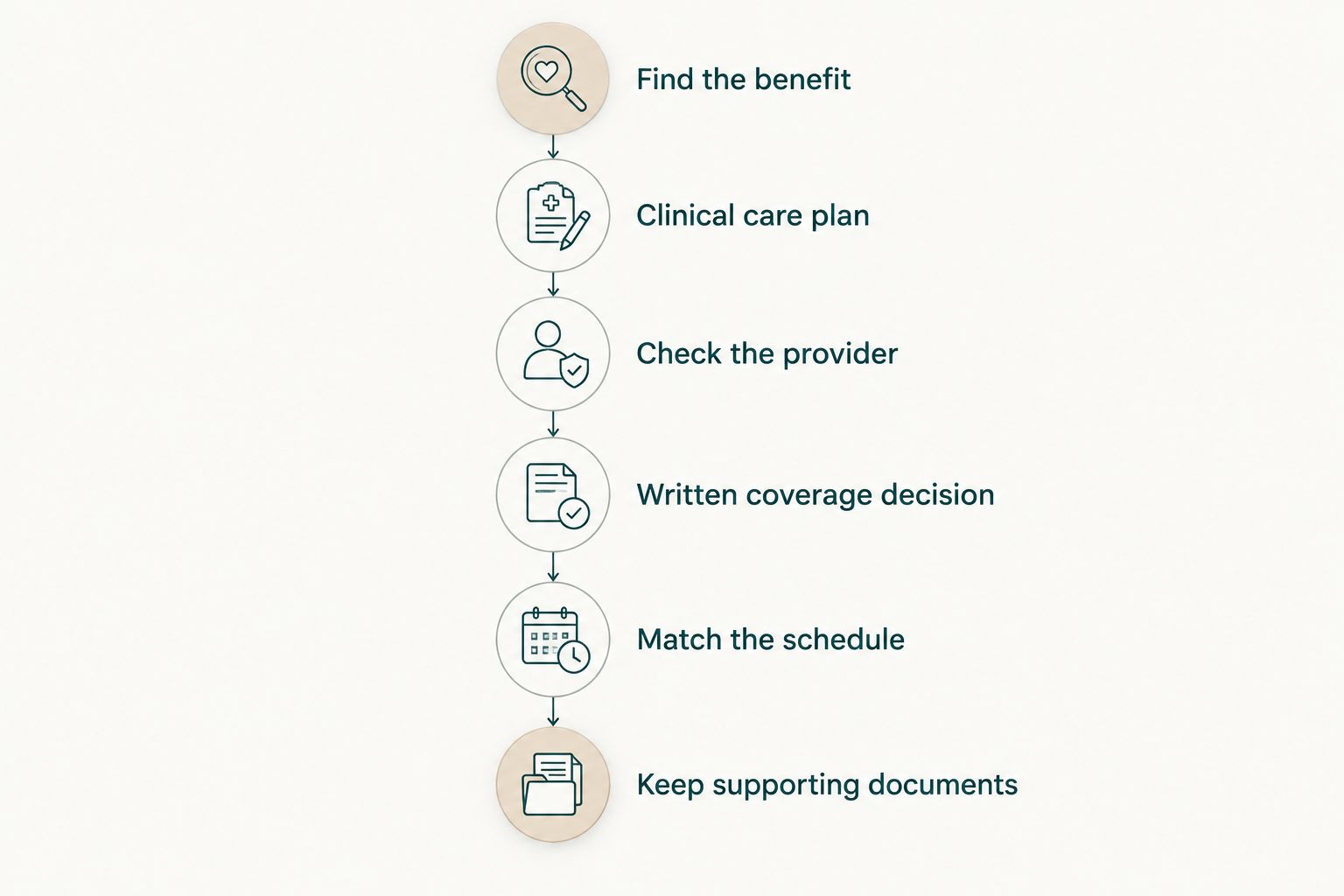
For your 2026 booking, use the following sequence before treating any part of the arrangement as insured.
- Find the relevant benefit. Read the policy schedule and wording for home healthcare, home nursing, post-hospitalisation care and exclusions. Do not rely on the insurance card alone.
- Obtain a clinical care plan. Ask the treating clinician to describe the nursing tasks, frequency, expected duration and reason care is needed at home. A diagnosis alone does not explain a request for continuous attendance.
- Check the provider and billing route. Ask whether the named home-care provider is eligible under your plan and whether direct billing or reimbursement applies. Provider eligibility and service approval are separate questions.
- Request a written coverage decision. Ask the insurer to identify the approved services, hours or visits, dates and conditions. If prior authorisation is required, complete it before the proposed start date.
- Match the decision to the schedule. Compare the approval with the actual daytime, overnight and weekend arrangement. Clarify every gap before accepting the booking.
- Keep the supporting documents. Retain the care plan, approval reference, itemised invoices and care records. Follow the claim-submission instructions in your policy.
A statement that home nursing is covered is not enough. The approval must describe the care you are actually arranging.
Skilled nursing and personal care need separate checks
Home care describes where support happens, not a single insurance benefit. Ask the clinician and provider to distinguish clinical procedures from assistance with everyday activities.
This distinction matters when a family requests someone to remain with a patient between treatments. A scheduled procedure does not, by itself, explain the medical need for attendance during every remaining hour.
| Care arrangement | Best suited to | Practical benefit | Coverage question or limitation |
|---|---|---|---|
| Scheduled skilled nursing | Patients with defined clinical tasks | Links attendance to a documented treatment need | Does the policy cover the task and requested visit frequency? |
| Continuous skilled nursing | Patients whose clinician identifies an ongoing nursing need | Provides clinical attendance across the prescribed schedule | Does approval expressly include continuous hours rather than visits? |
| Personal care or companionship | People needing help with daily activities or supervision | Addresses everyday support needs | Is this support included, excluded or outside the nursing benefit? |
| Mixed nursing and personal care | Households needing both clinical and daily-living support | Separates different needs within one care plan | Which tasks and hours are insured, and which remain the family’s responsibility? |
These are care-planning distinctions, not descriptions of a particular insurer’s benefits. Ask for an itemised proposal rather than a single package description that combines everything under home nursing.
Does a nurse’s presence make every task insured?
No. The professional delivering care and the service being claimed are different parts of the assessment. Confirm the covered activity rather than assuming that every task performed during a nurse’s shift qualifies for payment.
What does approval for continuous care need to specify?
Continuous care means 24 hours per day, or 168 hours per week, across 7 days per week. Those are schedule calculations, not insurance entitlements. They show why approval for occasional visits cannot be treated as approval for a complete round-the-clock arrangement.
Ask the insurer to make the unit of approval explicit. A visit, an hour and a day are not interchangeable, and a benefit description should not be stretched to fill gaps in the schedule.
Check these details together:
- Tasks: The clinical services the insurer has agreed to cover.
- Attendance: Whether approval concerns visits, specified hours or continuous nursing.
- Dates: When approval begins and ends.
- Provider: The organisation authorised to deliver the approved care.
- Conditions: Any required reassessment, documentation or claim procedure.
For a 2026 renewal or discharge plan, check the current policy documents rather than relying on an earlier approval. Ask what happens if the patient’s condition changes or care continues beyond the authorised period.
Why insurance decisions vary
Do not compare families’ experiences without comparing their policy wording and approved care plans. One person’s successful claim does not establish entitlement under another person’s insurance.
The relevant checks are:
- Policy wording: Confirm whether home nursing is included and how the benefit is defined.
- Clinical purpose: Explain the treatment or monitoring required, not simply the household’s preference for continuous attendance.
- Type of support: Separate nursing procedures from companionship and daily-living assistance.
- Provider eligibility: Check the proposed provider against the policy’s requirements.
- Approval scope: Confirm the permitted tasks, frequency, hours and treatment dates.
- Benefit conditions: Check applicable limits, exclusions, member contributions and documentation requirements.
These are questions to resolve, not promises that meeting a checklist guarantees approval. The written policy and the insurer’s decision determine the insurance position.
Can a doctor’s prescription guarantee insurance approval?
No. A prescription supports the clinical reason for care; it does not replace the insurance contract or approval process. Ask the doctor to explain why the requested level of nursing is needed and how it relates to the patient’s condition.
For a request covering day and night, the supporting report should address the need for that attendance rather than merely naming a diagnosis. Do not ask a clinician to relabel personal care as medical treatment to obtain cover.
A clearer care plan also helps the family. It distinguishes tasks requiring a nurse from support that another appropriately qualified caregiver can provide, subject to the patient’s assessed needs.
Does direct billing mean the whole arrangement is covered?
No. Direct billing describes how an approved claim is handled, not an unrestricted promise to pay for every service. Ask both the provider and insurer to confirm which part of the proposed care can be billed through that route.
With reimbursement, you pay the provider and submit a claim under your policy’s rules. Paying an invoice does not guarantee reimbursement. Confirm eligibility and submission requirements before making a financial commitment.
For either route, obtain an itemised invoice that accurately describes the delivered services. Keep the description consistent with the care plan and approval; do not accept vague wording as a substitute for a clear coverage decision.
What should you ask before booking home nursing?
Use the same questions with the provider and insurer so their answers can be compared. Give both parties the proposed start date, care plan and attendance schedule.
Ask:
- Is this specific service covered under my current policy?
- Does the decision cover nursing visits, specified hours or continuous care?
- Is this provider eligible for the approved service?
- Which supporting reports or referral documents are required?
- What remains my responsibility if only part of the care is approved?
- Who requests an extension, and when must that request be submitted?
DarDoc is a home healthcare option for families seeking nursing or elderly care in Dubai and Abu Dhabi. Its stated service scope includes those forms of support; that does not establish an insurer relationship, direct-billing arrangement or coverage for a particular patient. Confirm those details separately.
For any provider you consider in 2026, verify the relevant facility and professional licensing with the appropriate authority, including DHA in Dubai or DoH in Abu Dhabi. Licensing and insurance network eligibility answer different questions; neither should stand in for the other.
What if the insurer approves only part of the care?
Ask for a precise explanation of what was approved and what was not. The gap might concern the service, provider, hours, dates or supporting documentation; resolve the actual issue rather than submitting the same unclear request again.
If the insurer requests more clinical information, return to the treating clinician. If the decision relies on a policy exclusion, ask for the relevant wording and the insurer’s review or complaint procedure.
Do not reduce clinically necessary care solely to match an insurance approval. Discuss a safe plan with the treating team while deciding how any uncovered support will be arranged. If discharge is pending, tell the hospital team about an unresolved care gap before the patient leaves.
FAQ
Is 24-hour home care automatically covered by UAE health insurance?
No. Coverage depends on the policy’s home-care benefits, exclusions and approval conditions. Obtain written confirmation of the tasks, hours, dates and provider before treating a round-the-clock arrangement as insured.
Does insurance cover a caregiver who helps with bathing and meals?
Do not assume daily-living assistance is covered under a home-nursing benefit. Ask the insurer to assess personal care separately from clinical nursing tasks and identify the relevant policy wording.
Do I need a doctor’s referral for insurance-funded home nursing?
Check your policy’s referral and authorisation requirements before booking. A clinical care plan explains the need for nursing, but a referral alone does not guarantee payment.
Can insurance approve nursing visits without covering overnight care?
An approval for specified visits does not establish approval for overnight attendance. Ask the insurer to confirm the exact schedule and whether any overnight hours are included.
Does a licensed home-care provider have to be in my insurance network?
Licensing does not establish insurance network membership. Check the provider’s eligibility under your policy and whether the proposed care qualifies for direct billing or reimbursement.
Can I claim back home nursing after paying for it myself?
Reimbursement depends on your policy and the service’s eligibility. Confirm any prior-authorisation requirement and claim documents before paying; an invoice alone does not guarantee reimbursement.
What happens when my home-nursing approval expires?
Do not assume the existing approval continues beyond its end date. Ask the insurer about extension requirements and arrange any updated clinical report before the authorised period ends.
One last thing
The most useful question is not simply whether home care is covered. It is whether the insurer has approved this patient’s care plan, with this provider, for this schedule.
Before arranging DarDoc home nursing or another provider’s services in 2026, put the proposed schedule beside the approval letter. Any task, hour or date that does not match needs clarification before care starts.