Do you need a doctor referral for elderly home care in Dubai?
Do you need a doctor referral for elderly home care in Dubai? Not for every enquiry. Check nursing orders, assessments and insurance before booking.

You can contact an elderly home-care provider in Dubai directly to discuss support; a doctor's referral is not the same as permission to carry out medical treatment. For a 2026 booking, distinguish help with daily living from clinical nursing, then ask the provider whether the proposed care needs a physician's assessment, treatment order or referral. If you intend to claim through insurance, confirm the insurer's documentation requirements separately.
TL;DR- Do you need a doctor referral for elderly home care in Dubai? Separate daily-living support, clinical nursing and insurance requirements.
- Contact a provider directly, but confirm clinical requirements before arranging treatment.
- A referral, treatment order and insurance approval serve different purposes; ask which document is required.
- Dardoc offers elderly care and at-home nursing; confirm the assessment and documentation needed for your relative.
Why this matters
Booking care and authorising treatment are different decisions. Your parent might need assistance getting dressed, a prescribed wound dressing, or a medical review after a hospital stay. Describing all three as elderly care hides the information a provider needs to arrange appropriate support.
For someone leaving hospital, start with the discharge instructions rather than a general request for a carer. The hospital discharge-to-home nursing care workflow explains that transition; the immediate task is to identify the care prescribed and who remains responsible for reviewing it.
Do you need a doctor referral for elderly home care in Dubai?
There is no useful blanket answer without identifying the care involved. You can make the initial enquiry yourself, but you should not assume that a direct booking removes the need for clinical assessment or written treatment instructions.
Use this comparison when describing your relative's needs. These are care categories, not a statement that every provider or insurance policy follows identical admission rules.
| Care route | Best for | What to clarify before booking | Main limitation |
|---|---|---|---|
| Daily-living support | Help with washing, dressing, meals and companionship | Whether the provider accepts direct enquiries and requires an initial assessment | Does not replace clinical assessment or authorise medical procedures |
| Clinical home nursing | Care involving prescribed treatment or nursing procedures | Which physician instructions, records and nursing assessments are needed | A booking request alone does not establish a treatment plan |
| Doctor assessment | New symptoms, an unclear diagnosis or treatment decisions | Whether assessment is appropriate at home and what records to share | A consultation does not automatically arrange ongoing nursing |
| Insurance-funded care | Families seeking reimbursement or direct billing | Referral, medical-necessity evidence, authorisation and network requirements | Clinical suitability does not establish insurance coverage |
When you enquire in 2026, describe the actual tasks rather than asking only whether a referral is compulsory. “My father needs help dressing” and “my father needs an injection” require different conversations.
What is the difference between a referral and a treatment order?
A referral asks another professional or service to assess or manage a patient. A treatment order gives instructions for a particular intervention; an insurance authorisation concerns payment under a policy.
These documents are not interchangeable. Ask the receiving provider to name the document required and explain whether an existing discharge summary or prescription supplies the necessary information.
Daily-living support: start with the care needs
For assistance with everyday activities, start by explaining what your relative can do independently and where help is needed. Do not assume that age alone determines the level of care.
Useful details include walking ability, falls, memory difficulties, toileting needs and whether your relative can safely be left alone. Describe changes honestly, including problems the family has been managing informally.
Best for: an older adult whose main needs involve personal assistance rather than medical treatment. The benefit is support matched to practical daily tasks; the limitation is that a non-clinical arrangement cannot substitute for assessment of new symptoms or management of a medical procedure.
Medication needs deserve a separate discussion. Reminding someone about prescribed medication is not the same as deciding a dose, administering an injection or changing treatment. Ask the provider to define the proposed worker's responsibilities explicitly.
Clinical home nursing: confirm the instructions before treatment
If your relative needs wound care, injections or care involving a medical device, tell the provider before agreeing to a visit. Share the relevant prescription, discharge instructions and treatment history for clinical review.
Ask whether the instructions specify the treatment, frequency, review arrangements and action to take if the patient's condition changes. Do not fill gaps yourself or ask a visiting professional to infer a prescription from what the family remembers.
Best for: an older adult with identified nursing needs and an appropriate clinical plan. Home nursing brings care into the patient's home, but it does not remove the need for reassessment when symptoms, treatment or risks change.
For a 2026 clinical booking, request the facility's licensing details and the attending professional's relevant registration. Dubai Health Authority and Abu Dhabi's Department of Health are distinct authorities; do not treat a reference to one as verification under the other.
Insurance-funded care: check the policy separately
A doctor recommending home care does not establish that your insurer will fund it. Ask the insurer about the specific service, the named provider and the evidence required before you agree to a claim-dependent arrangement.
Best for: families who need to establish the payment route before arranging ongoing care. Written confirmation helps distinguish an approved service from an enquiry or an incomplete application; its limitation is that approval remains subject to the policy's terms and stated scope.
Ask whether the provider handles direct billing or whether you must submit a reimbursement claim. Do not treat a provider accepting your details as confirmation that the insurer has authorised treatment.
What should you ask the insurer?
Use precise questions rather than “Is home care covered?”:
- Does the policy cover the particular nursing or support task requested?
- Is the chosen provider eligible under the policy?
- Is a doctor referral, prescription or medical report required?
- Does care need authorisation before it starts?
- What must happen if the care plan changes?
Keep the written response with the clinical documents. If the answer is unclear, resolve it with the insurer rather than asking a carer to interpret the policy.
Why referral requirements vary
The document needed depends on the decision being made. For a 2026 booking, establish these factors before arranging treatment:
- Nature of care: personal assistance and medical treatment involve different responsibilities.
- Clinical stability: new or worsening symptoms need clinical assessment, not simply more care hours.
- Treatment instructions: a prescribed procedure needs instructions the responsible clinician can assess and follow.
- Hospital discharge: ongoing care must account for the discharge plan, medication changes and follow-up arrangements.
- Insurance route: payment requirements are separate from the patient's clinical needs.
- Provider admission process: ask what records and assessment the receiving service requires before accepting care.
Do not spend time obtaining a vaguely worded referral until you know what it must address. A document saying only “needs home care” does not explain the tasks, clinical risks or review arrangements.
How do you arrange elderly home care without delaying assessment?
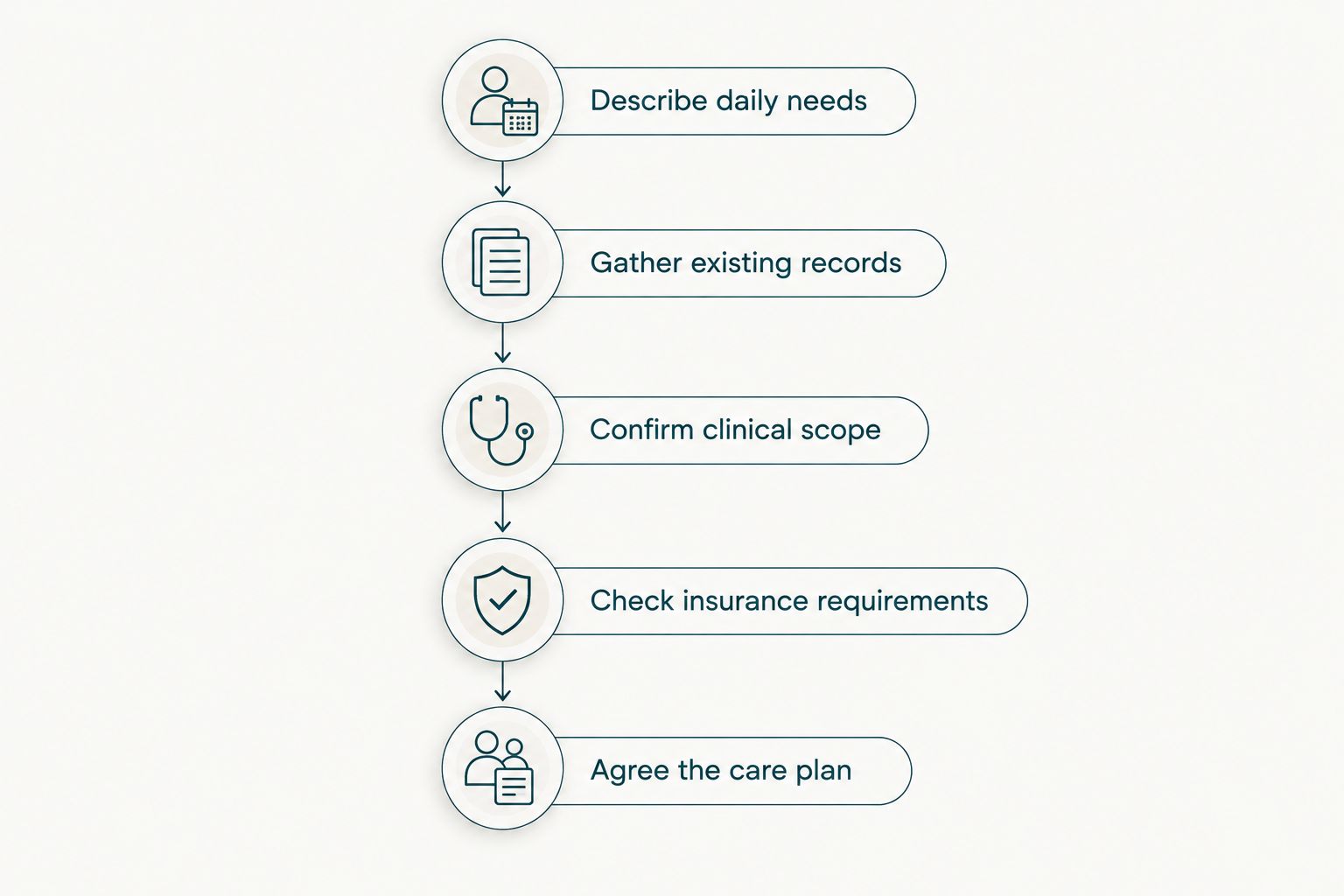
Follow this sequence to separate practical support, medical decisions and payment. Start with the patient's condition, not the paperwork.
- Describe daily needs. List the tasks your relative needs help with, including walking, washing, meals and toileting. Explain any recent change from their usual ability.
- Gather existing records. Collect the current medication list, relevant prescriptions, discharge summary and follow-up instructions. Flag conflicting instructions rather than choosing between them yourself.
- Confirm clinical scope. Ask which tasks require a nurse, which require a doctor's review and what instructions must be in place. Request an explanation of any unfamiliar procedure.
- Check insurance requirements. Establish authorisation and documentation requirements before relying on reimbursement. Keep this decision separate from whether care is medically appropriate.
- Agree the care plan. Confirm responsibilities, review arrangements and whom to contact when the patient's condition changes. Include the older adult in decisions wherever possible.
A clear task list makes the enquiry more useful than a general request for “someone to look after Mum.” It also gives your family a practical way to check whether the proposed service answers the actual need.
Can I arrange care before my parent leaves hospital?
Start the discussion before discharge and ask the hospital team to describe the support needed at home. Request written instructions for medication changes, prescribed nursing tasks, follow-up and symptoms that require urgent help.
Do not assume that a discharge summary contains every instruction the receiving service needs. Ask the home-care provider to review the records and identify questions for the hospital team before treatment begins.
Does paying privately mean we can skip the doctor?
Private payment does not replace clinical assessment or treatment instructions. It changes the payment route, not whether a procedure is appropriate or who is qualified to perform it.
If your relative needs only daily-living support, explain that clearly. If symptoms or treatment needs are uncertain, arrange a clinical assessment rather than treating a private booking as permission to proceed.
What if my parent suddenly becomes confused or breathless?
Sudden confusion, severe breathing difficulty, chest pain or stroke symptoms need urgent medical assessment, not a routine elderly-care enquiry. For an ambulance in the UAE, call 998.
Do not wait for a referral or insurance response when emergency symptoms are present. For less urgent but new symptoms, seek prompt medical advice and explain how the person differs from their usual condition.
Where Dardoc fits
Dardoc is a relevant option for families seeking elderly care and at-home nursing in Dubai. Its stated services include both categories; the appropriate next step is to describe your relative's needs and confirm the required assessment, documentation and clinical responsibilities.
The advantage is relevance to families seeking care at home. The boundary is equally important: that service description does not establish a particular patient's eligibility, insurer approval or suitability for treatment without assessment.
You can contact Dardoc to discuss the care needed. Ask specifically what must be reviewed before care starts; do not assume a referral, prescription or insurer approval is included in the initial enquiry.
FAQ
Can I contact an elderly home-care provider myself in Dubai?
You can make the initial enquiry yourself. Describe the care tasks and ask the provider which assessments, clinical instructions and documents are required before care starts.
Does my parent need a referral just because they are elderly?
Age alone does not describe your parent's care needs. Explain their daily abilities, symptoms and prescribed treatment so the provider can identify the appropriate assessment and documentation.
Is a discharge summary the same as a home-nursing referral?
A discharge summary and a referral serve different purposes. Ask the receiving provider whether the summary contains sufficient instructions or whether the treating team must supply additional information.
Can a caregiver change my parent's medication?
A caregiver should not independently change prescribed medication. Ask the prescribing clinician about changes and confirm the care worker's responsibilities for reminders or administration.
Will insurance cover elderly care if a doctor recommends it?
A doctor's recommendation does not establish insurance coverage. Confirm the specific service, provider eligibility, authorisation requirements and policy terms with the insurer.
What should I check when booking elderly care in Dubai in 2026?
For a 2026 booking, check the proposed tasks, relevant licensing, clinical instructions, payment route and review arrangements. Ask who to contact if your relative's condition changes.
Can home care replace emergency assessment?
Routine home care does not replace emergency assessment. Call 998 for an ambulance in the UAE when your relative has emergency symptoms such as severe breathing difficulty or signs of stroke.
One last thing
The most useful question is not simply “Do we need a referral?” Ask: “Who is responsible if the care needs change?” A clear answer should identify the clinical contact, the review process and the action your family should take when the original plan no longer fits.
Paperwork records a decision. It does not replace ongoing attention to the person receiving care.