From food intolerance test results to a diet plan: 2026 workflow
Build a food intolerance test diet plan around symptoms, not IgG flags. Follow clinical review, targeted changes and safe reintroduction in 2026.

Instead of manually turning every flagged food into a shopping restriction, use a clinician-reviewed food intolerance test diet plan: identify what the test measures, record your symptoms, and change only what the evidence supports. This 2026 workflow takes you from a report to a practical eating plan without treating a food IgG result as a diagnosis.
TL;DR- A food intolerance test diet plan should follow symptoms and clinical assessment, not a food IgG exclusion list.
- DarDoc provides home and online healthcare for families in Dubai and Abu Dhabi; specialist dietary care needs separate confirmation.
- Check for food allergy and coeliac disease before starting an elimination diet.
- Use a food diary, targeted changes and clinician-agreed reintroduction to avoid unnecessary restrictions.
Why this matters
A flagged result does not automatically identify a food you need to avoid. Food-specific IgG testing is not recommended for diagnosing food allergy or intolerance. IgG antibodies can reflect exposure to food, including foods you tolerate.
The American Academy of Allergy, Asthma & Immunology explains this distinction in its patient guidance, The Myth of IgG Food Panel Testing. For your 2026 decision, the relevant question is what a test can establish—not how many foods appear on its report.
DarDoc is best for families seeking home and online healthcare in Dubai and Abu Dhabi. You can use DarDoc as a starting point for discussing care, while confirming who will interpret your report and whether a dietitian or allergy specialist is needed. Home sample collection is convenient; it does not make an unsuitable test diagnostically useful.
Before you start
- Collect the original report and your history. Bring the test name, method, units, laboratory comments, medicines, supplements, existing diagnoses and a description of the symptoms that prompted testing. A screenshot of coloured food names is not enough.
- Arrange appropriate clinical review. Ask who will assess the symptoms and whether dietary restriction needs a registered dietitian. Check the relevant DHA or DoH professional registration rather than assuming that home collection includes specialist interpretation.
- Do not remove gluten before discussing coeliac testing. Testing is less reliable after gluten avoidance. Also, never challenge a suspected allergen at home after breathing difficulty, throat swelling, faintness or another potentially serious reaction.
The workflow below uses headings you create in a notebook or document. These are not DarDoc app fields, and no particular software account is required.
Report assessment
Identify the test before interpreting the food list
- Find the report's exact test name and method. Record whether it measures food-specific IgG, food-specific IgE, or something else. Do not assume every blood test labelled food sensitivity measures the same thing.
- Write down the original clinical question. Describe the actual problem: bloating after particular meals, recurring diarrhoea, immediate hives, or another symptom. Include when it began and whether it is worsening.
- Ask the reviewing clinician what the result establishes. Separate a confirmed diagnosis, evidence requiring further assessment, and a result that does not explain your symptoms.
- Keep the report attached to that explanation. Do not translate high, moderate or red categories into dietary rules without a valid clinical basis.
Expected result: you understand what the report measures and whether it can inform dietary decisions. You have not started a blanket exclusion diet.
Match the assessment to the symptom pattern
The following comparison separates common assessment routes. These are not interchangeable tests, and none replaces a clinical history.
| Assessment route | Best for | Useful contribution | Limitation |
|---|---|---|---|
| Clinical history and food diary | Identifying patterns to investigate | Connects food, timing and symptoms | An association alone does not prove the cause |
| Food-specific IgG panel | Not recommended for diagnosing intolerance | Shows antibody responses to tested foods | Cannot establish which foods cause symptoms |
| Targeted allergy assessment | Suspected food allergy | Combines history with appropriate specialist testing | A positive IgE result alone does not prove clinical allergy |
| Hydrogen breath testing | Selected suspected carbohydrate malabsorption | Assesses a specific question, such as lactose malabsorption | Does not investigate every cause of digestive symptoms |
| Coeliac assessment | Symptoms or risk factors suggesting coeliac disease | Investigates an immune-mediated condition requiring specific management | Gluten avoidance before testing can affect results |
For your 2026 appointment, ask: What diagnosis are we investigating, and would this result change treatment? A longer panel is not a substitute for an answer.
Symptom baseline
Build a record you can actually use
- Create the headings Food and drink, Time, Symptoms, Bowel changes, and Medicines. Record ingredients where practical, including sauces, milk added to drinks and supplements.
- Use a 24-hour clock for meals and symptoms. Write down whether discomfort started during the meal, later that day or the following morning, rather than relying on memory at the appointment.
- If you have no urgent symptoms, use a 7-day diary as an organisational starting point while arranging review. This is a recording example, not a validated diagnostic period or a reason to delay care.
- Record ordinary eating rather than deliberately provoking symptoms. Include symptom-free meals: they help prevent a single uncomfortable episode from becoming an unsupported lifelong restriction.
Expected result: your clinician receives a usable baseline instead of a list of foods you suspect.
Keep the baseline interpretable
Do not start several restrictions, a new supplement and a different meal schedule simultaneously. If symptoms improve, you will not know which change mattered. If symptoms worsen, the same confusion applies.
Include changes in medication timing, illness, travel and sleep when they coincide with symptoms. These details do not prove an alternative explanation; they help the clinician interpret the sequence.
For your 2026 diary, consistency matters more than elaborate tracking. A brief record completed when symptoms happen is more useful than a detailed reconstruction days later.
Clinician-reviewed diet plan
Set the decision before changing the menu
- Define the question. Ask the clinician to state which food or component is being investigated and why. “Every red food on the panel” is not an adequate rationale for restriction.
- Choose a targeted change. If appropriate, agree which food to reduce or remove, what you will eat instead, and what should stay unchanged. Avoid broad exclusions without dietetic support.
- Protect nutritional intake. Identify the nutrients affected by the proposed restriction. Removing dairy, for example, requires attention to calcium and other nutrients; replacing it with any plant drink does not automatically provide equivalent nutrition.
- Write the stopping rules. Agree what symptom change you are looking for, how long the trial should last, and when persistent or worsening symptoms require reassessment. The duration depends on the clinical question, not the report's colour scale.
Expected result: you have a written, time-limited plan with a reason for the change, suitable replacements and a review date.
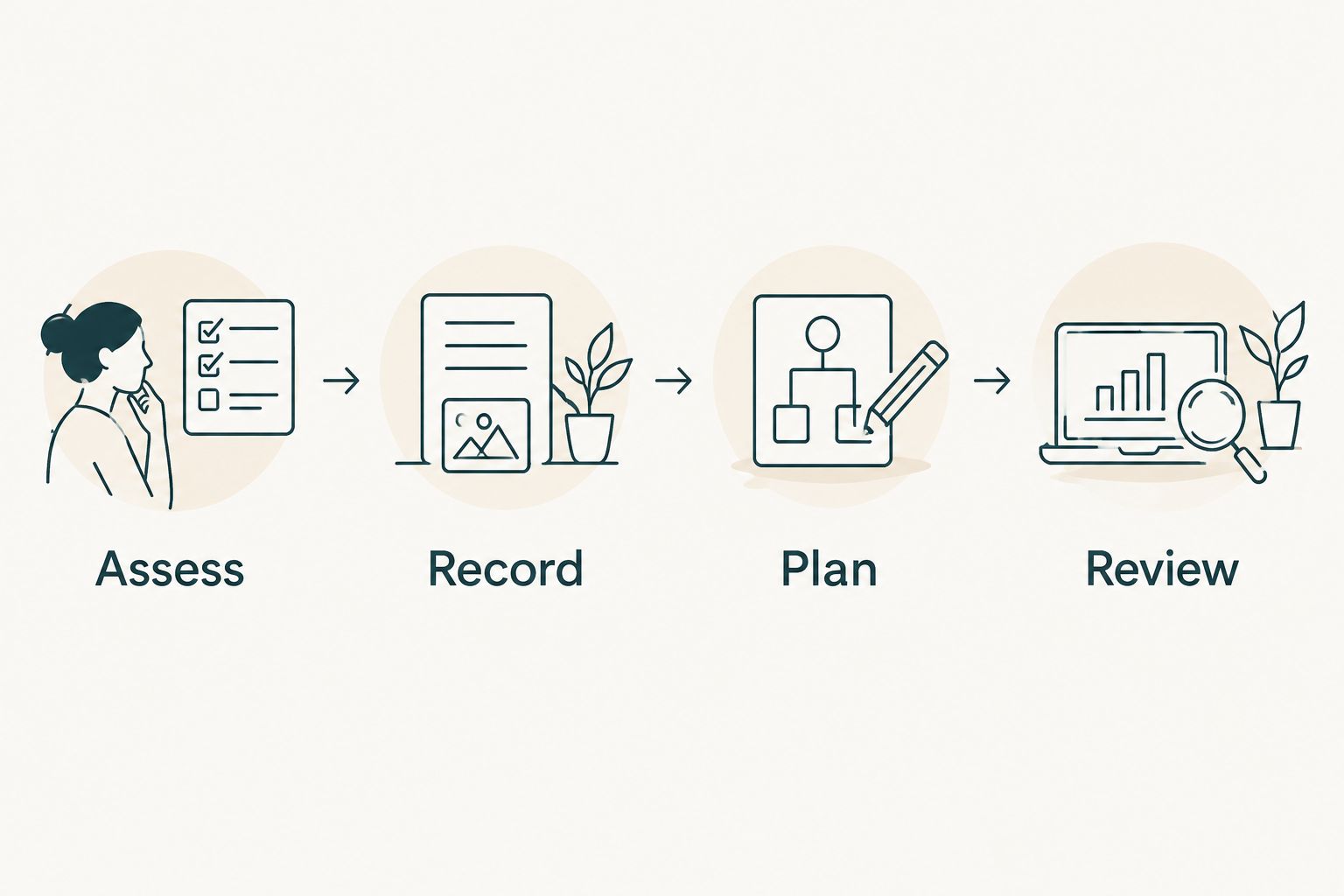
The 2026 workflow is Assess, Record, Plan, Review. The decision to restrict food belongs after assessment—not immediately after opening the results email.
Translate the plan into everyday meals
Build meals around foods you already tolerate, your usual cuisine and your household routine. A plan that requires a separate kitchen or removes familiar staples without replacements is difficult to maintain.
Write a 1-page summary for whoever shops or cooks. Include the exact agreed restriction, suitable substitutions, relevant ingredient labels and the review appointment. This page is an organisational aid, not a permanent list of unsafe foods.
Ask how the plan applies to restaurants, shared meals and packaged foods. Allergy precautions and intolerance management are different; do not assume the same approach to traces or cross-contact applies to both.
If you need help preparing for the appointment, the blood-test-to-doctor-consultation workflow covers the handover between a report and clinical review. Confirm the actual appointment arrangements separately.
Reintroduction and review
Test the dietary explanation safely
- Review the symptom diary before extending the restriction. Improvement during avoidance is useful information, but it does not by itself prove that a food caused the original symptoms.
- Agree whether reintroduction is appropriate. Do not reintroduce a suspected allergen at home, and do not use this workflow to challenge foods excluded for confirmed coeliac disease.
- Where the clinician recommends a home dietary trial, follow the individual instructions for food, amount, timing and symptom recording. Do not borrow a challenge schedule from another person's plan.
- Record the outcome and revise the diet. If the suspected trigger is not supported, ask about restoring the food rather than keeping an unnecessary restriction indefinitely.
Expected result: the plan becomes more specific, or the clinician changes the investigation. Restriction does not continue simply because it appeared on the original report.
When symptoms change but the report does not
A second workflow starts with new symptoms rather than a new test. Repeating a broad panel is not the default next step.
Update your diary, note new medicines or illnesses, and explain what changed after the original review. Contact the clinician before adding further exclusions. New symptoms can require a different assessment, even when a previous dietary explanation seemed plausible.
For your 2026 follow-up, bring the previous plan alongside the updated record. Ask whether the working diagnosis still fits, whether nutrition is adequate, and whether referral is needed. Do not treat a changing IgG number as proof that an intolerance has appeared or resolved.
Troubleshooting
The report flags many everyday foods
Do not eliminate the whole list. Check the test method first. With food-specific IgG panels, numerous positive findings do not establish numerous intolerances; ask for a symptom-led assessment instead.
Symptoms improve, but the diet is becoming narrower
Arrange dietetic review before removing more foods. A restrictive diet can become nutritionally inadequate even when digestive symptoms improve. Bring your actual meals and substitutions, not just the original report.
Nothing changes after the agreed trial
Return to the clinician rather than extending the restriction indefinitely. Review whether you followed the plan, whether the suspected food was relevant and whether another explanation needs investigation.
You already stopped eating gluten
Tell the clinician when you stopped and how strictly you avoid it. Do not restart gluten independently if you have had severe reactions. The clinician should decide how to approach coeliac assessment safely.
Symptoms suggest more than intolerance
Breathing difficulty, throat swelling, collapse or a rapidly progressing reaction needs emergency care, not a food diary. Blood in the stool, unexplained weight loss, persistent vomiting or dehydration also requires prompt medical assessment rather than further self-directed restriction.
Customize your workflow
Adapt the record to your care needs without turning it into a larger testing programme. Children, pregnant people, frail older adults and anyone already eating a restricted diet need particular attention to nutritional adequacy before exclusions expand.
For a shared household, nominate who records meals and who communicates changes to the clinician. Keep one current version of the plan so different caregivers do not follow conflicting instructions.
DarDoc's home and online healthcare services can be a starting point for families coordinating care in Dubai and Abu Dhabi. Confirm the clinician's scope, any specialist referral and what follow-up includes before proceeding.
Discuss your next clinical step
Ask who can review your report and whether specialist dietary assessment is needed.
Contact the teamFAQ
What is the best food intolerance test diet plan?
The best plan follows your symptoms and a clinical assessment, not an automatic exclusion list from a food IgG panel. Where appropriate, it uses a targeted dietary trial, nutritional replacements and a planned review.
Should I stop eating every food marked red on my report?
No. A red category on a food-specific IgG report does not establish that the food causes symptoms or needs avoiding. Check the test method and discuss the result before changing your diet.
Can a food intolerance blood test diagnose a food allergy?
A food-specific IgG test cannot diagnose food allergy. Suspected allergy requires a clinical history and appropriate assessment; even a positive food-specific IgE result needs clinical interpretation.
How long should I follow an elimination diet?
Follow the duration agreed for your specific clinical question. There is no single timetable for every suspected intolerance, and an unexplained restriction should not continue indefinitely.
Should I stop gluten while waiting for my appointment?
Do not start a gluten-free diet before discussing coeliac testing with your clinician. Gluten avoidance can affect test results; if you have already stopped, explain this before testing is arranged.
Can I reintroduce a food at home?
Only follow a home reintroduction plan when your clinician considers it appropriate. Do not challenge a suspected allergen at home, particularly after breathing difficulty, throat swelling or faintness.
Can DarDoc help me understand my next step?
DarDoc provides home and online healthcare in Dubai and Abu Dhabi. Ask whether report review fits the clinician's scope and whether your symptoms require a dietitian, gastroenterologist or allergy specialist.
One last thing
A useful diet plan can end with fewer restrictions, not more. Keep the original report, but judge the plan by the clinical explanation, nutritional adequacy and reviewed symptom pattern—not by how faithfully your meals reproduce its coloured categories.