Home nursing care for cancer patients in Dubai: complete 2026 guide
Home nursing for cancer patients Dubai: choose oncology-led support. Check nurse credentials, care tasks and emergency plans before arranging visits.

Cancer patients’ home nursing care is clinical support delivered at home with the aim of helping you manage prescribed care safely between oncology appointments. This 2026 Dubai guide explains how to arrange that support without confusing routine nursing, cancer treatment and emergency care.
TL;DR- For home nursing for cancer patients Dubai families need an oncology-led plan, verified nursing credentials and clear escalation instructions.
- DarDoc offers home nursing in Dubai; confirm cancer-specific tasks and clinical oversight before arranging care.
- Home nursing supports prescribed care; it does not replace chemotherapy appointments, oncology reviews or emergency assessment.
- Choose scheduled visits or extended support according to assessed needs, not the cancer diagnosis alone.
Why home nursing matters for cancer patients
Cancer care does not stop when you leave the treatment centre. At home, you still need to understand medicines, notice changes, protect wounds and decide when a symptom needs urgent attention.
The difficulty is that similar symptoms can have different causes. Fatigue, for example, is not enough information to decide whether you need rest, a medication review or an urgent assessment. A nurse’s observations need a route back to the treating team.
The safest starting point in 2026 is a written oncology plan, not a booking for an unspecified nursing shift. Use the hospital discharge-to-home nursing workflow to organise the handover before the first visit.
Home nursing also has limits. A nurse can carry out agreed tasks within their competence and authorised scope; the nurse does not independently change your cancer treatment. Your oncology team remains responsible for treatment decisions.
How to arrange home nursing in Dubai
1. Ask your oncology team to define the home-care tasks
Start with your discharge summary and a conversation with the treating team. You can make the first task list yourself using a notebook; ask the clinician to confirm which activities need a nurse and which a trained family member can manage.
Separate personal assistance from clinical care. Help with washing or meals is different from assessing a wound, administering prescribed medication or handling a vascular access device. The distinction determines the skills you need.
Ask what must happen at home, what stays at the treatment centre and what would make home care unsuitable. A clear boundary prevents a family from expecting hospital-level treatment from a routine visit.
- Request a current diagnosis and treatment summary.
- List each prescribed nursing task separately.
- Record allergies and relevant treatment precautions.
- Identify who approves changes to the plan.
- Ask when the next clinical review is due.
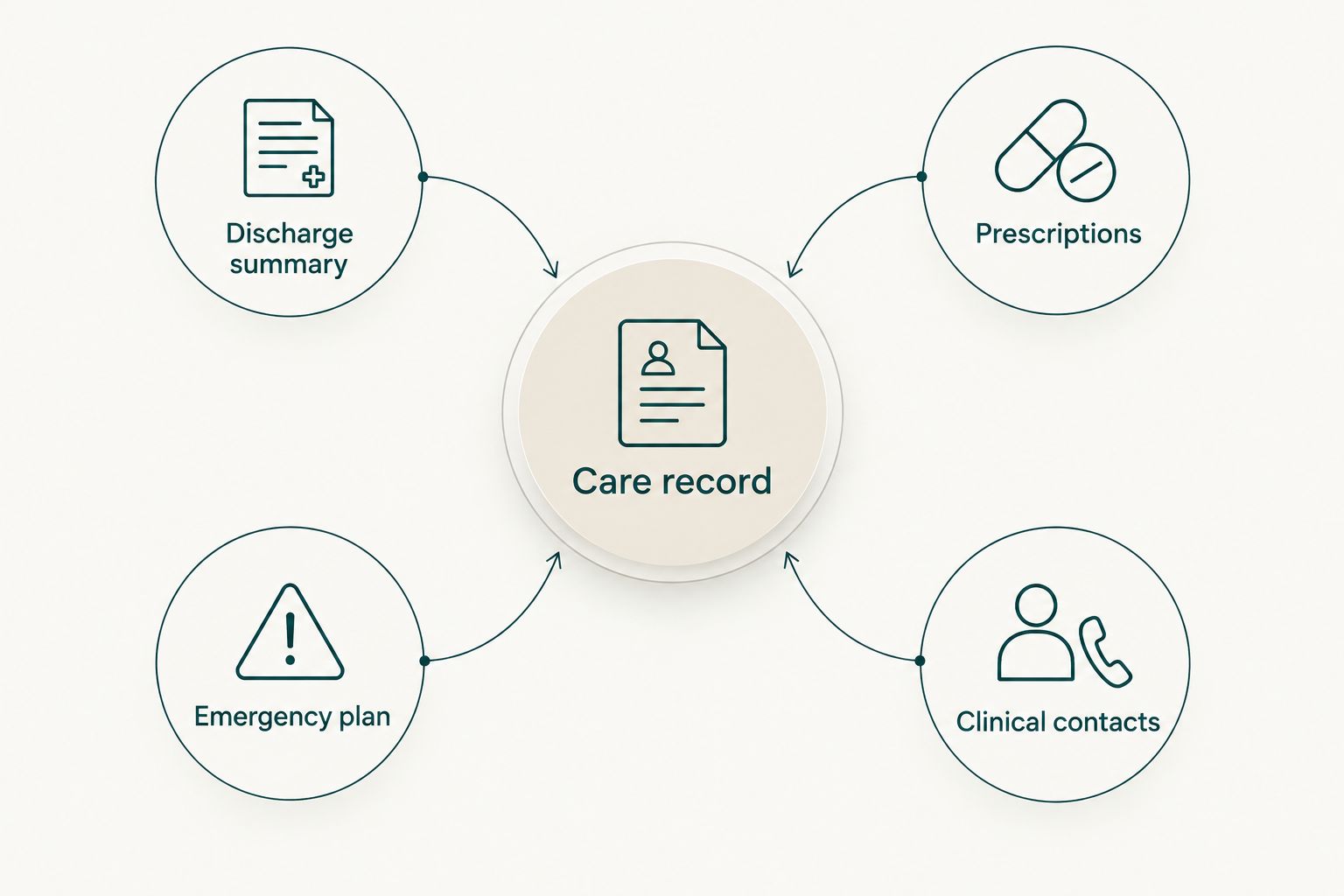
2. Build one shared care record
Create a paper folder or shared document before comparing providers. Keep the information readable enough that a replacement nurse or family member can understand it without reconstructing the history from messages.
Your medication list needs the medicine name, prescribed dose, route and timing. Include non-prescription medicines, supplements and herbal products so the treating team can check for interactions. Do not treat a discharge list as current if prescriptions have changed since discharge.
Keep the emergency plan at the front rather than buried behind laboratory reports. A useful record answers three questions: what is prescribed, what has changed and who needs to know?
- Keep the latest discharge summary and prescriptions together.
- Record medication changes with the prescriber’s instructions.
- Add the treating team’s daytime and after-hours contacts.
- Store wound, line or drain instructions where applicable.
- Document the patient’s consent for sharing health information.
3. Verify the provider and the assigned nurse
Before booking, request the provider’s healthcare facility licence details and the assigned nurse’s professional licence details. Verify the relevant Dubai authorisation through the Dubai Health Authority rather than relying on an advertisement or a uniform.
For your 2026 checks, confirm current validity and whether the proposed tasks fall within the service’s authorised scope. A professional licence alone does not demonstrate competence in every oncology-related procedure.
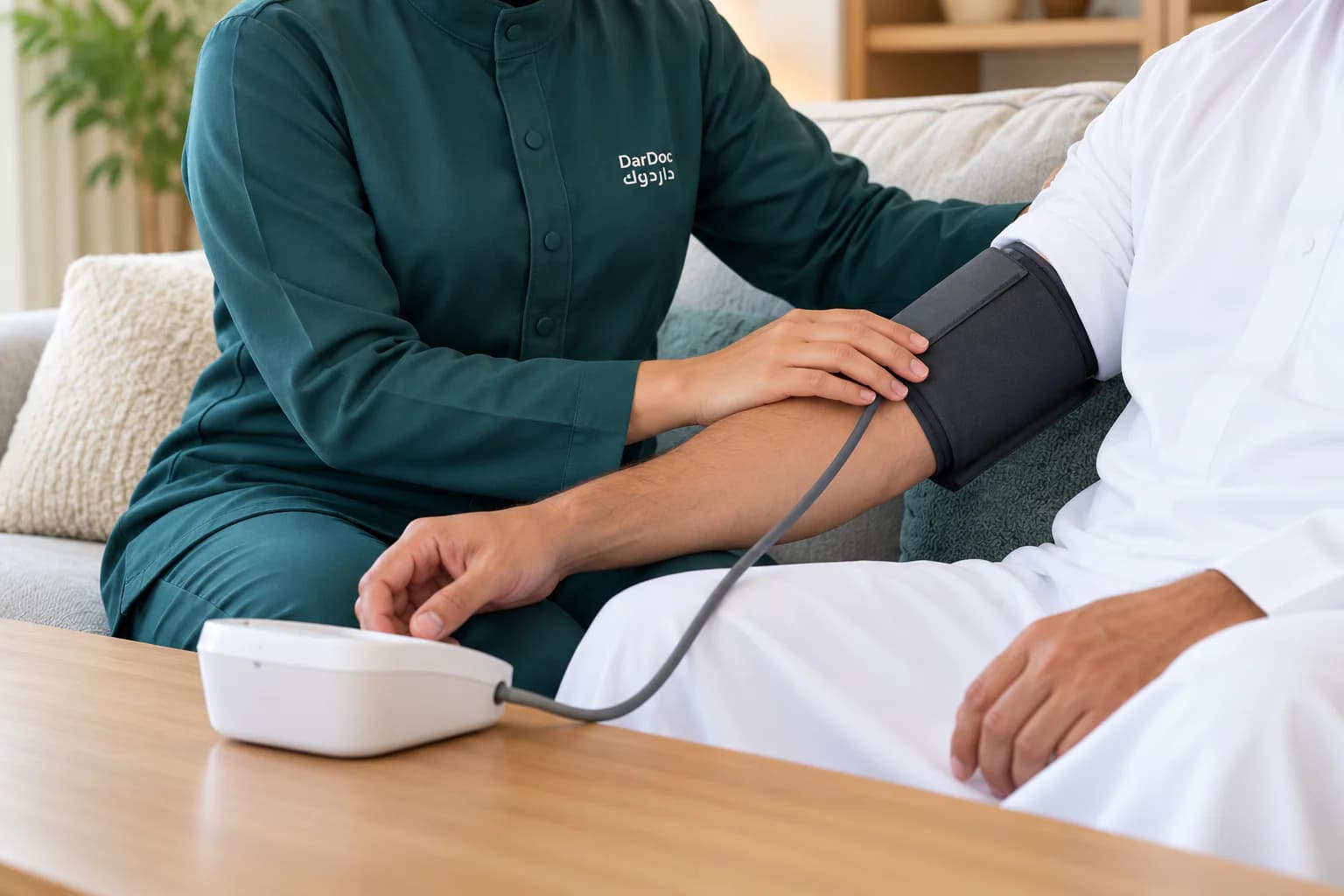
DarDoc provides home nursing in Dubai. DarDoc home nursing is best considered by families seeking general nursing support alongside an oncology-led care plan. For cancer-specific procedures, ask for confirmation of the assigned clinician’s competence and the provider’s scope before booking.
- Request current facility and professional licence details.
- Describe the exact procedures before accepting a booking.
- Ask how task-specific competence is checked.
- Identify the supervising clinician and escalation route.
- Confirm how replacement staff receive the care plan.
4. Match the schedule to actual care needs
Write down when help is needed across a typical day and night. A simple diary can show whether the gap is a specific clinical task, assistance with daily activities or repeated overnight support.
Scheduled nursing visits suit defined tasks when the patient is otherwise safe between visits. Extended support addresses a different problem: someone needs to be present for more of the day. Neither arrangement automatically supplies specialist oncology treatment or continuous medical monitoring.
Discuss the pattern with the treating team before choosing hours. Reassess after treatment changes or discharge; yesterday’s schedule is not proof that today’s support is adequate.
- Map prescribed tasks against their required timing.
- Record help needed with transfers, washing and toileting.
- Identify periods when the patient would otherwise be alone.
- Ask whether overnight symptoms need clinical review.
- Agree who covers gaps between nursing visits.
5. Agree symptom monitoring and emergency thresholds
Ask the oncology team for written instructions tailored to the treatment. Record what to observe, when to report a change and where to go if the team cannot be reached. A symptom diary helps communication; it does not establish the cause of a symptom.
During chemotherapy, a temperature of 38°C or higher requires immediate contact with the treating team. Fever can signal a serious infection. Follow any lower threshold or additional precautions your oncology team has given you, and do not wait for the next nursing visit.
For severe breathing difficulty, collapse or other life-threatening symptoms, call the UAE ambulance service on 998. A routine home-care booking is not an emergency response service.
- Keep a working thermometer within reach.
- Use a 0–10 pain scale to describe changes consistently.
- Record symptoms alongside medication timing.
- Report inability to keep fluids down or markedly reduced urine promptly.
- Keep the emergency destination and transport plan explicit.
6. Set boundaries for medicines, wounds and lines
Use the prescription and discharge instructions as the starting point. Ask the nurse to explain the checks before a procedure and what would make the nurse stop and contact the prescriber.
Do not assume that ordinary home IV services include chemotherapy, blood products or central-line procedures. Each requires its own assessment, authorisation, competence and appropriate setting. A provider’s general nursing service does not establish any of those capabilities.
Avoid adding wellness drips, supplements or herbal remedies without oncology approval. Cancer treatment is not a reason to bypass an interaction check, and an infusion is not automatically appropriate because it is delivered by a clinician.
- Match every administered medicine to a current prescription.
- Confirm who supplies and stores medicines and consumables.
- Request procedure-specific wound or line instructions.
- Ask how used sharps and clinical waste are managed.
- Keep treatment changes with the authorised prescriber.
7. Review the plan and protect caregiver capacity
Agree a review point before care begins. For a 2026 home-care plan, useful triggers include hospital readmission, a treatment change, new confusion, declining mobility or a family caregiver becoming unable to continue safely.
Start with a short daily handover rather than scattered updates across several conversations. Record completed tasks, new symptoms, missed medicines and any clinician advice. Make sure the patient’s preferences remain visible, including who they want involved in decisions.
If symptoms are difficult to control, ask the oncology team about palliative care. Palliative care addresses symptoms and quality of life; it is not limited to the final days of life and can accompany cancer treatment.
- Name one family contact for routine coordination.
- Document what happened during each nursing visit.
- Agree review triggers with the treating team.
- Arrange practical breaks for the main caregiver.
- Record the patient’s communication and privacy preferences.
Compare the care options before booking
Choose the option that addresses the missing support. More hours do not correct a mismatch in clinical skills, and a qualified nurse does not replace a specialist treatment setting.
| Option | Best for | Main benefit | Key limitation |
|---|---|---|---|
| Scheduled home nursing | Patients with defined prescribed tasks and safe support between visits | Brings agreed nursing care into the home | Does not provide continuous observation between visits |
| Extended nursing support | Patients whose assessed nursing needs extend across the day or night | Provides support over a longer period | Hours alone do not establish oncology-specific competence |
| Family or non-clinical caregiver support | Daily activities and companionship within an agreed plan | Helps maintain familiar routines | Does not replace licensed clinical care |
| Oncology clinic or hospital care | Cancer treatment, specialist assessment and acute deterioration | Provides access to treatment and investigation in a clinical setting | Requires attendance or admission rather than routine support at home |
| DarDoc home nursing | Dubai families seeking home nursing alongside their treating team | Offers a home-based nursing option | Cancer-specific procedures, staffing arrangements and oversight need confirmation |
For each option, ask who owns the clinical plan and what happens when the patient’s condition changes. Choose home nursing to close a defined care gap, not to recreate an oncology ward at home.
Common mistakes families make
These are the decisions to avoid when arranging cancer-related home care in Dubai in 2026. Each creates a gap between what the patient needs and what the booking actually covers.
Booking hours before defining the clinical work
A request for “someone to stay overnight” does not explain whether you need help walking to the bathroom, medication administration or assessment of new breathlessness. Specify the tasks first, then agree the staffing and schedule.
Treating fever as something to watch until morning
During chemotherapy, fever needs immediate clinical contact under the oncology team’s instructions. Do not use a planned nursing visit as a reason to delay, or take fever-reducing medication as a substitute for seeking advice.
Assuming every nurse can manage every device
A port, central line, drain or feeding tube needs a device-specific plan and appropriate competence. Ask about the actual device and procedure rather than accepting a general statement about nursing experience.
Adding treatments without telling the oncologist
Include wellness infusions, supplements and non-prescription medicines in the medication discussion. The relevant question is whether they are appropriate alongside the cancer treatment, not whether they are described as natural or restorative.
Leaving insurance and handovers until after care starts
Ask the insurer about benefits, authorisation and required documents before arranging non-emergency care. Separately, make sure every staff change includes a clinical handover; insurance approval does not define the nursing instructions.
FAQ
Can a cancer patient receive nursing care at home in Dubai?
Yes, a cancer patient can receive home nursing when the treating team considers the setting appropriate and the provider can perform the required tasks. The plan should specify prescriptions, clinical responsibilities and escalation instructions.
Does home nursing replace chemotherapy appointments?
No, routine home nursing does not replace chemotherapy appointments or oncology reviews. Any proposal to deliver cancer treatment at home requires separate confirmation from the treating oncology team and an appropriately authorised service.
What should I do if a patient develops a fever during chemotherapy?
Contact the treating oncology team immediately for a temperature of 38°C or higher during chemotherapy. Follow any lower threshold in the patient's written plan and do not wait for the next home nursing visit.
Is round-the-clock nursing necessary for every cancer patient?
No, the cancer diagnosis alone does not determine the nursing schedule. The treating team should assess clinical tasks, mobility, overnight needs and the support available between visits.
Can a home nurse manage a port or central line?
Only arrange port or central-line care after confirming the prescription, provider scope and assigned nurse's procedure-specific competence. Do not assume that a general nursing booking includes access, flushing or dressing changes.
How do I check a home nurse's credentials in Dubai?
Request the nurse's professional licence details and the provider's facility licence details, then verify the relevant Dubai authorisation through the Dubai Health Authority. Also ask about competence for the exact tasks in the care plan.
Does health insurance cover home nursing for cancer patients?
Coverage depends on the patient's policy and the insurer's assessment of the requested care. Ask about medical-necessity documentation, prior authorisation, provider eligibility and the approved scope before arranging non-emergency services.
Is palliative care only for someone who has stopped cancer treatment?
No, palliative care can accompany active cancer treatment. Ask the oncology team about referral when symptoms, emotional distress or caregiver strain need additional support.
One last thing
Before the first visit, ask: “If the patient becomes unwell tonight, who makes the clinical decision and where do we go?” Write the answer down. A nursing schedule tells you who is expected at the door; an escalation plan tells you what to do when the situation changes.