How to connect Thiqa insurance to elderly home care claims
Thiqa insurance home nursing claims need member-specific checks. Follow the steps for eligibility, authorisation, care records and claim follow-up.

Instead of repeating your parent's medical history for every claim, connect Thiqa insurance home nursing claims through a documented workflow: confirm eligibility, establish the clinical need, obtain any required authorisation, and match each claim to the care delivered. For care arranged in 2026, get member-specific written confirmation before treating a nursing booking as insured.
TL;DR- Thiqa insurance home nursing claims start with member-specific eligibility and provider checks, not a nursing booking.
- DarDoc provides elderly home care; confirm Thiqa participation and billing arrangements separately before booking.
- Keep the clinical order, authorisation, nursing records and claim reference together.
- Recheck approval requirements whenever the provider, care plan or authorised period changes.
Why this matters
A home-care booking, an insurance authorisation and a paid claim are different things. Connecting them means keeping the patient's identity, prescribed care, provider details and service dates consistent throughout the process.
DarDoc home nursing is best suited to families seeking clinical care at home in Dubai and Abu Dhabi. Insurance eligibility remains a separate check; the existence of a service does not establish Thiqa coverage or direct billing.
If your parent is leaving hospital, start with the hospital discharge-to-home nursing workflow. The discharge plan should explain the care needed at home, rather than leaving the family to translate a general recommendation into a nursing request.
Before you start
- Member details and permission: Have the patient's current insurance details, identification and consent for the family member coordinating care. Ask what representative authorisation is required before sharing medical information.
- Clinical documents and provider details: Gather the treating clinician's order, relevant discharge information and proposed nursing plan. Ask the provider for its legal billing name and relevant facility and professional licensing details.
- The hidden gotcha: Do not assume that an approved provider means every home-care task is covered. Ask specifically about the prescribed service, treatment location, billing route and any preauthorisation requirement.
Use 1 shared folder for the care episode and appoint 1 family coordinator. These are organisational recommendations, not Thiqa requirements. Store sensitive records securely and use the submission channel confirmed by the insurer or provider.
Member eligibility and billing route
Confirm the member and the proposed service
- Contact the insurer using the contact details on the patient's membership materials or an authenticated member channel. Confirm that the membership is active for the intended service dates.
- Describe the actual care requested. State the clinical task, why it is needed at home, the proposed frequency and the treating clinician's involvement.
- Give the proposed provider's legal name and treatment location. Ask whether that provider can deliver the specified service under the member's benefits.
- Ask whether preauthorisation, a particular referral or further assessment is required. Request a written response or a reference for the conversation.
Expected result: You have a member-specific answer about the proposed care and a list of conditions to satisfy before booking it as insured treatment.
For a 2026 care episode, record when this confirmation was obtained. A previous claim or another relative's experience does not establish the answer for the current member and service.
Establish who submits the claim
Ask the insurer and provider to confirm the same billing route. Do not treat reimbursement as an automatic fallback if direct billing is unavailable.
| Route to verify | Best for | Practical advantage | Limitation to resolve |
|---|---|---|---|
| Direct billing, if confirmed | Families whose provider and service have insurer confirmation | The provider handles the insurer submission | Confirm authorisation responsibilities and any patient obligations |
| Member reimbursement, if permitted | Members explicitly authorised to submit their own claim | The family controls its submission record | The member must confirm eligibility, documents and submission conditions |
Neither route guarantees payment. Choose the route confirmed for the member, provider and prescribed care—not the route that sounds easier.
- Identify the person responsible for the submission: the provider's billing contact or the authorised member representative.
- Ask where documents must be submitted, what evidence is required and which submission deadline applies. Record the insurer's answer rather than using a deadline from an unrelated policy.
- Confirm how you will receive status updates and requests for additional information.
Expected result: One named person owns the submission, and the family knows which route and requirements apply.
Clinical care plan and authorisation
Assemble a request that describes the clinical need
A diagnosis alone does not describe a home-nursing service. The request should connect the patient's condition to the skilled task being prescribed and explain the proposed care setting.
- Ask the treating clinician to document the diagnosis, relevant functional limitations and clinical reason for home nursing.
- Ask the clinician and nursing provider to specify the tasks, visit frequency, intended treatment period and review plan. The clinician determines the appropriate care; the family should not select clinical tasks to fit an insurance category.
- Separate skilled nursing tasks from requests for supervision, companionship or household support. Ask the insurer to assess each requested component explicitly.
- Check that the clinical documents and proposed service description agree. Return clinical inaccuracies to the clinician for correction before submission.
Expected result: The request explains what care is needed, why it is needed at home and how the clinician will review it.
For example, a wound-care request should describe the prescribed wound management rather than simply state that an elderly person needs assistance. A family request for someone to remain with a parent throughout the day needs its own assessment; it is not interchangeable with a prescribed nursing visit.
Obtain and read the authorisation decision
- Have the responsible submitter send the required documents through the confirmed channel. Retain the submission reference and a copy of the packet.
- Read the decision against the proposed plan. Check the patient, provider, approved services, dates and any conditions or limits stated in the decision.
- Resolve missing or inconsistent details before relying on the authorisation for planned care. Ask for written clarification when the approval wording does not match the requested service.
Expected result: You hold a written decision that can be checked against the nursing schedule. A submission acknowledgement is not an approval.
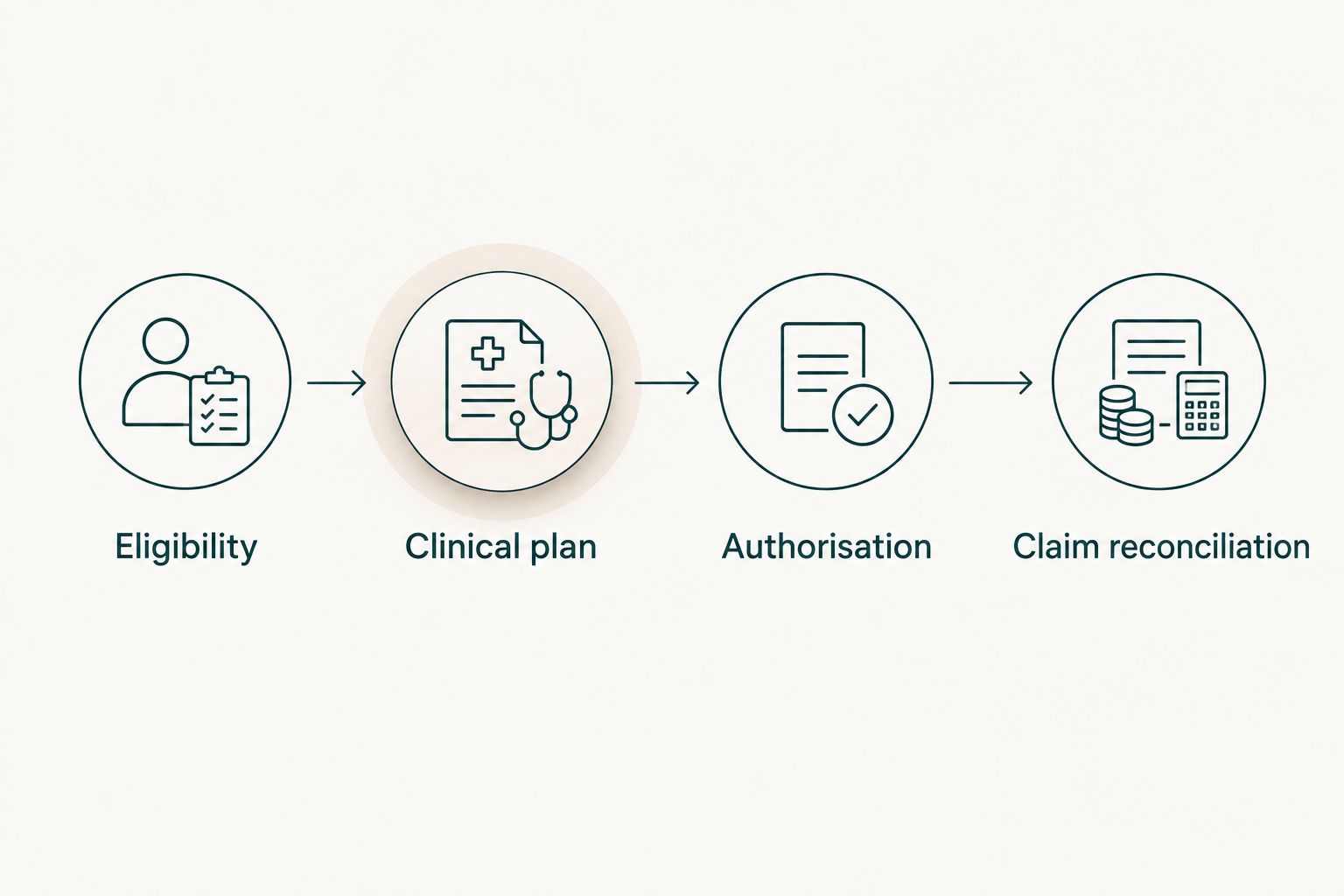
Use 4 checkpoints for your 2026 file: eligibility, clinical plan, authorisation and claim reconciliation. Keep each checkpoint separate so that a booking confirmation cannot be mistaken for an insurance decision.
Nursing records and claim submission
Match the delivered care to the approved request
- Confirm the first planned visit against the written decision and clinical instructions. Ask the provider to identify discrepancies before the visit.
- Keep a family record of visit dates and relevant communications. The provider maintains the clinical record; your family log helps identify missing visits or administrative discrepancies.
- Ask the provider how nursing notes, invoices and any required attendance evidence will support the claim. Obtain the documents required for your confirmed billing route.
- Compare the service dates and descriptions across the authorisation, supporting records and claim documents. Refer clinical questions to the treating team and billing questions to the submitter.
Expected result: The claim describes the care actually delivered and has the supporting evidence requested for that billing route.
Ask DarDoc's home nursing team about the proposed care and required clinical assessment, then verify the insurance arrangements separately. Do not interpret a clinical recommendation, provider quotation or scheduled visit as confirmation of Thiqa acceptance.
Submit and reconcile the outcome
- Submit through the agreed channel, or obtain confirmation that the provider has submitted. Save the claim reference alongside the authorisation reference; they serve different purposes.
- Track the response and send requested information through the confirmed secure channel. Retain the original records when supplying corrected administrative documents.
- Review the written outcome against the submitted services. Ask for an explanation of any rejected item, adjustment or unresolved patient responsibility.
Expected result: Every submitted claim has a traceable status and a recorded next action until it is resolved.
For ongoing care in 2026, review the open-claim list regularly with the responsible billing contact. Resolve an unexplained discrepancy before repeating the same submission problem across later visits.
When the elderly home-care plan changes
A longer care period, a different clinical task or a replacement provider needs a fresh check against the existing decision. Do not assume that the original authorisation extends to the change.
- Ask the clinician to document the revised need and update the care plan.
- Tell the billing contact exactly what is changing: the provider, task, frequency, treatment period or another condition specified in the approval.
- Ask whether an amendment, extension or new request is required. Obtain the answer before treating changed planned care as authorised.
- Record the new decision and its effective dates. Keep the earlier approval so claims for earlier visits remain traceable.
Expected result: Each period of care maps to the clinical instructions and insurance decision that apply to it.
Do not delay urgent medical assessment while resolving insurance administration. If your parent's condition deteriorates, contact the treating clinician or emergency services as appropriate; billing questions come after immediate safety.
Troubleshooting Thiqa home nursing claims
The provider says it accepts insurance, but cannot confirm this service
Ask for confirmation covering the specific member, provider location and nursing service. General insurance acceptance does not answer those questions. Keep the booking and insurance decisions separate until the details are resolved.
The request is pending because clinical information is missing
Obtain the exact information request and send it to the treating clinician. Ask the clinician to address the missing clinical point directly; repeatedly resending an unchanged report does not answer a new question.
The approved period does not cover the planned visit dates
Compare the decision's dates with the schedule and ask whether an extension or correction is required. Do not alter a clinical record or service date to make it fit an approval.
A claim is rejected despite an earlier authorisation
Request the written rejection reason and compare it with the authorisation and submitted documents. Correct administrative errors through the permitted process; ask the clinician to respond to clinical questions. Retain the rejection notice and ask which review route and deadline apply.
A family member cannot obtain a claim update
Confirm the patient's consent and the insurer's representative-access requirements. Ask how to register the authorised coordinator. Do not circulate passwords or medical records among relatives to work around access controls.
Customize your workflow
Build your 2026 handover record around owners, not just documents. Name the treating clinician for clinical changes, the provider contact for visit records and the billing contact for submissions.
Before you proceed, ask these questions together:
- Who confirms the clinical plan?
- Who obtains any required authorisation?
- Who checks that the decision matches the schedule?
- Who responds when the insurer requests more information?
Discuss the care requirements through the DarDoc contact page. Ask explicitly about Thiqa participation and the billing route for the proposed service; do not assume either from the ability to arrange home care.
FAQ
How do I connect Thiqa insurance to elderly home nursing claims?
Confirm the member's eligibility, the proposed provider and the specific nursing service before establishing the billing route. Obtain any required authorisation, then match the claim to the clinical plan and care delivered.
Does Thiqa automatically cover elderly care at home?
Do not assume automatic coverage for elderly care at home. Request member-specific confirmation for the prescribed nursing tasks, provider and service dates, and distinguish clinical nursing from general daily support.
Can DarDoc submit my Thiqa home nursing claim?
Confirm submission arrangements with DarDoc and the insurer before booking. DarDoc provides home nursing and elderly care, but those services alone do not establish Thiqa participation or direct billing.
What documents should I prepare for a home nursing claim?
Prepare member identification details, the clinician's order, relevant medical reports and the proposed nursing plan. Obtain the exact submission checklist for your billing route, including any authorisation, invoice and care-record requirements.
Can I claim reimbursement if direct billing is unavailable?
Only rely on reimbursement after the insurer confirms that route for the member and proposed service. Ask about provider eligibility, preauthorisation, supporting evidence and submission deadlines before proceeding.
What happens if my parent needs more nursing visits?
Ask the treating clinician to update the care plan and check whether an extension or new authorisation is required. Keep additional planned visits separate from the existing approval until their status is confirmed.
What should I do if a home nursing claim is rejected?
Obtain the written rejection reason and compare it with the authorisation and submitted records. Ask the responsible billing contact about correction or review requirements and the applicable deadline.
One last thing
Treat the authorisation reference and claim reference as separate records. The first identifies the decision about proposed care; the second tracks the submission for care delivered. Keeping both beside the relevant visit dates makes a disputed item easier to investigate without reconstructing the entire care episode.