Best home care agencies for expat families in Abu Dhabi 2026
Home care for expat families Abu Dhabi: choose by clinical need. Compare nursing, elderly and newborn support, with clear checks before care starts.

Best starting point for mixed family needs: DarDoc. Best for hospital recovery: discharge-led home nursing. Best for an ageing parent: elderly care matched to daily support needs. For home care for expat families in Abu Dhabi in 2026, choose the service around the person’s clinical needs, then check credentials, communication and escalation arrangements.
TL;DR- DarDoc is a starting point for home care for expat families Abu Dhabi, including nursing, elderly care and mother/newborn care.
- Choose post-discharge home nursing when recovery involves prescribed clinical tasks, not just household assistance.
- Check Abu Dhabi licensing, the written care plan and emergency arrangements before agreeing to care.
- Match elderly care and newborn support to assessed needs; the service label alone does not establish suitability.
Why this matters
An expat household can need very different kinds of help: nursing after surgery, support for an older parent, or care after a baby arrives. These are not interchangeable services. Choose the required tasks before choosing the agency.
DarDoc provides home and online healthcare in Dubai and Abu Dhabi, including at-home nursing, blood tests, mother/newborn care and elderly care. DarDoc is a relevant starting point for expat families seeking home care across different life stages. Confirm the specific care arrangements against your family’s needs before proceeding.
This 2026 guide ranks choices by their purpose. It distinguishes a named provider from specialist care models rather than presenting an unsupported league table of competing agencies.
What makes the best home care for expat families?
Use these criteria to assess any provider. A familiar name does not replace a clear answer about who will deliver care and what that person is qualified to do.
- Clinical fit: Match the professional’s role to the actual tasks, including medication administration, wound care or personal assistance.
- Verifiable credentials: Check the relevant facility and professional licensing for care delivered in Abu Dhabi. Do not treat a Dubai credential as proof of Abu Dhabi authorisation.
- Written responsibilities: Establish what the care worker does, what the family does and which decisions belong to the treating clinician.
- Continuity: Ask how handovers, absences and changes in the care plan are handled.
- Clear communication: Confirm a shared language, the update process and permission to share health information with relatives.
- Escalation: Ask who responds to deterioration, what requires urgent assessment and when emergency services are needed.
For your 2026 shortlist, request 3 documents: evidence of relevant licensing, a written care plan and written service terms. These are practical checks, not a substitute for a clinical assessment.
Home care options at a glance
The order below starts with broad family needs, then separates more specific situations. Specialist care is the better choice when a patient’s condition requires it.
| Option | Best for | Main strength | Key limitation |
|---|---|---|---|
| DarDoc | Families considering several types of home healthcare | Stated services include nursing, elderly care and mother/newborn care | Each care requirement still needs individual confirmation |
| Discharge-led home nursing | Recovery involving prescribed clinical tasks | Organises care around hospital instructions | Does not replace hospital treatment when the patient is unstable |
| Elderly home care | An older relative needing daily support | Focuses on function, comfort and everyday needs | Personal assistance alone does not cover skilled nursing tasks |
| Mother and newborn care | Support after birth | Focuses on the mother–baby period | Does not replace maternity or paediatric follow-up |
| Non-clinical caregiving | Companionship and everyday practical assistance | Keeps the focus on non-medical support | Cannot substitute for a qualified healthcare professional |
1. DarDoc: best starting point for mixed family healthcare needs
DarDoc offers at-home and online healthcare for families in Abu Dhabi and Dubai. Its stated services include nursing, blood tests, elderly care and mother/newborn care, making it a relevant first enquiry when your household needs more than one category of support.
Start with a description of the person’s condition and the tasks you need covered. Ask for an assessment of the appropriate service rather than assuming that every requirement belongs in one care arrangement.
DarDoc pros:
- Covers several stated categories of family home healthcare.
- Includes both home and online healthcare services.
- Explicitly serves families in Abu Dhabi as well as Dubai.
DarDoc limitations:
- A broad service range does not establish suitability for a particular clinical condition.
- The professional role, care schedule and handover arrangements need confirmation for your case.
Best for: Families seeking an initial discussion about nursing, elderly support or mother/newborn care through a provider with those stated services.
Verdict — Hold: Make a care decision only after the proposed professional, responsibilities and escalation plan match your needs.
2. Discharge-led home nursing: best for recovery after hospital care
Discharge-led home nursing starts with the treating team’s instructions. The home-care plan should translate those instructions into named tasks, responsible professionals and clear follow-up arrangements.
This is the right category to assess when care includes prescribed wound management, medication administration or monitoring directed by a clinician. Do not select general companionship simply because the patient also needs help around the house.
Discharge-led home nursing pros:
- Connects home care to the hospital’s documented instructions.
- Separates clinical tasks from household support.
- Gives the family a clear basis for discussing changes with the treating team.
Discharge-led home nursing limitations:
- Incomplete discharge instructions need clarification before care begins.
- Home nursing does not provide the same resources as a hospital.
- Deterioration can require urgent reassessment rather than an extra home visit.
Best for: A clinically stable person whose treating team has recommended care at home after hospital treatment.
Before discharge, ask who owns the follow-up plan. A nurse completing an assigned task and a doctor deciding whether treatment should change are different responsibilities; your family needs to know how those roles connect.
Verdict — Buy: Choose this care model when the treating team confirms home care is appropriate and the provider can deliver the prescribed tasks.
3. Elderly home care: best for an older parent’s daily support
Elderly home care should begin with what your parent can do independently and where help is needed. Discuss washing, dressing, meals, mobility, toileting, medication routines and communication rather than relying on a broad label such as “senior support”.
For expat families, include the older person in decisions wherever possible. A relative living overseas needs an agreed update process, but distance does not remove the patient’s right to privacy or involvement.
Elderly home care pros:
- Builds support around the person’s daily routine.
- Makes practical needs visible before care starts.
- Creates a basis for reviewing changes in independence.
Elderly home care limitations:
- A non-clinical caregiver does not replace a nurse for skilled procedures.
- New confusion, falls or sudden weakness require clinical attention, not just a schedule change.
- Support needs can change after illness or hospital treatment.
Best for: An older adult who needs assistance with everyday activities, with nursing added when clinically indicated.
Ask how the provider records changes and informs the family. “Everything was fine” is less useful than an agreed account of meals, mobility, concerns and tasks completed.
Verdict — Buy: Choose elderly care when the task list reflects the person’s current abilities and distinguishes personal assistance from nursing.
4. Mother and newborn care: best for support after birth
Mother and newborn care focuses on the period after delivery, but the service title does not define its scope. Ask separately about support for the mother, support for the baby and tasks that require a qualified clinician.
Share maternity discharge instructions and any feeding or follow-up plan. If either patient has a medical concern, ask the treating maternity or paediatric team what level of home support is appropriate.
Mother and newborn care pros:
- Keeps the needs of both mother and baby in the discussion.
- Helps define practical support around recovery and newborn routines.
- Gives families a way to plan handovers and rest without leaving responsibilities unclear.
Mother and newborn care limitations:
- A newborn-care label does not establish nursing qualifications.
- Home support does not replace scheduled medical follow-up.
- Feeding or health concerns need appropriate clinical assessment.
Best for: Families seeking clearly defined support after birth, matched to the mother’s recovery and the newborn’s needs.
In 2026, apply the same credential checks to newborn support as to other home healthcare. Reassuring language is not evidence of a professional’s clinical scope.
Verdict — Buy: Choose this model after confirming qualifications, permitted tasks and the route to maternity or paediatric advice.
5. Non-clinical caregiving: best for companionship and practical help
Non-clinical caregiving covers assistance that does not require healthcare assessment or a clinical procedure. It is a distinct choice, not a lower-skilled substitute for nursing when nursing is needed.
Write down the requested tasks in plain language. Companionship, help with daily routines and support getting around the home should not be bundled with clinical responsibilities without checking qualifications and scope.
Non-clinical caregiving pros:
- Keeps everyday assistance separate from medical treatment.
- Gives families a clear task list to discuss.
- Supports routines when clinical procedures are not the requirement.
Non-clinical caregiving limitations:
- Does not cover diagnosis or treatment decisions.
- Does not replace qualified nursing for clinical procedures.
- Requires reassessment if the person’s health or independence changes.
Best for: Someone whose assessed needs are practical and social rather than clinical.
Verdict — Skip: Skip this option as the sole arrangement when the person needs skilled nursing or active medical assessment.
Before care starts: a practical handover
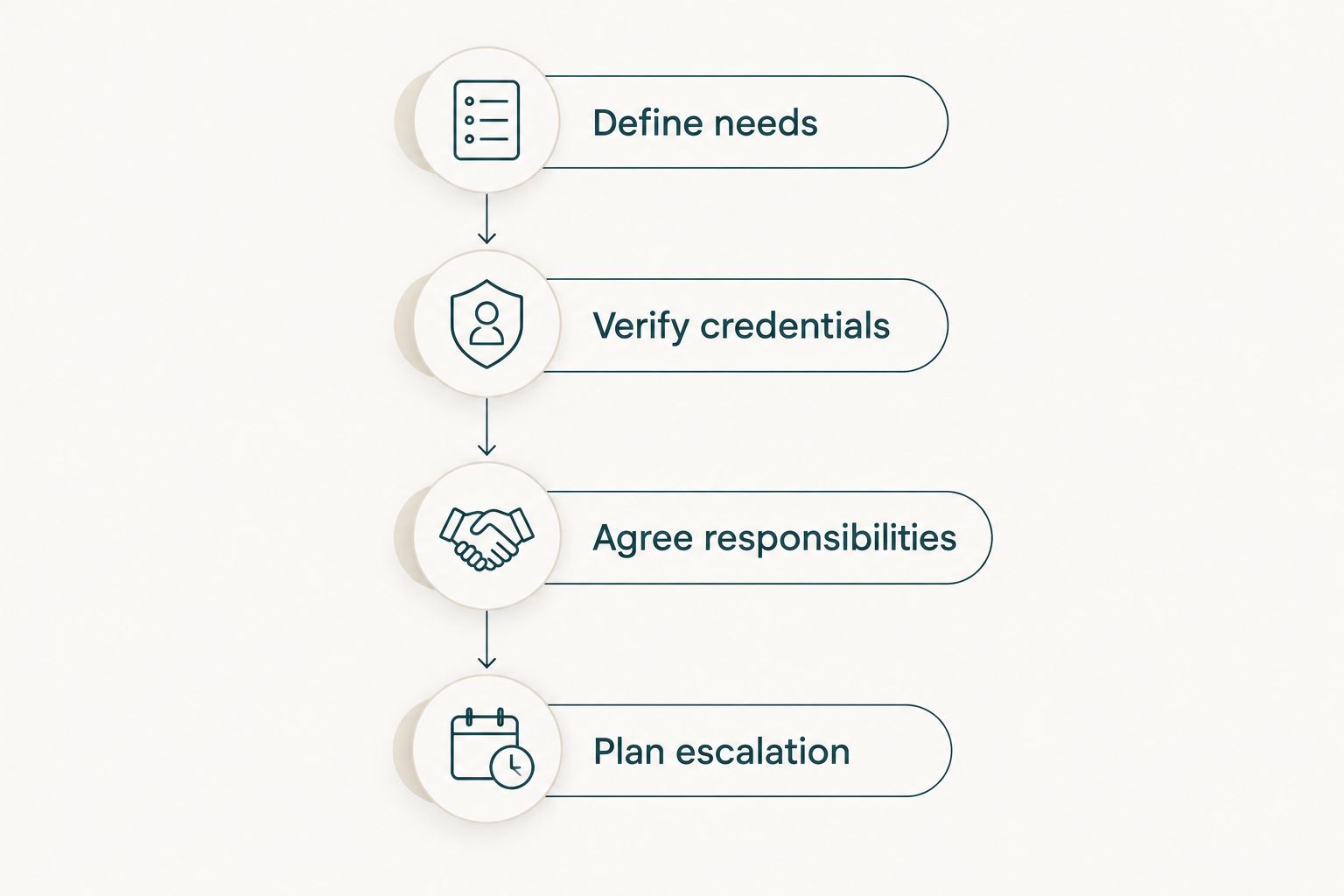
Use this sequence for a 2026 care arrangement. Complete it before leaving a dependent relative with a new care worker, not after a problem exposes an unclear responsibility.
- Define needs: List daily tasks, clinical instructions, communication needs and relevant home-access considerations.
- Verify credentials: Check the provider and the professional delivering care. Use the Abu Dhabi home-nursing verification guide to structure your questions.
- Agree responsibilities: Put the task list, consent arrangements, updates and handover process in writing.
- Plan escalation: Record whom to contact for routine questions, clinical concerns and emergencies.
Choose 1 primary family contact for routine coordination, with the patient’s consent. This reduces conflicting instructions without excluding other relatives from agreed updates.
Ask 4 questions at the handover: What happens today? What must be recorded? What change needs a clinician? What change needs emergency help? The answers should be specific to the patient, not copied from a general brochure.
How these choices are ranked
The ranking uses clinical fit, verifiable credentials, written responsibilities, continuity, communication and escalation. It prioritises matching the service to the need rather than treating every home-care offer as equivalent.
The named provider’s description establishes its service categories, not comparative clinical outcomes. The specialist options explain when a narrower care model takes priority over a broad family-healthcare enquiry.
Which home-care option should you choose?
Start with the patient’s tasks, not an agency’s headline. For mixed family needs, begin with a provider covering the relevant service categories. For recovery after hospital treatment, let the discharge plan determine the professional and care model.
For an older parent or a newborn, ask what support is practical and what is clinical. Your 2026 decision is ready only when the qualifications, written responsibilities and escalation arrangements fit the person receiving care.
FAQ
What is the best home care for expat families in Abu Dhabi?
The best fit is a provider whose professional qualifications and written care plan match your family’s needs. DarDoc is a relevant starting point for families considering nursing, elderly care or mother/newborn care, subject to individual assessment.
Do I need a home nurse or a caregiver for my parent?
Choose a qualified nurse when your parent needs skilled clinical tasks. A caregiver is appropriate for defined non-clinical assistance; some people need both roles.
How do I check a home-care provider in Abu Dhabi?
Check the relevant facility and professional licensing through the Department of Health – Abu Dhabi’s official channels. Confirm that the details match the provider and the professional assigned to deliver care.
Can I arrange home care for a relative while living overseas?
You can coordinate enquiries from overseas, but consent, local responsibilities and communication need explicit agreement. Establish who receives updates and who can respond locally when circumstances change.
Is newborn support the same as newborn nursing?
No, the labels do not establish the same qualifications or scope. Ask which tasks the professional can perform and how medical concerns reach the maternity or paediatric team.
Does health insurance cover home care in Abu Dhabi?
Coverage depends on your policy and the proposed service. Obtain confirmation from the insurer about authorisation, documentation and the claim process before relying on reimbursement.
Can home care replace emergency treatment?
No, routine home care is not a substitute for emergency assessment. Severe breathing difficulty, suspected stroke or other urgent deterioration requires emergency help rather than waiting for a scheduled visit.
One last thing
Ask the proposed care worker to explain the care plan back to you, with the patient involved wherever possible. A shared understanding of the next task and the next escalation is more useful than a promise to “handle everything”. Resolve any mismatch before responsibility changes hands.