DarDoc vs Bin Sina: which is better in 2026
Dardoc vs Bin Sina: choose home healthcare for nursing and clinical care, or pharmacy support for medicines. Compare roles, safety checks and next steps.

Choose Dardoc if you need healthcare delivered at home or online in Dubai or Abu Dhabi; choose Bin Sina if your task is pharmacy dispensing or advice about a medicine. The dardoc vs bin sina decision in 2026 is about clinical care versus pharmacy support—not two interchangeable ways to book the same service.
TL;DR- Dardoc vs Bin Sina: choose home healthcare for clinical care at home, and pharmacy support for dispensing needs.
- Bin Sina is the better starting point when you already have a prescription and need pharmacist guidance.
- Home nursing, blood tests and GLP-1 treatment require different decisions from buying or collecting medicine.
- Verify clinician credentials, care responsibilities and billing terms before committing to either route.
Why this matters
A prescription, a nursing visit and a treatment review solve different problems. Confusing them leaves an important question unanswered: who is responsible for assessing the patient and deciding what happens next?
For a family arranging care in 2026, the right comparison starts with the task. An older parent who needs hands-on nursing needs a care provider. Someone holding a prescription and asking how to take the medicine needs pharmacy support. Neither service replaces the other, and some patients need both.
Dardoc is the better fit for families seeking home healthcare in Dubai or Abu Dhabi. That is a service-fit verdict, not a claim that every treatment belongs at home.
At a glance
| Dimension | Dardoc | Bin Sina |
|---|---|---|
| Best for | Families seeking home or online healthcare | People seeking pharmacy dispensing and medicine advice |
| Standout service | At-home nursing, blood tests, IV drips and family care | Pharmacy support centred on medicines |
| Hands-on care | Home nursing, elderly care and mother/newborn care | Start with a care provider when the task requires nursing |
| Medicine questions | Relevant when questions form part of treatment | Better starting point for dispensing and pharmacist questions |
| GLP-1 treatment | Offers GLP-1 weight-loss treatment | Pharmacy role is distinct from assessment and prescribing |
| Safety checks | Verify the clinician and scope of the planned service | Verify the pharmacy professional and prescription requirements |
| Practical access | Home and online service model in Dubai and Abu Dhabi | Pharmacy route; confirm arrangements for your particular request |
| Pricing model | Request an itemised quote for the care being arranged | Request an itemised quote for the medicine or pharmacy service |
Home healthcare wins when your problem requires care
Choose the home-care route when somebody needs a clinician to assess, monitor or perform a clinical task—not simply supply an item. That distinction matters after discharge, during ongoing elderly care, or when a family needs mother and newborn support.
Write the task in plain language before contacting anyone. “My father needs help following his discharge plan” is more informative than “I need healthcare.” It tells the provider that the request involves clinical responsibilities rather than a product enquiry.
The limitation is equally important: home healthcare is not a substitute for every clinic or hospital service. Ask whether the requested task belongs within the provider's home-care scope and what would trigger referral elsewhere.
Bin Sina is the more direct starting point when your problem is already narrowed to a pharmacy question. Booking clinical care solely to clarify a medicine label adds a different service to a task a pharmacist is trained to address.
At-home services win for procedures; pharmacy support wins for medicines
The standout difference is what you need someone to do. Dardoc offers at-home nursing, blood tests and IV drips, alongside online healthcare and other home-care services. Bin Sina's pharmacy role centres on medicines rather than acting as an interchangeable home-nursing service.
For a blood test, separate sample collection from interpretation. Ask who orders the test, who collects the sample, who receives the result and who explains any next step. A result without an agreed review pathway leaves you to arrange the next decision yourself.
For an IV drip, start with clinical suitability rather than the name of the infusion. Ask what problem the treatment addresses, what assessment precedes it and who handles an adverse reaction.
The service list is not the treatment recommendation. A provider offering a procedure does not establish that you need it. Equally, access to a medicine does not establish that starting it is appropriate.
Home nursing wins for hands-on family care
An elderly relative who needs nursing support has a different requirement from someone collecting a repeat prescription. The same applies to a family arranging mother and newborn care: identify the actual responsibilities before comparing providers.
Use the hospital-discharge-to-home-nursing workflow to structure a handover discussion. The practical questions concern the discharge instructions, the tasks to be performed and the clinician responsible for reviewing progress.
Prepare 2 documents where applicable: the discharge summary and the current medication list. This is a preparation checklist, not a universal booking requirement. Tell the provider if either document is unavailable so the clinical team can explain what it needs.
Home care also needs boundaries. Agree which tasks belong to the nurse, which remain with the treating doctor and what the family is expected to do. A pharmacy can support medicine questions within that arrangement, but a dispensing interaction does not replace the nursing plan.
Bin Sina wins when the question belongs to a pharmacist
Choose Bin Sina first when you already have a prescription and need pharmacy support. Questions about the directions on a label, the medicine supplied or a potential interaction belong in a pharmacist conversation. Bring the complete medication list, including supplements, rather than asking about one item in isolation.
Do not interpret that recommendation as permission to change a prescription yourself. If the question requires a new diagnosis, a prescribing decision or a change to the treatment plan, ask which clinician should review it.
The pharmacy route has a clear boundary: obtaining a medicine and managing the condition are separate responsibilities. Ask what the pharmacist can resolve and what needs to return to the prescriber.
Home healthcare has its own boundary. A home visit is not automatically the most appropriate answer to every medicine question. Start with the professional whose role matches the decision, then involve the other service when the issue crosses that boundary.
GLP-1 treatment needs assessment as well as dispensing
Dardoc offers GLP-1 weight-loss treatment. That makes it relevant when you are seeking a treatment pathway rather than only pharmacy dispensing. It does not establish a particular medicine, dose, consultation schedule or monitoring package; agree those details with the treating clinician.
In 2026, keep 3 questions separate: is treatment appropriate, what is prescribed, and who reviews progress? A pharmacy interaction addresses a different part of that pathway from a clinical assessment. Do not treat the two as competing substitutes.
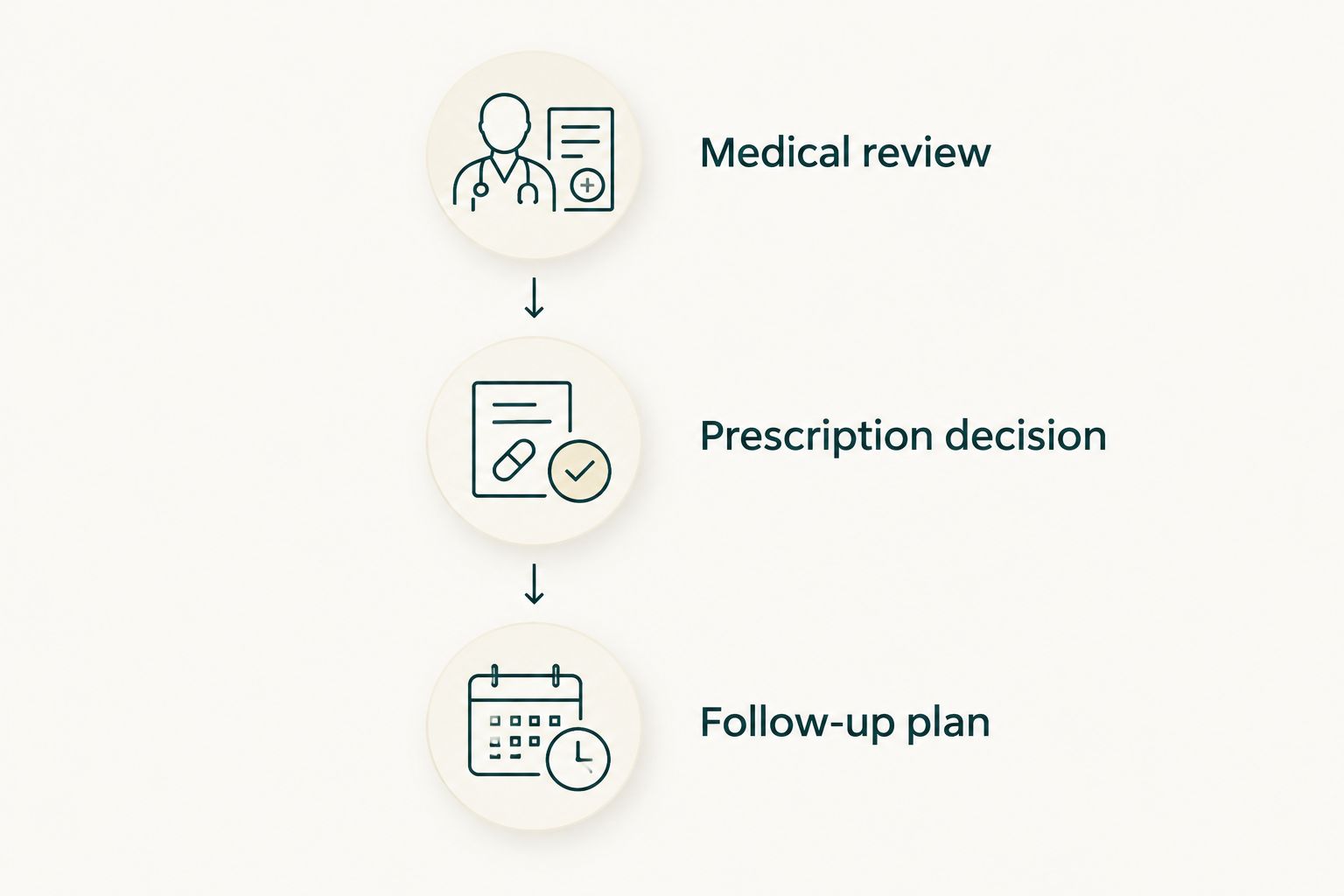
A clear pathway should identify these responsibilities:
- Medical review: the clinician assesses the treatment request and relevant medical history.
- Prescription decision: the prescriber decides whether medication is appropriate and provides instructions.
- Follow-up plan: you know who to contact about tolerability, progress or concerns.
The distinction also explains why the steps to obtain a weight-loss prescription involve more than selecting a medicine: consultation and prescribing are clinical decisions, while dispensing is a separate pharmacy responsibility.
The limitation of a treatment provider is any unclear handover between assessment, prescribing and follow-up. The limitation of a pharmacy-only approach is expecting dispensing to supply that entire clinical pathway. Ask each professional to name their responsibility before you proceed.
Neither wins on safety without service-specific checks
Safety is a verification task, not a brand-comparison shortcut. A familiar name does not answer whether the professional assigned to your particular service holds the appropriate licence or whether the planned task falls within that professional's scope.
For Dubai, check the relevant Dubai Health Authority credentials. For Abu Dhabi, check the relevant Department of Health credentials. Ask about both the healthcare facility and the professional involved, rather than treating one licence as evidence for every activity.
For home procedures, ask how the team confirms identity, reviews relevant history, documents treatment and responds if the patient becomes unwell. For medicines, ask the pharmacist to clarify the instructions and any issue that needs the prescriber's attention.
Neither setting earns an automatic safety advantage from convenience. Home care should not be mistaken for emergency care, and a pharmacy visit should not delay urgent medical assessment. If the situation is urgent, choose the appropriate emergency service rather than continuing a provider comparison.
Home access wins for care needs; pharmacy access wins for pharmacy tasks
Dardoc's home and online healthcare model serves families in Dubai and Abu Dhabi. That is relevant when travel is difficult or when the service itself needs to happen in the home. It does not establish a specific appointment window or response time.
Before arranging care in 2026, confirm the exact address, the requested task and the appropriate professional. Ask what happens if the assessment finds that the patient needs a different setting. Convenience matters only after suitability is clear.
For Bin Sina, confirm the arrangements for your specific pharmacy request. Do not assume that every medicine question requires a visit, or that every request can be completed remotely. Establish the process before planning around it.
Neither wins universally on convenience. A home visit removes a journey for a suitable home-care task; pharmacy support keeps a medicine enquiry focused on the relevant professional. Compare the complete task, including any follow-up, rather than counting only the first interaction.
Pricing: compare the unit of care, not unlike bills
The useful pricing comparison is clinical care versus a pharmacy transaction, not one headline figure against another. Ask each provider to itemise what you are requesting. Do not assume either uses a particular subscription, package or per-visit model without checking the terms.
For home healthcare, clarify whether the quote covers assessment, the planned visit or procedure, consumables, tests and follow-up. These are questions to resolve, not claims that every item is included or charged separately.
For a pharmacy request, distinguish the prescribed medicine from any other service being discussed. If a clinical consultation is also needed, establish who arranges it and how it is billed.
Predictability comes from a defined scope. Flexibility comes from agreeing how additional needs will be authorised. Ask for a written explanation of both, and confirm insurer approval separately rather than treating a quote as proof of reimbursement. For a 2026 decision, use current written terms—not an older screenshot or someone else's bill.
Final verdict: choose the service that owns your next step
Choose Dardoc if your family needs home healthcare
Best for: a family in Dubai or Abu Dhabi arranging clinical care at home. The service range includes nursing, blood tests, IV drips, elderly care, mother/newborn care and GLP-1 weight-loss treatment.
Choose this route when the task needs clinical assessment or hands-on care. Its limitation is scope: confirm the specific service, professional and follow-up arrangements rather than assuming one booking covers every need.
Choose Bin Sina if your next step is a pharmacy task
Best for: someone with a prescription or a medicine-specific question who needs pharmacist support. Choose the pharmacy route when dispensing and medicine advice are the immediate requirements.
Its limitation is the distinction between pharmacy support and clinical management. If your condition needs assessment, a treatment change or nursing care, involve the appropriate clinician instead of expecting the pharmacy interaction to replace that work.
| Dimension | Winner |
|---|---|
| Best fit for home healthcare | Dardoc |
| At-home procedures and family-care services | Home-care route |
| Hands-on nursing | Home-care route |
| Dispensing and pharmacist questions | Bin Sina |
| GLP-1 assessment versus dispensing | Different roles; choose by task |
| Safety and credential checks | No automatic winner |
| Practical access | Tie: depends on the task |
| Pricing structure | No winner without matched scope |
FAQ
Is Dardoc better than Bin Sina for home nursing?
Dardoc is the better fit for a home-nursing request because home nursing is among its stated services. Bin Sina's pharmacy role addresses a different need; confirm the nursing task and assigned professional before booking care.
Should I choose Bin Sina if I already have a prescription?
Choose Bin Sina when your immediate need is dispensing or advice from a pharmacist. A new symptom, prescribing decision or change to treatment belongs with the appropriate clinician.
Are home healthcare and pharmacy services interchangeable?
No, home healthcare and pharmacy services have different responsibilities. A patient can need both: clinical assessment or nursing from a care provider, and dispensing or medicine advice from a pharmacist.
Which option should I consider for GLP-1 weight-loss treatment?
Choose a clinical treatment pathway when you need assessment and a prescribing decision; choose pharmacy support when you need dispensing or medicine advice. Establish who manages follow-up rather than treating receipt of medication as the entire treatment plan.
How do I compare the cost of home care with a pharmacy request?
Compare itemised services with the same scope rather than comparing unlike bills. Clarify assessment, treatment, medicines, tests and follow-up, and ask your insurer about approval separately.
What licences should I check before booking healthcare in Dubai or Abu Dhabi?
Check the relevant Dubai Health Authority credentials in Dubai and Department of Health credentials in Abu Dhabi. Verify the facility and the professional involved, and confirm that the planned task falls within the authorised scope.
Can I use a pharmacy and a home-care provider together?
Yes, pharmacy support and home healthcare can serve different parts of the same care plan. Keep the medication list consistent and make clear who owns prescribing, administration and clinical review.
One last thing
Ask for 1 named contact responsible for the next clinical decision. That is a practical request, not a promised staffing arrangement. A nurse, pharmacist and prescriber can each perform their role correctly while you remain unsure who should respond to a new concern.
Before you finish booking, complete this sentence: If the plan needs to change, I contact this professional through this agreed route. A clear answer matters more than choosing the longer service list.