DarDoc vs Life Pharmacy: which is better in 2026
DarDoc vs Life Pharmacy: choose home healthcare for hands-on care or pharmacy retail for products. Compare clinical roles, safety checks and next steps.

Choose DarDoc if you need healthcare delivered at home or online; choose Life Pharmacy if your task is buying pharmacy products or getting pharmacist guidance about a medicine. This 2026 comparison separates hands-on care from pharmacy retail so you can choose the right service without confusing a prescription, a purchase and a clinical appointment.
TL;DR- DarDoc vs Life Pharmacy is primarily a home healthcare versus pharmacy retail decision, not a like-for-like clinical comparison.
- Choose home nursing when you need hands-on care; buying supplies does not replace a nursing visit.
- Choose Life Pharmacy for pharmacy purchases and pharmacist questions about medicines.
- For GLP-1 treatment, separate prescribing, dispensing and follow-up before choosing a provider.
Why this matters
A medicine purchase and a care plan solve different problems. You can obtain supplies without arranging anyone to administer treatment, assess symptoms or support recovery at home. Equally, you do not need a home nursing appointment simply to ask a pharmacist about instructions on a medicine label.
For families in Dubai and Abu Dhabi, the useful starting point in 2026 is the task: do you need a product, professional advice about that product, or someone to provide care? Make that distinction before comparing convenience or fees.
At a glance
| Dimension | DarDoc | Life Pharmacy |
|---|---|---|
| Best for | Families seeking home and online healthcare in Dubai and Abu Dhabi | People seeking pharmacy products and pharmacist guidance |
| Standout difference | At-home nursing, blood tests, IV drips, GLP-1 treatment and family care | Pharmacy retail and medicine dispensing |
| Hands-on home care | Matches a need for nursing, elderly care or mother/newborn care | A pharmacy purchase alone does not arrange hands-on care |
| Medicine purchase | Treatment decisions should remain separate from dispensing arrangements | The more direct fit for a pharmacy purchase |
| Medicine instructions | Clinical questions belong with the treating professional | Pharmacists are the appropriate contact for dispensing and label questions |
| Ongoing treatment | Relevant when you need assessment and follow-up around care | Dispensing alone is not a complete treatment pathway |
| Safety checks | Verify the clinician, scope and escalation arrangements | Verify the medicine, instructions and dispensing requirements |
| Pricing model to compare | Request a defined quote for the clinical service | Check the medicine or product transaction separately from clinical fees |
The table compares purposes, not every service either organisation might offer. For a specific booking, confirm the service itself rather than assuming that a brand name tells you who will attend, prescribe or review your results.
DarDoc wins for care delivered at home
DarDoc is the better fit for families seeking home healthcare in Dubai and Abu Dhabi. Its stated services include at-home nursing, blood tests, IV drips, GLP-1 weight-loss treatment, mother/newborn care and elderly care.
That scope matters when the problem is practical care rather than obtaining an item. An older relative who needs nursing support has a different requirement from someone purchasing dressings. A parent arranging newborn support needs to define the caregiver's responsibilities, not just assemble supplies.
The limitation is equally clear: a service category is not a patient-specific care plan. Before booking, describe the actual task and ask whether it falls within the attending professional's scope. Do not treat the words home care as confirmation that every clinical procedure is included.
For recovery after a hospital stay, start with the discharge instructions. The guide to hospital discharge and home nursing helps frame the handover questions before you arrange care.
Best for: the family coordinating practical support
Choose a home healthcare pathway when someone needs an assessment, nursing intervention or help with an agreed care plan. Confirm who receives the handover, what the visit covers and whom you contact if the patient's condition changes.
The advantage is care where the patient lives. The tradeoff is that you must define the clinical need clearly; a general enquiry about home support is not enough to establish the right visit.
Life Pharmacy wins for a straightforward pharmacy purchase
Life Pharmacy is the more direct fit when your task is a pharmacy transaction. Buying an appropriate non-prescription item or presenting a prescription for dispensing is a different workflow from arranging a clinician to visit your home.
This is a genuine reason to choose the pharmacy route. If your immediate question concerns a medicine label, the pharmacist is an appropriate professional to ask. You should not have to arrange an unrelated care service to clarify dispensing instructions.
The boundary matters. Purchasing a medicine does not establish a diagnosis, confirm that a new symptom is harmless or create a follow-up plan for a long-term condition. A pharmacist can identify questions that need the prescriber rather than replace every part of medical care.
Best for: the person with a defined product need
Choose the pharmacy route when you know what you need and the task falls within pharmacy practice. Take your prescription and an accurate medicine list when relevant.
Do not infer the suitability of a treatment from its presence in a retail catalogue. In 2026, the useful comparison remains the same: a product transaction answers what you are obtaining, while a clinical appointment addresses whether the treatment is appropriate for you.
Life Pharmacy wins for dispensing questions; use a clinician for changes
A pharmacist is the right starting point for questions about the medicine being dispensed: how to interpret the label, how to store it and whether instructions need clarification. Life Pharmacy is the better starting point when the problem sits inside that pharmacy transaction.
A change in treatment is a different question. If you want to increase a dose, switch a prescription medicine or stop treatment because of symptoms, involve the prescribing clinician. Do not use a retail comparison page as permission to make that change.
Keep these questions separate:
- Product questions: What is this item, and does it match the prescription?
- Instruction questions: How should I follow the dispensing label?
- Treatment questions: Is this medicine suitable for my condition and other medicines?
- Follow-up questions: Who reviews response, side effects and the next treatment decision?
The first questions fit naturally within pharmacy support. The later questions require a clearly identified treating professional. Some situations need both, which is why choosing one organisation does not eliminate the other role.
DarDoc fits a treatment pathway better than a product-only transaction
DarDoc offers GLP-1 weight-loss treatment; that is a clinical service, not simply a medicine purchase. If you are seeking treatment, ask about assessment, prescribing responsibility and follow-up before focusing on obtaining the medication.
For an at-home blood test, make the same distinction. Collecting a sample and explaining the result are separate tasks. Ask who orders the test, who interprets it and what happens when a result needs further investigation.
For an IV drip, the decision is not just which formulation to select. Ask why it is indicated, who assesses suitability and what the attending professional will do if you develop a reaction. Do not equate a home setting with a lower need for clinical checks.
Use this sequence when comparing treatment arrangements in 2026:
- Assessment: Establish the reason for treatment and relevant medical history.
- Prescription: Identify who makes and documents the treatment decision.
- Administration: Confirm who performs the procedure or explains medicine use.
- Follow-up: Establish who reviews progress and responds to problems.
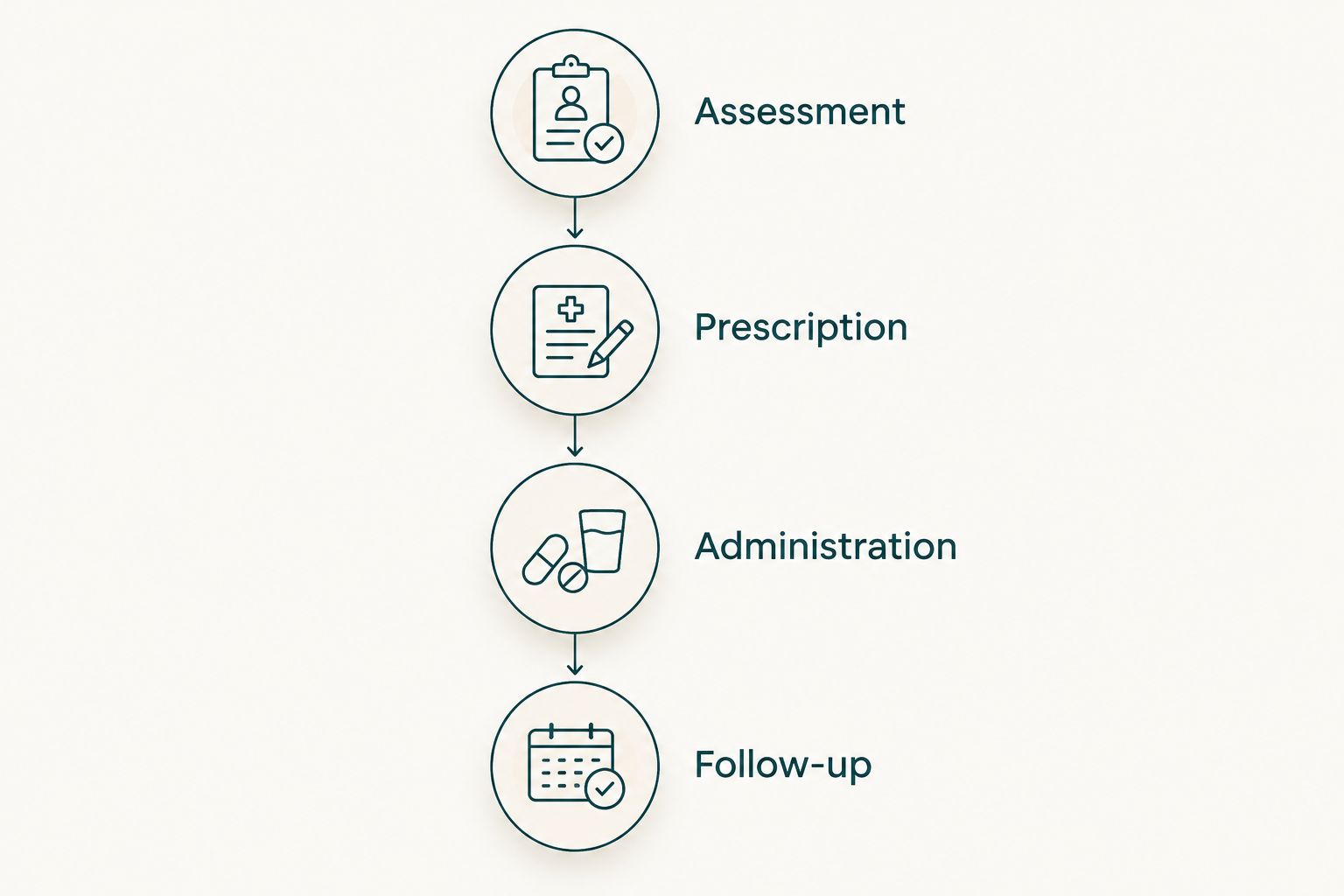
The benefit of this framework is accountability. You can see whether a proposed service covers the whole need or only one part. Its limitation is that you still need direct confirmation of each responsibility before booking.
Both routes require safety checks; neither wins by name alone
Clinical safety is a tie until you verify the relevant professional and process. A familiar name does not answer who is responsible for your care, what their scope covers or how concerns are escalated.
For a home clinical service in Dubai, check the relevant DHA licensing; in Abu Dhabi, check the relevant DoH licensing. Verify the facility and attending professional as appropriate to the service. Do not assume that a general statement about healthcare credentials confirms every individual booking.
For a pharmacy transaction, check that the dispensed medicine and instructions match the prescription. Raise discrepancies before using it. Tell the pharmacist about other medicines and allergies when asking about suitability or interactions.
For either route, ask these 3 questions:
- Who is responsible for this part of my care?
- What exactly is included in the service or transaction?
- What should I do if something goes wrong?
Home healthcare and pharmacy support are not emergency services by default. Severe breathing difficulty, chest pain or signs of stroke need emergency assessment, not a comparison of routine booking options.
Pricing: compare a defined service with a defined transaction
There is no defensible overall cost winner without matching the scope. A nursing visit and a pharmacy purchase are not interchangeable items, even when both relate to the same treatment.
For home healthcare, request a written breakdown of the clinical service. Ask whether the quote includes assessment, professional time, consumables, laboratory work and follow-up where relevant. Treat these as questions, not assumed inclusions.
For a pharmacy purchase, check the exact prescribed medicine or selected product. Ask separately about any associated service charges. Do not assume that the product transaction includes a consultation or continuing clinical oversight.
The pricing-model tradeoff is scope versus transaction clarity. A defined care quote helps you understand responsibility across a visit or treatment pathway; an itemised pharmacy transaction helps you identify what you are obtaining. Neither format proves better value on its own.
For your 2026 comparison, keep 2 separate lists: clinical tasks and products. Then ask each provider to confirm which items they cover. Check insurance eligibility and authorisation directly rather than treating a brand comparison as evidence of coverage.
Final verdict: choose the route that owns your next task
Choose DarDoc if you are coordinating care at home
Winner for the family care coordinator: DarDoc. Choose this route when you need home nursing, elderly care, mother/newborn support, an at-home blood test or an assessment-led treatment service in Dubai or Abu Dhabi.
Your next move is to describe the patient, the clinical task and any existing instructions. Confirm the attending professional, care scope and follow-up arrangements before committing.
Choose Life Pharmacy if you have a defined pharmacy need
Winner for the prescription holder or pharmacy shopper: Life Pharmacy. Choose this route when you need a pharmacy product, prescription dispensing or pharmacist clarification about the medicine being supplied.
Your next move is to bring the prescription and relevant medicine information. If the question becomes a diagnosis, a dose change or a procedure, identify the clinician responsible rather than treating the purchase as the whole care plan.
| Dimension | Winner |
|---|---|
| Best for | Home healthcare provider for care; pharmacy for products |
| Standout difference | Different purposes, not an overall winner |
| Hands-on home care | Home healthcare route |
| Medicine purchase | Life Pharmacy |
| Dispensing and label questions | Life Pharmacy |
| Assessment-led treatment pathway | Home healthcare route over a product-only transaction |
| Safety checks | Tie: verify the relevant professional and process |
| Pricing | No overall winner without a matched scope |
FAQ
Is DarDoc better than Life Pharmacy for home nursing?
DarDoc is the better fit for home nursing because at-home nursing is an explicitly stated service. Confirm the particular nursing task, attending professional and care plan before booking.
Which should I choose if I only need a pharmacy product?
Choose Life Pharmacy for a straightforward pharmacy purchase. If you also need assessment, prescribing or hands-on care, arrange those responsibilities separately.
Can a pharmacy purchase replace a home nursing visit?
No, a pharmacy purchase does not itself provide a nursing visit. Obtaining a medicine or supplies is different from arranging a professional to assess a patient or perform a procedure.
Who should I ask about instructions on my medicine label?
Ask the dispensing pharmacist to explain the label. Contact the prescribing clinician when the question involves changing treatment, adjusting a dose or reviewing new symptoms.
Which route should I choose for GLP-1 weight-loss treatment?
Choose a clinical treatment pathway when you need assessment, prescribing and follow-up. Dispensing the medicine is a separate responsibility and does not replace clinical review.
How should I compare the cost of home healthcare and pharmacy services?
Compare the exact clinical tasks and products you need, not the brand names alone. Request a written scope for clinical care and check the pharmacy transaction separately.
What credentials should I check before a home healthcare booking?
Check the relevant facility and professional licensing for the service and emirate. Dubai healthcare enquiries involve DHA requirements, while Abu Dhabi enquiries involve DoH requirements.
One last thing
Write down the verb before choosing the provider: buy, explain, assess, administer or monitor. That single word often exposes a mistaken comparison. If your actual need is administer, a successful purchase still leaves the care task unfinished.