DarDoc vs Mediclinic: which is better in 2026
Dardoc vs Mediclinic: choose home care for suitable planned services or hospital care for specialist needs. Compare safety, follow-up and insurance.

Choose Dardoc if you need planned home or online healthcare in Dubai or Abu Dhabi; choose Mediclinic if you need hospital-based investigation, specialist assessment or inpatient treatment. This 2026 comparison separates convenience from clinical capability so you can choose the right setting, not just a familiar name.
TL;DR- Dardoc vs Mediclinic is primarily a home healthcare versus hospital-based care decision, not a universal quality ranking.
- Choose home healthcare for suitable planned nursing, blood tests, elderly care and mother/newborn support.
- Choose Mediclinic for hospital-based assessment, specialist investigation or inpatient treatment.
- Neither setting removes the need to verify clinician licensing, treatment suitability and insurance approval.
Why this matters
A blood sample, a specialist consultation and an overnight admission solve different problems. Comparing them as interchangeable appointments creates the wrong expectations about what a provider can safely deliver.
The best choice is the setting that can complete your next clinical step safely. Home care removes the journey for suitable services. Hospital care provides access to assessment and treatment that cannot be delivered through a home visit or video consultation.
For your 2026 decision, start with the clinical task. Then compare the clinician, follow-up arrangements and written scope—not the length of a service menu.
At a glance
| Dimension | Dardoc | Mediclinic |
|---|---|---|
| Best for | Planned home and online healthcare for families in Dubai and Abu Dhabi | Patients needing clinic, specialist or hospital-based care |
| Care setting | Home care and online consultations | Clinics and hospitals |
| Specialist and inpatient access | Home services do not replace hospital assessment | Better fit when the next step requires hospital facilities |
| Blood tests and investigations | At-home blood tests | Facility-based assessment and investigations |
| Ongoing family support | Elderly care, nursing and mother/newborn support at home | Medical assessment and facility-based follow-up |
| Clinical safeguards | Verify clinician credentials and the treatment plan | Verify clinician credentials and the treatment plan |
| Pricing model | Request a service-specific quote and insurance terms | Request an appointment or episode-specific estimate and insurance terms |
| Standout feature | Delivery of suitable care in your home | Access to hospital-based care when clinically required |
Home care wins when the journey is the main obstacle
For a stable patient with a defined care need, travelling to a facility adds work without necessarily changing the task. An at-home blood test or planned nursing visit puts the service where the patient already is.
Dardoc home healthcare is best for families in Dubai and Abu Dhabi who need planned care delivered at home. Its stated services include nursing, IV drips, blood tests, GLP-1 weight-loss treatment, elderly care and mother/newborn support.
The benefit is practical: you avoid moving the patient for a service that is suitable for home delivery. This matters when an older relative needs assistance leaving the house or a family is managing a newborn's routine.
The limitation is equally clear. A home visit is not an admission, an operating theatre or an emergency department. Convenience only wins after a clinician has established that home is an appropriate setting.
Mediclinic wins when you need specialist or hospital access
Mediclinic is the better fit when the next step requires a hospital or specialist clinic. That includes situations where assessment leads to facility-based investigations, a procedure or inpatient treatment.
The distinction is access to the required setting—not a claim that every hospital appointment delivers better care than every home visit. A planned blood draw and an unexplained deterioration have different requirements.
For a new or unresolved problem, ask what happens if the initial consultation does not answer the question. You need a clear route to the next investigation or specialist, rather than another appointment that repeats the same assessment.
The tradeoff is travel and attendance at a facility. That is justified when the setting contributes something clinically necessary; it is less useful when your only task is a suitable planned service at home.
Both can support testing; the required investigation decides
Home blood collection wins on location; a hospital wins when testing is only part of a wider assessment. The important distinction is between obtaining a sample and resolving the clinical question behind it.
For a home blood test, ask who orders the test, what preparation you need, who receives the report and who explains an abnormal result. Collection alone is not a complete follow-up plan.
If you need imaging, a procedure or an examination alongside laboratory testing, choose a setting that can provide the required assessment. Do not book a blood test as a substitute for medical review when your symptoms need investigation.
Neither provider earns a blanket win on report speed or diagnostic accuracy here. Judge the specific test, laboratory arrangements and reporting process. For a 2026 booking, obtain the expected reporting window for your actual tests rather than relying on a general service description.
Home care wins for suitable ongoing support between appointments
Elderly care and mother/newborn support involve more than isolated consultations. Families also need a workable plan for daily care, observations and communication between medical appointments.
A home service fits that setting directly. The clinician or caregiver works where the family manages medicines, mobility, feeding and recovery, within the agreed scope of care.
The limitation is that ongoing support does not replace the doctor responsible for diagnosis and treatment. A change in symptoms, feeding, alertness or mobility needs assessment rather than an automatic extension of the existing care plan.
After discharge, start with the hospital's written instructions. The hospital-discharge-to-home-nursing workflow explains the handover to consider before arranging home support.
For your 2026 care plan, make the handover explicit: what the home team does, what the treating doctor reviews and what triggers a return to a facility. The strongest arrangement often uses both settings rather than choosing one permanently.
Both need verified credentials and an escalation plan
Neither a home address nor a hospital address substitutes for checking clinical responsibility. Verify the professional licence relevant to the clinician's role and emirate, along with the provider's authorisation for the service you are booking.
In Dubai, check the relevant Dubai Health Authority requirements; in Abu Dhabi, check the Department of Health requirements. Do not treat a logo, uniform or general reference to hospital standards as proof of a specific professional's current credentials.
Before treatment, identify 1 named clinician responsible for reviewing the plan. Ask who handles questions outside the visit and what happens if the patient becomes unwell.
For IV treatment, ask about the clinical indication, screening, prescription requirements and management of an adverse reaction. For GLP-1 treatment, ask about eligibility, medicine selection, side effects and follow-up. A convenient setting does not remove any of those obligations.
This dimension is a tie: both settings require checks. The winner is the specific service that gives you clear, verifiable answers—not the provider with the more reassuring wording.
Pricing: compare the same care episode, not headline fees
There is no useful cost winner until you define the service. A nursing visit, laboratory collection, specialist appointment and hospital admission have different scopes; comparing their headline charges does not tell you which meets your need.
For home care, request a written breakdown covering the visit, professional time, tests or treatment, consumables and follow-up where applicable. For facility care, ask what the appointment estimate includes and how additional investigations or procedures are authorised.
Compare 2 written estimates for the same clinical task. Specify the same test list, nursing duties or consultation purpose so differences reflect the proposed care rather than different assumptions.
The tradeoff is predictability versus an evolving assessment. A clearly defined planned task is easier to scope in advance; an unresolved medical problem can require further investigation. Ask how either provider communicates and obtains agreement for additional charges.
For a 2026 insurance check, confirm the exact provider, service, clinician category, referral requirements and preauthorisation with your insurer. Network participation alone does not establish cover for every treatment or care setting.
The standout difference is location versus hospital access
The home provider's distinguishing feature is delivery: suitable healthcare comes to you. Mediclinic's distinguishing feature in this comparison is access to a clinic or hospital when that setting is part of the treatment requirement.
Neither feature makes the other unnecessary. A patient can need specialist review at a facility and later receive planned nursing at home. Those services belong to different stages of the same care pathway.
Choose the setting first, then compare the provider within that setting. Otherwise, a convenient booking process can distract you from a missing clinical capability—or a hospital name can send you on an unnecessary journey.
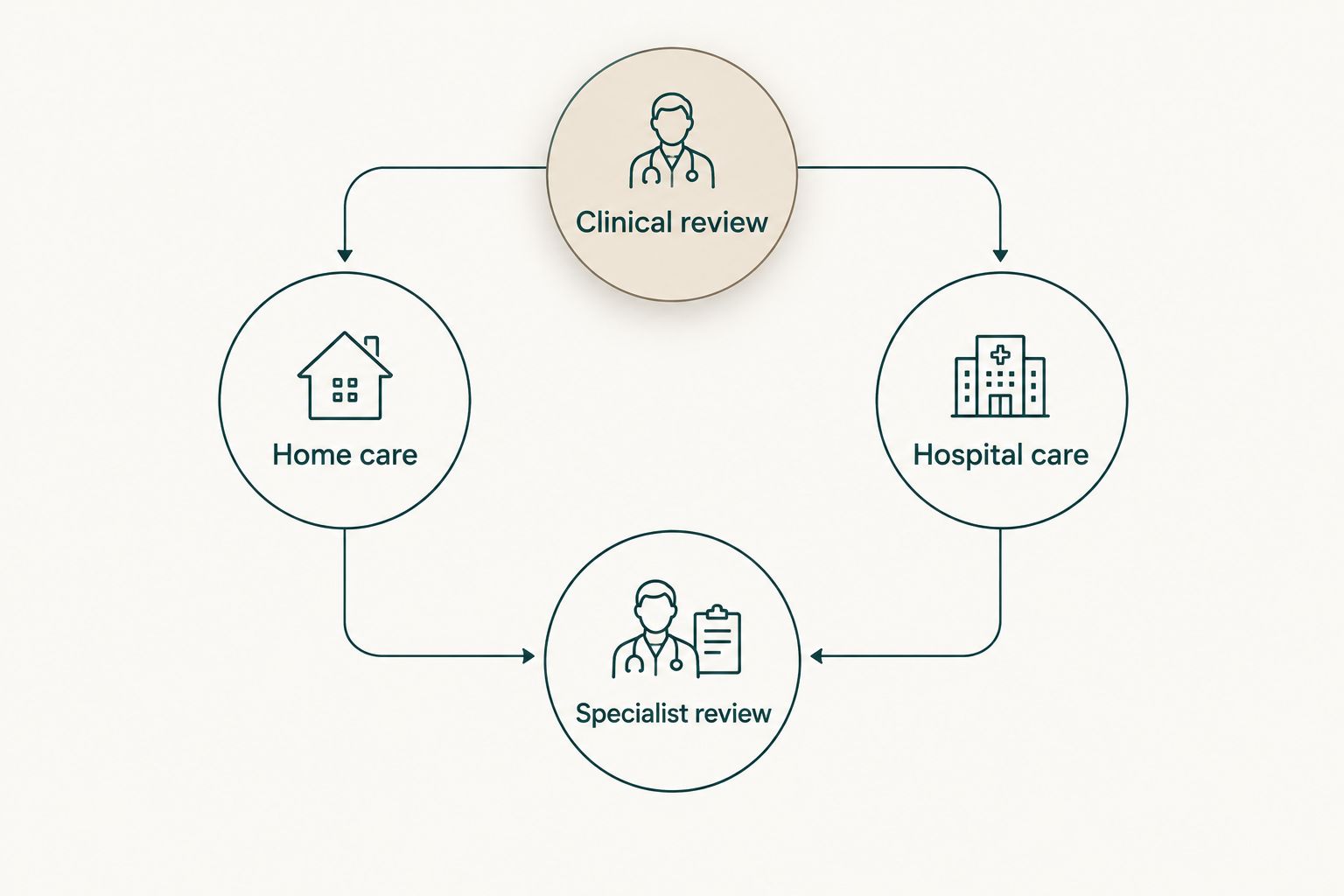
Use this booking sequence
- Clinical review: Establish what needs assessing or treating before selecting a service.
- Home care: Choose this route when the task is defined and the patient is suitable for home treatment.
- Hospital care: Choose this route when assessment or treatment requires facility-based resources.
- Specialist review: Arrange the relevant expertise when the clinical question remains unresolved.
The sequence starts with clinical need, not a preferred address. Specialist review can sit alongside either setting; the important point is that someone remains responsible for the next decision.
Final verdict: choose for the next step you actually need
Choose Dardoc if you are organising planned care at home
Best for: the family care coordinator in Dubai or Abu Dhabi. You need suitable nursing, elderly care, mother/newborn support or blood collection without taking the patient to a facility.
Before booking, confirm the precise duties, clinician credentials, responsible doctor and escalation arrangements. Home delivery is the advantage; hospital-level capability is not the promise.
Choose Mediclinic if you need facility-based assessment
Best for: the patient whose next step requires specialist or hospital resources. You need an assessment, investigation, procedure or admission that belongs in a clinical facility.
Confirm the relevant department and appointment type rather than booking solely by brand. Facility access is the advantage; travelling there for every suitable routine task is not automatically necessary.
One-glance scorecard
| Dimension | Winner |
|---|---|
| Best for | Home provider for planned home care; Mediclinic for hospital care |
| Care setting | Home provider for avoiding patient travel |
| Specialist and inpatient access | Mediclinic |
| Blood tests and investigations | Task-dependent: collection versus wider assessment |
| Ongoing family support | Home provider for suitable daily support |
| Clinical safeguards | Tie: verify both |
| Pricing model | No blanket winner; compare the same scope |
| Standout feature | Home delivery versus hospital access |
FAQ
Is Dardoc better than Mediclinic for home healthcare?
Dardoc is the more direct fit for planned home healthcare within its stated services in Dubai and Abu Dhabi. Mediclinic is the better choice when your next clinical step requires a specialist clinic or hospital.
Should I choose home care or a hospital for an elderly parent?
Choose home care for suitable planned support and a hospital when your parent needs facility-based assessment or treatment. Ask the treating clinician to define the care tasks and the symptoms that require escalation.
Can an at-home blood test replace a hospital appointment?
An at-home blood test replaces the collection visit, not necessarily the medical appointment. You still need an appropriate test request, interpretation and a plan for abnormal results.
Which provider is cheaper for the same treatment?
Compare written estimates for the same clinical task before choosing on cost. Include professional fees, tests, treatment, consumables and follow-up where applicable, then confirm insurance terms.
Does UAE health insurance cover both home and hospital care?
Cover depends on your policy, the provider and the specific service. Confirm network status, referral requirements, preauthorisation and reimbursement terms directly with your insurer before booking.
Can home nursing continue after a Mediclinic hospital discharge?
Home nursing can follow a hospital discharge when it is clinically appropriate and supported by a clear care plan. Share the discharge summary, medication instructions and escalation criteria with the receiving team.
Should I book a home visit for a medical emergency?
No—use emergency services for a suspected medical emergency rather than waiting for a routine home appointment. Severe breathing difficulty, signs of stroke or loss of consciousness require urgent assessment.
One last thing
The most useful comparison is sometimes the handover between providers. Before a discharge or change of care, gather 3 documents: the current medication list, the care instructions and the relevant clinical reports.
Ask the receiving clinician to confirm what happens next and who handles an unexpected change. A clear transfer of responsibility matters more than keeping every appointment under one brand.