Elderly dementia home care in Abu Dhabi: complete 2026 guide
Elderly dementia home care Abu Dhabi: choose care by clinical need, not job title. A 2026 guide to licensing, routines, medicines and family cover.

Elderly dementia home care in Abu Dhabi is support with daily living, supervision and prescribed clinical tasks aimed at keeping an older person safe and comfortable at home. Dementia adds needs that general elderly care does not automatically cover: changes in memory, communication, judgement and behaviour require an individual plan, not simply someone present in the house.
TL;DR- Elderly dementia home care Abu Dhabi: choose support by assessed needs, not a caregiver’s job title.
- Verify Department of Health – Abu Dhabi credentials for regulated home nursing and clinical tasks.
- Separate personal care, prescribed nursing and medical review; one does not replace the others.
- Sudden confusion needs prompt medical assessment, not an assumption that dementia has progressed.
Why dementia home care matters for elderly people
An older person can recognise family members yet still struggle to take medicines safely or find the bathroom at night. Match support to what the person can safely do, not how well they answer questions during a visit.
For families arranging care in Abu Dhabi in 2026, the practical questions are who supervises the person, who handles clinical tasks and what happens when needs change. Start with the guide to arranging elderly home care in Abu Dhabi, then add the dementia-specific requirements below.
Home care preserves familiar surroundings, but familiarity alone does not make a home safe. Family availability, night waking, mobility, swallowing and the person’s response to unfamiliar carers all affect whether the arrangement works.
How to arrange dementia home care in 2026
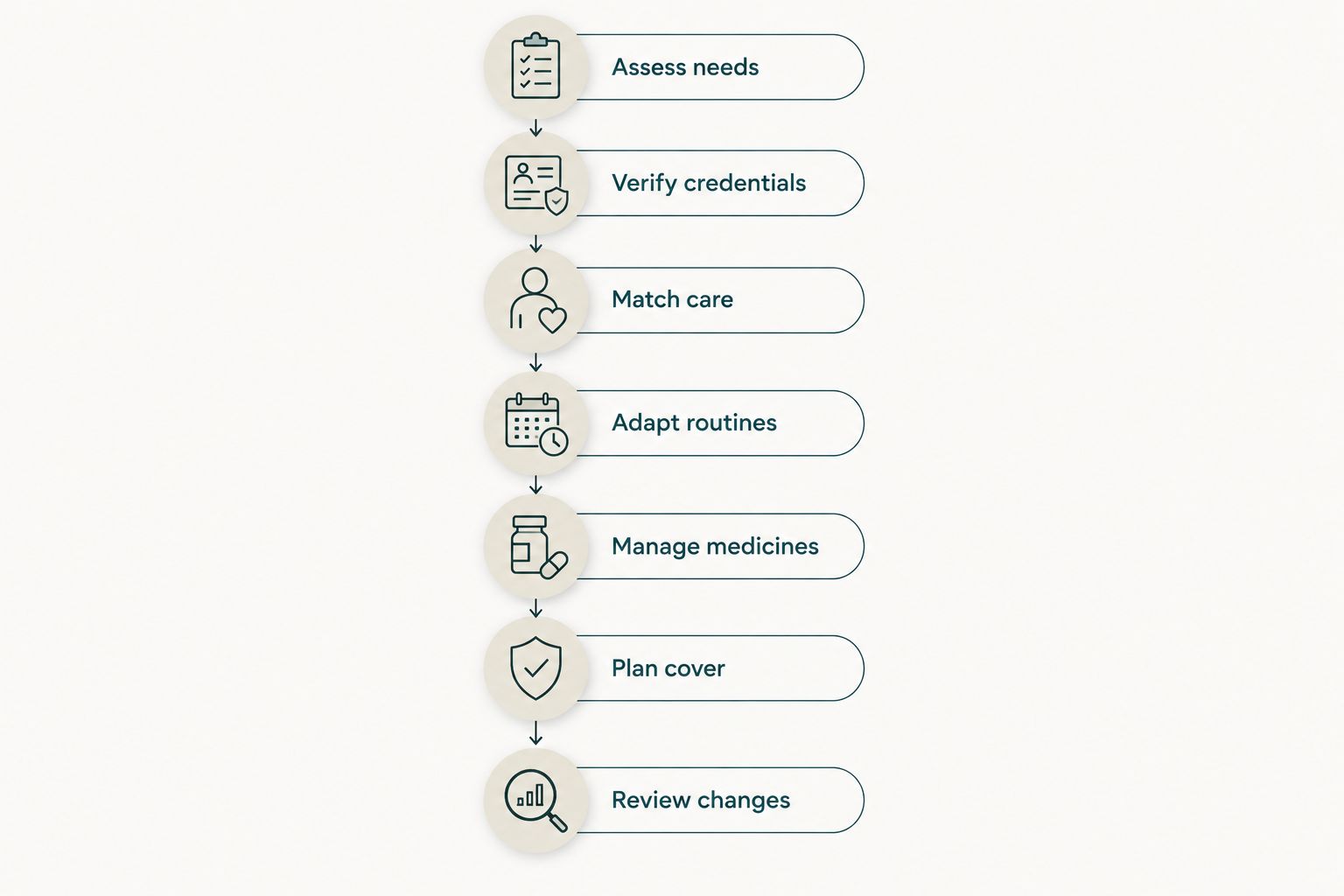
Build the plan in this order: assess needs, verify credentials, match care, adapt routines, manage medicines, plan cover and review changes. A shared document is enough to start; the quality of the information matters more than the format.
Assess needs
Write down what happens during an ordinary day and night before asking for a service. Record the help actually needed with washing, dressing, eating, toileting, walking and supervision. Include what the person still does independently.
A clinician should assess new symptoms, uncertain diagnoses and changes in function. NICE guideline NG97 supports person-centred dementia care and assessment of distress; a provider’s booking conversation does not replace medical assessment.
If you keep a 7-day observation record, use it to describe patterns rather than delay care for a new concern. Include the person’s preferred language, familiar routines and how they communicate discomfort.
- Record falls, near-falls and attempts to leave home unsafely.
- Describe help needed with meals, washing and toileting.
- Note night waking and who responds.
- List diagnoses, allergies and current medicines.
- Record preferences, retained abilities and sources of distress.
Verify credentials
For regulated healthcare in Abu Dhabi, verify the provider and relevant professional credentials with the Department of Health – Abu Dhabi, or DoH. A reference to Dubai licensing does not, by itself, establish authorisation for Abu Dhabi practice.
Ask what each proposed worker is qualified and authorised to do. Personal-care experience, nursing registration and dementia-specific training answer different questions. None should be treated as interchangeable.
For your 2026 checks, use the guide to verifying a DoH home-nursing provider. Ask the provider to explain responsibility for assessment, supervision and escalation in writing, rather than accepting a general assurance about experienced staff.
- Request the provider’s legal name and relevant licence details.
- Verify credentials for professionals performing clinical tasks.
- Ask about practical dementia-care training and supervision.
- Confirm who reviews concerns outside scheduled visits.
- Request written boundaries between caregiver and nursing duties.
Match care
Separate companionship and personal care from tasks requiring a licensed healthcare professional. A person needing help dressing does not automatically need continuous nursing; a person with a wound or prescribed clinical treatment needs an appropriate clinical plan.
Start with a task list and mark who can safely perform each task. Then ask a provider to assess the gaps. DarDoc is best suited to families seeking home healthcare and elderly care in Abu Dhabi. DarDoc offers those service categories, but you should confirm dementia-specific experience, staffing arrangements and clinical scope before choosing a plan.
The benefit is access to relevant home-care services. The limitation is that a general service description does not establish suitability for a particular person’s dementia needs.
- Assign daily-living support to a named responsible person.
- Identify clinical tasks requiring professional assessment.
- Ask how the proposed carer handles refusal or distress.
- Confirm language and communication suitability.
- Request a written explanation of tasks outside scope.
Adapt routines
Begin with small changes you can make yourself: remove trip hazards, improve lighting and keep frequently used items in familiar places. Ask an appropriate professional to assess transfers, bathing or mobility when these are difficult or unsafe.
Keep the person involved. Offer simple choices and explain care before touching or moving them. If a task causes distress, pause and look for pain, embarrassment, fatigue, noise or difficulty understanding the request.
Do not treat preventing movement as the default safety solution. Door arrangements and supervision must protect the person without obstructing emergency escape. Avoid introducing restrictive measures without appropriate professional advice.
- Keep routes to the bathroom clear and well lit.
- Store medicines and hazardous household items securely.
- Use familiar routines for meals, washing and bedtime.
- Give short instructions and allow time to respond.
- Keep emergency exits usable and assess wandering risks.
Manage medicines
Create one current medicine list from prescriptions and actual use, including non-prescription products. Ask the prescribing clinician or pharmacist to resolve discrepancies. Do not independently stop, increase or substitute treatment because behaviour has changed.
The plan must distinguish reminding someone to take medicine, helping them access it and administering it. Agree who is responsible for each task and what happens after a missed dose or refusal.
Do not crush tablets, open capsules or hide medicines in food without appropriate clinical and consent advice. Swallowing difficulty needs assessment, not an improvised workaround. New sleepiness, falls or confusion also require review rather than an automatic request for sedating treatment.
- Keep the current prescription and allergy list accessible.
- Record doses administered and report refusals accurately.
- Ask for written missed-dose instructions where relevant.
- Request review of medicines associated with new symptoms.
- Escalate coughing, choking or difficulty swallowing medicines.
Plan cover
Draw a weekly schedule showing who is responsible at each time, including nights, appointments and handovers. A family member living in the same house is not necessarily able to provide uninterrupted supervision.
For 24-hour care, distinguish continuous coverage from one worker being expected to remain awake indefinitely. Ask how shifts, rest, replacement staff and overnight needs are managed. A live-in arrangement and awake overnight care are not the same service.
DarDoc offers at-home nursing and elderly care; confirm whether the proposed arrangement covers your identified hours and tasks. Do not assume overnight supervision or replacement arrangements from the service category alone.
- Mark every period when supervision is required.
- Identify who responds to night waking and toileting.
- Agree handover arrangements between carers and family.
- Keep 2 named family contacts with their agreement.
- Write a backup plan for absence or sudden care changes.
Review changes
Use a shared 1-page handover summary for the person’s usual abilities, care preferences, medicines and escalation instructions. Keep detailed records separately. A short summary helps a replacement carer recognise what is normal for that individual.
Review the arrangement after a fall, hospital admission, medicine change or noticeable loss of function. A plan agreed early in 2026 should not remain unchanged simply because the original booking continues.
Sudden confusion or a rapid change from usual behaviour needs prompt medical assessment. NICE guideline CG103 identifies acute changes and fluctuations as features relevant to delirium assessment; families should not diagnose the cause themselves.
- Record changes from the person’s usual behaviour or function.
- Seek urgent assessment for sudden or fluctuating confusion.
- Call emergency services for stroke signs or severe breathing difficulty.
- Reassess support after hospital discharge or repeated falls.
- Update the handover when treatment or responsibilities change.
Compare dementia-care options
The best arrangement is the least restrictive option that safely meets assessed needs. More hours do not correct the wrong skill mix, and a nursing visit does not provide supervision between visits.
Use this comparison to separate service types before discussing individual providers. Each option has a role and a limitation; none is automatically appropriate throughout dementia progression.
| Option | Best for | Main benefit | Key limitation |
|---|---|---|---|
| Family-led support | Needs relatives can safely meet | Familiar people and routines | Depends on family capacity, skills and rest |
| Paid personal-care support | Help with daily living and supervision | Practical assistance with recurring tasks | Does not automatically include clinical nursing |
| Scheduled home nursing | Assessed clinical tasks and nursing review | Professional input for defined healthcare needs | Does not cover gaps between visits |
| Coordinated personal care and nursing | Combined daily-living and clinical needs | Matches different tasks to appropriate staff | Requires clear handovers and responsibility |
| Facility-based care | Needs that cannot safely be met at home | Care in a dedicated setting | Requires assessment and a change of environment |
DarDoc belongs in the discussion when you need home healthcare or elderly-care support. Assess the proposed individual plan against this table, rather than treating a provider name as evidence that every care need is covered.
Common mistakes families make
Buying hours before defining tasks
A long shift is not proof of appropriate care. Write the task list first, then ask whether the proposed worker can safely carry it out and recognise when clinical help is needed.
Treating distress as deliberate behaviour
Resistance to bathing or repeated calling can communicate discomfort, fear or an unmet need. Look for the trigger and seek assessment for new or persistent distress; do not assume the answer is stronger sedation.
Calling sudden confusion dementia progression
A rapid change deserves medical attention. Dementia does not make a person immune to other illnesses, medicine effects or delirium, and waiting for the next routine care review can delay assessment.
Leaving the family coordinator permanently on duty
A rota that depends on one relative answering every call is fragile. Give backup contacts the information and authority they need, while respecting the person’s consent and applicable decision-making arrangements.
FAQ
What is the best elderly dementia home care in Abu Dhabi?
The best elderly dementia home care in Abu Dhabi matches the person’s assessed daily-living, supervision and clinical needs. Verify relevant credentials, dementia experience, staff responsibilities and the escalation plan before choosing a provider.
Does someone with dementia need a nurse or a caregiver?
The required tasks determine whether someone needs personal-care support, nursing or both. Help with dressing and companionship differs from prescribed clinical care, and a clinician should assess uncertain or changing needs.
Can a person with dementia stay at home safely?
A person with dementia can remain at home when their assessed needs can be safely met there. Review supervision, mobility, medicines, eating, night waking and family capacity rather than relying on the diagnosis alone.
How do I check a home nurse’s credentials in Abu Dhabi?
Verify the relevant professional credentials and provider authorisation with the Department of Health – Abu Dhabi. Ask for details that identify the professional and provider, and confirm that the proposed clinical tasks fit their authorised scope.
Does dementia automatically mean someone needs 24-hour care?
Dementia alone does not determine whether 24-hour care is needed. The decision depends on risks and support needs across the day and night, including whether the person can safely be left alone.
What should I do if my parent with dementia suddenly becomes more confused?
Seek prompt medical assessment for sudden or rapidly worsening confusion. Do not assume it is dementia progression; call emergency services when there are emergency symptoms such as stroke signs or severe breathing difficulty.
Can DarDoc arrange elderly care at home in Abu Dhabi?
DarDoc offers elderly care and at-home nursing in Abu Dhabi. Confirm dementia-specific experience, the proposed worker’s scope, care hours and escalation arrangements for your family member before agreeing to a plan.
One last thing
A quiet person is not necessarily a comfortable person. Reduced speech or participation can make pain and illness harder to recognise. Tell carers how your family member usually shows discomfort, including facial expressions, movement and changes in appetite.
Before the first handover, ask the incoming carer to explain the plan back to you: what the person needs, what the carer must not do and whom they contact when something changes. That is a practical final check for your 2026 care arrangement.
This guide supports care planning; it does not replace an individual clinical assessment or emergency care.